Key takeaways
- "Agentic" in GEO means the platform doesn't just report a visibility gap — it plans, writes, and publishes the fix. Most tools still stop at the report.
- Promptwatch is the only one of the three with a full closed loop: crawler logs, first-party conversion tracking, content gap analysis against your own page index, and Content Agents that publish to Webflow, Framer, or WordPress.
- Gradial is the enterprise pick when the bottleneck is workflow plumbing — approvals, governance, and publishing through complex CMS and DAM stacks — rather than AI search measurement itself.
- Temso AI is a newer entrant in the agentic GEO space, which means you should grill it on data sourcing, engine coverage, and audit trails before committing.
- Before signing any agentic GEO contract, ask three questions: where does the response data come from, who publishes the output, and can you audit what the agent did?
Why "agentic" became the GEO buzzword of 2026
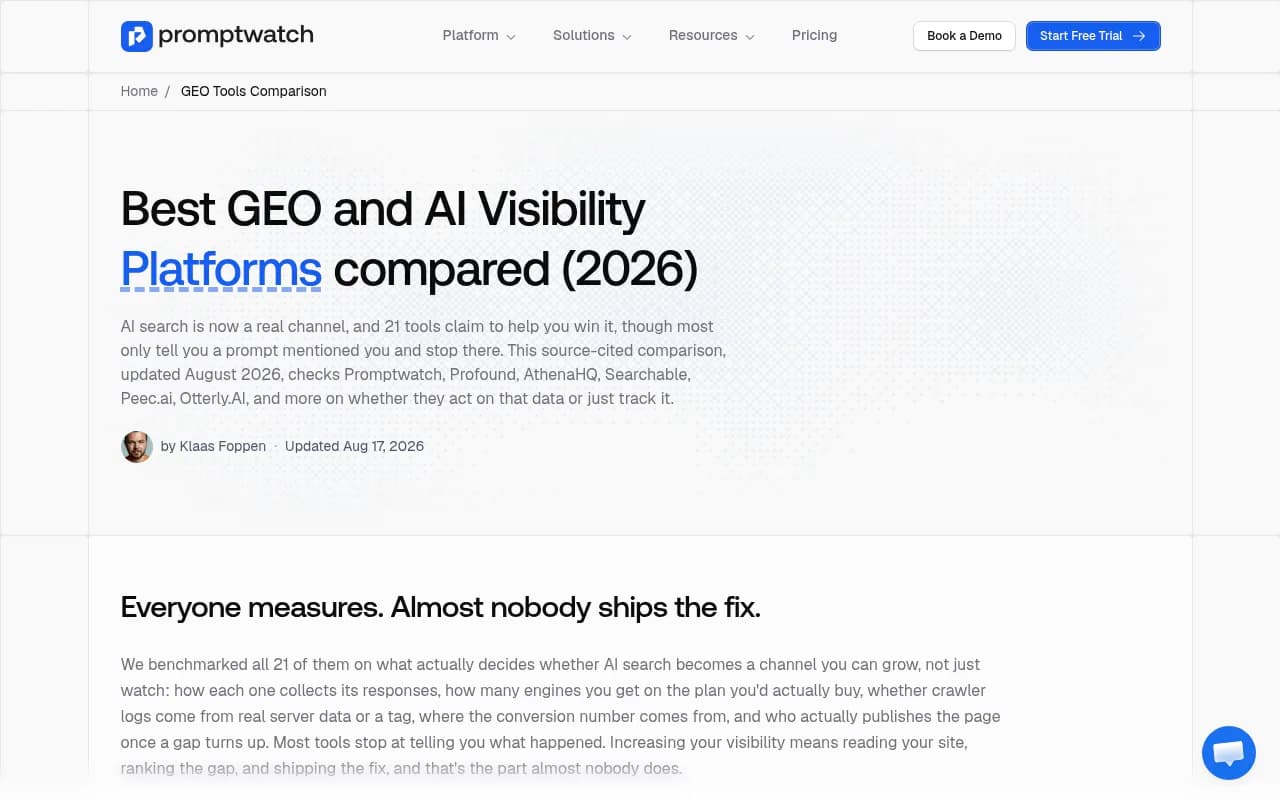
Two years ago, every AI visibility tool was a tracker. You typed in prompts, the tool told you whether ChatGPT mentioned you, and that was the product. That market is basically solved now — 18 of the 21 platforms benchmarked in Promptwatch's 2026 comparison do prompt and citation tracking, and a dozen read crawler logs.
The new battleground is execution. The pitch has shifted from "we'll show you where you're invisible" to "our agents will fix it for you." The 2026 agentic platform comparison over at Agentic.ai scored 25 enterprise agent platforms on a 36-point framework covering autonomy, planning, reliability, and what they call operator sovereignty — how much control you keep over cost, models, and auditability. That last dimension is the one most GEO buyers skip, and it's the one that decides whether agentic automation is a productivity win or a quality liability.
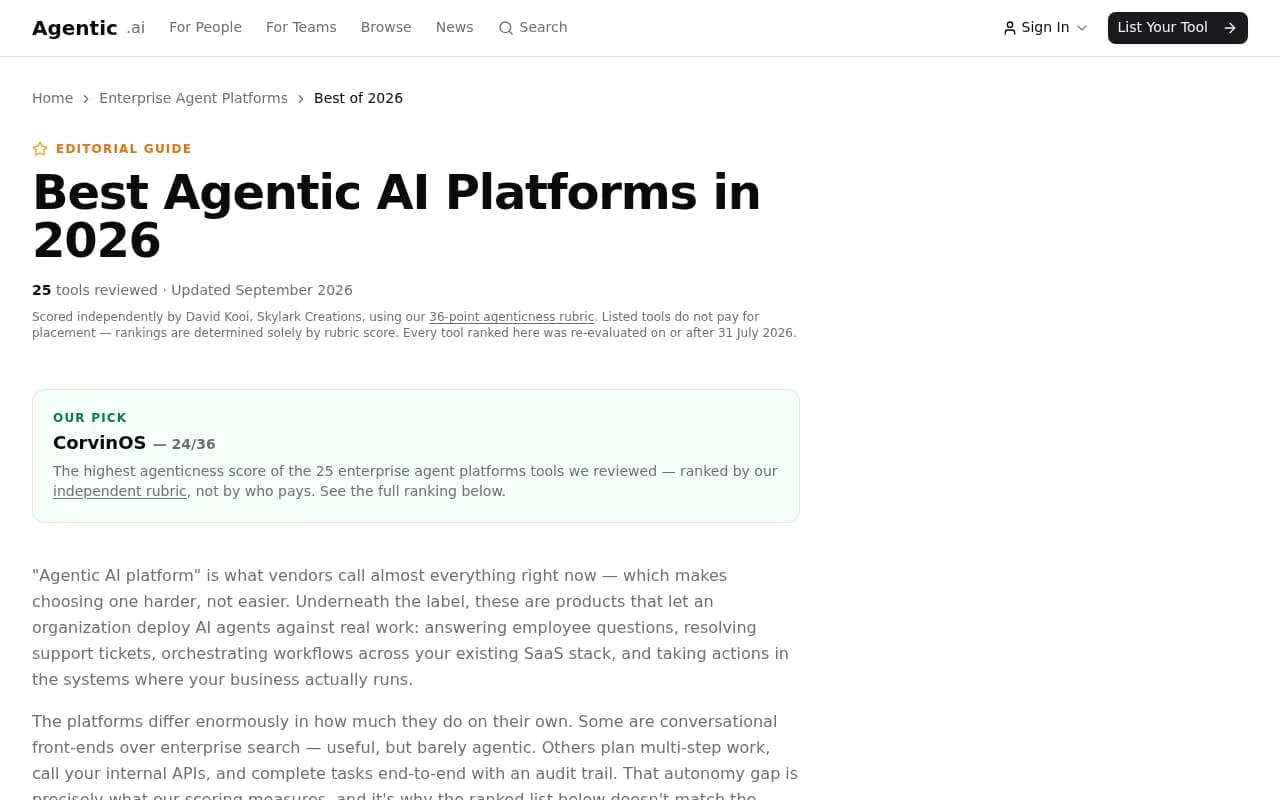
That framework is worth borrowing here. When you compare agentic GEO platforms, three questions matter more than any feature grid: how much the agent does on its own (autonomy), whether what it produces is actually good (quality), and how much visibility and veto power you retain (control). Promptwatch, Gradial, and Temso AI give three genuinely different answers to those questions.
The three axes that actually matter
Autonomy — does the agent stop at a recommendation, or does it plan, draft, and publish? A content brief is not autonomy. An agent that reads your crawler logs, identifies a decaying page, drafts a rewrite, and pushes it to your CMS on a schedule is.
Quality — autonomy is worthless if the output needs three rounds of human editing. Quality depends on what the agent is grounded in: real crawler data, an index of your actual pages, prompt volumes, and citation analytics. An agent writing from vibes produces vibe-quality content.
Control — can you review before publish? Can you see the audit trail of what the agent did and why? Can you export your data, use the API, and keep your own model keys if you want? The Agentic.ai framework makes this explicit: if you can't audit it, you can't safely give it autonomy.
Keep those three in mind as we go through each platform.
Promptwatch: the closed-loop platform
Promptwatch started as a visibility tracker and grew into an execution platform, which shows in how its pieces connect. The chain runs like this: prompt tracking on real AI interfaces (ChatGPT, Gemini, Claude, Perplexity, Grok, Google AI Overviews, AI Mode, and the rest) feeds AI crawler logs from actual server data — Cloudflare, Fastly, Vercel, Akamai, and other CDN integrations — so you can see which pages ChatGPTBot and 400+ other crawlers read and where they hit errors. First-party visitor analytics attribute actual traffic and conversions to AI platforms. Then Content Agents close the loop: they draft GEO-optimized content and publish it straight to Webflow, Framer, or WordPress, either through a review inbox or fully automated.

Two details separate it from the monitoring crowd. First, the content gap analysis checks an index of your own crawled pages before recommending new content — most competitors infer gaps from whoever got cited instead of you, which is a recipe for "write another blog post" advice. Second, Unified Actions turns visibility, citation, and crawler data into a prioritized to-do list, so the agent's work has an order of operations rather than a random queue.
The track record is what you'd want from a platform making autonomy claims: 1,840+ brands and agencies including Duolingo, Yelp, Typeform, and agencies like Monks and WPP, a 4.7/5 on G2, and a dataset of more than 4.5 billion citations, clicks, and prompts analyzed. Crisp reported 2x higher conversion rates from AI traffic versus traditional channels and scaled to 5-10 agent-written articles per day. That last number is the autonomy claim proven out: an agent producing a article per weekday, with human review on top, is a real content operation.
On control, Promptwatch gives you the review inbox before full automation, a REST API v2, an MCP server that works with ChatGPT, Claude, and Cursor, and exports. Pricing is public: Essential at $95/month with every engine included, Professional at $245/month (where crawler logs and automated content kick in), Business at $579/month. No engine costs extra at any tier.
Where it's weaker: if your problem isn't AI search but general marketing workflow chaos — approvals across five systems, brand governance across 40 regional teams — Promptwatch won't fix that. It does one loop and does it well.
Gradial: agentic when the bottleneck is the workflow
Gradial approaches the problem from the opposite end. Where Promptwatch grew out of AI search measurement, Gradial grew out of enterprise marketing operations — the painful plumbing of getting content produced, approved, and published through complex organizations. Its agents handle content workflows end to end, connected to the systems big companies actually run: SharePoint, Adobe products, Drupal, WordPress, and the approval chains that sit around them.
That focus shapes what Gradial is good at. If your team spends more time routing drafts through legal review and chasing publishing permissions than worrying about citation trends, Gradial's automation of the operational layer is a real cost saving. Enterprise governance is a control feature too — audit trails, approval gates, and human sign-off before changes go live are the whole point for regulated industries.
The trade-off is data grounding. Gradial is an agentic content operations platform that applies to GEO, not a GEO measurement platform that grew agents. You get the workflow automation without the native crawler logs, prompt volume data, and citation analytics that tell an agent what to write and why. If you pair Gradial with a measurement tool, you can assemble a full stack — but you're buying and integrating two platforms, and the agent's quality depends on whatever inputs you feed it.
For enterprises that already have visibility data (or agencies running measurement elsewhere) and need the execution and governance layer, Gradial is worth a look. For teams that want measurement and execution wired together natively, it's the wrong shape.
Temso AI: the newcomer you should grill
Temso AI is the newest name of the three in the agentic GEO space, and I want to be straight with you: it doesn't have the public track record, published dataset, or third-party benchmark presence that Promptwatch and Gradial have. That doesn't make it a bad product — every platform was unproven once. It means the buying process is different.
With an established vendor you can read the comparison pages, the changelogs, and the customer lists. With a newer entrant, the demo is the due diligence. The questions below are exactly what I'd take into a Temso conversation (or any newcomer's conversation), and the answers you get will tell you whether its agents are grounded in real data or winging it.
One honest advantage newer platforms sometimes have: pricing flexibility and responsiveness. A vendor fighting for its first hundred customers will often negotiate harder and build faster than one with 1,800 accounts. Just make sure you're not trading auditability for attention.
Head-to-head comparison
| Dimension | Promptwatch | Gradial | Temso AI |
|---|---|---|---|
| Core strength | Closed loop from measurement to published fix | Enterprise content workflow and governance automation | Emerging agentic GEO — verify in demo |
| Response data source | Real AI interfaces, 4.5B+ citations/prompts analyzed | Not a native measurement platform | Unverified — ask |
| Crawler logs | Yes, real server data via Cloudflare, Fastly, Vercel, Akamai, and others | No | Unverified — ask |
| Conversion tracking | First-party script, not GA4-derived | Not native | Unverified — ask |
| Content gap analysis | Index of your own crawled pages | Workflow-driven, not data-driven | Unverified — ask |
| CMS publishing | Webflow, Framer, WordPress | SharePoint, Drupal, WordPress, enterprise stacks | Unverified — ask |
| Review before publish | Review inbox or full automation | Enterprise approval gates | Unverified — ask |
| Audit and control | API v2, MCP server, CSV exports, scheduled reports | Governance and audit focus for regulated orgs | Unverified — ask |
| Track record | 1,840+ customers, 4.7/5 on G2, G2-cited brands like Duolingo and Yelp | Enterprise marketing ops deployments | Early-stage |
| Public pricing | $95–$579/month, engines included | Enterprise, typically custom | Ask |
A second, smaller table for the speed-vs-risk trade-off:
| You prioritize... | Best fit |
|---|---|
| Proof the loop works, end to end | Promptwatch |
| Governance, approvals, enterprise CMS plumbing | Gradial |
| Early-adopter pricing and vendor attention | Temso AI (with hard questions) |
Verdict: which platform for whom
Pick Promptwatch if AI search is a channel you need to grow this year. It's the only one of the three where the measurement and the execution are the same product: crawler logs explain why you're invisible, the content gap index says which page to fix, and the Content Agent publishes the fix. The fact that you can start at $95/month with every engine included, and that Crisp and Monks have run the loop in production, makes it the lowest-risk path to agentic GEO.
Pick Gradial if your real problem is operational. Large organizations with layered approvals, legacy CMS ecosystems, and compliance requirements get genuine value from agentic workflow automation. Just know you'll need measurement from somewhere else to tell the agents what to write.
Consider Temso AI only if you enjoy early adoption. Bring the checklist below, demand a trial on your own site, and get every claim about data sourcing and publishing in writing.
Nine questions to ask before signing with any agentic GEO platform
Whether you're talking to these three or any other vendor claiming agentic capabilities, these are the questions that separate platforms doing the work from platforms doing the marketing:
- Where does your response data come from — real AI interfaces, APIs, or modeled/inferred data? (UI outputs and API outputs genuinely differ.)
- Do you read crawler logs from actual server data or from a JavaScript tag? Tags miss most bot traffic.
- How do you measure conversions — your own script, or by reading our GA4?
- When you recommend content, do you check an index of our existing pages first?
- Which CMSs can you publish to natively, and who owns the publish button — us or you?
- Can we require human review before anything goes live?
- Is there an audit trail of every action the agent took, and why?
- Can we export our data and use your API or MCP server?
- What shipped in the last six months, and can you show us the changelog?
That last question is underrated. A capability that shipped last month is a different purchase than one that's been running for a year. Promptwatch, for instance, shipped Fastly log ingestion in July 2025 and full server log analysis in August 2025, so by now there are months of log history to compare patterns against. A connector that just launched hasn't collected that yet, no matter what the feature grid says.
And if after all this you conclude you'd rather have a specialist run the strategy than another platform to operate, that's a legitimate answer too — this site is published by 1001 SEO Media, an agency focused specifically on getting brands ranked in Google and cited in ChatGPT, Perplexity, Gemini, and Claude. Some teams buy the tool; some teams buy the team. Either way, the three questions — autonomy, quality, control — are the ones worth answering first.