Key takeaways
- Botify, Lumar, and OnCrawl are built for technical SEO at scale -- crawling, log file analysis, and site health. Their AI visibility features are thin or nonexistent.
- Profound and Promptwatch are built for AI search visibility -- tracking how LLMs cite and mention your brand. Their technical SEO capabilities are minimal by design.
- If you need both in one platform, Promptwatch comes closest through its crawler log integration, page-level citation tracking, and content generation loop.
- Most teams in 2026 are running two tools: a technical SEO crawler plus a dedicated AI visibility platform. That's not a failure -- it's the right call given how different these jobs are.
- The real question isn't "which one does everything" -- it's "which AI visibility platform pairs best with the technical SEO tool you already have."
The framing of this comparison is a little uncomfortable to write, because these five platforms don't really compete with each other in the traditional sense. Botify, Lumar, and OnCrawl were built to solve a specific, hard problem: understanding how search engine crawlers move through large, complex websites. Profound and Promptwatch were built to solve a different problem: understanding how AI models like ChatGPT, Perplexity, and Gemini talk about your brand.
The reason they're being compared in 2026 is that marketing and SEO teams are being asked to do both -- keep the technical foundation solid while also figuring out this new AI search world. So the question becomes: can any of these platforms actually do both? And if not, which combinations make the most sense?
Let's go through each one honestly.
What each platform actually does
Botify
Botify is an enterprise SEO platform that has made a genuine push into AI search territory. Its core product is still built around crawl data, log file analysis, and rendering -- things like understanding which pages Googlebot actually visits, how JavaScript rendering affects indexation, and where crawl budget is being wasted on large sites.
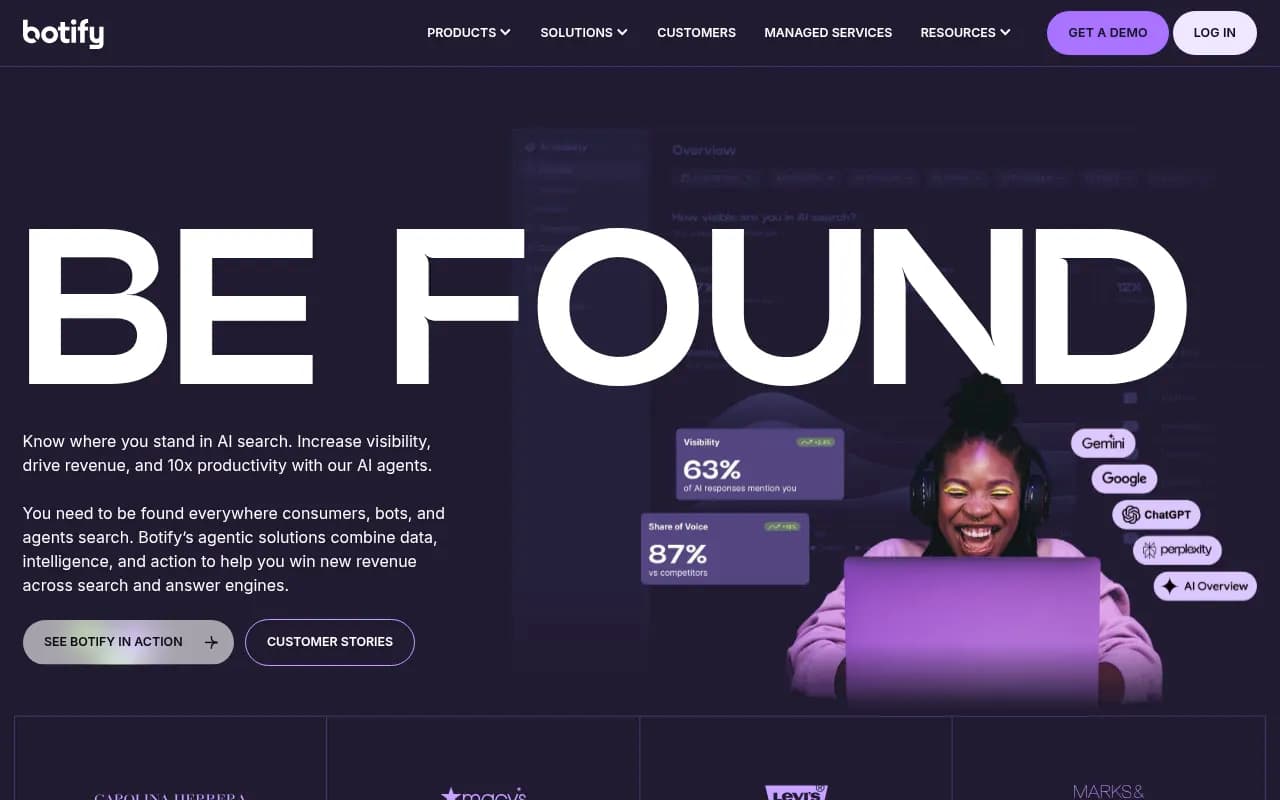
The AI search angle Botify has taken is interesting: it frames AI crawlers (like GPTBot and ClaudeBot) as another type of crawler to track in log files. That's actually a smart and technically grounded approach. If you're already ingesting server logs to understand Googlebot behavior, adding AI crawler behavior to the same pipeline makes sense. Botify has also added some prompt monitoring features, though these are less developed than what you'd get from a dedicated GEO platform.
Where Botify shines: very large sites (millions of pages), JavaScript-heavy architectures, crawl budget optimization, and teams that already have a technical SEO workflow built around log file analysis.
Where it falls short on AI visibility: prompt tracking is limited, there's no content gap analysis tied to AI responses, no Reddit or YouTube citation tracking, and the brand monitoring across LLMs is surface-level compared to dedicated platforms.
Lumar
Lumar (formerly DeepCrawl) is a website intelligence platform that covers technical SEO, Core Web Vitals, accessibility, and site performance. It's well-regarded for its crawl accuracy and the depth of its technical auditing -- things like hreflang validation, structured data errors, and page experience signals.
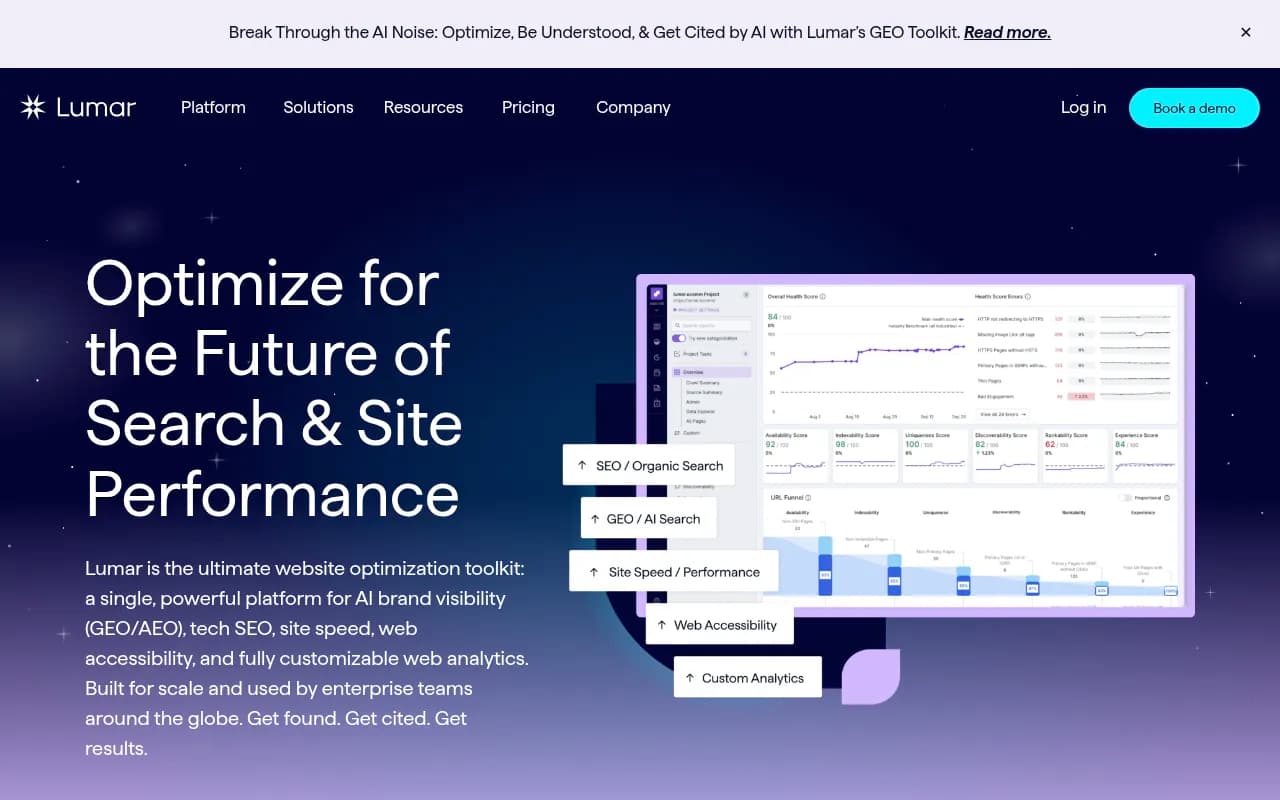
Lumar has added some AI-related features, primarily around content quality signals and structured data that might influence AI responses. But it's honest about what it is: a technical SEO and website health platform. It doesn't claim to track how ChatGPT talks about your brand, and it doesn't generate content designed to improve AI citations.
Where Lumar shines: technical auditing for mid-market and enterprise sites, accessibility compliance, Core Web Vitals monitoring, and teams that want a clean, well-designed interface for site health data.
Where it falls short on AI visibility: essentially no LLM monitoring, no prompt tracking, no citation analysis. If AI search visibility is a priority, Lumar needs a companion tool.
OnCrawl
OnCrawl is an enterprise technical SEO crawler with a strong emphasis on data science -- it's one of the few tools that lets you join crawl data with log files and Google Search Console data in a single environment, then run custom analysis on top of it.
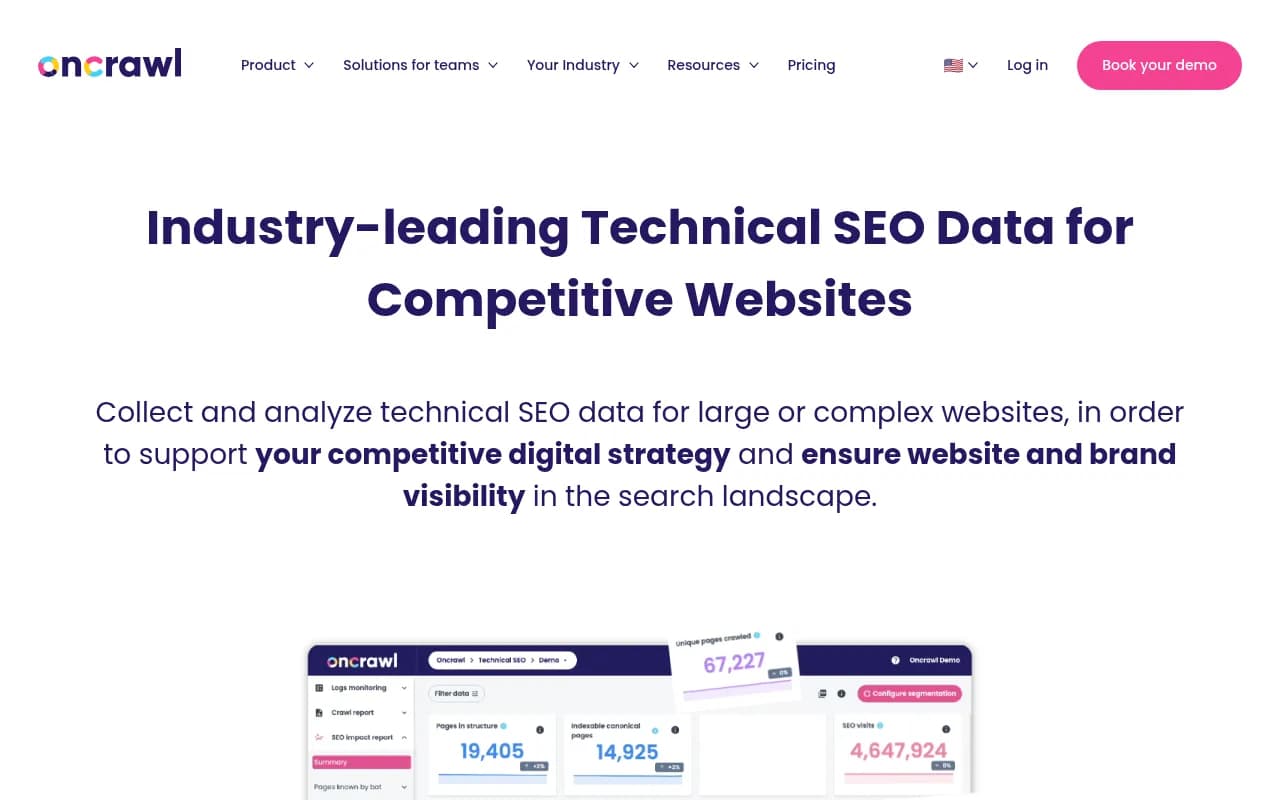
The data flexibility is genuinely impressive. You can build custom segments, run SQL-like queries on crawl data, and connect it to BI tools. For technical SEO analysts who want to go deep on crawl behavior, link equity flow, or content quality at scale, OnCrawl is a serious tool.
On AI visibility: similar story to Lumar. OnCrawl has some awareness of AI crawlers in log file analysis, but there's no dedicated LLM monitoring, no brand tracking across AI models, and no content optimization for AI search. It's a technical SEO tool.
Profound
Profound is one of the earlier dedicated AI search visibility platforms, focused on tracking brand mentions across LLMs and helping teams understand their share of voice in AI-generated responses.

It covers the core monitoring use case well: you set up prompts, Profound queries AI models, and you get data on how often your brand appears, what context it appears in, and how competitors are doing. The interface is clean and the reporting is solid.
Where Profound has limitations: it's primarily a monitoring platform. The action side -- what do you actually do with this data to improve your AI visibility -- is less developed. Content generation, gap analysis tied to specific missing content, and crawler log integration aren't core parts of the product. Pricing is also on the higher end, which makes it harder to justify for teams that aren't yet sure how much they'll use AI visibility data.
Promptwatch
Promptwatch is the platform that comes closest to bridging the gap between technical SEO infrastructure and AI visibility optimization. It's not a technical SEO crawler in the Botify/Lumar/OnCrawl sense, but it does have meaningful technical depth on the AI side that the others lack.

The core difference is that Promptwatch is built around an action loop, not just monitoring. It tracks how 10+ AI models (ChatGPT, Perplexity, Claude, Gemini, Grok, DeepSeek, Copilot, Meta AI, Mistral, Google AI Overviews) cite and mention your brand. But it also shows you what's missing -- specifically which prompts competitors are visible for that you're not -- and then helps you create content to fill those gaps.
The technical angle that makes Promptwatch relevant to this comparison: it has real AI crawler log analysis. You can connect it via Cloudflare, Fastly, Vercel, server logs, or a tracking snippet, and see exactly which AI crawlers (GPTBot, ClaudeBot, PerplexityBot, etc.) are hitting your site, which pages they're reading, what errors they're encountering, and when pages move from "crawled" to "cited." That's a genuinely technical capability that most AI visibility platforms don't have.
It also tracks page-level citations -- not just "your brand appeared" but "this specific URL was cited in this specific response" -- which gives you the kind of granular data that technical SEO teams are used to working with.
Feature comparison
| Feature | Botify | Lumar | OnCrawl | Profound | Promptwatch |
|---|---|---|---|---|---|
| Technical site crawling | Yes (enterprise) | Yes (enterprise) | Yes (enterprise) | No | No |
| Log file analysis | Yes | Limited | Yes (advanced) | No | AI crawlers only |
| Core Web Vitals monitoring | Yes | Yes | Limited | No | No |
| AI crawler tracking in logs | Yes (basic) | No | Basic | No | Yes (detailed) |
| LLM brand monitoring | Limited | No | No | Yes | Yes (10+ models) |
| Prompt tracking & volume data | No | No | No | Yes | Yes |
| Answer gap / competitor analysis | No | No | No | Limited | Yes |
| Page-level citation tracking | No | No | No | No | Yes |
| Content generation for AI | No | No | No | No | Yes |
| Reddit / YouTube citation tracking | No | No | No | No | Yes |
| ChatGPT Shopping tracking | No | No | No | No | Yes |
| Multi-language / multi-region | Yes | Yes | Yes | Limited | Yes |
| Traffic attribution from AI | No | No | No | No | Yes |
| Pricing (entry point) | Enterprise only | ~$500+/mo | ~$500+/mo | ~$500+/mo | $99/mo |
The honest verdict on "combining" technical SEO and AI visibility
Here's the uncomfortable truth: no single platform in 2026 does both well. The technical SEO tools (Botify, Lumar, OnCrawl) are built around crawl infrastructure that takes years to develop properly. The AI visibility tools (Profound, Promptwatch) are built around LLM querying, citation analysis, and content optimization -- a completely different technical stack.
Asking Botify to track how Perplexity talks about your brand is like asking OnCrawl to write content briefs. It's not what the tool was built for, and the features feel bolted on.
The more useful question is: which AI visibility platform has enough technical depth to complement your existing technical SEO stack?
On that question, Promptwatch has the most to offer. The AI crawler log integration means you can see the full picture: your technical SEO tool tells you how Googlebot crawls your site, and Promptwatch tells you how GPTBot, ClaudeBot, and PerplexityBot crawl it -- and crucially, which pages actually get cited after being crawled. That's a workflow that makes sense.
Which combination makes sense for your team
If you're a large enterprise with a complex site
You probably already have Botify or a similar enterprise crawler. Add Promptwatch for AI visibility. The two tools solve genuinely different problems and the data doesn't overlap much. Botify's log file analysis for Googlebot + Promptwatch's AI crawler logs and citation tracking gives you a complete picture of how both traditional and AI search engines interact with your site.
If you're a mid-market team on Lumar or OnCrawl
Same logic applies. Keep your technical SEO tool for what it does well. Add a dedicated AI visibility platform. At $99/month for Promptwatch's entry tier, the cost of adding AI visibility monitoring is low enough to justify even if you're still figuring out how much it matters for your business.
If you're starting fresh and AI visibility is the priority
Profound and Promptwatch are the two serious options. Profound has a cleaner enterprise positioning and strong brand recognition in the space. Promptwatch has more action-oriented features -- the content gap analysis, content generation, and page-level citation tracking -- and a lower entry price point. For most teams, Promptwatch's action loop (find gaps, create content, track results) is more useful than monitoring alone.
If budget is tight
Promptwatch's $99/month Essential plan covers one site, 50 prompts, and 5 AI-generated articles per month. That's enough to get real data on your AI visibility and start doing something about it. Botify, Lumar, and OnCrawl all start at enterprise pricing that puts them out of reach for smaller teams.
A note on what "technical SEO for AI" actually means
There's a framing that's worth pushing back on slightly. "Technical SEO for AI" is sometimes used to mean the same things as traditional technical SEO -- crawlability, structured data, page speed. And those things do matter for AI visibility to some extent.
But AI search has its own technical layer that's different. Things like:
- Which pages AI crawlers actually visit (and how often)
- Whether your content answers questions directly enough to be cited
- How your brand is represented in third-party sources that AI models train on or cite
- Whether your structured data helps AI models understand what your business does
The tools that address this layer are the AI visibility platforms, not the traditional technical SEO crawlers. Botify tracking GPTBot in log files is useful, but it doesn't tell you why GPTBot visited a page and then didn't cite it. Promptwatch's page-level citation tracking -- which shows the gap between "crawled" and "cited" -- gets closer to answering that question.
Bottom line
If you need technical SEO at scale, Botify, Lumar, and OnCrawl are all strong choices depending on your specific needs. Botify for very large sites with complex JavaScript, Lumar for clean auditing and accessibility, OnCrawl for data-science-heavy analysis.
If you need AI visibility -- and in 2026, most brands do -- you need a dedicated platform. Profound is a solid monitoring option. Promptwatch is the better choice if you want to actually do something with the data: find content gaps, generate content that fills them, and track whether AI models start citing you as a result.
The combination that makes the most sense for most teams: your existing technical SEO tool (whatever it is) plus Promptwatch for AI visibility. That covers both jobs without asking either tool to do something it wasn't built for.