Key takeaways
- Peec AI is a solid monitoring tool for tracking brand visibility across ChatGPT, Perplexity, and Google AI Overviews — but it stops at diagnosis.
- Agencies managing multiple clients will hit prompt and answer limits faster than expected, and the cost scales up quickly.
- The platform lacks content generation, crawler logs, and actionable optimization features — you'll need separate tools to act on what you find.
- Sentiment analysis and competitor benchmarking are genuine strengths, especially for reputation-conscious clients.
- If you need a full optimization loop (find gaps, create content, track results), Peec AI alone won't get you there.
- Overall rating from independent reviews: around 7.3/10 — good for monitoring, not built for execution.
Agencies evaluating AI visibility tools in 2026 face a real problem: most tools in this space look similar on the surface. They all track mentions, show share-of-voice charts, and promise to tell you how your brand performs in AI search. The differences only become obvious once you're actually trying to run campaigns for clients.
Peec AI is one of the more established names in this category. It launched early, built a clean interface, and covers the core use case well. But "well" has limits, and for agencies specifically, those limits matter more than they do for solo in-house teams.
This review is based on publicly available testing data, independent reviews from practitioners who've run Peec AI across multiple client accounts, and direct comparison with other tools in the GEO/AEO space.

What Peec AI actually does
Peec AI is an AI search analytics platform. The core idea: instead of tracking where you rank on Google, you track how often AI systems mention your brand when users ask relevant questions.
The platform uses UI scraping technology to simulate real user interactions with AI models. This matters because the answers you get through a user interface can differ from what you'd get through an API — and most buyers are using the interface, not the API.
You set up prompts that mirror real buyer questions ("what's the best project management tool for agencies?", "which CRM is best for B2B SaaS?"), and Peec AI runs those prompts across ChatGPT, Perplexity, and Google AI Overviews. It then measures three things at the prompt level:
- Visibility: how often your brand appears in the answer
- Position: where in the answer you appear (first mention, third mention, etc.)
- Sentiment: whether the AI describes you positively, neutrally, or negatively
That's a clean, useful framework. For clients who've never had any visibility into how AI search talks about them, this is genuinely eye-opening data.
What agencies actually care about
Before getting into strengths and weaknesses, it's worth being clear about what agency use looks like. You're not just running one brand — you're managing multiple clients, often in different verticals, with different competitive sets. You need:
- Multi-client management without the cost exploding
- Enough prompt volume to cover each client's real question universe
- Competitor benchmarking that's actually granular
- Reporting you can hand to a client without a 20-minute explanation
- Some path from "here's the problem" to "here's what to do about it"
Peec AI handles some of these well. Others, not so much.
Where Peec AI gets it right
Competitor benchmarking
This is probably Peec AI's strongest feature for agencies. You can track how your client's brand performs against direct competitors across the same set of prompts. The share-of-voice view shows you who's winning for each question, not just in aggregate.
For a client who suspects a competitor is dominating AI search recommendations, this is exactly the kind of data you need to make the case for investment. It's concrete, visual, and easy to explain.
Sentiment analysis
Most monitoring tools in this space tell you whether you were mentioned. Peec AI also tells you how. Positive, neutral, or negative framing matters a lot for brand-sensitive clients — a company that appears in AI answers but gets described as "expensive" or "difficult to integrate" has a different problem than one that simply doesn't appear.
For reputation management work, this is a real differentiator. Independent reviews have specifically called this out as one of the more valuable features for clients in competitive or regulated industries.
Transparent pricing and setup
Peec AI starts at $100/month and has public pricing. For agencies evaluating tools, this is a small but meaningful thing — you can actually budget for it without a sales call. Setup is relatively straightforward, and the interface is clean enough that experienced SEOs can get oriented quickly.
Citation source tracking
The platform shows you which URLs AI models are citing when they answer prompts. This is useful for understanding where authority is coming from — whether it's your own site, third-party review platforms, Reddit threads, or competitor content. Knowing the source helps you figure out where to focus optimization efforts.
Where Peec AI breaks down for agencies
It monitors, but doesn't optimize
This is the central limitation. Peec AI will tell you that your client is invisible for 40% of the prompts you're tracking. It will not tell you what to write, which pages to update, or how to close that gap. There's no content generation, no content brief builder, no answer gap analysis that maps specific missing topics to specific prompts.
For an in-house team with a content strategist who can translate data into action, this is manageable. For agencies trying to deliver outcomes (not just reports), it creates a gap. You're paying for monitoring, then paying separately for the execution layer.
Prompt and answer limits hit fast
Lower-tier plans have real constraints on how many prompts you can track and how many AI answers you can analyze per month. For a single brand with a focused keyword set, this might be fine. For agencies running multiple clients with broad competitive landscapes, you'll hit the ceiling quickly.
The cost to scale up isn't trivial. Independent reviews note that growing teams often find themselves upgrading plans or adding engines faster than expected, which pushes the effective monthly cost well above the entry price.
No crawler logs or AI traffic attribution
Peec AI doesn't show you when AI crawlers visit your client's website, which pages they read, or whether a crawl led to a citation. It also doesn't connect AI visibility to actual traffic or revenue.
This matters for agencies because clients eventually ask "is this working?" in terms of business outcomes, not just visibility scores. Without traffic attribution, you're answering that question with a shrug.
Enterprise readiness is limited
There's no public API, no SSO authentication, and no SOC-2 compliance on base plans. For agencies working with enterprise clients who have IT security requirements, this creates friction. Automation workflows are also limited — you can't easily pipe Peec AI data into a client's existing reporting stack without manual exports.
Beginner-unfriendly for client-facing work
The interface and metrics can be complex for clients who aren't already familiar with GEO concepts. If you're handing a Peec AI report to a CMO who's new to AI search visibility, expect to spend time explaining what visibility score actually means. This isn't a dealbreaker, but it's worth factoring in for agencies that do a lot of client-facing reporting.
How Peec AI compares to alternatives
Here's a direct comparison across the features that matter most for agency use:
| Feature | Peec AI | Otterly.AI | Profound | Promptwatch |
|---|---|---|---|---|
| AI model coverage | ChatGPT, Perplexity, Google AI Overviews | ChatGPT, Perplexity, Gemini | ChatGPT, Perplexity, Gemini, others | 10+ models incl. Claude, Grok, DeepSeek, Copilot |
| Competitor benchmarking | Yes | Basic | Yes | Yes |
| Sentiment analysis | Yes | Limited | Yes | Yes |
| Content generation | No | No | No | Yes (Content Agents) |
| Answer gap analysis | No | No | No | Yes |
| AI crawler logs | No | No | No | Yes |
| Traffic attribution | No | No | No | Yes |
| Reddit/YouTube tracking | No | No | No | Yes |
| ChatGPT Shopping tracking | No | No | No | Yes |
| Public API | No | No | Limited | Yes |
| Starting price | $100/mo | ~$99/mo | Higher | $99/mo |
| Best for | Monitoring-focused teams | Budget monitoring | Mid-market monitoring | Full optimization loop |



The pattern is pretty clear. Peec AI, Otterly.AI, and most other tools in this space are monitoring dashboards. They answer "how visible are we?" They don't answer "how do we become more visible?" and they definitely don't help you do it.
Promptwatch is the exception worth noting here. It covers the same monitoring ground but adds content gap analysis, AI-powered content generation grounded in real prompt data, and crawler logs that show exactly when AI agents visit your pages and whether those visits lead to citations. For agencies that need to show clients a path from data to outcomes, that matters.
Who should actually use Peec AI
Peec AI makes sense in a few specific situations:
In-house teams with existing content capacity. If you have writers and strategists who can take monitoring data and turn it into action independently, Peec AI gives you solid inputs. You don't need the platform to tell you what to do — you just need the data.
Agencies doing reputation monitoring for brand-sensitive clients. The sentiment analysis is genuinely useful here. If a client is worried about how AI describes their brand (not just whether they appear), Peec AI gives you something concrete to work with.
Teams that are new to AI visibility and need a starting point. At $100/month, it's a reasonable way to get a first look at how your brand performs in AI search before committing to a more expensive platform.
Situations where you're supplementing a broader tool. Some agencies use Peec AI alongside other platforms — one for monitoring, one for content, one for technical optimization. If you already have the execution layer covered, Peec AI can sit comfortably in the monitoring role.
Who should probably look elsewhere
Agencies managing 5+ clients who need scalable prompt volumes. The cost curve gets steep fast. You'll either hit limits or pay significantly more than the entry price suggests.
Teams that need to show ROI in terms of traffic or revenue. Without attribution, you're limited to visibility metrics. That's fine internally but hard to defend in a quarterly business review.
Clients with enterprise IT requirements. No SSO, no SOC-2, limited API access. This will create friction with procurement.
Anyone who needs to actually fix the gaps, not just find them. If your deliverable is "here's what's wrong," Peec AI works. If your deliverable is "here's what we did about it," you need more.
A note on the broader market
The AI visibility monitoring space has gotten crowded fast. There are now dozens of tools that will show you a visibility score, a share-of-voice chart, and a list of prompts where you're not appearing. The differentiation that actually matters in 2026 is what happens after the monitoring.
A few tools worth knowing about in this space, depending on your specific needs:

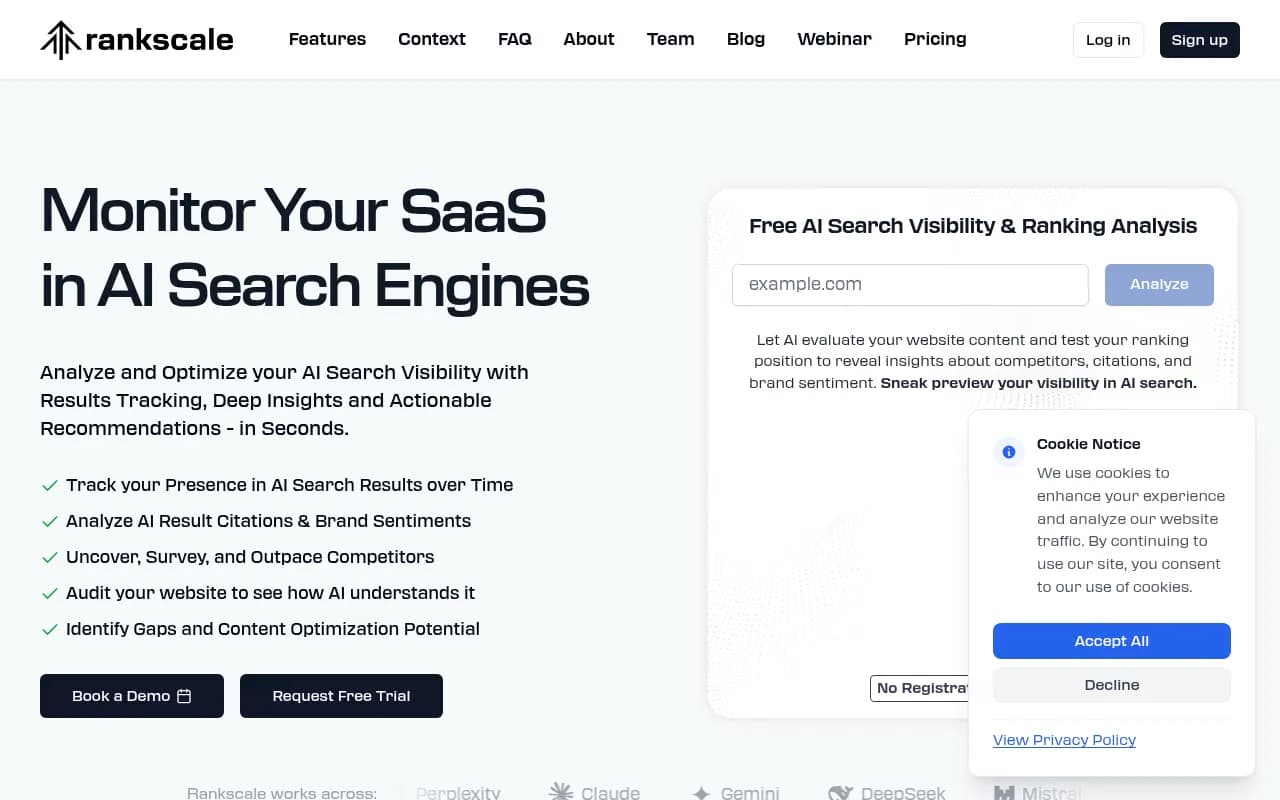
AthenaHQ and Rankscale are solid monitoring options with different coverage and pricing profiles. Scrunch AI is worth a look for agencies with influencer marketing clients alongside their SEO work.
For the full picture — monitoring, gap analysis, content generation, and traffic attribution in one place — Promptwatch is currently the most complete option available. It's used by over 1,480 brands and agencies, and it's the only platform in the 2026 comparison of 12 GEO tools rated as a leader across all categories.
The bottom line
Peec AI is a competent monitoring tool. The competitor benchmarking is good, the sentiment analysis is genuinely useful, and the pricing is transparent. For teams that already know how to act on data and just need a reliable visibility feed, it does the job.
For agencies that need to deliver outcomes — not just reports — the monitoring-only model has a real ceiling. You'll find the gaps, but you'll need other tools (and other budget) to close them. That's not a knock on Peec AI specifically; it's the limitation of the entire monitoring-only category.
The question worth asking before you buy: do you need to know where you're invisible, or do you need to fix it? If it's the former, Peec AI is a reasonable choice. If it's the latter, build your stack accordingly.