Key takeaways
- All four tools (MarketMuse, Clearscope, Frase, Surfer SEO) were built primarily for Google rankings, not AI search visibility -- each has different strengths and weaknesses in 2026.
- Surfer SEO is the best choice for teams that want fast, SERP-driven content scoring with a built-in editor. Clearscope wins on simplicity and team adoption. Frase is the most affordable all-in-one option. MarketMuse is best for strategic content planning at scale.
- None of these tools tell you whether your content is being cited by ChatGPT, Perplexity, or Gemini -- for that, you need a dedicated GEO/AI visibility platform.
- The smartest 2026 content workflow pairs a content optimization tool (for Google) with an AI visibility platform (for LLM search) rather than expecting one tool to do both.
The conversation around content optimization tools has shifted noticeably in the past 18 months. For years, the question was simple: which tool helps me rank on Google? Now it's more complicated. You still need Google rankings -- organic search isn't dead -- but a growing share of your potential customers are getting answers from ChatGPT, Perplexity, Gemini, and Google's own AI Overviews before they ever see a blue link.
That puts tools like MarketMuse, Clearscope, Frase, and Surfer SEO in an interesting position. They're excellent at what they were designed for. The question is whether what they were designed for is still enough.
This guide breaks down each tool honestly, compares them head-to-head, and addresses the AI search gap directly.
What these tools actually do
Before getting into comparisons, it's worth being clear about the core mechanic all four tools share. They analyze the top-ranking pages for a given keyword, extract the topics, terms, and questions those pages cover, and then score your draft against that benchmark. Write about the right things, cover the right subtopics, hit the right term frequencies -- and you're more likely to rank.
That's a genuinely useful workflow. It works. But it's a Google-first model, built on the assumption that ranking on Google is the primary goal. In 2026, that assumption needs some scrutiny.
Surfer SEO
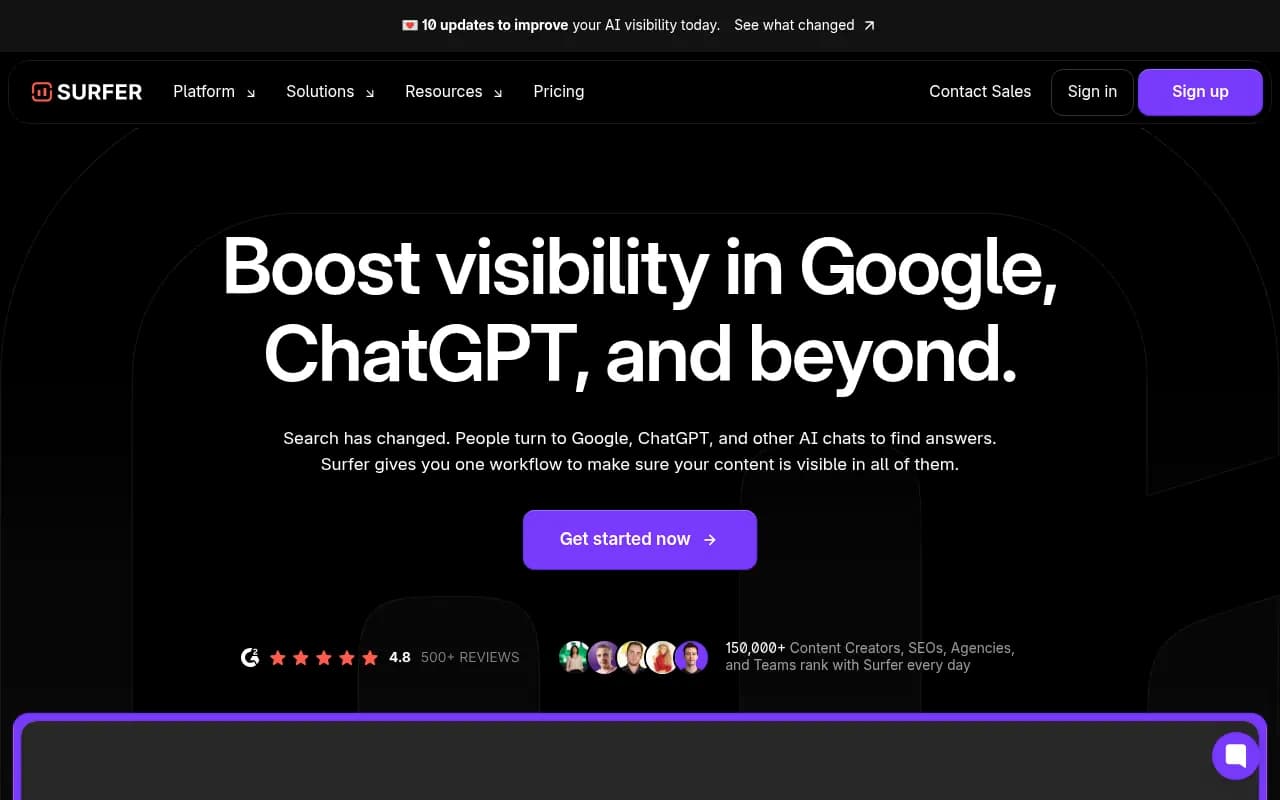
Surfer SEO is probably the most widely used content optimization tool on the market right now. The Content Editor is the main draw: you paste in your draft, and it gives you a real-time content score based on how well you're covering the topics that top-ranking pages cover for your target keyword.
What Surfer does well:
- Real-time scoring as you write, which is genuinely useful for keeping writers on track
- SERP Analyzer that reverse-engineers what the top 10 pages have in common
- Keyword research built into the same interface
- Topical Maps for planning content clusters
- Integrates with Google Docs and WordPress
The content score is Surfer's signature feature, and it's well-executed. Writers who use it consistently tend to produce more comprehensive content, which does correlate with better rankings.
Where Surfer falls short in 2026: it was built for Google, and it shows. There's no visibility into whether your content is being cited in AI answers. You can optimize a page to a perfect Surfer score and still be completely invisible in ChatGPT or Perplexity responses. That's not a knock on Surfer specifically -- it's just a gap in what the tool was designed to solve.
Pricing starts around $89/month for the Essential plan. The Scale plan at $129/month adds more articles and AI features.
Clearscope
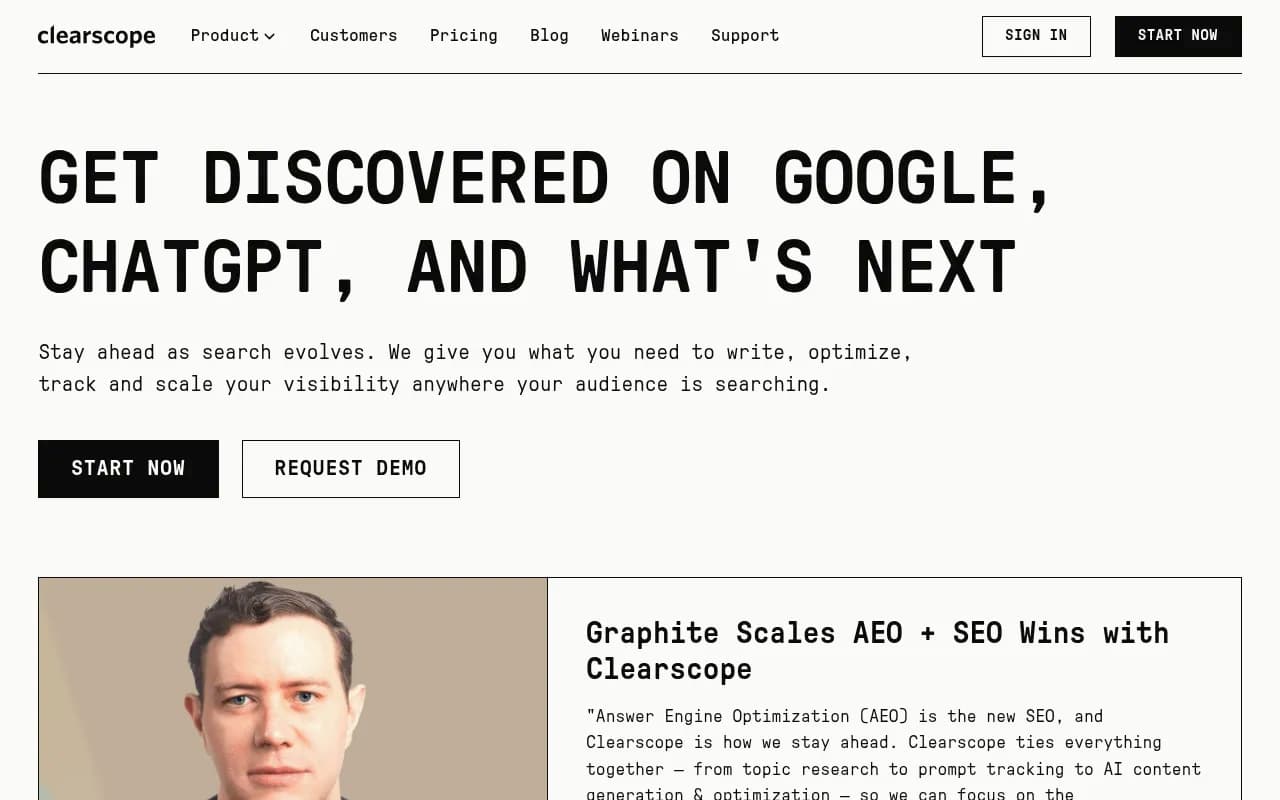
Clearscope takes a cleaner, more focused approach than Surfer. The interface is simpler, the reports are easier to read, and the term recommendations feel more curated. It's the tool that tends to get the best adoption rates on content teams because writers don't have to learn much to use it effectively.
What Clearscope does well:
- Clean, readable content reports with graded term recommendations (A+ to F)
- Google Docs integration that works smoothly
- Readability scoring alongside SEO scoring
- Strong for teams where multiple writers need to use the same tool consistently
The main criticism of Clearscope is price. The Essentials plan starts at $189/month, which is significantly more than Frase and more than Surfer's entry tier. For solo operators or small teams, that's a hard sell. For agencies or content teams with 5+ writers, the simplicity and adoption rate can justify the cost.
Like Surfer, Clearscope has no AI search visibility features. It's a Google optimization tool, full stop.
Frase
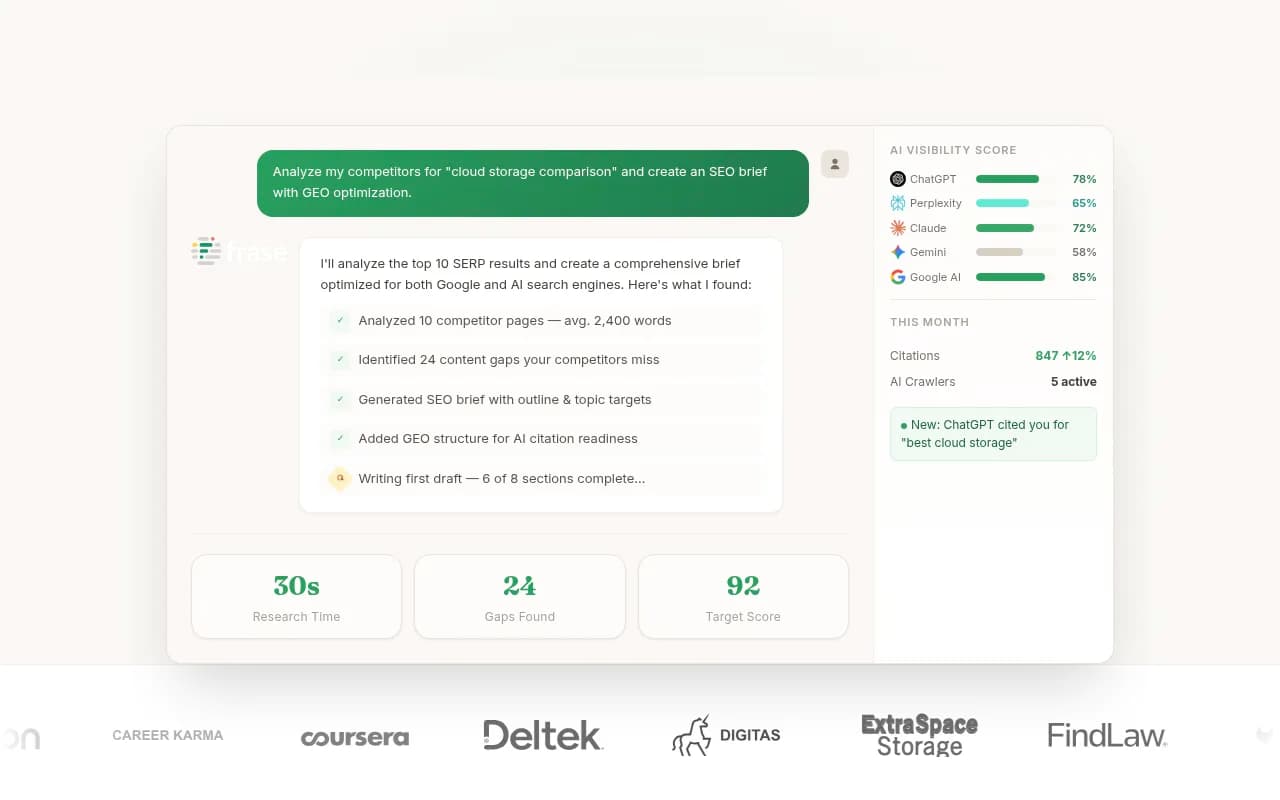
Frase is the most feature-dense option in this group relative to its price. It combines content research, brief generation, AI writing, and optimization scoring in one interface. The research tab pulls in SERP data and lets you see what questions people are asking around a topic, which is useful for structuring content.
What Frase does well:
- Content briefs generated from SERP analysis, which saves significant research time
- AI writing assistant built in (useful for drafts, not final copy)
- Question research pulled from People Also Ask and forums
- More affordable than Clearscope and MarketMuse -- plans start around $45/month
The tradeoff is that Frase tries to do a lot, and some features feel less polished than the focused tools. The content optimization scoring isn't quite as refined as Surfer's or Clearscope's. But for smaller teams or solo content marketers who want one tool that covers research, briefing, and optimization, Frase is hard to beat on value.
Frase has added some AI features over time, but like the others, it doesn't track AI search visibility or tell you whether your content is appearing in LLM responses.
MarketMuse
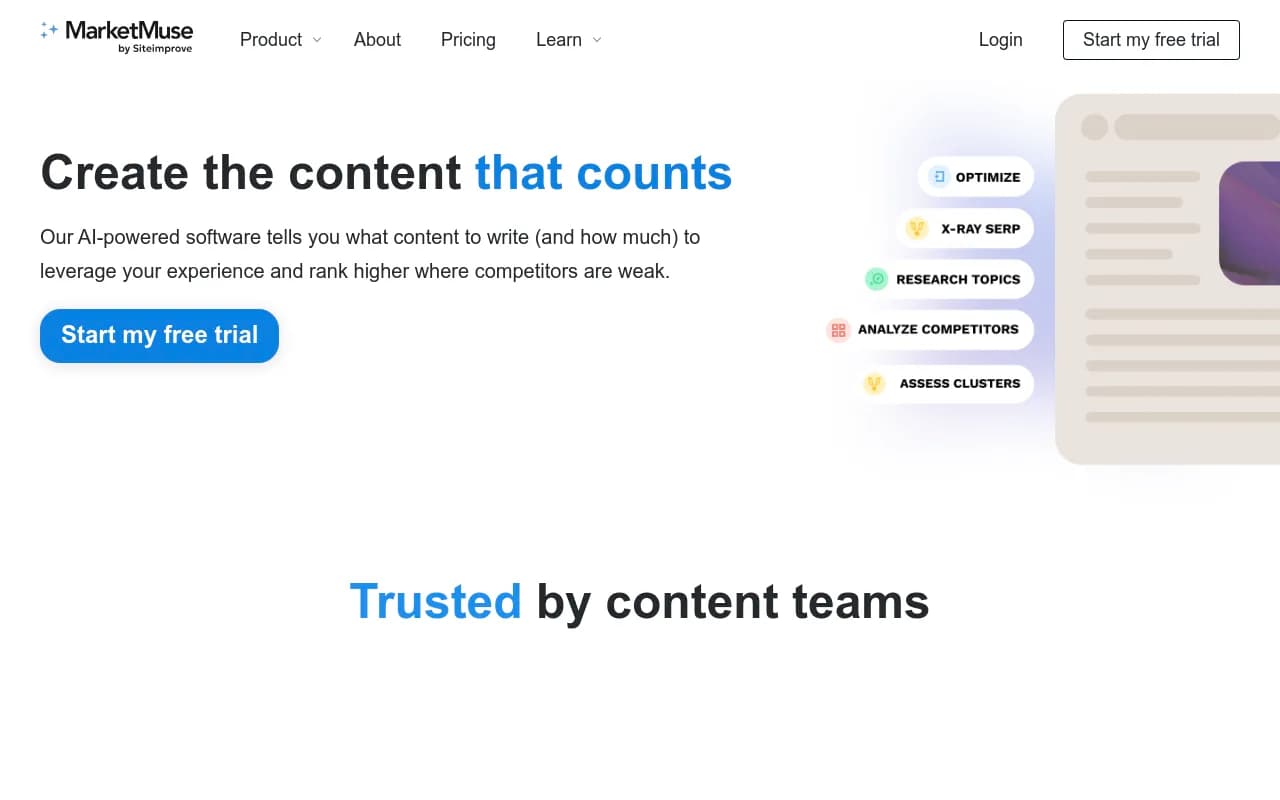
MarketMuse operates at a different level than the other three. Where Surfer and Clearscope focus on optimizing individual pieces of content, MarketMuse is more about content strategy at scale. It analyzes your entire site's topical authority, identifies gaps in your content coverage, and prioritizes which topics to target based on your existing authority.
What MarketMuse does well:
- Site-wide topical authority analysis, not just page-level scoring
- Content briefs that go deeper than competitors' -- covering subtopics, questions, related concepts
- Competitive analysis showing where your topical coverage is weak relative to competitors
- Better for content planning than for in-the-moment writing optimization
The downside is cost. MarketMuse's paid plans start at $149/month, and the full feature set requires higher tiers. It's genuinely an enterprise-leaning tool, and the ROI is clearest for larger sites with established content operations.
MarketMuse has also started incorporating some AI-related features, but it remains primarily a Google SEO tool.
Head-to-head comparison
| Feature | Surfer SEO | Clearscope | Frase | MarketMuse |
|---|---|---|---|---|
| Real-time content scoring | Yes | Yes | Yes | Yes |
| Content brief generation | Yes | Limited | Yes | Yes |
| AI writing assistant | Yes | No | Yes | No |
| Site-wide content strategy | Limited | No | No | Yes |
| Google Docs integration | Yes | Yes | Yes | No |
| Keyword research built-in | Yes | No | Yes | Limited |
| AI search visibility | No | No | No | No |
| Entry-level pricing | ~$89/mo | ~$189/mo | ~$45/mo | ~$149/mo |
| Best for | Content teams, agencies | Teams needing simplicity | Solo creators, small teams | Enterprise content strategy |
The AI search gap all four tools share
Here's the honest assessment: none of these tools help you rank in AI search. They optimize for Google's ranking algorithm, which is still important, but they don't tell you:
- Whether ChatGPT, Perplexity, or Gemini are citing your content
- Which prompts your competitors are visible for that you're not
- What topics AI models want to answer but can't find on your site
- How your AI search visibility changes over time
This matters more than it did 18 months ago. According to data from Promptwatch, AI search engines are now processing billions of queries monthly, and the sources they cite don't always overlap with Google's top results. A page can rank #1 on Google and be completely absent from AI answers -- and vice versa.
If your content strategy only accounts for Google, you're optimizing for a shrinking share of the total search landscape.
What a complete 2026 content workflow looks like
The most effective approach right now isn't choosing between Google optimization and AI search optimization -- it's doing both. That means:
- Use a content optimization tool (Surfer, Clearscope, Frase, or MarketMuse) to ensure your content covers the right topics and terms to rank on Google.
- Use an AI visibility platform to understand which prompts AI models are responding to, which sources they're citing, and where your content is missing from AI answers.
For the second part, Promptwatch is worth looking at. It tracks how your content appears across ChatGPT, Perplexity, Gemini, Claude, and other AI engines, identifies the specific prompt gaps where competitors are visible and you're not, and generates content briefs grounded in real prompt data to close those gaps.

The key difference from the four tools in this guide: Promptwatch shows you what's happening in AI search and helps you act on it, rather than just optimizing for Google's algorithm.
Which tool should you pick?
The right choice depends on your situation more than any objective ranking.
Pick Surfer SEO if you want the most feature-complete content editor with real-time scoring, you're running a content team that produces a high volume of articles, and you want keyword research and optimization in one place. It's the most balanced option for most content teams.
Pick Clearscope if team adoption is your biggest challenge. It's the easiest tool to hand to a writer and get consistent results from. The higher price is the main barrier, but if your team is larger, the per-seat cost becomes more reasonable.
Pick Frase if you're working with a smaller budget and want the most features per dollar. The brief generation and question research features are genuinely useful, and the AI writing assistant saves time on first drafts. It's not as polished as Surfer or Clearscope, but it's a strong value.
Pick MarketMuse if you're managing a large content operation and need site-wide topical authority analysis. It's overkill for small sites, but for enterprise content teams trying to systematically build authority in a competitive niche, the strategic layer is worth the cost.
A few tools worth knowing about
Beyond the main four, there are some adjacent tools that solve specific pieces of the content optimization puzzle.
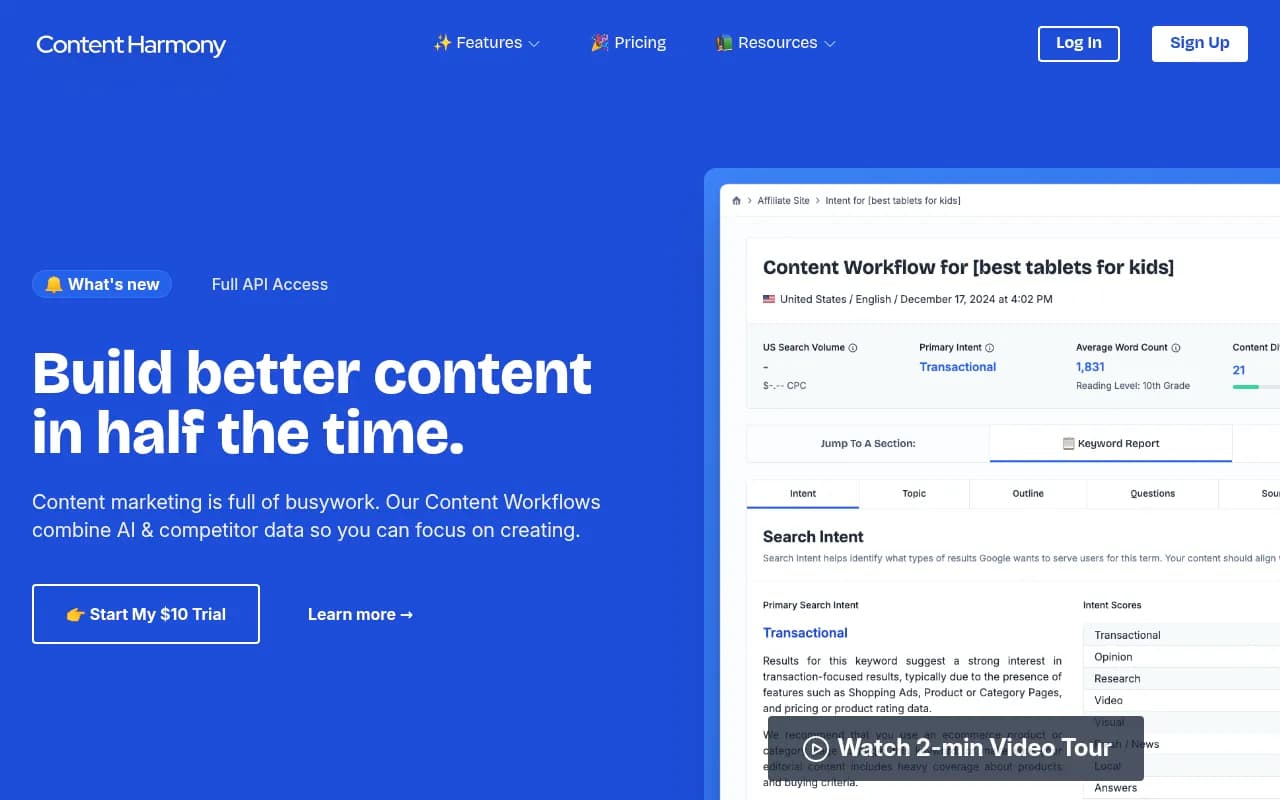
For content briefs specifically, Content Harmony takes a research-first approach that some teams prefer:
For AI-powered content creation that goes beyond optimization into drafting:
For teams that want SEO and content optimization in a single platform alongside broader marketing tools:
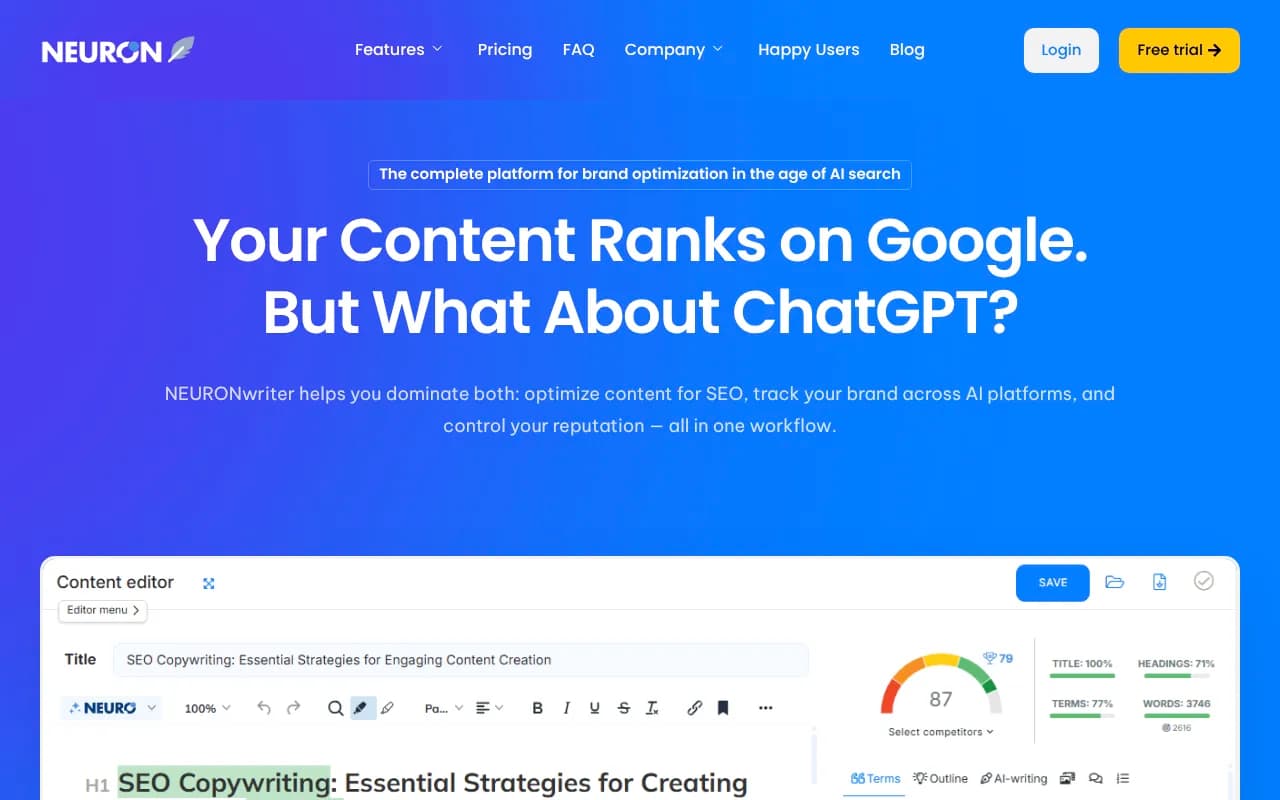
And for NLP-based content optimization at a lower price point:
The bottom line
MarketMuse, Clearscope, Frase, and Surfer SEO are all legitimate tools. They work for what they were designed to do. The question isn't which one is best in some absolute sense -- it's which one fits your team's workflow and budget, and whether you've accounted for the AI search layer that none of them cover.
In 2026, a content strategy that only optimizes for Google is leaving visibility on the table. The teams that will pull ahead are the ones treating AI search as a parallel channel with its own optimization requirements, not an afterthought. That means pairing whichever content tool you choose with something that actually tracks and improves your presence in AI answers.