Key takeaways
- Directory listings still matter for ChatGPT local recommendations. BrightLocal's analysis of 1.9 million citations found Yelp alone accounts for 8.53% of citations, with heavier use in ChatGPT.
- Your own website is still the most cited source. Steady Demand found about 50% of local AI citations point to the business's own site, and 60% for Gemini.
- Different engines cite different sources. Only about 5% of businesses appeared in all three of Gemini, AI Overviews and AI Mode in one 7-million-result study.
- Source mixes change quickly. Reddit fell out of both ChatGPT and Gemini citations within weeks, and directories absorbed much of the share.
- The practical plan: fix your core listings, add vertical-specific directories, keep your site strong, and measure AI visibility repeatedly instead of once.
Two kinds of citation, one confusing word
The word "citation" now means two different things, and mixing them up leads to bad decisions.
A local citation is the old-school kind: your business name, address and phone number (NAP) listed on Yelp, Apple Maps, Bing Places, the BBB or a niche directory. Local SEOs have built these for fifteen years to prop up map-pack rankings.
An AI citation is a source link that ChatGPT, Gemini or Google AI Overviews shows when it answers a question like "best plumber near me." It tells you which page the model leaned on to make its recommendation.
The overlap is the interesting part. Directory listings used to matter because Google read them as trust signals. They may matter now because AI engines fetch them as evidence. Whether those are the same value is the question this guide tries to answer with actual numbers.
What the data says about directories in ChatGPT
BrightLocal looked at 1.9 million citations across 116,670 domains and published the top directories for ChatGPT. Here is the top ten.
| Domain | DA | Citations | Locations |
|---|---|---|---|
| yelp.com | 93 | 99,281 | 1,068 |
| tripadvisor.com | 93 | 10,227 | 406 |
| opentable.com | 86 | 9,147 | 207 |
| bbb.org | 91 | 4,247 | 354 |
| angieslist.com | 81 | 1,768 | 174 |
| trustpilot.com | 93 | 1,136 | 110 |
| theinfatuation.com | 70 | 957 | 94 |
| yellowpages.com | 85 | 711 | 174 |
| homeadvisor.com | 80 | 705 | 106 |
| apple.com | 99 | 600 | 134 |
Yelp is not close. That is not a surprise given OpenAI's data relationship with Yelp, but the size of the gap is worth noticing. One directory has roughly ten times the citations of the second.
The long tail matters too. BrightLocal's conclusion is blunt: there is no single source you can optimize for and call it done. And about 93% of the cited domains were individual business websites, which tells you AI pulls from businesses directly at huge scale, even if the big platforms hold the top spots.
Your own website is still the biggest lever
This is the finding I think people underweight. In Steady Demand's analysis of 14,000+ local AI citations from Gemini and ChatGPT, the business's own website took about 50% of all citations, more than every directory, forum and review platform combined. For Gemini alone it was around 60%.
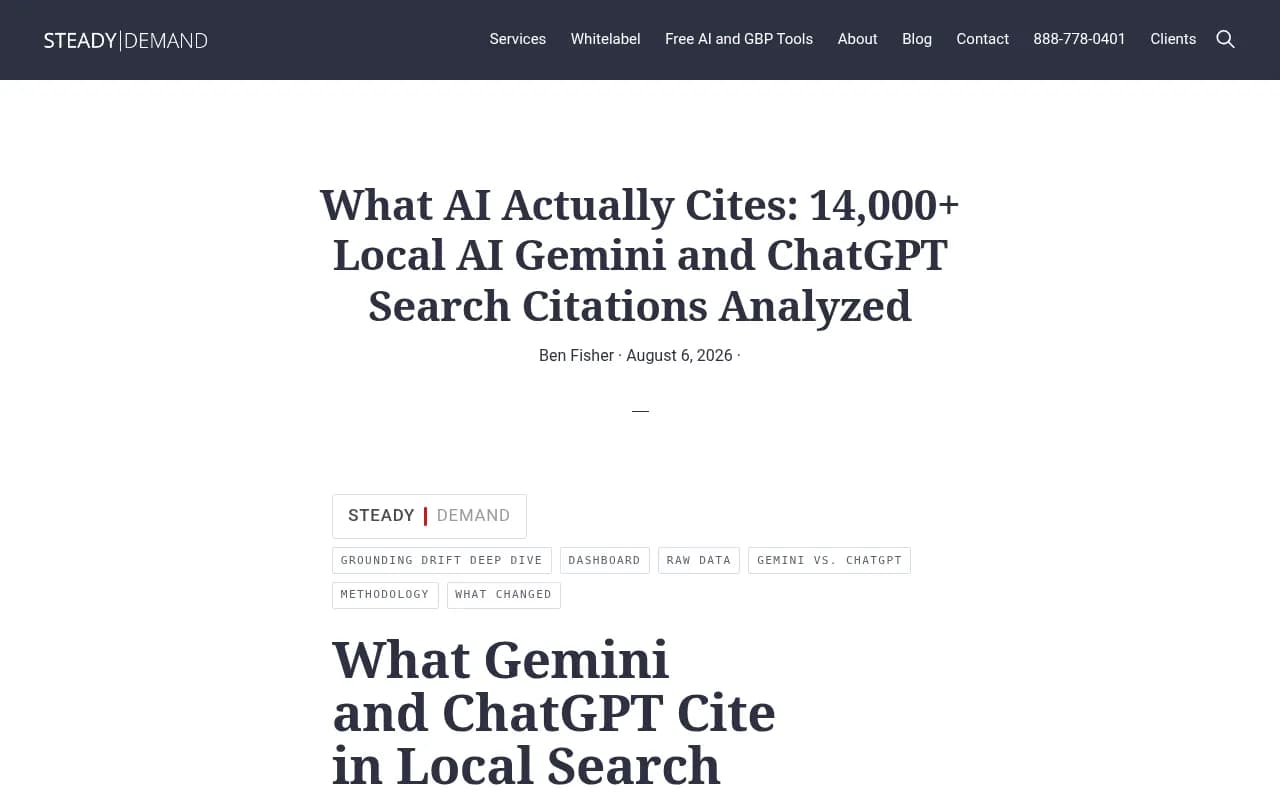
That runs against the narrative that AI made websites obsolete. The one asset you fully control is still where AI most often goes to back up what it says.
So the honest framing is not "citations or website." It is: the website is the base, and directories are the second layer that confirms who you are.
Why directories still help even when the site wins
Two reasons.
First, models cross-check. A business that shows consistent NAP, category and reviews across Yelp, Apple Maps and a niche directory looks more verifiable than one that exists only on its own domain.
Second, for comparison-style prompts, the model often wants a third-party opinion. A directory page with reviews is exactly that.
One caveat. Claims from vendor blogs that citations act as "grounding data" or that AI categorizes you by which directory lists you are plausible, but I could not find hard evidence for them. Treat them as theory.
The part nobody wants to hear: it shifts constantly
Steady Demand's most useful finding is not about any single source. It is about durability.
In July 2026, Reddit out-cited the entire local-service directory category, beating Angi, Thumbtack and HomeAdvisor combined. By September, Reddit had fallen from 13.7% to 1.7% of Gemini's citations, five weeks after the same thing happened in ChatGPT. Directories absorbed the share in both.
Promptwatch Data shows the same pattern at a larger scale. Reddit's share of ChatGPT citations held at about 3.83% from July 18 to August 7, 2026, then fell below 1% on August 14, averaging 0.52% for August 14 to 17. Promptwatch flags that the exact size of the drop is provisional, but the direction matches Steady Demand. Details are in Promptwatch's Reddit citation report. Google's surfaces moved more gently: AI Overviews eased from about 2.37% to 2.10%, and AI Mode from 2.22% to 1.54%.
There is a broader social-media angle as well. From Sep 28 to Oct 4, 2026, ChatGPT got only 0.46% of its citations from social platforms while Google AI Overviews got 12.2%, per the social media citations report. If your local strategy leaned on community posts, the engine you care about matters a lot.
It also means no playbook, including this one, is permanent. Treat it as a snapshot.
AI engines do not agree with each other
Two more numbers from the Steady Demand and related research:
- Ask Gemini the exact same question twice and the cited sources match only about 41% of the time. Steady Demand calls this Grounding Drift.
- Across 7 million local results, only about 5% of businesses appeared in Gemini, AI Overviews and AI Mode all together.
The way I read it: AI does not rank you, it samples you. A recommendation is a shifting distribution, not a fixed position. Checking once and declaring victory or failure is meaningless. You need repeated measurement over time.
This also splits the strategy by engine. Gemini leans heavily toward business websites. ChatGPT leans more on directories and, until recently, discussion sites. Optimizing for "AI visibility" as one target does not hold up.
Which directories, in which order
A reasonable structure borrows from the four-tier approach Sam Bretzmann lays out in his 2026 citation video: core platforms, data aggregators, industry directories, and local authority plus best-of lists.
| Tier | What goes here | Why it matters for AI |
|---|---|---|
| 1. Core platforms | Google Business Profile, Apple Maps, Bing Places, Facebook, Yelp | Feeds the engines directly; Yelp is the heaviest ChatGPT source in BrightLocal's data |
| 2. Data aggregators | BrightLocal, Whitespark, Yext | Pushes consistent NAP to many sites at once |
| 3. Industry directories | Vertical sites for your category | Different industries get cited from completely different ecosystems |
| 4. Local authority and best-of lists | Chamber of commerce, local press, "best of" roundups | Roundups are heavily cited in comparison prompts |
For tier 2, tools like Yext can distribute listings across a large network.
Go vertical, not generic
Steady Demand's recommendation is to build a vertical-specific directory list, not a generic one. Lawyers, dentists and auto shops get cited from entirely different source sets. Check what is actually cited for your category before assuming Angi and the BBB are enough.
Promptwatch Data shows the same vertical pattern for ChatGPT:
- Healthcare: NIH, the FDA and the NHS lead, and government and public health sites earn almost half of citations (report).
- Travel: Skyscanner, Going and Tripadvisor lead, and booking and search sites earn more than half (report).
- Automotive: marketplaces like Autotrader and Cars.com outrank every car brand (report).
- Software: GitHub, Microsoft's docs and G2 lead (report).
Those reports cover Sep to Oct 2026 for most categories and August 2026 for automotive. The lesson is consistent: category-specific directories and marketplaces win.
You do not need giant domains
A common fear is that only Yelp-sized sites matter. Promptwatch's domain rank data for August 2026 says otherwise. Domains with rank 61 to 75 took 23.4% of ChatGPT citations, 46 to 60 took 22.6%, and 76 to 90 took 18.9%. Sites in the 91 to 100 band had only 4.4% for the month and dropped from about 7% to about 3% by August 14.
So mid-authority niche directories are viable sources. A listing on a respected industry directory with real reviews can be worth more than a profile on a generic site nobody reads.
What kind of page gets cited
Promptwatch's content type report for Sep 28 to Oct 4, 2026 helps frame this. Product pages are 22.4% of classified ChatGPT citations and landing pages 16.8%. Listicles are 13.6% and reviews 1.7% overall, but reviews rise to 5.6% on branded prompts, more than 3x their overall share.
Two caveats. This report classifies content types and has no separate "directory listing" figure. And it says nothing directly about Yelp or the BBB. But it supports two actions: get included in the "best of" roundups ChatGPT cites for your category, and collect reviews on the sites people trust in your field.
Practical plan
- Audit NAP consistency on core platforms first. Fix mismatches before adding anything new.
- Claim and complete Yelp, Apple Maps, Bing Places and Facebook. Yelp matters most for ChatGPT.
- Search your category in ChatGPT and Gemini and note which directories and roundups are actually cited. Build your tier 3 list from that, not from a generic top-100 list.
- Pursue listing in local "best of" articles and niche directories with real reviews.
- Keep your own site detailed: services, locations, pricing signals, FAQs. It is still half of all citations.
- Re-test every few weeks. Because the same query can return different sources minutes apart, track patterns, not single results.
- Do not chase each shift. Steady Demand's long-term advice holds: make sure the data about your business reflects real quality, whichever source gets picked tomorrow.
One more reality check: even when you show up, clicks are scarce. Across 15.2 million local searches, only about 12% of AI results were clickable on desktop and about 28% on mobile. Visibility and traffic are different problems.
Tools for measuring both sides
Citation distribution tools handle the listings side. For the AI side, you need something that samples prompts repeatedly and shows which domains get cited.
Promptwatch tracks how brands appear in ChatGPT and other AI engines and shows which sources get cited, which is useful for the "what does ChatGPT cite in my category" step.

Other options in this space include Profound, Peec AI and Otterly.AI, plus local-focused platforms like SOCi and Birdeye for reviews and listings.



| Need | Tool type | Examples |
|---|---|---|
| Distribute listings | Listing management | Yext |
| Reviews and reputation | Review platforms | Birdeye, SOCi |
| See what AI cites | AI visibility tracking | Promptwatch, Profound, Peec AI, Otterly.AI |
For broader comparisons of AI tracking software, the GEO directory at bestgeosoftware.com is a decent place to browse.
So, do directory listings still matter?
Yes, but not in the way they did in 2015. They are one input among several. Your website carries the most weight, Yelp carries a lot for ChatGPT, niche directories carry the long tail, and all of it moves. Build the base once, then spend your ongoing effort on measuring what the engines actually cite for your category this month.
A caution on the evidence: much of it is from vendors with a stake in citations, and I did not find Promptwatch data on Yelp or BBB share specifically. The direction is consistent across sources, though. Keep the listings accurate, and stop treating any single source as permanent.