Summary
- Prompt intelligence reveals what AI models actually want to cite: Volume estimates, difficulty scores, and query fan-outs show which prompts are worth targeting and which content gaps exist on your site
- The action loop is find gaps → create content → track results: Use Answer Gap Analysis to identify missing content, generate AI-optimized articles grounded in citation data, then monitor visibility improvements across multiple AI engines
- Most brands are still guessing: While 88% of marketers use AI tools daily, structured prompt intelligence frameworks deliver measurably better ROI than ad-hoc approaches
- Prioritization beats volume: Focus on high-volume, low-difficulty prompts with strong commercial intent rather than creating content for every possible query
- AI search requires different content than traditional SEO: AI models cite sources that directly answer questions with structured data, clear headings, and authoritative context—not keyword-stuffed blog posts
What is prompt intelligence and why it matters
Prompt intelligence data is the foundation of Generative Engine Optimization (GEO). It's structured information about how users prompt AI models, how often specific queries are asked, how difficult they are to rank for, and which sources AI models cite in their responses.
Think of it as keyword research for AI search—but more sophisticated. Traditional keyword research shows search volume and competition in Google. Prompt intelligence shows:
- Prompt volume estimates: How many times users are asking a specific question across ChatGPT, Claude, Perplexity, and other AI models
- Difficulty scores: How competitive it is to get cited for a given prompt based on existing citation patterns
- Query fan-outs: How one prompt branches into related sub-queries, revealing content opportunities you'd miss otherwise
- Citation patterns: Which pages, domains, and content types AI models actually cite when answering prompts
The difference between brands that show up in AI responses and those that don't often comes down to whether they're using prompt intelligence data to guide their content strategy. Without it, you're guessing. With it, you're building content that AI models are actively looking for but can't find on your site.
The shift from traditional SEO to AI-first content workflows
By 2026, content marketing has been reshaped by AI-driven platforms that combine planning, creation, and performance tracking into a single system. These tools reduce production time by 60-80% and triple or quintuple output while maintaining quality.
The shift to AI-first workflows prioritizes strategies like Generative Engine Optimization (GEO) to secure mentions in AI-generated answers from tools like ChatGPT and Perplexity. Content updated quarterly and structured with headings or FAQs sees 2.8x more AI citations.
Key shifts happening right now:
- 88% of marketers rely on AI tools every day: The question isn't whether to use AI, but how to use it strategically
- GEO replaces traditional keyword optimization for AI visibility: Ranking in Google matters less if ChatGPT never mentions your brand
- Unified platforms streamline strategy, creation, and publishing: Fragmented tools are being replaced by systems that handle everything from gap analysis to content generation to performance tracking
- AI handles repetitive tasks while humans refine brand voice and strategy: The most effective teams use AI for research, drafting, and optimization, then apply human judgment to ensure brand alignment
This transformation is reshaping how teams produce content, optimize for AI visibility, and maintain brand alignment. The brands winning in AI search aren't just creating more content—they're creating smarter content based on prompt intelligence data.
How prompt intelligence data works
Prompt intelligence data comes from analyzing billions of prompts, citations, and AI responses across multiple models. Platforms like Promptwatch process over 1.1 billion citations, clicks, and prompts to surface patterns that reveal what AI models want to cite.

Here's what the data looks like in practice:
Volume estimates
Volume estimates show how many times users are asking a specific prompt across AI models. Unlike Google search volume (which shows monthly searches), prompt volume estimates reflect queries across ChatGPT, Claude, Perplexity, Gemini, and other AI engines.
A prompt like "best AI visibility tracking tools" might have 8,500 monthly prompt volume, while "how to track brand mentions in ChatGPT" has 2,100. This tells you which questions are worth targeting with dedicated content.
Difficulty scores
Difficulty scores (typically 0-100) indicate how competitive it is to get cited for a given prompt. A score of 20 means it's relatively easy to rank—there's demand but limited high-quality content. A score of 85 means you're competing against authoritative sources that AI models already trust.
The sweet spot for most brands: prompts with volume above 1,000 and difficulty below 40. These are winnable opportunities where you can build authority without fighting established players.
Query fan-outs
Query fan-outs show how one prompt branches into related sub-queries. A user asking "how to improve AI search visibility" might trigger follow-up prompts like:
- "what is generative engine optimization"
- "how to track citations in ChatGPT"
- "best practices for AI-friendly content structure"
- "how to optimize for Perplexity search"
Each branch represents a content opportunity. Instead of creating one generic guide, you can build a content cluster that addresses the full spectrum of related questions—and AI models reward comprehensive coverage.
Citation and source analysis
Citation analysis shows exactly which pages, Reddit threads, YouTube videos, and domains AI models cite in their responses. You can see:
- Which of your pages are already being cited (and for which prompts)
- Which competitor pages are being cited (and what makes them citation-worthy)
- Which third-party sources (Reddit, YouTube, industry publications) AI models trust
- Which content formats (listicles, comparisons, how-to guides) get cited most often
This data reveals patterns. If AI models consistently cite Reddit threads for a topic, it signals that users want real experiences and opinions—not corporate marketing speak. If they cite YouTube videos, it suggests the topic benefits from visual explanation.
The action loop: find gaps, create content, track results
Prompt intelligence data is only valuable if you act on it. The most effective GEO strategies follow a three-step action loop:
Step 1: Find the gaps with Answer Gap Analysis
Answer Gap Analysis shows exactly which prompts competitors are visible for but you're not. You see the specific content your website is missing—the topics, angles, and questions AI models want answers to but can't find on your site.
Here's how to run an Answer Gap Analysis:
- Identify your top competitors in AI search: Not just SEO competitors—brands that AI models cite when answering prompts in your category
- Pull prompt intelligence data for your category: Volume estimates, difficulty scores, and citation patterns for prompts related to your product or service
- Filter for high-value gaps: Prompts with volume above 1,000, difficulty below 40, and strong commercial intent (e.g. "best X for Y" or "how to choose X")
- Map gaps to content types: Some gaps need comparison pages, others need how-to guides, others need listicles or case studies
The output is a prioritized list of content opportunities ranked by potential impact. You're not guessing what to write—you're building content that fills documented gaps in AI model knowledge.
Step 2: Create content that ranks in AI
Once you know which gaps to fill, the next step is creating content that AI models will actually cite. This isn't generic SEO filler—it's content engineered to get cited by ChatGPT, Claude, Perplexity, and other AI models.
Key principles for AI-friendly content:
Write for questions and answers, not keywords: AI models prioritize content that directly answers user queries. Structure your content around the specific prompts you're targeting.
Make pages quotable: Use clear headings, short sections, and strong takeaways. AI models extract snippets—make it easy for them to pull a clean, authoritative answer.
Add structured data and markup: Schema markup, FAQ sections, and table-based comparisons help AI models parse and understand your content.
Include authoritative context: AI models favor sources that cite research, provide specific numbers, and demonstrate expertise. Vague claims get ignored.
Update existing pages regularly: Content updated quarterly sees 2.8x more AI citations than static pages. AI models favor fresh, maintained content over outdated guides.
Some platforms offer built-in AI writing agents that generate articles, listicles, and comparisons grounded in real citation data, prompt volumes, persona targeting, and competitor analysis. These tools aren't replacing human writers—they're accelerating the research and drafting phases so humans can focus on refining brand voice and strategic positioning.
Step 3: Track the results
The final step is monitoring your visibility scores as AI models start citing your new content. Page-level tracking shows exactly which pages are being cited, how often, and by which models.
Key metrics to track:
- Citation frequency: How often AI models cite your content when answering target prompts
- Share of voice: Your brand's visibility vs competitors across specific prompt categories
- Model coverage: Which AI engines (ChatGPT, Claude, Perplexity, etc.) are citing you and which aren't
- Page-level performance: Which specific pages are driving citations and which need optimization
- Traffic attribution: Actual traffic and conversions coming from AI search (via code snippet, GSC integration, or server log analysis)
This closes the loop. You're not just creating content and hoping—you're measuring impact and iterating based on what's working.
Prioritization frameworks: which prompts to target first
Not all prompts are worth targeting. The brands winning in AI search use prioritization frameworks to focus on high-impact opportunities.
The volume-difficulty matrix
Plot prompts on a 2x2 matrix:
| Volume | Difficulty | Priority | Action |
|---|---|---|---|
| High | Low | Highest | Target immediately—high demand, low competition |
| High | High | Medium | Target if you have strong domain authority |
| Low | Low | Low | Skip unless highly relevant to your niche |
| Low | High | Lowest | Avoid—not worth the effort |
The sweet spot is high volume, low difficulty. These are prompts with real demand but limited high-quality content. You can build authority without fighting established players.
Commercial intent scoring
Not all prompts drive business outcomes. Prioritize prompts with strong commercial intent:
- High intent: "best X for Y", "X vs Y comparison", "how to choose X", "X pricing"
- Medium intent: "what is X", "how does X work", "X use cases"
- Low intent: "history of X", "X statistics", "X trends"
A prompt with 5,000 volume and high commercial intent is more valuable than a prompt with 20,000 volume and low intent.
Competitive gap analysis
Compare your visibility to competitors across prompt categories. If competitors are consistently cited for a category and you're not, that's a high-priority gap—especially if the category aligns with your product or service.
Use tools like Profound or AthenaHQ to track competitor visibility across multiple AI engines.


Query fan-out depth
Prompts with deep query fan-outs represent content cluster opportunities. Instead of creating one article, you can build a hub-and-spoke model:
- Hub page: Comprehensive guide answering the main prompt
- Spoke pages: Detailed articles addressing each sub-query in the fan-out
AI models reward comprehensive coverage. If you're the only source that addresses the full spectrum of related questions, you become the go-to citation.
Tools and platforms for prompt intelligence
Several platforms offer prompt intelligence data and GEO optimization capabilities. Here's how they compare:
| Platform | Prompt volumes | Difficulty scores | Query fan-outs | Content generation | Crawler logs | Pricing |
|---|---|---|---|---|---|---|
| Promptwatch | Yes | Yes | Yes | Yes | Yes | $99-579/mo |
| Otterly.AI | No | No | No | No | No | $49-299/mo |
| Peec AI | No | No | No | No | No | $99-499/mo |
| AthenaHQ | No | No | No | No | No | $199-999/mo |
| Profound | Limited | No | No | No | No | $299-1499/mo |


Promptwatch is the only platform rated as a "Leader" across all categories in a 2026 comparison of 12 GEO platforms. The core difference: most competitors are monitoring-only dashboards that show you data but leave you stuck. Promptwatch is built around taking action—it shows you what's missing, then helps you fix it with Answer Gap Analysis, AI content generation grounded in 880M+ citations, and page-level tracking.
Other platforms worth considering:
- Searchable: AI search visibility platform with monitoring and content tools
- Qwairy: Ultimate GEO strategy and optimization platform
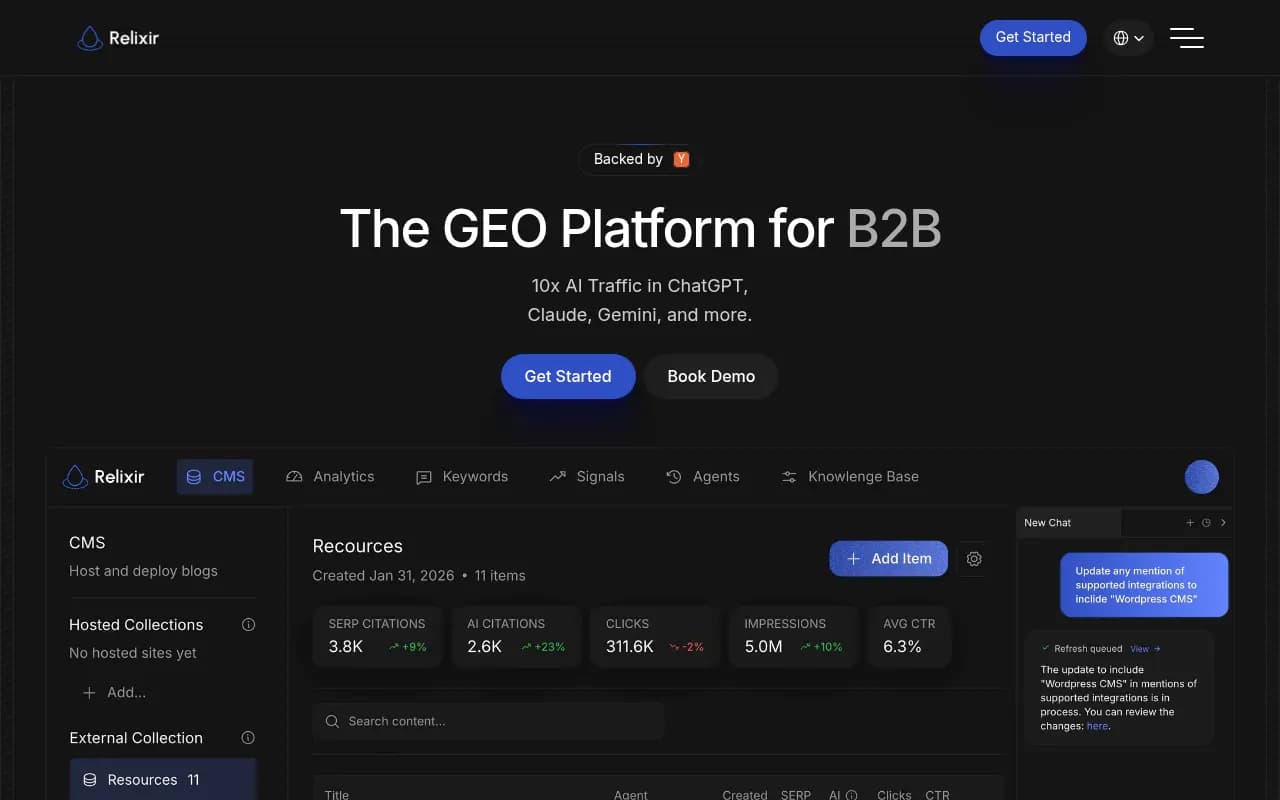
- Relixir: All-in-one GEO platform with AI-native CMS
Common mistakes to avoid
Brands new to GEO often make predictable mistakes. Here's what to avoid:
Treating GEO like traditional SEO
AI models don't rank pages—they synthesize information and cite sources. Keyword density, backlinks, and domain authority matter less than content structure, clarity, and authoritative context. Stop optimizing for crawlers and start optimizing for language models.
Creating content without prompt intelligence data
Guessing what AI models want is a waste of time. Use prompt intelligence data to identify documented gaps and prioritize high-value opportunities. The brands winning in AI search aren't creating more content—they're creating smarter content.
Ignoring query fan-outs
One prompt often branches into dozens of related sub-queries. If you only address the main prompt, you're missing 90% of the opportunity. Build content clusters that address the full spectrum of related questions.
Forgetting to track results
You can't improve what you don't measure. Track citation frequency, share of voice, model coverage, and page-level performance. Close the loop with traffic attribution so you know which content is driving actual business outcomes.
Assuming AI search is a side project
By 2026, AI search is mainstream. Millions of users ask ChatGPT for recommendations instead of searching Google. If AI models don't mention your brand, you're invisible to them. Treat GEO as essential, not optional.
Real-world examples and case studies
Brands using prompt intelligence data to guide their GEO strategy are seeing measurable results:
SaaS company increases AI visibility by 340%: A B2B SaaS company used Answer Gap Analysis to identify 47 high-value prompts where competitors were visible but they weren't. They created 47 targeted articles over 3 months, each optimized for a specific prompt. Result: 340% increase in citations across ChatGPT, Claude, and Perplexity, with 18% of new signups attributed to AI search traffic.
E-commerce brand captures ChatGPT Shopping recommendations: An e-commerce brand optimized product pages for prompts like "best X for Y" and "X vs Y comparison". They added structured data, comparison tables, and FAQ sections. Result: Product appeared in ChatGPT Shopping recommendations for 23 high-intent prompts, driving 12% increase in revenue from AI-referred traffic.
Agency scales content production 5x without sacrificing quality: A digital marketing agency used prompt intelligence data to prioritize content creation for clients. They focused on high-volume, low-difficulty prompts with strong commercial intent. Result: 5x increase in content output, 60% reduction in production time, and measurably better client results (average 2.1x increase in AI citations).
Getting started with prompt intelligence
Ready to start using prompt intelligence data to prioritize your GEO content strategy? Here's a practical roadmap:
Week 1: Audit your current AI visibility
- Sign up for a GEO monitoring platform (Promptwatch offers a free trial)
- Run a baseline audit: which prompts are you already visible for?
- Identify your top 5 competitors in AI search (not just SEO competitors)
- Pull prompt intelligence data for your category
Week 2: Run Answer Gap Analysis
- Identify prompts where competitors are visible but you're not
- Filter for high-value gaps (volume > 1,000, difficulty < 40, strong commercial intent)
- Map gaps to content types (comparison pages, how-to guides, listicles, case studies)
- Prioritize the top 10 opportunities
Week 3: Create your first AI-optimized content
- Choose 1-2 high-priority gaps to address
- Research what competitors are doing (and what's missing)
- Create content that directly answers the target prompt with clear structure, authoritative context, and quotable takeaways
- Add structured data, FAQ sections, and comparison tables where relevant
Week 4: Track results and iterate
- Monitor citation frequency for your new content
- Track share of voice vs competitors
- Measure page-level performance and traffic attribution
- Identify what's working and double down
This isn't a one-time project—it's an ongoing optimization loop. The brands winning in AI search are the ones that treat GEO as a core channel, not a side experiment.
The future of AI search and content strategy
AI search is evolving rapidly. By the end of 2026, we'll likely see:
- More AI models entering the market: DeepSeek, Grok, and other models are gaining traction. Multi-model monitoring becomes essential.
- Deeper integration with e-commerce: ChatGPT Shopping is just the beginning. Expect more AI models to offer product recommendations and purchase flows.
- Personalized AI responses: AI models will tailor responses based on user history, preferences, and context. Generic content will lose ground to content that addresses specific personas and use cases.
- Real-time content optimization: AI writing agents will suggest edits to existing content based on prompt intelligence data and citation patterns.
- Attribution and ROI tracking: Platforms will offer better tools to connect AI visibility to actual revenue, making it easier to justify GEO investment.
The brands that start building prompt intelligence-driven content strategies now will have a massive advantage. The ones that wait will be playing catch-up in a market where AI search is the primary discovery channel.
Final thoughts
Prompt intelligence data transforms GEO from guesswork into strategy. Instead of creating content and hoping AI models cite it, you're building content that fills documented gaps, targets high-value prompts, and gets cited because it's exactly what AI models are looking for.
The action loop is simple: find gaps with Answer Gap Analysis, create AI-optimized content grounded in citation data, and track results with page-level monitoring. Repeat.
Most brands are still guessing. The ones using prompt intelligence data are winning.