Key takeaways
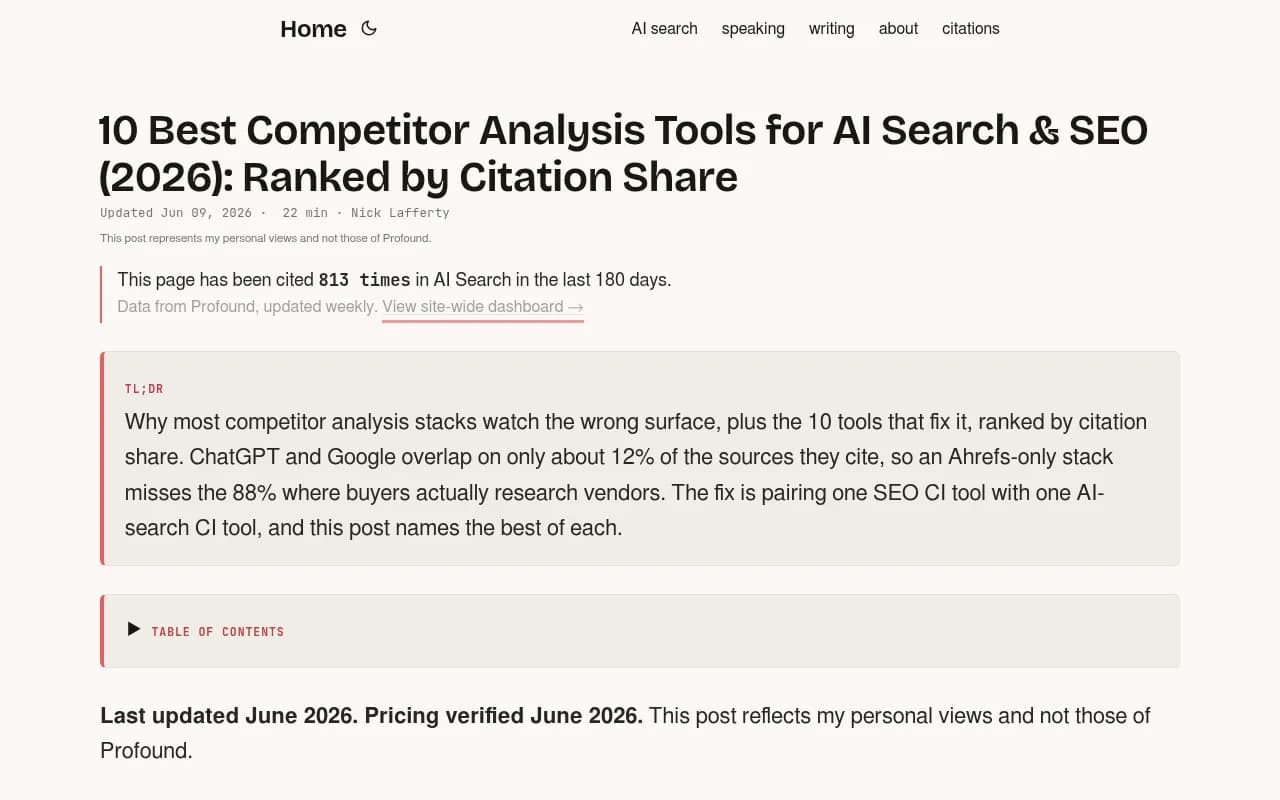
- ChatGPT and Google only overlap on roughly 12% of the sources they cite for the same query -- meaning traditional SEO tools miss 88% of where AI search decisions happen
- Competitor citation data tells you which prompts rivals are winning, which pages AI models trust, and what content gaps you need to fill
- The reverse-engineering process has four steps: identify who's being cited, analyze what they publish, find the gaps, then create content engineered to answer those gaps
- Monitoring alone won't move the needle -- the brands gaining ground in AI search are the ones turning citation data into new content, fast
- Tools like Promptwatch combine citation tracking, gap analysis, and content generation in one workflow so you're not just watching competitors win
Why competitor citation data is the new competitive intelligence
For years, competitive analysis meant checking who ranked on page one and reverse-engineering their backlinks. That still matters for traditional search. But in 2026, a growing share of your buyers never scroll to page one -- they ask ChatGPT, Perplexity, or Gemini and take the answer at face value.
The problem? Most CI stacks are still watching the wrong surface.
Profound's data from 27 million real answer-engine prompts shows that only 2.6% of AI citations come from Tier-1 publishers like Forbes or Bloomberg. The rest come from niche blogs, Reddit threads, YouTube videos, comparison pages, and specialized industry sites -- sources that Ahrefs and Semrush weren't built to track. If your competitor is getting cited for "best project management software for remote teams" and you're not, that's a revenue gap. And you won't find it by checking keyword rankings.
Competitor citation data flips this around. Instead of guessing what AI models want, you look at what they're already rewarding -- and build toward that.
Step 1: Identify who's actually winning in AI search (it's not always who you think)
Your traditional SEO competitors and your AI search competitors often aren't the same companies. A mid-sized blog with strong topical authority on a narrow subject can dominate AI citations in that niche while barely registering in Google's top 10.
Start by running your core prompts -- the questions your customers actually ask -- through ChatGPT, Perplexity, Claude, and Gemini. Don't use the API. Use the actual user interfaces, because the citations and recommendations in consumer-facing products can differ significantly from what the API returns. Note every source cited. Do this for 20-30 prompts and you'll start to see patterns: the same 5-10 domains appearing repeatedly.
Those are your real AI search competitors. Some will be familiar. Others will surprise you.
A few things to look for at this stage:
- Which domains appear across multiple AI models (not just one)
- Which specific pages are cited, not just domains
- Whether citations come from the homepage, blog posts, comparison pages, or third-party sources like Reddit or YouTube
- Whether any competitors are cited in shopping or product recommendation contexts
Tools like Promptwatch automate this across 10 AI models simultaneously, so you're not manually copying sources from chat windows.

Step 2: Decode what makes cited content work
Once you know who's winning, the next question is why. This is where most people stop at surface-level observations ("they write long articles" or "they have more backlinks"). That's not enough.
AI models don't cite content because it's long. They cite it because it directly answers the question being asked, in a format that's easy to extract. There are a few consistent patterns worth studying:
Answer structure matters more than length. Research from LLMClicks.ai's analysis of 30 Perplexity queries found that cited content tends to follow what they call a "BLUF" pattern -- Bottom Line Up Front. The direct answer appears in the first paragraph, not buried after three paragraphs of context-setting. If your competitor's cited page opens with a clear, specific answer to the prompt, that's not a coincidence.
Format matching is real. If the prompt is a comparison question ("X vs Y"), the cited content tends to be a comparison page with a table or structured breakdown. If the prompt is "how to do X," cited content tends to be a numbered process. Look at the format of what's being cited and match it intentionally.
Topical depth beats breadth. A page that thoroughly covers one specific question tends to get cited over a page that covers 10 questions shallowly. Check the word count and topic focus of your competitors' cited pages -- you'll often find they're narrower and deeper than you'd expect.
Third-party signals amplify everything. Reddit discussions, YouTube videos, and external mentions that reference your competitor's content create a citation ecosystem. AI models pick up on this. If a competitor is cited in a Reddit thread that itself gets cited by Perplexity, that's a compounding advantage.
Step 3: Map the gaps between their citations and yours
This is the most actionable part of the process. You now know which prompts competitors are winning. The question is: which of those prompts should you be winning, but aren't?
A few ways to approach this:
Prompt-by-prompt comparison. Run the same prompts through multiple AI models and record who gets cited for each. Build a simple spreadsheet: prompts in rows, AI models in columns, and citations as values. Where your competitors appear and you don't -- that's a gap.
Page-level citation audit. Look at which specific pages on competitor sites are getting cited most often. These are their "citation anchors" -- the pages AI models have learned to trust. Do you have equivalent pages? Are they as specific? As well-structured?
Topic cluster gaps. If a competitor is cited across a cluster of related prompts (say, everything related to "email marketing automation for e-commerce"), they've built topical authority in that cluster. You might be visible for some prompts in that cluster but not others. Filling in the missing pieces often lifts visibility across the whole cluster.
Offsite gap analysis. Sometimes the gap isn't on your site at all. A competitor might be winning citations partly because they're mentioned in a popular Reddit thread, a well-cited YouTube video, or a third-party comparison article. Those offsite citations matter and they're worth tracking separately.
Doing this manually is tedious. Promptwatch's Answer Gap Analysis surfaces exactly which prompts competitors are visible for that you're not, with prompt volume estimates so you can prioritize by potential impact rather than just filling gaps randomly.
Step 4: Build content that closes the gaps
Finding gaps is only useful if you do something with them. This is where most monitoring-focused tools leave you stranded -- they show you the problem but not the path forward.
The content you create to close citation gaps needs to be different from standard SEO content. Here's what that means in practice:
Write for the specific prompt, not the broad topic. If the gap is "best CRM for freelancers under $50/month," write a page that answers that exact question directly. Don't write a general "best CRM" roundup and hope it covers the gap. AI models are matching content to specific prompts, and specificity wins.
Structure for extraction. Use clear headings that mirror the question. Put the direct answer early. Use tables for comparisons. Use numbered lists for processes. AI models are essentially trying to extract a useful answer from your page -- make that extraction easy.
Publish proprietary data when you can. Matt Diggity made this point clearly in a 2026 LinkedIn post: "Conduct surveys, compile proprietary data, publish findings. These become evergreen citation sources because AI platforms prefer unique data." A page with original research or data that can't be found elsewhere gives AI models a reason to cite you specifically rather than a generic source.
Cover the topic completely. If you're writing about a specific prompt, think about the related sub-questions that naturally follow. Query fan-outs -- where one prompt branches into related sub-queries -- mean that a page covering a topic thoroughly can capture citations across multiple related prompts, not just the one you targeted.
Update regularly. AI models re-crawl content. A page that was accurate six months ago but is now outdated will lose citations over time. Build a process for refreshing your highest-performing citation pages.
Step 5: Track what's working and iterate
The feedback loop is what separates brands that improve their AI visibility from those that stay stuck. You need to know:
- Which new pages are getting crawled by AI agents
- How long it takes from publish to first citation
- Which AI models are citing which pages
- Whether your visibility scores are improving for the target prompts
- How citation gains translate to actual traffic and revenue
This is harder than it sounds because AI crawler behavior isn't visible in standard analytics. You need either server log analysis or a dedicated crawler monitoring tool. Promptwatch's AI Crawler Logs show exactly which AI agents (ChatGPT, Claude, Perplexity, etc.) are hitting your pages, how often they return, and when pages move from crawled to cited. That timeline data is genuinely useful for understanding whether your content is being discovered or ignored.
Tools for competitor citation analysis in 2026
Here's a practical comparison of the tools most relevant to this workflow:
| Tool | Citation tracking | Competitor comparison | Content gap analysis | Content generation | AI crawler logs |
|---|---|---|---|---|---|
| Promptwatch | 10 AI models | Yes, heatmaps | Yes, Answer Gap Analysis | Yes, Content Agents | Yes |
| Profound | Multiple models | Yes | Limited | No | No |
| Otterly.AI | Multiple models | Basic | No | No | No |
| Peec.ai | Multiple models | Basic | No | No | No |
| AthenaHQ | 8+ models | Yes | No | No | No |
| LLM Clicks | Perplexity focus | Limited | No | No | No |
The core distinction is whether the tool helps you act on what you find. Monitoring-only tools are useful for awareness, but if you're trying to close citation gaps systematically, you need something that connects the data to content creation.



A practical workflow you can start this week
If you want to run this process without a full platform investment, here's a stripped-down version:
- Pick 20-30 prompts that matter to your business -- questions your customers actually ask when evaluating solutions like yours
- Run each prompt through ChatGPT, Perplexity, and Gemini. Record every cited source in a spreadsheet
- Identify the 5-10 domains that appear most often -- these are your real AI search competitors
- For each competitor domain, look at which specific pages are cited and what they have in common (format, structure, depth, topic focus)
- Map your own content against those cited pages. Where are the gaps?
- Pick the 3-5 highest-value gaps and write pages specifically designed to answer those prompts
- Monitor whether those pages get crawled and cited over the following 4-6 weeks
It's manual and time-consuming at this scale, but it works. The process scales much faster with the right tooling -- particularly for step 2 (running prompts across multiple models) and step 5 (systematic gap analysis).
The mindset shift that makes this work
The brands winning in AI search in 2026 aren't the ones with the biggest budgets or the most backlinks. They're the ones who understand that AI models are trying to answer specific questions, and who've built content that makes those answers easy to find and extract.
Competitor citation data is valuable not because it tells you what to copy, but because it tells you what AI models have already validated as useful. Your competitors have done the experiment. The citations are the results. Your job is to look at those results, find where you're absent, and build something better.
That's a different kind of competitive analysis than checking keyword rankings. But in a world where a growing share of your buyers get their answers from AI before they ever visit a website, it's the analysis that actually matters.