Key takeaways
- Manual tracking (spot-checking prompts in ChatGPT, Perplexity, Claude) costs nothing but scales poorly -- best for initial reconnaissance or micro-brands with 5-10 core prompts
- Affordable tools like Otterly.AI ($29/mo), Airefs ($4/mo), and Peec AI (€89/mo) deliver 80% of enterprise functionality at a fraction of the cost
- Free-tier options exist: Promptwatch Essential ($99/mo with trial), SE Visible ($189/mo), and Nightwatch ($39/mo base + AI add-on) offer entry points without long-term contracts
- Strategic prompt selection matters more than volume -- track 20-50 high-intent prompts that directly influence purchase decisions instead of monitoring thousands
- Competitor heatmaps, citation analysis, and Share of Voice metrics are now table stakes even in budget tools
Your competitors are being recommended by ChatGPT. Right now. When someone asks "What's the best project management tool for remote teams?" or "Which CRM should a 50-person startup use?" -- AI models are citing brands, naming names, and steering purchase decisions. If you're not in those answers, you're invisible.
The enterprise GEO platforms (Profound, Bluefish, BrightEdge) charge $2,500-$10,000/month because they assume you need to track 10,000 prompts across 12 LLMs with white-glove onboarding. Most teams don't. You need to know: Are competitors mentioned more than us? Which prompts are we losing? What content gaps are costing us visibility?
This guide shows you how to get those answers without enterprise budgets. I've tested the affordable end of the market, run manual experiments, and identified the exact workflows that deliver competitive intelligence on AI visibility without burning cash.
Why tracking competitor AI visibility matters in 2026
AI search engines processed over 100 billion queries in 2025. ChatGPT alone handles 1 billion+ searches per month. Google's AI Overviews appear in 47% of traditional search results. When someone asks an AI model for recommendations, they're not clicking through ten blue links -- they're getting 2-3 brand names in a conversational answer and making decisions on the spot.
This shift breaks traditional SEO assumptions. Ranking #1 on Google for "best email marketing software" used to guarantee traffic. Now that same user asks ChatGPT, gets a direct answer citing Mailchimp and ConvertKit, and never opens a browser. Your organic rankings are invisible to them.
Competitor tracking in this environment means understanding:
- Share of Voice: What percentage of relevant AI responses mention your brand vs competitors?
- Citation context: Are competitors positioned as premium options, budget picks, or category leaders?
- Prompt coverage: Which high-intent queries are competitors dominating that you're absent from?
- Sentiment and framing: Do AI models describe competitors as "industry-leading" while calling you "affordable" (a polite way of saying cheap)?
Brands that ignore this data are flying blind. You might be losing deals to competitors who've optimized for AI visibility while you're still obsessing over keyword rankings that no longer drive purchase behavior.
The manual approach: Free but labor-intensive
Before spending money, understand what you're buying. Manual tracking teaches you which prompts matter and what good data looks like.
Step 1: Build your prompt list
Start with 10-20 prompts that represent real user intent in your category. Not SEO keywords -- actual questions people ask AI models.
Examples for a project management SaaS:
- "What's the best project management tool for remote teams?"
- "Asana vs Monday.com vs ClickUp -- which should I choose?"
- "I need a project management tool with time tracking and Gantt charts"
- "What do agencies use for client project management?"
- "Affordable project management software for startups"
These prompts should span:
- Category queries: "best [category] tool"
- Comparison queries: "[your brand] vs [competitor]"
- Use-case queries: "[category] tool for [specific need]"
- Buyer-stage queries: "affordable", "enterprise", "for teams under 50 people"
Step 2: Test prompts across multiple LLMs
Open ChatGPT, Claude, Perplexity, Gemini, and (if you have access) Grok. Run each prompt in each model. Copy the full response into a spreadsheet.
Track:
- Which brands are mentioned
- Order of mention (first = strongest signal)
- Whether your brand appears
- Sentiment/framing ("industry-leading" vs "budget option")
- Whether the model cites a source (URL, Reddit thread, review site)
Repeat this weekly. Manual tracking works for 5-10 core prompts. Beyond that, you're spending 3-4 hours per week on data entry instead of strategy.
Step 3: Analyze citation sources
When an AI model cites a competitor, note the source. Perplexity and ChatGPT often link to:
- Review sites (G2, Capterra, TrustRadius)
- Reddit discussions
- Blog comparisons and listicles
- Official documentation or case studies
These sources reveal where competitors are investing. If they're cited from a Reddit thread with 400 upvotes, they've either organically built community trust or seeded the discussion. If they're cited from a "Top 10 [Category] Tools" listicle on a high-authority blog, they've likely paid for placement or pitched the author.
Manual citation analysis takes 10-15 minutes per prompt but surfaces the exact content gaps you need to fill.
Limitations of manual tracking
- Doesn't scale: 50 prompts across 5 LLMs = 250 manual checks per week
- No historical data: You can't see how visibility changed over time unless you've been logging responses for months
- Persona blindness: AI models tailor answers to user context (location, previous queries, device). Your manual checks reflect one persona, not the full market.
- No automation: Competitors launch new content, AI models update their training data, and you won't know until you manually re-check
Manual tracking is reconnaissance. It teaches you what to measure. Then you graduate to tools.
Affordable AI visibility tools under $100/month
The budget tier of AI visibility tools delivers 80% of enterprise functionality at 5% of the cost. Here's what works.
Otterly.AI: $29/month for core tracking
Otterly.AI is the entry point for teams that need automated tracking without enterprise complexity.

What you get:
- Track up to 50 prompts (Professional plan)
- Monitor ChatGPT, Perplexity, Claude, Gemini
- Competitor comparison dashboard
- Weekly email reports
- Basic citation analysis
What's missing:
- No crawler logs (you can't see when AI models visit your site)
- No content gap analysis (it shows you're invisible but not why)
- Limited historical data (90 days on lower tiers)
Otterly works for small teams that need to answer one question: "Are we being mentioned?" It won't tell you how to fix invisibility, but it will tell you the problem exists.
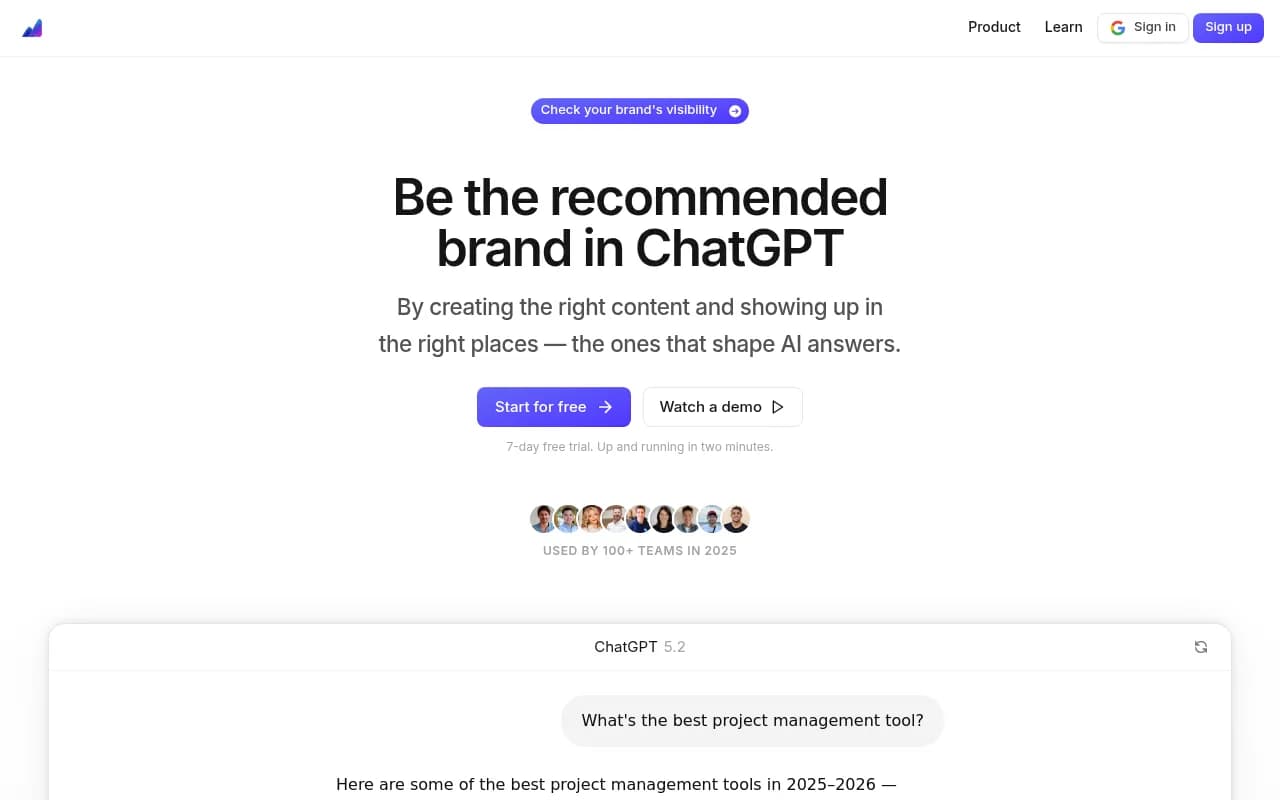
Airefs: $4/month for basic rank tracking
Airefs is the cheapest tool in the market, built for solo founders and micro-brands.
What you get:
- Track 10 prompts (Starter plan)
- Daily checks across ChatGPT, Perplexity, Gemini
- Simple visibility score (0-100)
- Competitor mentions flagged
What's missing:
- No sentiment analysis
- No citation source tracking
- No historical trends beyond 30 days
- No multi-language support
Airefs is a tripwire. It tells you when competitors start appearing in prompts you care about. You won't get strategic insights, but you'll know when to investigate deeper.
Peec AI: €89/month for multi-language tracking
Peec AI is the best option for brands operating in non-English markets or tracking localized AI responses.

What you get:
- Track 100 prompts (Standard plan)
- Multi-language support (20+ languages)
- Competitor benchmarking dashboard
- Citation source analysis
- Region-specific tracking (US, UK, Germany, France, etc.)
What's missing:
- No content generation tools
- No crawler log visibility
- Limited to 5 competitors per project
Peec shines when your competitors are region-specific or when AI models return different answers in German vs English. If you're a European SaaS competing against US brands, Peec shows you where localized content gives you an edge.
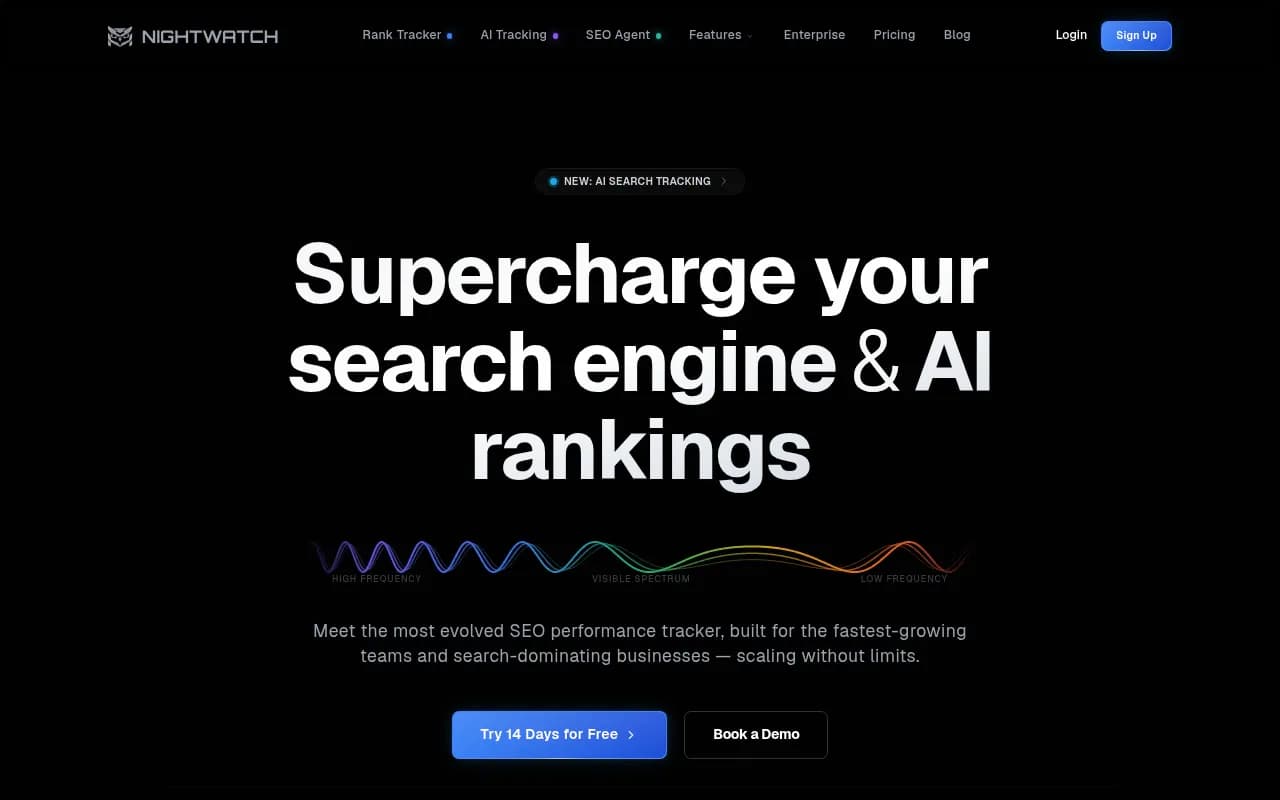
Nightwatch: $39/month base + AI add-on
Nightwatch started as a traditional SEO rank tracker and added AI visibility as a module.
What you get:
- Traditional SERP tracking + AI Mode tracking in one platform
- Geo-level precision (track AI responses by city/state)
- Competitor heatmaps
- Integration with Google Search Console
What's missing:
- AI features require add-on pricing (not included in base $39/mo plan)
- Fewer LLMs supported (focuses on ChatGPT and Google AI Overviews)
Nightwatch makes sense if you're already tracking traditional rankings and want to add AI visibility without switching platforms. The combined view (organic rankings + AI mentions) helps you see the full picture of search visibility.
Comparison table: Budget tools
| Tool | Starting price | Prompts included | LLMs tracked | Best for |
|---|---|---|---|---|
| Otterly.AI | $29/mo | 50 | 4+ | Small teams needing automated tracking |
| Airefs | $4/mo | 10 | 3 | Solo founders, micro-brands |
| Peec AI | €89/mo | 100 | 5+ | Multi-language, regional tracking |
| Nightwatch | $39/mo + add-on | Varies | 2 (ChatGPT, Google) | Teams already using Nightwatch for SEO |
Mid-tier tools: $100-$300/month for serious tracking
Once you've validated that AI visibility impacts your pipeline, mid-tier tools add the features that turn data into action.
Promptwatch: $99-$249/month for content gap analysis
Promptwatch is the only platform in this price range that connects tracking to content creation.

What you get:
- Answer Gap Analysis: shows which prompts competitors rank for but you don't
- AI writing agent: generates articles grounded in citation data (880M+ citations analyzed)
- Crawler logs: see when ChatGPT, Claude, Perplexity visit your site
- Page-level tracking: know exactly which pages are being cited
- Traffic attribution: connect AI visibility to actual revenue
The action loop:
- Promptwatch identifies content gaps ("Competitors appear for 'best CRM for real estate' but you don't")
- Built-in AI agent generates an article optimized for that prompt
- Track visibility improvements as AI models start citing your new content
- Measure traffic and conversions from AI search
This is the difference between monitoring and optimization. Most competitors (Otterly.AI, Peec.ai, AthenaHQ) stop at step one. Promptwatch closes the loop.
Pricing:
- Essential: $99/mo (1 site, 50 prompts, 5 articles)
- Professional: $249/mo (2 sites, 150 prompts, 15 articles, crawler logs)
- Business: $579/mo (5 sites, 350 prompts, 30 articles)
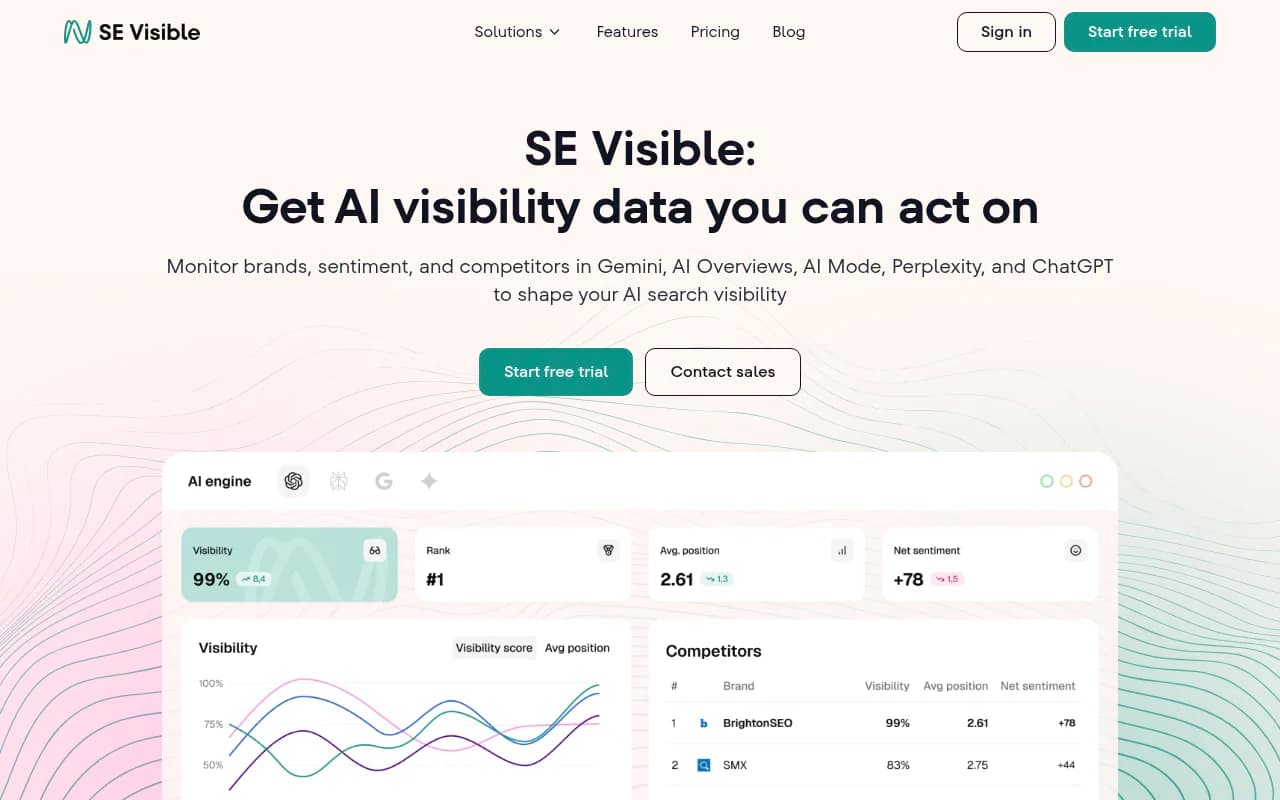
SE Visible: $189/month for agency-friendly dashboards
SE Visible is built for agencies managing multiple clients.
What you get:
- White-label reporting
- Client dashboard access (clients can log in and see their own data)
- AI Mode tracking (Google AI Overviews focus)
- Competitor benchmarking across 5+ competitors per project
- Historical data back to January 2025
What's missing:
- No content generation tools
- Limited to Google AI Overviews and ChatGPT (fewer LLMs than competitors)
SE Visible works if you're an agency billing clients for AI visibility monitoring. The white-label reports and client portals justify the $189/mo price when you're reselling the service.
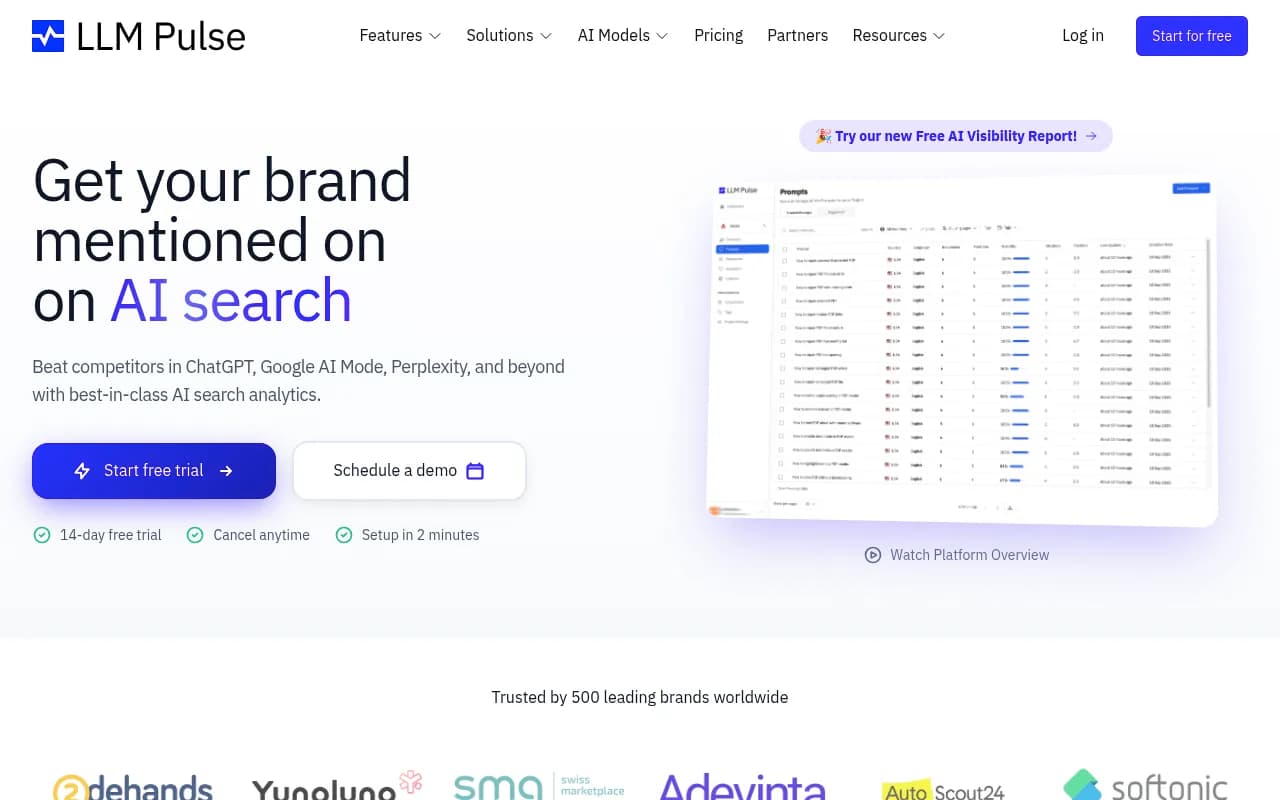
LLM Pulse: €49-€199/month for sentiment tracking
LLM Pulse focuses on brand reputation and sentiment inside AI responses.
What you get:
- Share of recommendations (what % of responses mention your brand vs competitors)
- Sentiment scoring (positive, neutral, negative framing)
- Prompt volume estimates
- Multi-LLM tracking (8+ models)
What's missing:
- No citation source analysis
- No content optimization tools
- Limited to 3 competitors on lower tiers
LLM Pulse is for CMOs and PR teams who care more about brand perception than traffic. If an AI model describes your competitor as "industry-leading" and you as "affordable," LLM Pulse flags that framing issue.
Comparison table: Mid-tier tools
| Tool | Starting price | Key differentiator | Best for |
|---|---|---|---|
| Promptwatch | $99/mo | Content gap analysis + AI writing agent | Teams that want to fix invisibility, not just track it |
| SE Visible | $189/mo | White-label reporting, client dashboards | Agencies managing multiple clients |
| LLM Pulse | €49/mo | Sentiment tracking, Share of Voice | Brand reputation and PR teams |
Strategic approaches that don't require expensive tools
Tools automate data collection. Strategy determines which data matters.
Focus on high-intent prompts, not volume
Enterprise platforms brag about tracking 10,000 prompts. You don't need 10,000 prompts. You need the 20-50 prompts that directly precede purchase decisions.
Example: A project management SaaS doesn't need to track "what is project management" (informational, low intent). They need:
- "Asana vs Monday.com for marketing teams" (comparison, high intent)
- "Best project management tool with time tracking" (feature-specific, high intent)
- "What project management software do agencies use" (social proof, high intent)
Identify high-intent prompts by:
- Reviewing sales call transcripts -- what questions do prospects ask before buying?
- Analyzing Google Search Console data -- which queries have high CTR and low bounce rate?
- Checking Reddit and Quora -- what questions get 50+ upvotes in your category?
Track 50 high-intent prompts instead of 500 random keywords. You'll get better signal and spend less.
Reverse-engineer competitor citations
When a competitor appears in an AI response, the model cites a source (review site, blog post, Reddit thread). That source is your roadmap.
Workflow:
- Run a prompt in Perplexity or ChatGPT: "Best [category] tools for [use case]"
- Note which competitors are mentioned
- Click the citation links -- where is the model pulling data from?
- Audit those sources:
- Is it a listicle? Pitch the author to include your brand.
- Is it a Reddit thread? Join the discussion with a helpful comment (not spam).
- Is it a review site? Claim your profile and encourage customers to leave reviews.
- Is it a competitor's blog? Write a better, more comprehensive version.
This approach costs zero dollars. It requires time and content creation, but you're targeting the exact sources AI models trust.
Use free tools for citation source discovery
You don't need a paid tool to find where competitors are being cited. Use:
- Perplexity: Always shows citation sources. Run competitor brand names as queries ("Tell me about [Competitor]") and note which URLs Perplexity links to.
- ChatGPT with browsing enabled: Ask "What are the top 5 [category] tools according to recent reviews?" and request sources. ChatGPT will link to the pages it referenced.
- Google site search:
site:reddit.com "[competitor name]" "[category]"surfaces Reddit threads where competitors are mentioned. Same for Quora, HackerNews, and niche forums.
Once you have the citation sources, you know where to focus content efforts.
Track Share of Voice manually with a spreadsheet
Share of Voice = (Your brand mentions / Total brand mentions) × 100
Example: You run 10 prompts in ChatGPT. Your brand appears in 3 responses. Competitor A appears in 7. Competitor B appears in 5.
Total mentions = 3 + 7 + 5 = 15
Your Share of Voice = (3 / 15) × 100 = 20%
Track this weekly in a spreadsheet. If your Share of Voice drops from 20% to 10%, you know competitors are gaining ground. If it climbs to 35%, your content efforts are working.
This metric is simple but powerful. Enterprise tools automate it, but you can calculate it manually in 10 minutes per week.
When to upgrade to enterprise tools (and when not to)
Enterprise platforms (Profound, Bluefish, BrightEdge) make sense when:
- You're tracking 500+ prompts across 10+ LLMs
- You need white-glove onboarding and dedicated account management
- You're a multi-brand enterprise with complex reporting hierarchies
- You require API access for custom integrations
- Compliance and data governance matter (SOC 2, GDPR)
They don't make sense when:
- You're a startup or SMB with <$5M ARR
- You're still figuring out which prompts matter
- Your budget is under $500/mo for all marketing tools
- You don't have a dedicated GEO team (1-2 people minimum)
Most teams overestimate their needs. Start with a $99-$249/mo tool, prove ROI, then upgrade if you hit scaling limits.
Building a competitor tracking workflow without breaking the bank
Here's a realistic workflow for a 5-person marketing team with a $200/mo budget:
Month 1: Manual reconnaissance
- Identify 20 high-intent prompts
- Run each prompt in ChatGPT, Perplexity, Claude
- Log competitor mentions in a spreadsheet
- Analyze citation sources
- Identify 3-5 content gaps (prompts where competitors appear but you don't)
Month 2: Sign up for Promptwatch Essential ($99/mo)
- Import your 20 prompts
- Set up weekly tracking
- Use Answer Gap Analysis to find 10 more high-value prompts
- Generate 2-3 articles with the built-in AI writing agent
- Publish articles, wait 2-4 weeks for AI models to index
Month 3: Measure and iterate
- Check if your Share of Voice improved
- Identify which prompts saw visibility gains
- Double down on content types that work (listicles, comparisons, how-to guides)
- Add 10 more prompts to tracking
Month 4+: Scale or optimize
- If ROI is positive (AI visibility → traffic → conversions), upgrade to Professional plan ($249/mo) for more prompts and crawler logs
- If ROI is unclear, pause paid tools and return to manual tracking until you can tie visibility to revenue
This workflow costs $99-$249/mo and delivers actionable insights without enterprise complexity.
Common mistakes when tracking competitor AI visibility
Mistake 1: Tracking vanity metrics
"We're mentioned in 40% of AI responses!" means nothing if those responses are for low-intent prompts that don't drive revenue. Track prompts that matter, not prompts that make dashboards look good.
Mistake 2: Ignoring citation sources
Knowing your competitor appears in ChatGPT is useless. Knowing ChatGPT cites them from a G2 review page with 500 reviews tells you exactly what to fix: get more G2 reviews.
Mistake 3: Treating all LLMs equally
ChatGPT has 1 billion+ monthly users. Mistral has 50 million. If you're choosing between optimizing for ChatGPT vs Mistral, prioritize ChatGPT. Don't spread efforts evenly across 10 LLMs when 2-3 drive 80% of queries.
Mistake 4: Expecting instant results
AI models don't re-crawl your site daily. It takes 2-6 weeks for new content to influence AI responses. Track weekly, not daily. Patience matters.
Mistake 5: Copying competitor content
If a competitor ranks for "best CRM for real estate," writing a worse version of their article won't help. Write a better version: more comprehensive, more specific, more useful. AI models cite depth and authority, not keyword stuffing.
Conclusion: Start small, scale smart
You don't need $5,000/mo enterprise tools to track competitor AI visibility. You need:
- A clear list of 20-50 high-intent prompts
- A system for checking those prompts weekly (manual or automated)
- A process for analyzing citation sources and fixing content gaps
- A way to measure Share of Voice over time
Start with manual tracking. Prove the concept. Then graduate to a $99-$249/mo tool like Promptwatch, Otterly.AI, or Peec AI. Reserve enterprise platforms for when you're tracking 500+ prompts and have a dedicated GEO team.
The brands winning in AI search aren't the ones with the biggest budgets. They're the ones that identified the right prompts, created better content, and tracked what actually moved the needle. You can do that without enterprise pricing.