Summary
- AI assistants like ChatGPT, Claude, and Perplexity are replacing traditional search for millions of users -- if your brand isn't mentioned in their answers, you're invisible to a growing segment of potential customers
- Tracking AI visibility requires different methods than SEO: you need to monitor citation rates, share of voice, sentiment, and whether your brand appears in relevant AI responses at all
- Start with manual testing to establish a baseline, then scale with monitoring tools that automate prompt testing across multiple AI platforms
- The best approach combines automated tracking (to measure visibility at scale) with strategic content optimization (to actually improve how AI models perceive and cite your brand)
- Tools like Promptwatch go beyond monitoring to help you find content gaps, generate citation-worthy content, and track the results -- closing the loop between visibility measurement and optimization

A marketing director opens ChatGPT and asks: "What's the best project management tool for remote teams?" The AI responds with three specific recommendations, detailed comparisons, and reasons why each tool excels. Your competitor's name appears. Yours doesn't.
This scenario plays out millions of times daily. Users aren't supplementing Google searches with AI anymore -- they're replacing them. They ask conversational questions and trust AI-generated answers without clicking through to websites. The question every brand must answer: when potential customers ask AI assistants about solutions in your category, does your brand appear?
If you don't know, you're operating blind in what's becoming the most important visibility channel since Google itself.
Why AI visibility tracking matters now
Traditional search followed a predictable pattern: users typed keywords, scanned blue links, clicked through to websites, and evaluated options themselves. AI assistants have disrupted this flow entirely.
Users now ask complete questions in natural language and receive synthesized answers that feel like recommendations from a knowledgeable colleague. Instead of "project management software comparison," they ask "Which project management tool would work best for a 15-person design agency that's fully remote?" The AI doesn't return a list of links -- it delivers a direct answer with specific brand recommendations, feature comparisons, and contextual reasoning.
This creates a visibility problem that traditional SEO metrics can't capture. Your website might rank #1 on Google for "enterprise analytics platform," but if ChatGPT never mentions your brand when users ask for analytics recommendations, that top ranking becomes irrelevant. You're winning a game that fewer people are playing.
The behavioral shift is real. Pew Research found that 9% of Americans now get news from AI chatbots -- a number that exceeds radio as a news source (5%). For product research and recommendations, the adoption is even higher. Users trust AI answers because they feel personalized, comprehensive, and authoritative.
The problem: AI models don't have "page two." Your brand either gets mentioned or it doesn't. There's no fallback position.
Understanding the four AI platforms you need to monitor
Not all AI assistants work the same way. Each platform has different data sources, update frequencies, and citation behaviors. You need to understand what you're tracking before you can measure it effectively.
ChatGPT (OpenAI)
ChatGPT is the most widely used AI assistant, with over 200 million weekly active users. It pulls information from web searches (via Bing integration), its training data, and increasingly from real-time web browsing when users enable that feature.
Key characteristics:
- Tends to favor well-established brands with strong online presence
- Cites sources when browsing is enabled, but often synthesizes answers without explicit attribution
- Updates knowledge through periodic model retraining and real-time search
- Heavily influenced by Wikipedia, major news outlets, and authoritative industry publications
Claude (Anthropic)
Claude has a more conservative citation style and tends to acknowledge uncertainty more explicitly than other models. It's popular among professionals and researchers who value nuanced, well-reasoned responses.
Key characteristics:
- More likely to say "I don't have enough information" rather than guess
- Favors academic sources, research papers, and technical documentation
- Less aggressive about making specific brand recommendations without strong evidence
- Updates through model retraining rather than real-time web access (in most versions)
Perplexity
Perplexity is built specifically as an answer engine, not a conversational AI. It always cites sources and provides clickable references for every claim.
Key characteristics:
- Always shows sources with direct links
- Pulls from real-time web search, making it more current than models relying solely on training data
- Citation style makes it easier to track exactly which pages influenced the answer
- Particularly strong for news, current events, and recently published content
Google AI Overviews
Google's AI-generated summaries appear at the top of search results, synthesizing information from multiple sources into a single answer.
Key characteristics:
- Integrated directly into Google Search, reaching billions of users
- Heavily influenced by traditional SEO signals (domain authority, backlinks, content quality)
- Shows source links beneath the AI-generated summary
- More conservative about appearing for commercial/YMYL queries compared to informational ones
Essential metrics for tracking AI visibility
Measuring AI visibility requires different metrics than traditional SEO. Here's what actually matters.
Citation rate
Citation rate tells you what percentage of relevant queries result in your brand being mentioned. If you test 50 prompts related to your category and your brand appears in 8 responses, your citation rate is 16%.
This is your north star metric. A 10% citation rate means your brand appears in 1 out of 10 relevant AI responses. Start by tracking 20-30 core queries your ideal customers actually ask.
How to calculate it:
- Define a set of category-relevant prompts (e.g., "best CRM for small businesses," "top email marketing tools," "CRM software comparison")
- Test each prompt across your target AI platforms
- Count how many times your brand appears
- Citation rate = (mentions / total prompts tested) × 100
Share of voice
Share of voice measures your brand's visibility relative to competitors. If an AI response mentions five project management tools and yours is one of them, you have 20% share of voice for that query.
This metric reveals competitive positioning. You might have a decent citation rate but consistently appear as the fourth or fifth option mentioned -- that's a different problem than not appearing at all.
How to track it:
- Identify your top 5-10 direct competitors
- Test the same prompt set across all brands
- Calculate what percentage of total mentions belong to your brand
- Track position (first mentioned, second, third, etc.) as well as raw mention count
Sentiment and positioning
Not all mentions are equal. Being cited as "a budget option" sends a different signal than being described as "the industry leader." Track how AI models describe your brand:
- Positive framing ("leading," "innovative," "trusted")
- Neutral framing (factual feature descriptions)
- Negative framing ("limited features," "expensive," "difficult to use")
- Context (recommended for what use cases, company sizes, industries)
This qualitative analysis often matters more than raw citation counts. A brand mentioned once but described as "the gold standard" may have more impact than a brand mentioned three times with lukewarm descriptions.
Response accuracy
AI models sometimes hallucinate features, pricing, or capabilities. Track whether the information they provide about your brand is actually correct:
- Feature accuracy (do they correctly describe what your product does?)
- Pricing accuracy (are the numbers current and correct?)
- Use case accuracy (do they recommend you for appropriate scenarios?)
- Comparison accuracy (are competitive comparisons fair and factual?)
Inaccurate information can be worse than no mention at all.
Step 1: Manual baseline testing
Before investing in tools, establish a baseline through manual testing. This gives you a sense of where you stand and what problems you're solving.
Build your prompt library
Start with 20-30 prompts that represent how real customers ask about solutions in your category. Mix different intent types:
Comparison prompts:
- "What's the difference between [Your Brand] and [Competitor]?"
- "Compare the top 5 [category] tools"
- "[Your Brand] vs [Competitor]: which is better?"
Recommendation prompts:
- "What's the best [category] tool for [use case]?"
- "Which [category] software should I choose for [specific need]?"
- "Recommend a [category] solution for [company size/industry]"
Problem-solving prompts:
- "How do I [solve specific problem]?"
- "What tools help with [specific challenge]?"
- "I need to [accomplish goal] -- what should I use?"
Feature/capability prompts:
- "Which [category] tools have [specific feature]?"
- "Best [category] software with [integration/capability]?"
- "[Category] tools that support [specific requirement]"
Test systematically
For each prompt:
- Open a fresh conversation/session (to avoid context contamination)
- Ask the exact prompt
- Record whether your brand was mentioned (yes/no)
- If mentioned, note: position (1st, 2nd, 3rd, etc.), sentiment (positive/neutral/negative), accuracy (correct/incorrect/partially correct), context (how you were described)
- Screenshot the response for reference
Repeat this across ChatGPT, Claude, Perplexity, and Google AI Overviews. Yes, it's tedious. That's why automation exists. But doing this manually first helps you understand the nuances before scaling.
Document your baseline
Create a simple spreadsheet:
| Prompt | ChatGPT Mention? | Claude Mention? | Perplexity Mention? | Google AI Mention? | Position | Sentiment | Notes |
|---|---|---|---|---|---|---|---|
| Best CRM for startups | No | No | Yes (3rd) | Yes (2nd) | 2-3 | Neutral | Perplexity cited our blog post |
| CRM with email automation | Yes (1st) | No | Yes (1st) | No | 1 | Positive | ChatGPT called us "leading" |
| Affordable CRM options | No | No | No | No | - | - | Not mentioned anywhere |
This baseline tells you:
- Your current citation rate across platforms
- Which platforms favor your brand (and which ignore you)
- Which types of prompts you win (and which you lose)
- Competitive gaps (prompts where competitors appear but you don't)
Step 2: Scale with monitoring tools
Manual testing doesn't scale. You can't manually test 100 prompts across 4 platforms every week. This is where monitoring tools become essential.
What to look for in an AI visibility tool
Not all monitoring tools are created equal. The best platforms offer:
Automated prompt testing:
- Schedule recurring tests of your prompt library
- Test across multiple AI platforms simultaneously
- Track changes over time (citation rate trends, position changes)
Competitor tracking:
- Monitor your share of voice vs competitors
- See which prompts competitors win that you don't
- Identify competitive positioning patterns
Citation analysis:
- Which sources AI models cite when mentioning your brand
- Which pages on your website get referenced most often
- What content types (blog posts, docs, case studies) drive citations
Prompt intelligence:
- Volume estimates for different prompts
- Difficulty scores (how hard to rank for each prompt)
- Related prompt suggestions you should also track
Content gap analysis:
- Prompts where competitors appear but you don't
- Topics/angles your website is missing
- Specific content recommendations to improve visibility
Monitoring-only tools vs optimization platforms
Most AI visibility tools fall into two categories:
Monitoring-only dashboards show you data but leave you stuck. They tell you your citation rate is 12% and your competitor's is 28%, then... what? You're left guessing what content to create or how to improve.
Tools in this category:



Optimization platforms close the action loop: they show you what's missing, then help you fix it. Promptwatch is the only platform rated as a "Leader" across all categories in a 2026 comparison of 12 GEO platforms precisely because it goes beyond monitoring.
The difference:
-
Find the gaps: Answer Gap Analysis shows exactly which prompts competitors are visible for but you're not. You see the specific content your website is missing -- the topics, angles, and questions AI models want answers to but can't find on your site.
-
Create content that ranks in AI: The built-in AI writing agent generates articles, listicles, and comparisons grounded in real citation data (880M+ citations analyzed), prompt volumes, persona targeting, and competitor analysis. This isn't generic SEO filler -- it's content engineered to get cited by ChatGPT, Claude, Perplexity, and other AI models.
-
Track the results: See your visibility scores improve as AI models start citing your new content. Page-level tracking shows exactly which pages are being cited, how often, and by which models. Close the loop with traffic attribution (code snippet, GSC integration, or server log analysis) to connect visibility to actual revenue.
This cycle -- find gaps, generate content, track results -- is what makes Promptwatch an optimization platform, not just another tracker.
Additional capabilities that support the action loop:
- AI Crawler Logs: Real-time logs of AI crawlers (ChatGPT, Claude, Perplexity, etc.) hitting your website -- which pages they read, errors they encounter, how often they return. Most competitors lack this entirely.
- Prompt Intelligence: Volume estimates and difficulty scores for each prompt, plus query fan-outs that show how one prompt branches into sub-queries.
- Citation & Source Analysis: See exactly which pages, Reddit threads, YouTube videos, and domains AI models cite in their responses.
- Reddit & YouTube Insights: Surface discussions that directly influence AI recommendations -- a channel most competitors ignore.
- ChatGPT Shopping Tracking: Monitor when your brand appears in ChatGPT's product recommendations and shopping carousels.
- Competitor Heatmaps: Compare your AI visibility vs competitors across LLMs.
Pricing: Essential $99/mo (1 site, 50 prompts, 5 articles), Professional $249/mo (2 sites, 150 prompts, 15 articles, crawler logs), Business $579/mo (5 sites, 350 prompts, 30 articles). Free trial available.
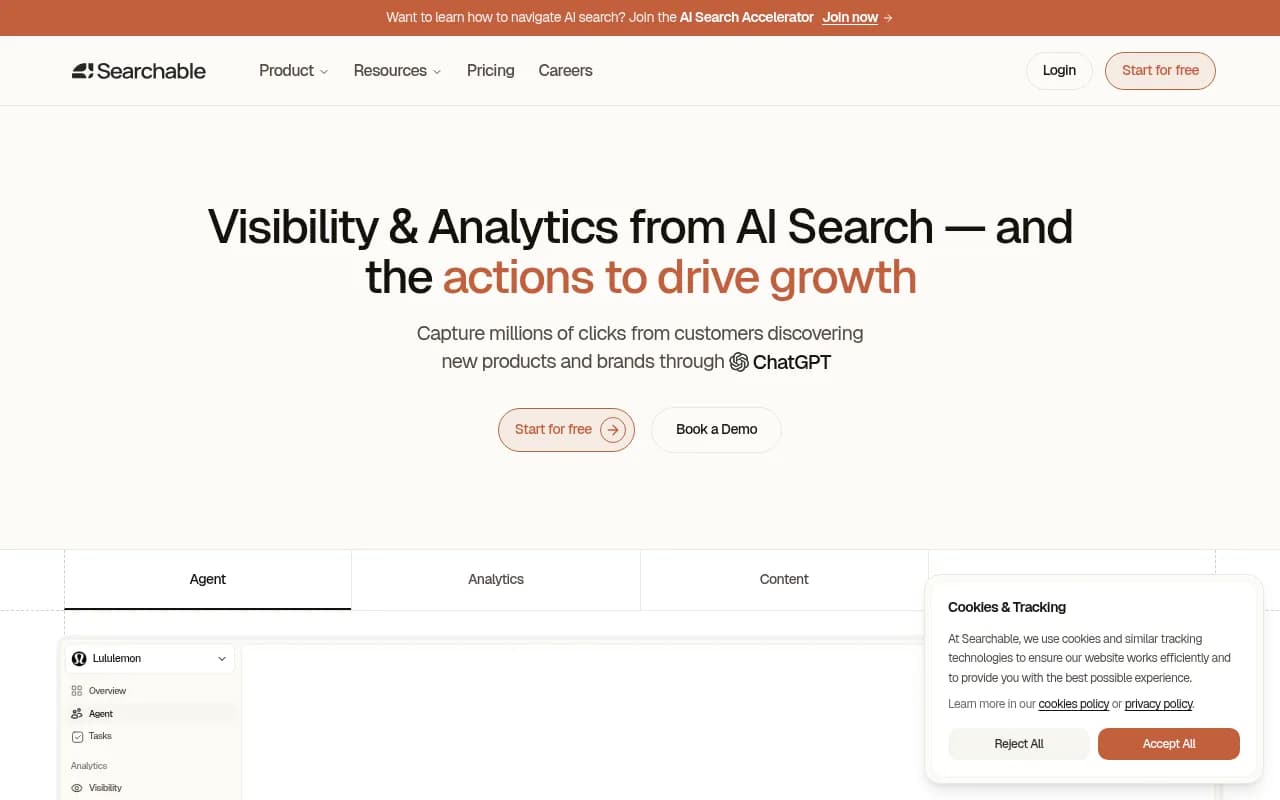
Other tools worth considering
Depending on your needs and budget:

Step 3: Set up traffic attribution
Visibility metrics are useful, but you need to connect AI citations to actual business outcomes. Are people who see your brand in ChatGPT actually visiting your website? Are they converting?
Three methods for tracking AI referral traffic
Method 1: JavaScript snippet
Add a tracking snippet to your website that captures referrer data from AI platforms. When someone clicks a link in Perplexity or Google AI Overviews, the referrer header tells you where they came from.
Limitations: Only works for platforms that provide clickable links (Perplexity, Google AI Overviews). Doesn't capture ChatGPT or Claude traffic since those models rarely link out.
Method 2: Google Search Console integration
Google Search Console now shows AI Overview impressions and clicks separately from traditional search results. Connect your GSC account to see:
- Which queries triggered AI Overviews
- How often your site appeared in those overviews
- Click-through rates from AI Overviews vs regular results
Limitations: Only covers Google AI Overviews, not ChatGPT, Claude, or Perplexity.
Method 3: Server log analysis
AI platforms send crawlers to read your website content. These crawlers leave traces in your server logs:
- ChatGPTBot (OpenAI)
- ClaudeBot (Anthropic)
- PerplexityBot (Perplexity)
- Google-Extended (Google's AI training crawler)
Analyzing these logs tells you:
- Which pages AI crawlers visit most often
- How frequently they return
- Whether they encounter errors (404s, timeouts, blocked resources)
- Which pages they read before citing your brand
This is the most comprehensive method because it captures all AI platform activity, not just the ones that provide referrer data.
Tools like Promptwatch include AI Crawler Log analysis built-in, showing real-time logs of which AI crawlers are hitting your site, which pages they're reading, and any errors they encounter.
Step 4: Improve your AI visibility
Tracking is pointless without action. Here's how to actually improve your citation rate and share of voice.
Create citation-worthy content
AI models cite content that is:
Authoritative: Published on domains with strong reputation signals (backlinks, brand mentions, Wikipedia presence, news coverage). If your domain authority is weak, guest posting on high-authority sites can help.
Comprehensive: Long-form content that thoroughly answers questions performs better than thin, surface-level pages. Aim for 2,000+ words on core topics.
Structured: Use clear headings, bullet points, tables, and lists. AI models parse structured content more easily than dense paragraphs.
Current: Fresh content gets prioritized. Update your key pages regularly with new data, examples, and insights.
Specific: Generic advice gets ignored. Concrete examples, case studies, and data points get cited.
Fill content gaps
Use your competitor analysis to identify prompts where competitors appear but you don't. These represent content gaps -- topics your website doesn't adequately cover.
For each gap:
- Identify the specific question or angle competitors are answering
- Create content that answers that question more thoroughly
- Optimize for the entities and concepts AI models associate with that topic
- Publish and promote to build initial authority signals
Platforms like Promptwatch automate this process with Answer Gap Analysis that shows exactly which prompts you're missing, then generates optimized content to fill those gaps.
Strengthen entity signals
AI models understand the web through entities (people, places, brands, concepts) and the relationships between them. Strengthen your brand's entity signals:
Wikipedia presence: If your brand has a Wikipedia page, keep it updated and well-sourced. If you don't have one yet, focus on building the notability required (significant news coverage, industry recognition).
Knowledge graph optimization: Ensure your brand appears correctly in Google's Knowledge Graph. Use schema markup, maintain consistent NAP (name, address, phone) across the web, and build structured data on your website.
Brand mentions: Get mentioned on authoritative sites in your industry. Guest posts, interviews, case studies, and news coverage all strengthen entity signals.
Relationships: AI models understand your brand through its relationships to other entities. If you integrate with Salesforce, make sure that relationship is clearly documented. If you serve healthcare companies, make sure that association is explicit.
Optimize for specific AI platforms
Each platform has quirks:
For ChatGPT:
- Focus on Wikipedia, major news outlets, and high-authority industry publications
- Create comprehensive guides and comparison content
- Use clear, factual language (ChatGPT favors confident, authoritative tone)
For Claude:
- Publish research-backed content with citations
- Use nuanced, balanced language that acknowledges trade-offs
- Create technical documentation and detailed how-to guides
For Perplexity:
- Optimize for traditional SEO (Perplexity pulls from real-time search)
- Use structured data and schema markup
- Publish timely, newsworthy content
- Include clear source citations in your own content
For Google AI Overviews:
- Follow traditional SEO best practices (domain authority, backlinks, content quality)
- Use FAQ schema and structured data
- Target informational queries (Google is conservative about showing AI Overviews for commercial queries)
- Create content that directly answers common questions
Step 5: Monitor and iterate
AI visibility isn't set-and-forget. Models update, competitors publish new content, and your citation rate will fluctuate.
Weekly monitoring routine
Check your core metrics:
- Citation rate across platforms
- Share of voice vs top competitors
- New prompts where you've gained visibility
- Prompts where you've lost visibility
Review new content performance:
- Which recently published pages are getting cited?
- How long did it take for AI models to start referencing them?
- Are citations accurate?
Scan for issues:
- Inaccurate information in AI responses
- Negative sentiment or unfavorable comparisons
- Competitor content that's outperforming yours
Monthly deep dives
Competitive analysis:
- Which competitors gained share of voice this month?
- What content did they publish?
- Which prompts are they winning that you're not?
Content gap analysis:
- New prompts to add to your tracking list
- Emerging topics in your category
- Questions your audience is asking that you haven't covered
Traffic attribution:
- How much traffic came from AI referrals?
- Conversion rates from AI traffic vs other channels
- Revenue attribution (if you have the data)
Quarterly strategy reviews
Evaluate overall progress:
- Citation rate trends over the quarter
- Share of voice changes
- ROI of content investments
Adjust strategy:
- Double down on what's working
- Cut or revise underperforming content
- Identify new opportunities (platforms, prompts, content types)
Competitive positioning:
- How has the competitive landscape shifted?
- New competitors entering the space?
- Changes in how AI models describe your category?
Common mistakes to avoid
Mistake 1: Tracking vanity metrics
Citation count alone doesn't matter. Being mentioned 50 times but always as "a budget option" or "limited features" is worse than being mentioned 10 times as "the industry leader."
Track sentiment and positioning, not just raw mention counts.
Mistake 2: Ignoring accuracy
AI models hallucinate. They'll confidently state incorrect pricing, describe features you don't have, or recommend you for use cases you don't support.
Regularly audit the accuracy of information AI models provide about your brand. Inaccurate citations can damage your reputation and waste sales team time correcting misconceptions.
Mistake 3: Only monitoring one platform
Different audiences use different AI assistants. Developers favor Claude. Researchers use Perplexity. Mainstream users default to ChatGPT. Enterprise buyers often use Microsoft Copilot.
If you only track ChatGPT, you're missing 60% of the picture.
Mistake 4: Treating AI visibility like SEO
AI visibility and SEO overlap but aren't identical. A page that ranks #1 on Google might never get cited by ChatGPT. A Reddit thread with zero SEO value might get cited constantly by Perplexity.
AI models favor different content types, sources, and signals than Google's algorithm. Optimize for both, but don't assume they're the same.
Mistake 5: Not connecting visibility to revenue
Visibility metrics are directional indicators, not business outcomes. If your citation rate doubles but revenue doesn't change, something's broken.
Always connect visibility tracking to traffic attribution and conversion data. The goal isn't to be mentioned -- it's to drive business results.
The connection between traditional SEO and AI visibility
AI visibility doesn't replace SEO -- it extends it. The two channels reinforce each other.
SEO helps AI visibility:
- High domain authority makes your content more likely to be cited
- Backlinks signal credibility to AI models
- Structured data helps AI models parse your content
- Traditional ranking factors (content quality, relevance, freshness) still matter
AI visibility helps SEO:
- Being cited by AI models can drive referral traffic
- AI-generated summaries often appear above traditional search results
- Brands mentioned in AI responses may see increased branded search volume
- Content optimized for AI citations tends to perform well in traditional search too
The best strategy addresses both channels simultaneously. Create comprehensive, authoritative content that ranks well in Google AND gets cited by ChatGPT, Claude, and Perplexity.
What to expect: realistic timelines
Improving AI visibility takes time. Here's what realistic progress looks like:
Week 1-2: Baseline and setup
- Complete manual testing
- Set up monitoring tools
- Identify initial content gaps
Month 1: Early wins
- Publish first round of optimized content
- See initial citations from Perplexity (fastest to update)
- Citation rate may improve 2-5 percentage points
Month 2-3: Momentum builds
- More content gets indexed and cited
- ChatGPT and Claude start referencing newer content
- Citation rate improvements of 5-10 percentage points
- Share of voice gains vs competitors
Month 4-6: Sustained growth
- Consistent citation rate improvements
- Traffic attribution data becomes meaningful
- Clear ROI on content investments
- Share of voice approaching or exceeding top competitors
Don't expect overnight results. AI models update on different schedules:
- Perplexity: Real-time (hours to days)
- Google AI Overviews: Days to weeks
- ChatGPT: Weeks to months (depends on model updates and web browsing)
- Claude: Weeks to months (depends on model retraining)
Start tracking today
AI visibility isn't a future concern -- it's a present reality. Every day you're not monitoring is a day competitors gain ground.
Here's your action plan:
- Today: Run manual baseline tests on 10 core prompts across ChatGPT, Claude, Perplexity, and Google AI Overviews
- This week: Build your full prompt library (20-30 prompts) and complete systematic testing
- This month: Sign up for a monitoring tool (start with Promptwatch's free trial), set up automated tracking, and identify your top 3 content gaps
- Next month: Publish optimized content to fill those gaps, set up traffic attribution, and begin weekly monitoring routine
- Ongoing: Monthly deep dives, quarterly strategy reviews, continuous optimization
The brands that win in AI search will be the ones that started tracking early, optimized systematically, and connected visibility to business outcomes. Start today.