
Key takeaways
- A year-end AI visibility audit has four parts: your prompt set, your brand's presence and accuracy per engine, the sources AI cites, and whether AI crawlers can reach your site.
- Citation patterns move fast. Compare month-by-month trends, not one snapshot, and keep your measurement window consistent.
- Set 2027 targets per engine. The source mix differs a lot between ChatGPT, Perplexity and Google AI Overviews.
- A manual audit takes roughly 6 to 10 hours. A tool makes sense once you want weekly tracking instead of an annual check.
- Finish with one to three fixes per quarter and a re-run date, otherwise the audit is just a spreadsheet.
Why December is the right time
December is quiet. Budgets for next year are being set, and you have twelve months of behavior to look back on. That makes it a good moment for an AI visibility audit, which is a structured check of how often AI assistants mention your brand, how accurately they describe it, and which sources they cite when they do.
The other reason is that 2026 was volatile. A few examples from Promptwatch Data:
- ChatGPT's average citations per response dropped around the GPT-5.3 rollout on March 4, 2026 (report).
- On August 8, ChatGPT Search started using the site: operator at scale, and site: queries went from about 0.4% to about 17% of fanout queries overnight (report).
- reddit.com's share of ChatGPT citations fell from roughly 4% to 0.5% on August 14 (report).
If your 2026 numbers wobbled, some of that was you and some of it was the platforms changing underneath you. A good audit separates the two.
What a year-end audit covers
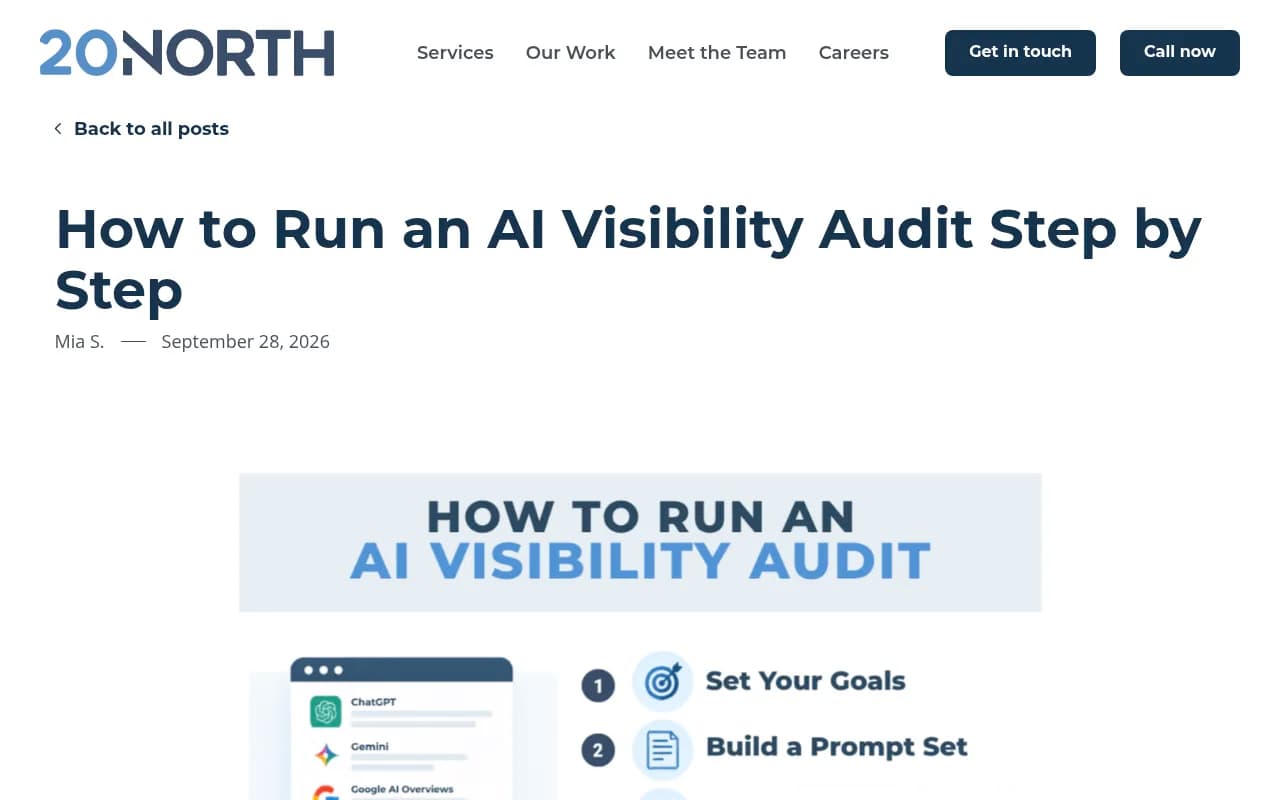
Most published checklists (the 6-step, 7-step and 26-check versions all differ in the details) boil down to the same layers. I would group them like this:
| Layer | Question it answers | Typical output |
|---|---|---|
| Presence | Does AI name us for category prompts? | Mention rate per engine |
| Accuracy | Does it describe us correctly? | List of wrong or outdated claims |
| Sources | Which pages and sites does it cite? | Cited-domain list, self-citation rate |
| Access | Can AI crawlers read our site? | Robots.txt and crawl findings |
| Outcomes | Does any of this send traffic or leads? | AI-referred sessions and conversions |
The outcomes layer is the one people skip, and it is the one finance cares about in January.
Step 1: Define scope, competitors and the comparison window
Pick three to five competitors and the engines your buyers actually use. For most B2B brands that means ChatGPT, Google AI Overviews and AI Mode, Gemini, Perplexity, and maybe Copilot or Claude.
Then decide your window now. The Promptwatch social-citation reports show why: the October report covered 7 days (Sep 28 to Oct 4) while the November one covers 30 days (Oct 11 to Nov 9), so month-over-month comparisons need care. If you compare a 7-day sample from last quarter to a 30-day sample today, you are measuring the window, not your brand.
My suggestion: use full calendar months, and compare November 2026 against the same number of days earlier in the year.
Step 2: Build a prompt set from real buyer questions
Write 20 to 50 prompts. Fewer than 10 is noise. More than 100 is hard to review by hand.
Split them into types:
- Category prompts, such as "best project management tool for agencies"
- Comparison prompts, such as "Brand A vs Brand B"
- Brand-specific prompts, such as "is Brand A good for small teams"
- Problem prompts that never name a product
Pull wording from sales calls, support tickets and Search Console queries. Real phrasing beats what the marketing team thinks people ask. If you want search-style demand data, Promptwatch's prompt volumes and the query fan-out docs show what AI searches behind the scenes for each prompt.
Also add personas. A CFO and a developer ask the same category question differently, and the answers differ.
Step 3: Run the prompts and log what you see
If you go manual, use a fresh chat for every prompt, logged out or in a clean profile where possible, and record the date. Log these fields per answer:
- Was the brand mentioned, and at what position among brands?
- Was it recommended, or just listed?
- Which sources were cited, and was one of them your own domain?
- Was anything stated about you wrong?
- Sentiment: positive, neutral or negative
The free 7-step checklist from OutreachBloom suggests a benchmark of around a 20% mention rate on category-defining prompts. Treat that as a rough starting reference, not a law. Your own baseline matters more.
Manual testing has a real weakness. Answers vary run to run, so one test per prompt proves little. Run each prompt at least three times, or use a tracker that runs them daily and averages.
Tools for the tracking step
A spreadsheet works for one audit. For ongoing tracking, there are many options. The catalog here lists dozens of AI visibility trackers; a few worth knowing:
Promptwatch tracks the real interfaces of ChatGPT, Google AI Overviews and AI Mode, Gemini, Perplexity, Copilot and others per country and language, then goes further than monitoring with crawler logs, visitor analytics, and a Content Agent that writes and publishes pages for the gaps it finds.

Profound is a strong monitoring-focused platform, usually at a higher price point.

Peec AI and Otterly.AI are lighter prompt trackers that suit smaller budgets.


Semrush and Ahrefs Brand Radar add AI tracking to suites you may already pay for.
For a wider look, the GEO software directory at bestgeosoftware.com lists far more options.
| Approach | Cost | Best for | Weak spot |
|---|---|---|---|
| Manual spreadsheet | Free, 6 to 10 hours | One-off year-end baseline | Noisy, no history |
| Prompt tracker (Peec, Otterly) | Low | Mention and position tracking | No crawler or traffic data |
| Suite add-on (Semrush, Ahrefs) | Bundled | Teams already in the suite | Fixed prompt sets, shallower data |
| End-to-end platform (Promptwatch) | Mid to high | Tracking plus fixing plus measuring | More to set up |
Step 4: Analyze the sources AI cites
This is where the audit turns into strategy. Mentions tell you where you stand. Citations tell you why.
The source mix differs sharply by engine, according to Promptwatch's November 2026 data:
| Engine | Share of citations going to social platforms (Oct 11 to Nov 9) |
|---|---|
| Google AI Overviews | 13.16% |
| Perplexity | 1.94% |
| ChatGPT | 0.64% |
Within that, YouTube is 6.71% of AI Overviews citations, Reddit leads Perplexity's social citations at 0.82% with LinkedIn at 0.66%, and Reddit is back as ChatGPT's top social platform at 0.40% (full report).
ChatGPT looks different. In November 2026 the top 20 popular sites together earned under 2% of ChatGPT citations, with review sites holding 5 of the top 10 spots and Reddit leading at 0.23% (November citation share). Promptwatch's own advice from that report: get listed and reviewed on G2, Capterra, Gartner and Trustpilot, publish answers on your own site, and don't build the ChatGPT plan around Reddit.
So the audit question is not "are we cited?" but "are we cited where this engine looks?" A brand with great YouTube coverage and no review-site presence will look fine in AI Overviews and weak in ChatGPT.
Also check authority. In Nov 3 to Nov 16 data, the median cited domain was DR 56 to 57 across ChatGPT, Perplexity, AI Overviews and AI Mode, but DR 100 sites earned 13.7% of AI Overviews citations versus 0.3% of ChatGPT's (report). You do not need a DR 90 to be cited in ChatGPT.
Check content types and age
Product pages were the most cited content type in ChatGPT at 22.4% of citations (Sep 28 to Oct 4), ahead of landing pages and listicles (report). And pages age differently. From pages cited on July 6, tracked to October 4:
| Content type | Still cited after 30 days | Still cited after 60 days |
|---|---|---|
| Landing pages | 78% | 69% |
| Docs | 76% | 67% |
| Comparisons | 72% | 63% |
| Listicles | not reported | 60% |
| News | not reported | 41% |
News hit its half-life at 36 days (content half-life report). For your audit, that means: check pricing, specs and positioning on long-lived pages first, because those are what AI keeps quoting. Treat press and news as short bursts.
Step 5: Check technical access
You cannot be cited from a page AI crawlers cannot read. Check:
- Robots.txt rules for GPTBot, OAI-SearchBot, ChatGPT-User, ClaudeBot, PerplexityBot and Google's agents
- CDN or firewall rules that block bots silently
- Sitemap coverage and orphaned pages
- Server errors on key pages
- Whether key content renders without JavaScript
The crawler landscape changed this year too. Meta-WebIndexer went from about 2% to nearly 38% of tracked AI crawler requests between mid-July and August 9 (report), so a robots.txt written in 2025 may not cover what is hitting you now. Weekly AI crawler traffic data for June to September is a useful benchmark.
Free starting points: the Agentic Readiness Check, the AI crawler URL inspector, and the AI bots directory. If you want to see real bot visits instead of guessing, Promptwatch's crawler logs are IP-verified and show which pages AI reads and where it fails. DarkVisitors is another option for bot tracking.
Step 6: Fact-check what AI says about you
Go back to your log of wrong claims. Old pricing, discontinued features, and mistaken competitor comparisons are the usual suspects. For each wrong claim, find the page it came from: your own outdated page, a third-party listing, or an old review. Fix the source, not the answer.
Promptwatch has Brand Narrative and Fact Check for this, which group repeated claims and trace them to pages. A manual alternative is to search the exact wording of the wrong claim and see what ranks.
Step 7: Connect visibility to traffic and revenue
None of the above matters to the CFO unless it moves traffic or pipeline. Check:
- AI-referred sessions in analytics, by engine
- Conversion rate of that traffic against other channels
- Landing pages that receive AI traffic
Note that ChatGPT stopped sending a referrer on October 8, 2026, so your analytics may undercount it. Tag links where you can, and read the attributing AI traffic guide. For context on what is achievable, Crisp reported 2x higher conversion rates from AI traffic than traditional channels (case study).
Step 8: Score the results
Put it all on one scorecard. Here is a simple version:
| Metric | ChatGPT | AI Overviews | Perplexity | Gemini |
|---|---|---|---|---|
| Mention rate (% of prompts) | ||||
| Average position among brands | ||||
| Self-citation rate | ||||
| Accuracy (% of claims correct) | ||||
| Sentiment (positive, neutral, negative) | ||||
| AI-referred sessions |
The read-across is useful. A low mention rate means coverage is the problem. Late position means prominence. Mentions without self-citations point to content or crawlability. Weak sentiment is reputation. Definitions of these are in the metrics overview.
Setting 2027 targets
This is the part most guides skip. Some rules I would use.
Set targets per engine, not one blended number
Because the source mix differs so much, one blended "visibility score" hides the real picture. Write a separate target for each engine, tied to the lever that moves it:
| Engine | Main lever | Example 2027 target type |
|---|---|---|
| ChatGPT | Own product and landing pages, review-site presence | Raise mention rate on category prompts by a set number of points |
| Google AI Overviews | YouTube, Facebook-adjacent and broad authority | Add video coverage for top 10 topics |
| Perplexity | Reddit and LinkedIn presence | Increase citations from named communities |
| Gemini and AI Mode | Google ecosystem, structured data | Hold or raise position among brands |
Anchor targets to your baseline
If you start at a 5% mention rate, a target of 50% is fantasy. A realistic jump over a year is a relative improvement, say doubling your mention rate on prompts you already have coverage for. Pick numbers from your own December scorecard, not from other people's benchmarks.
Use leading and lagging indicators
- Leading: pages published or refreshed, review-site profiles completed, crawler errors fixed
- Lagging: mention rate, position, citations, AI-referred sessions, conversions
Leading indicators are what you control in Q1. Lagging ones follow with a delay of weeks.
Plan for volatility
Given the August Reddit drop and the March citation shift, build ranges into targets and review quarterly. If an engine changes its behavior overnight, you want to know whether your own numbers moved or the whole market did. Tracking competitors alongside you answers that, since a market-wide drop hits everyone.
Assign owners and a calendar
A workable 2027 rhythm:
- January: fix technical access and wrong claims
- Q1: refresh long-lived pages and fill the top content gaps
- Q2: build off-site presence on the sources each engine favors
- Q3: mid-year re-audit
- Q4: next year-end audit with the same prompt set
Keep the same core prompts year to year so you can compare. Add new ones, but do not swap out the old ones.
When to bring in help
If your team lacks the time to run this weekly, an SEO and GEO agency can take it over. 1001 SEO Media publishes this site and runs audits like this one for clients, using Promptwatch for AI visibility tracking. That is worth considering only if you cannot staff it internally.
A short checklist to finish
- Prompt set written and frozen (20 to 50 prompts)
- Each prompt run at least three times per engine
- Mentions, positions, citations and wrong claims logged
- Cited sources grouped by type and engine
- Robots.txt, CDN and sitemap checked
- AI-referred traffic and conversions pulled from analytics
- Scorecard filled in per engine
- Targets written per engine with owners and dates
- Re-audit dates in the calendar
For a quick free baseline before you start, Promptwatch's free AI visibility report scans how ChatGPT, Gemini and Perplexity talk about your brand with no login. Then do the manual work above, and put the next audit in your calendar before you close the spreadsheet.
FAQ
How long does a year-end AI visibility audit take?
A manual audit takes about 6 to 10 hours for a small prompt set. With a tracking tool, the data collection is automatic and you spend your time on analysis and targets.
How many prompts do I need?
Aim for 20 to 50 real buyer prompts to start. Fewer than 10 gives you noise, and every prompt should be run multiple times because AI answers vary.
Should I use one score for all AI engines?
No. Source mixes differ sharply between engines, so track and target each one separately, then summarize.
How often should I re-audit after December?
Quarterly at minimum for the full audit, with weekly or daily automated tracking for the core prompt set if you can afford it.
What if my numbers dropped in 2026?
Check competitors for the same period first. Several 2026 shifts, including the March citation drop and the August Reddit collapse, affected the whole market rather than individual brands.