
Key takeaways
- A free trial is easy to pass if you only look at the dashboard. The goal is to break the data: repeat it, audit it by hand, and see what changes when nothing should have changed.
- Freeze a dated prompt set before day one (the AEO Labs method uses 50 prompts: 40 unbranded, 10 branded) and run every platform against the same set.
- Report organic, brand and comparison prompts separately. Promptwatch Data shows they behave very differently in ChatGPT.
- Log model releases during the 14 days. A visibility swing can come from the engine, not your content or the vendor.
- Check whether data comes from real interfaces or API calls, whether fan-out queries and cited URLs are visible, and whether you can export raw responses.
Why trials hide weak data
I have watched a lot of teams sign up for a 14-day AEO trial, paste in 20 prompts, see a visibility score, and conclude the tool "works." Nothing in that process tests anything. Every platform produces a score. The question is whether the score survives contact with reality.
Trials are designed to show you the good part: an onboarding wizard, a polished chart, a competitor leaderboard. Weak data shows up later, when you try to explain a drop to your boss and discover you cannot see the underlying responses. Or when you run the same prompt by hand and get a completely different answer than the tool reports.
So treat the trial as a lab test. You are not evaluating features. You are evaluating whether you can trust the numbers enough to make budget decisions on them.
Several vendors currently advertise 14-day trials, including Ansvisor, Searchable and LLM Pulse (LLM Pulse lists plans from EUR 49/month). Others use shorter trials or a one-time report. Fourteen days is enough for the plan below, but only if you prepare before you sign up.
Before day one: build your test harness
Do this work before you create any account, because the trial clock starts at signup.
Freeze a prompt set
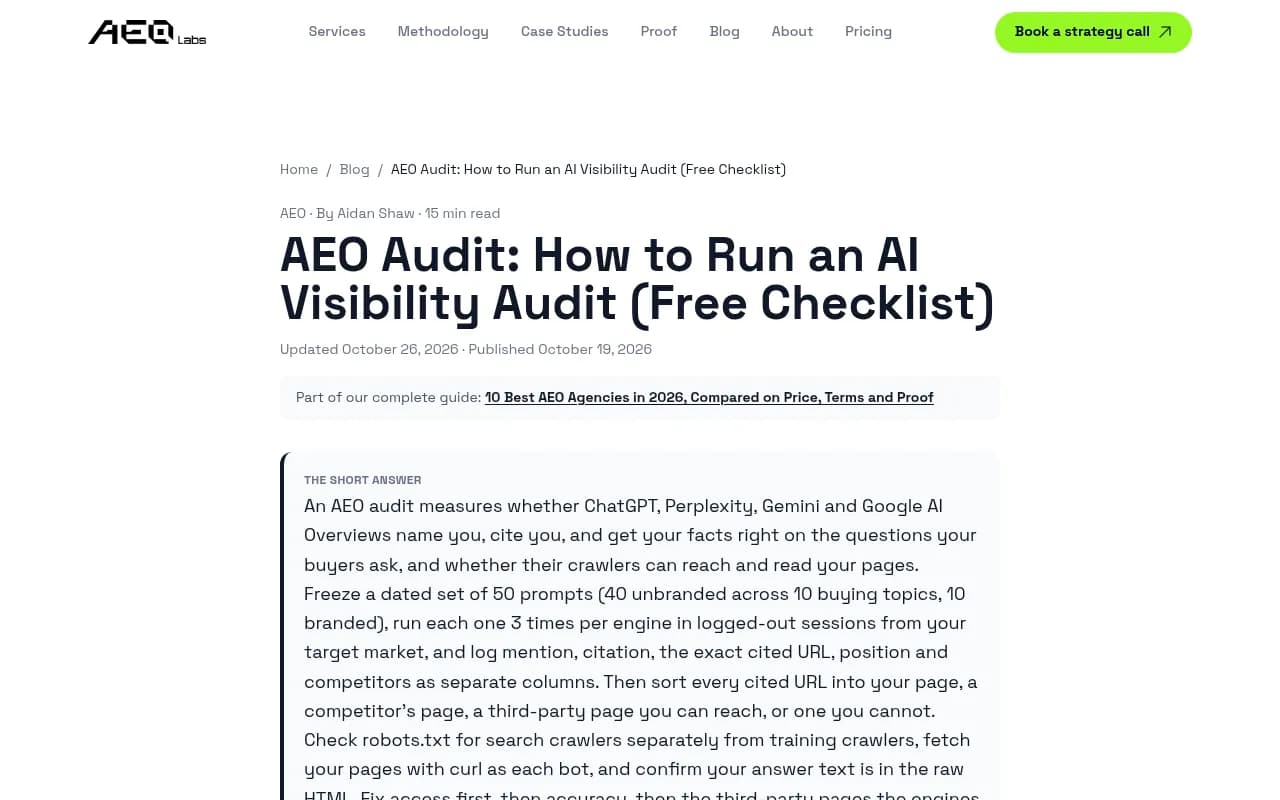
The AEO Labs audit guide recommends a frozen, dated set of 50 prompts: 40 unbranded prompts across 10 buying topics, plus 10 branded ones. Run each prompt three times per engine, logged out, from your target market. I think that is a sensible baseline, and it doubles as your ground truth for the trial.
Why freeze it? If you edit prompts mid-trial, you cannot tell whether a change in results came from the tool, the engine or you.
Split prompts by type
Promptwatch's unique domains per response report (Sep 28 to Oct 4, 2026, responses with at least one citation) shows why. Across all ChatGPT responses, 47.6% cited 10 or more domains. But the split by prompt type is wide:
| Prompt type | Cite 10+ domains | Notes |
|---|---|---|
| Organic | 52.5% | Only 4.5% cite three or fewer |
| Competitor comparison | 49.1% | Only 0.35% cite a single domain |
| Brand-specific | 21.3% | Most common count is 5 domains (14.9%) |
If a vendor blends these into one average, you will not see that brand prompts behave like a different product from organic ones. Tag every prompt as organic, brand or comparison, and demand per-type reporting.
Build the manual ground-truth sheet
Create a spreadsheet with these columns for each prompt and engine run: date, engine, run number, mentioned (yes/no), cited (yes/no), exact cited URL, position in the answer, and competitors named. That sheet is what you compare every vendor against. It takes an afternoon for a subset and it is the single most useful artifact in the whole trial.
Write down your pass criteria
Decide in advance what "good enough" means. For example: the tool's mention rate must land within a set tolerance of your manual sheet, every number must drill down to a stored response, and exports must include raw text. Writing this down stops you from being charmed by a nice interface on day 13.
The 14-day plan
Days 1 and 2: setup and the first honesty check
Load your frozen prompt set exactly as written. Notice what the platform does to it. Some tools rewrite prompts, cap prompt length, or force you into a template. Note every modification.
Then ask the vendor, or check the docs, three questions:
- Does data come from the real user interfaces of ChatGPT, Gemini, Perplexity and AI Overviews, or from API calls? Real UI answers and citations can differ from API output. Promptwatch, for example, says it collects from actual interfaces, which is why it is worth asking every other vendor the same thing.
- How often does each prompt run, and how many runs are averaged?
- Which country, language and logged-in state does the collection use?
A vague answer to any of these is data. Write it down.
Days 3 and 4: the manual audit
Run your manual sheet for a sample of 15 to 20 prompts across the engines you care about. Logged out, from your target market, three runs each. This is tedious. Do it anyway.
Now compare against the platform. You are not looking for identical answers, because AI answers vary. You are looking for the same shape: similar mention rates, overlapping cited domains, plausible competitor sets. If the tool says you are mentioned in 80% of responses and your manual runs show 30%, something is off, and you want to know now.
Days 5 and 6: drill-down and traceability
Pick five numbers from the dashboard and try to trace each to its source. For every metric, ask:
- Can I open the actual stored response?
- Can I see the exact URLs cited, not just domains?
- Can I see position in the answer and which competitors were co-cited?
- Can I see the query fan-out, meaning the web searches the engine ran to build the answer?
This matters because a mention and a citation are different signals. A score that merges them is hiding something. Promptwatch's fan-out data also shows why fan-out visibility is useful: measured averages ran from about 2.15 fan-outs per response in early December 2025 to about 1.84 by early March 2026, and returned at exactly 1.0 in April. Query length fell from about 117 characters to the high 80s, then around 53. If a vendor's prompts and content suggestions still assume last quarter's behavior, you will see it here.
Day 7: the repeatability test
This is the test most trials skip. Re-run the same set of prompts on the platform, or trigger a manual refresh, and compare to the earlier results. Same prompts, same engines, same day.
Some variance is normal and expected. Large swings are a warning that the vendor samples too few times per prompt. Ask how many runs go into each reported number. One run per prompt per day is thin, and a single prompt tells you little when answers are this crowded.
Days 8 and 9: competitors and citations
Check whether the competitor list is auto-discovered or entirely manual, and whether competitor mentions match your own manual sheet. Then sort the cited URLs by owner, the way AEO Labs suggests: your page, a competitor's page, a third-party page you could realistically influence, or one you cannot.
Good platforms make that sort easy. Weak ones show you a domain list and stop there. If the data is only domain-level, you cannot tell which page to fix.
Days 10 and 11: accuracy and access
Check the branded answers against your official facts. Does the platform flag wrong claims about pricing, features or locations? Or does it just show a sentiment number? Sentiment can be positive while the facts are wrong.
Then test crawler access, because a visibility problem is sometimes an access problem. Check robots.txt for search crawlers separately from training crawlers, fetch key pages with curl as each bot, and confirm your answer text exists in the raw HTML. A platform with IP-verified crawler logs can show whether AI bots actually read your pages, which separates "they cannot read us" from "they read us and chose someone else."
Days 12 and 13: the date-awareness test
Check your event log. Did any model releases or search changes happen during the trial? Promptwatch's citation drop report is the cautionary tale. In the week before the GPT-5.3 rollout on March 4, 2026, ChatGPT cited about 6.4 sources per search-enabled response. By late March that was about 4.7 to 4.9, roughly 27% fewer citation slots, hitting GPT-5.3, GPT-5.4 and GPT-5-Mini within a day.
If your visibility moved during a platform change, a good tool lets you annotate it or compare across the date. A weak one hands you a trend line and lets you blame your content. Keep a log of releases for the 14 days and check every movement against it.
Day 14: score and decide
Fill in the scorecard below for each vendor and compare against your pass criteria.
Trial scorecard
| Test | What a pass looks like | Red flag |
|---|---|---|
| Data source | Real UI collection, documented | "Proprietary" with no detail |
| Prompt handling | Your frozen prompts run unchanged | Rewritten or capped prompts |
| Manual match | Mention rate roughly matches your sheet | Large gap you cannot explain |
| Traceability | Every number opens to a stored response | Aggregates only |
| Citation detail | Exact URLs, position, co-cited competitors | Domain list only |
| Fan-outs | Visible queries per response | Not shown |
| Repeatability | Small variance on re-run | Big swings, one run per prompt |
| Prompt types | Organic, brand and comparison split | One blended score |
| Accuracy | Flags wrong claims in branded answers | Sentiment only |
| Events | Model releases can be annotated | Trend line with no context |
| Export | Raw responses and citations in CSV or API | Charts only |
Which tools are worth putting through this test
You do not need to trial everything. Pick two or three that match your situation, run the identical plan, and compare scorecards. For wider lists, the GEO software directory at bestgeosoftware.com is a decent starting point.
Promptwatch is the one I would test if you want monitoring and the fixing in one place. Promptwatch collects from real interfaces, shows fan-outs, cited URLs, IP-verified crawler logs and AI-referred visitor analytics, and its Content Agent writes and publishes pages against the gaps it finds. It has a 7-day free trial on monthly billing, so schedule a compressed version of the plan above and check pricing at promptwatch.com/pricing. Its free AI visibility report is a quick way to get a first reading without committing.

Other platforms that come up often in trial shortlists:



There is also an open-source route. Ansvisor says its open-source platform has a managed cloud version with a 14-day free trial, and it lists projects like GetCito, oneglanse and geo-aeo-tracker for self-hosting. Open source is attractive here because you can inspect exactly how data is collected.
A caution on shorter trials: a 7-day window cannot cover the repeatability and date-awareness tests properly. If a vendor only offers 7 days, run the manual audit before signup and spend the week on traceability, repeatability and exports.
Special case: local businesses
If you serve specific cities, the plan changes. Local answers shift with city names, neighborhoods and "near me" intent, and a mention does not prove your address, hours or service area are correct. The SearchEye local AEO roundup makes the same point: track real buyer questions by market, inspect cited sources, and keep separate controls for listings, reviews and map rankings.
So add city-level prompts to your frozen set, and ask whether the platform can pin tracking to a location. Promptwatch, for instance, supports exact-coordinate local targeting on its Business and higher plans.
Common mistakes that let weak data through
- Changing prompts mid-trial. You lose the ability to separate tool noise from your own edits.
- Trusting one run. AI answers are variable, so single snapshots mislead.
- Reading only the headline score. Break it into mention, citation, position and sentiment.
- Skipping the manual sheet. Without ground truth, every number sounds plausible.
- Ignoring the calendar. A platform change looks like a content win or loss if you are not watching dates.
- Letting the vendor pick the prompts. Their demo set is tuned to look good.
- Forgetting exports. If you cannot get raw data out, you cannot verify it later.
What to do with the results
If a vendor fails two or three rows of the scorecard, move on. If it passes most but has gaps, send those findings to the vendor and watch how they respond. A team that engages with specific data problems is a better long-term partner than one that sends you a feature deck.
Then pick the platform whose data you could defend in a meeting, not the one with the best chart. If you want to compare against a wider field afterward, the AI rank tools directory lists more trackers to run through the same checklist.
FAQ
How many prompts do I need for a 14-day trial?
Fifty is a workable baseline: 40 unbranded across 10 buying topics and 10 branded. Many trials cap prompts, so load your best subset and keep the full manual sheet for comparison.
Why do my manual results not match the tool exactly?
AI answers vary run to run, and personalization and location matter. You are checking for the same overall shape, not identical text. Large, persistent gaps are the concern.
Does API-based data count as weak data?
Not automatically. API output can be useful for what models say from training data. But user-facing answers and citations can differ, so for visibility in ChatGPT or AI Overviews, real-interface collection is the safer measure.
What if a visibility drop happens during the trial?
Check the date against model releases first. Promptwatch Data shows ChatGPT cut average citations per search-enabled response by roughly 27% within a day of the GPT-5.3 rollout, with no recovery a month later.