Key takeaways
- A raw citation count tells you almost nothing on its own -- context, frequency, sentiment, and position all determine whether a mention actually drives business value
- Citation rate, share of voice, sentiment score, position in response, source diversity, prompt-to-citation ratio, and traffic attribution are the seven metrics that matter most
- Most brands are invisible to AI search engines for the majority of relevant prompts -- the gap between "we got mentioned once" and "we're consistently cited" is enormous
- Tracking these metrics across multiple AI models (ChatGPT, Perplexity, Claude, Gemini) reveals wildly different visibility profiles for the same brand
- The only way to close visibility gaps is to act on the data -- creating content that directly answers the prompts where competitors show up and you don't
Someone on your team runs a ChatGPT query, your brand name appears in the response, and there's a small celebration. You were mentioned. You're in the game.
Except... were you? And are you?
A single mention in a single AI response is about as meaningful as seeing your name in one Google search result on one day. It tells you something happened, but nothing about whether it matters, whether it's consistent, or whether it's actually sending anyone to your website.
The brands winning in AI search right now aren't just getting mentioned. They're tracking the right metrics, understanding what the data actually means, and using it to make decisions. Here's what those metrics are and how to read them.
Why "you were mentioned" is the wrong thing to measure
Before getting into the seven metrics, it's worth understanding why raw mentions are so misleading.
AI models don't cite sources the way a journalist or academic does. They generate responses dynamically, pulling from training data and (in some cases) live retrieval. The same query asked twice can produce different citations. The same brand can appear prominently in ChatGPT responses but be completely absent from Perplexity or Google AI Overviews.
AI-referred traffic grew 527% year-over-year between January and May 2025, according to data from Search Engine Land. But most analytics platforms still misattribute that traffic as "direct." So even when AI search is driving real visitors to your site, you might not know it -- and you definitely can't optimize what you can't measure.
The seven metrics below give you a framework for turning raw citation data into something you can actually act on.
Metric 1: Citation rate (not just citation count)
Citation count is how many times you appeared. Citation rate is how often you appeared relative to how many times you could have appeared.
Run a set of 20-30 queries that are relevant to your business. These should be the kinds of questions your customers actually ask AI tools: "What's the best [category] tool for [use case]?" or "How do I solve [problem]?" Track how many of those queries produce a response that cites your brand.
If you're cited in 4 out of 30 queries, your citation rate is 13%. That's a real number you can benchmark against competitors and track over time.
Citation rate is more useful than count because it accounts for opportunity. A brand with 100 citations across 500 relevant queries (20% rate) is in a much stronger position than one with 100 citations across 2,000 relevant queries (5% rate).
Track this weekly. Changes in citation rate -- up or down -- are usually the first signal that something has shifted, either in your content, in a competitor's content, or in how a particular AI model is weighting sources.
Metric 2: AI share of voice
Share of voice in traditional SEO measures how much of the available search traffic you're capturing versus competitors. The same concept applies to AI search, but the calculation is different.
For a given set of prompts, count how many times your brand is cited versus how many times each competitor is cited. Your AI share of voice is your citations divided by total citations across all brands in your category.
This metric is particularly revealing because it shows you the competitive landscape in a way that citation rate alone doesn't. You might have a 20% citation rate and feel good about it -- until you realize your main competitor has a 60% citation rate for the same prompt set.
Share of voice also varies dramatically by AI model. A brand might dominate Perplexity citations but barely appear in Google AI Overviews. That's not just interesting -- it's actionable, because different AI models weight different types of sources differently.
Tools like Promptwatch surface this with competitor heatmaps that show exactly who's winning for each prompt across different LLMs.

Metric 3: Sentiment and framing score
Being cited isn't always a good thing. AI models sometimes mention brands in neutral comparisons, negative contexts, or as cautionary examples. "Brand X is known for poor customer support" is a citation -- just not one you want.
Sentiment analysis on AI citations means categorizing each mention as positive, neutral, or negative, and then going further to look at framing. How is your brand being described? Are you positioned as a leader, an option, a budget choice, a legacy player? Is the AI recommending you or just acknowledging you exist?
The framing often matters more than the sentiment score. A neutral mention that positions you as "the most comprehensive option for enterprise teams" is worth more than a positive mention that calls you "a good starter tool."
Run sentiment analysis on the full response text, not just the citation itself. The surrounding language tells you how the AI model is contextualizing your brand -- and that context is what the user actually reads.
Metric 4: Position in response
Where you appear in an AI response affects how much attention you get. This is analogous to ranking position in traditional search, but the dynamics are different.
In a list-style response ("Here are the top tools for X"), position one gets significantly more weight than position five. In a narrative response, being mentioned in the opening paragraph versus a footnote makes a real difference in how users perceive the recommendation.
Track not just whether you're cited, but where. Are you consistently the first brand mentioned, or are you appearing as an afterthought? Are you in the main recommendation or in a "you might also consider" section?
Position data also reveals something important about how AI models perceive your authority on a topic. Consistent first-position citations suggest the model has strong associations between your brand and that topic. Inconsistent positioning -- sometimes first, sometimes absent -- suggests your content coverage is patchy.
Metric 5: Source diversity and page-level citations
This metric asks: which specific pages on your site are being cited, and how many different pages are contributing to your overall visibility?
A brand where 90% of citations point to the homepage is in a fragile position. A brand where citations are distributed across 15-20 specific articles, guides, and product pages is much more resilient -- and is likely capturing a wider range of prompts.
Source diversity matters for two reasons. First, it tells you which content is actually working. If your comparison guide is getting cited constantly but your product pages never appear, that's a signal about what AI models value. Second, it reveals gaps. If you're getting cited for some topics but not others, you can see exactly which content you're missing.
Page-level citation data is one of the most actionable outputs from any AI visibility tracking setup. It tells you what to protect (pages that are already working), what to improve (pages that are getting cited but in weak positions), and what to create (topics where competitors are cited but you're not).
Metric 6: Prompt-to-citation ratio and answer gap analysis
This is where things get genuinely strategic.
For any given prompt, either you're cited or you're not. The prompts where competitors are cited but you aren't represent your answer gaps -- the specific questions AI models are being asked where your content isn't good enough to get pulled in.
Prompt-to-citation ratio measures how many of the prompts in your tracked set produce a citation for your brand. But the more valuable output is the list of prompts where you're not appearing. That list is essentially a content brief: these are the topics, questions, and angles you need to cover if you want to show up.
This is the metric that separates monitoring from optimization. Knowing your citation rate is useful. Knowing exactly which prompts you're losing -- and which competitor is winning them -- tells you what to do next.
Metric 7: Traffic attribution from AI referrals
All of the above metrics live in the AI search layer. This one connects that layer to actual business outcomes.
AI-referred traffic is notoriously hard to attribute. When someone reads a ChatGPT response that cites your site and then visits your site, that visit often shows up as direct traffic in Google Analytics. The referral chain gets lost.
Proper AI traffic attribution requires one of three approaches: a tracking code snippet that captures referral data before it's dropped, Google Search Console integration that surfaces AI-related queries, or server log analysis that identifies AI crawler and referral patterns.
Once you have attribution working, you can answer the question that actually matters: are AI citations driving revenue? Which prompts are sending converting visitors? Which AI models are sending the highest-quality traffic?
AI search visitors convert at 4.4x the rate of traditional organic search visitors, according to Semrush data. That number makes AI citation tracking one of the highest-ROI measurement investments available -- but only if you can actually connect citations to conversions.
How these metrics work together
The seven metrics aren't independent. They form a diagnostic framework.
Start with citation rate and share of voice to understand your baseline competitive position. Layer in sentiment and position data to understand the quality of your citations, not just the quantity. Use source diversity and page-level data to identify which content is working and which topics are uncovered. Run answer gap analysis to build your content roadmap. Then close the loop with traffic attribution to connect all of it to revenue.
The cycle looks like this: measure where you are, find the gaps, create content to fill them, track whether citations improve, attribute the traffic. Repeat.
Most brands are stuck at step one -- they know they're getting some mentions but have no idea what's driving them or how to get more. The metrics above give you the full picture.
Tools that track these metrics
The market for AI visibility tracking has grown quickly, and the tools vary significantly in what they actually measure.
| Tool | Citation tracking | Share of voice | Sentiment | Page-level data | Traffic attribution | Content gap analysis |
|---|---|---|---|---|---|---|
| Promptwatch | Yes | Yes | Yes | Yes | Yes | Yes |
| Otterly.AI | Yes | Basic | No | No | No | No |
| Peec AI | Yes | Yes | No | No | No | No |
| Profound | Yes | Yes | Yes | Yes | No | No |
| AthenaHQ | Yes | Yes | No | No | No | No |
| SE Ranking | Yes | Basic | No | No | No | No |
| Rankshift | Yes | Yes | No | No | No | No |
A few tools worth knowing about, depending on your needs:
Promptwatch covers all seven metrics and goes further with an answer gap analysis that shows you exactly which prompts competitors are winning that you're not -- plus a built-in content generation tool to help you close those gaps. It's the most complete option if you want to move from tracking to actually improving your visibility.
For teams that want monitoring without the optimization layer, Otterly.AI and Peec AI are lighter-weight options.


Profound and AthenaHQ are stronger on the enterprise side, with deeper data but less focus on content creation.


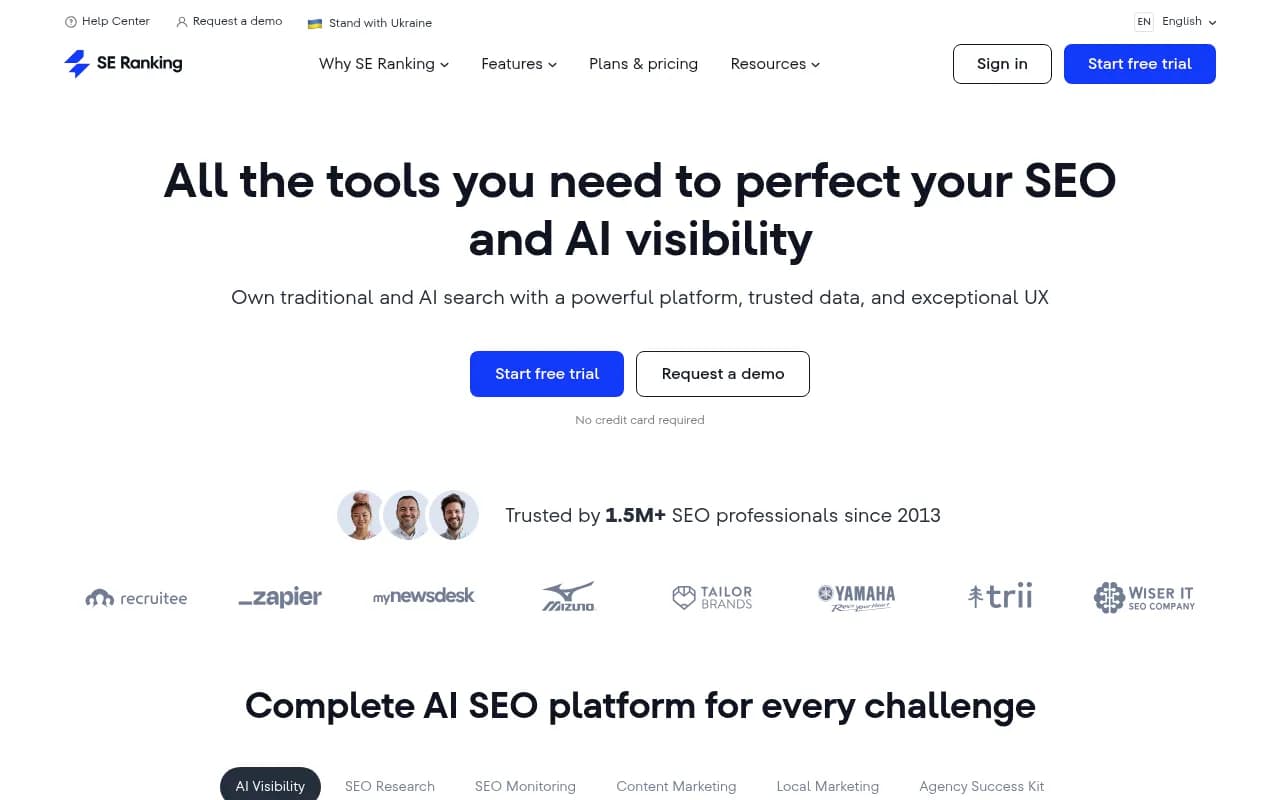
SE Ranking has an AI visibility toolkit that integrates with its broader SEO platform, which is useful if you're already using it for traditional SEO.
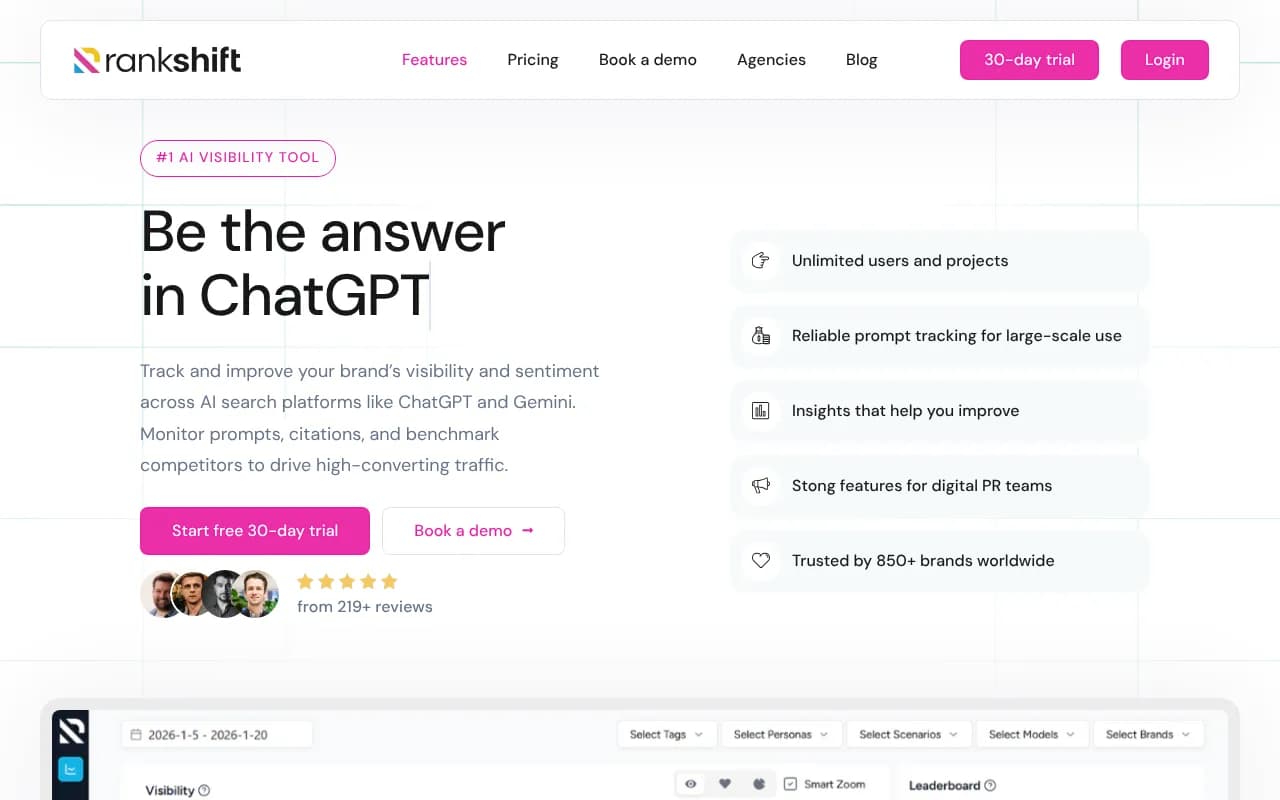
Rankshift is worth a look for teams that want LLM-specific tracking across multiple models.
A practical tracking workflow
If you're starting from scratch, here's a simple setup that covers the core metrics without requiring an enterprise budget.
First, define your prompt set. Identify 20-30 queries that represent how your customers actually use AI tools to research your category. Include comparison queries ("X vs Y"), problem-solving queries ("how do I..."), and recommendation queries ("best tool for...").
Second, run those queries weekly across at least three AI models: ChatGPT, Perplexity, and Google AI Overviews. Log whether you're cited, where you appear, and what the surrounding context says about your brand.
Third, track your competitors in the same prompt set. Note which prompts they're winning that you're not -- that's your gap list.
Fourth, use your gap list to prioritize content creation. Write articles, guides, and comparisons that directly answer the prompts where you're missing. Structure them to be scannable and specific -- AI models cite content that directly answers questions, not content that talks around them.
Fifth, connect your analytics to capture AI referral traffic. Even a basic UTM setup on your most-cited pages will start giving you data on which citations are actually sending visitors.
The whole setup can run manually with a spreadsheet if you're just starting out. As your prompt set grows and you need more consistency, a dedicated tool makes the process significantly faster.
What good citation data actually looks like
A healthy AI citation profile looks something like this: consistent citation rates above 30% for your core prompt set, first or second position in most responses where you appear, positive or neutral sentiment with framing that matches how you want to be positioned, citations distributed across 10+ different pages on your site, and measurable traffic from AI referrals that you can connect to conversions.
Most brands are nowhere near that. The average brand is cited in fewer than 15% of relevant prompts, often appears in lower positions when it does appear, and has no idea which pages are driving citations or whether any of that traffic is converting.
The gap between where most brands are and where they could be is the opportunity. The seven metrics above are how you measure it, and how you close it.
Getting mentioned once by ChatGPT is a start. Building consistent, high-quality AI citation coverage across the prompts your customers are actually asking -- that's the goal.