
Key takeaways
- ChatGPT stopped sending a referrer on October 8, 2026. Visits that used to show up as chatgpt.com referrals now land in Direct, so a drop in your referral report does not mean a drop in visibility.
- There is no rank to hold in ChatGPT. You win by being mentioned, cited, and described accurately inside a single answer.
- Product and landing pages make up about 39% of ChatGPT citations, so your commercial pages matter more than a blog full of thought pieces.
- Measure in four layers: citations and mentions, AI crawler logs, tagged or inferred traffic, and conversions. No single report is enough anymore.
- Content decays at different speeds. Landing pages and docs stay cited for months, news fades in about five weeks.
What changed on October 8
For a while, ChatGPT referral traffic was the easy part. Someone clicked a citation, the browser passed chatgpt.com as the referrer, and your analytics put it in a tidy bucket. You could screenshot that bucket for your boss.
On October 8, 2026, ChatGPT stopped sending that referrer. The clicks still happen. They just arrive looking like someone typed your URL by hand. If you watched the Referral channel in GA4 and saw it fall off a cliff, that is mostly a measurement problem, not a ranking problem.
I think this is annoying but healthy. It forces the question you should have been asking anyway: is ChatGPT actually recommending us, and does it lead to revenue? Referral counts were always a thin proxy for that.
The rest of this guide has two jobs. First, how to get cited more often. Second, how to prove it is working without relying on a referrer header.
What ranking in ChatGPT means
Type a buying question into ChatGPT and count the results. There are not ten. There is one answer with a handful of brands inside it. Profound's practitioner guide makes the same point: the old keyword-and-position model has nothing left to attach to, so visibility splits into separate measurements.
- Mentions: does your brand appear in answers to your buyers' questions?
- Citations: which pages, yours or someone else's, does ChatGPT pull from?
- Sentiment and accuracy: how are you described? An answer can name you and rule you out in the same sentence.
That last one is the sharpest break from SEO. In a ranked list, appearing was winning. In a synthesized answer you can appear, be described wrongly, and lose.
How ChatGPT picks sources
When a question needs fresh information, ChatGPT turns the prompt into several web searches (query fan-outs), pulls candidate pages, and cites a few. SegMetrics cites an analysis of 15,000 prompts where ChatGPT pulled about 36.5 pages per query into its working set but cited only 15% of them. Being found is step one. Being picked from the pile is step two.
Two things from Promptwatch Data matter here:
- Fan-outs change. Promptwatch's data on ChatGPT Search shows it started using the site: operator at scale on August 8, 2026, jumping from roughly 0.4% to about 17% of fan-out queries overnight. Your pages are being searched in new ways, so read the fan-outs for your prompts rather than guessing. There is a free query fan-out generator if you want a quick look.
- Domain authority is not everything. In Promptwatch's November 2026 domain rank report, the median cited domain was DR 57 in ChatGPT, and DR 100 sites earned just 0.3% of ChatGPT citations versus 13.7% in AI Overviews. Mid-authority sites compete fine.
Seven things that raise your odds of being cited
1. Let the right crawler in
OAI-SearchBot surfaces sites in ChatGPT search. GPTBot collects training data. They are separate, so you can block training and still appear in search answers. Check your robots.txt, then check your CDN and firewall, because broad bot rules block OAI-SearchBot by accident.
User-agent: OAI-SearchBot
Allow: /
The robots.txt generator for AI and the AI bots directory help if you are unsure which user agents are which.
2. Get into Bing
SegMetrics reports that Seer Interactive found 87% of SearchGPT citations matched Bing's top results, against 56% for Google. Newer tests are mixed, so cover both. Submit your sitemap to Bing Webmaster Tools and use IndexNow for new and updated pages.
3. Treat product and landing pages as the main surface
This surprised me. In Promptwatch's content type report (Sep 28 to Oct 4, 2026), product pages were 22.4% of ChatGPT citations and landing pages 16.8%. Listicles came third at 13.6%, how-tos 8.7%, documentation 7.5%.
For commercial prompts, product pages hit 26.0% and landing pages 20.6%. So complete specs, honest prices, clear positioning and a real comparison to alternatives on your own site are doing more work than another opinion post.
4. Get into the roundups ChatGPT already cites
Listicles and comparisons together are a large slice of citations. Find the best-of pages cited for your category and get listed, then publish your own comparison pages. Branded prompts lean on reviews (5.6% of branded citations, over three times their overall share), so keep review profiles current on trusted sites.
5. Lead with the answer
Open each section with the direct answer, then support it. Moon Sauce Agency's guide recommends a short, clear answer at the top of every page, and it matches how models quote text. Add a plain brand FAQ page too.
6. Keep docs public and crawlable
In the half-life data, ChatGPT cited 93% of docs again after the first day, against 77% of news pages. Documentation behind a login is documentation ChatGPT cannot use.
7. Do not count on social
From Oct 11 to Nov 9, 2026, ChatGPT got only 0.64% of its citations from social platforms, with Reddit its top social source at 0.4% (Promptwatch's November social citations report). Google AI Overviews was 13.16%, with YouTube alone at 6.71%. If your plan was a Reddit push for ChatGPT, rethink it. Reddit's share fell from about 4% to 0.5% in August.
How long a cited page stays cited
Promptwatch's half-life study tracked every page ChatGPT cited on July 6, 2026 for 90 days.
| Content type | Still cited at 30 days | Still cited at 60 days | Takeaway |
|---|---|---|---|
| Landing pages | 78% | 69% | Long-term asset |
| Docs | 76% | 67% | Long-term asset |
| Comparisons | 72% | 63% | Durable |
| Listicles | n/a | 60% | Refresh periodically |
| Product pages, reviews, how-tos | n/a | 55% | Half-life about 74 to 77 days, keep current |
| News | n/a | 41% | Half gone after 36 days |
Use news and PR for bursts. Build landing, docs and pricing pages as things you maintain for years.
Measuring without a referrer
Here is the part most guides skip. Measuring with GA4 alone is a mistake, and now more than ever. Use four layers and compare them.
Layer 1: citations and mentions
This is the source of truth for visibility. You need to know which prompts mention you, which pages get cited, how you are described, and who appears next to you. Tracking from the real ChatGPT interface matters, because API outputs can differ from what customers see.
Promptwatch tracks mentions, citations, sentiment and the claims AI makes about your brand across ChatGPT, Gemini, Perplexity, AI Overviews and others, from the real interfaces rather than just APIs.

Other trackers worth a look if you want to compare approaches:



For a wider list, the GEO software directory covers the category.
Layer 2: AI crawler logs
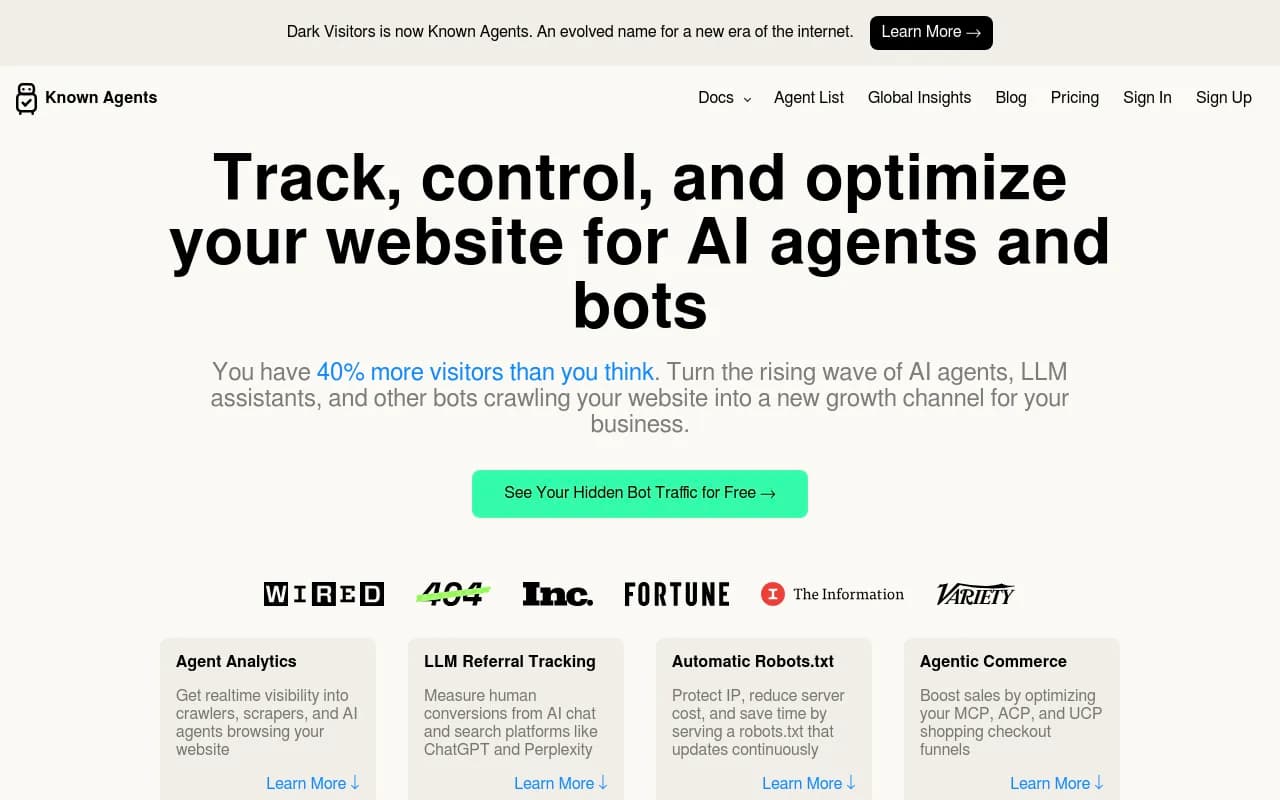
A citation needs a fetch first. Server logs show whether OAI-SearchBot and ChatGPT-User are reading your pages and where they hit errors. That separates an access problem from a content problem: if the bot never reaches the page, no rewrite will help. Promptwatch's crawler logs are IP-verified, which filters out spoofed bots, and its AI crawler traffic report gives you benchmarks. DarkVisitors is a lighter option focused on tracking agents and bots.
Layer 3: tagged and inferred traffic
With no referrer, you have three ways to recover the signal:
- Count visits where utm_source=chatgpt.com. ChatGPT often appends it to links, and Promptwatch's visitor analytics has an optional setting that counts those visits as ChatGPT traffic.
- Watch for the pattern: Direct traffic rising on pages ChatGPT cites, with no matching campaign or email.
- Ask people. Add a free-text field such as how did you hear about us to forms and demos. It is crude and it works.
Add a custom channel group in GA4 for the utm_source value so it stops hiding inside Direct. SegMetrics is built around pulling ChatGPT-sourced leads and sales out of the referral pile, which helps if your question is revenue rather than sessions.

Layer 4: conversions
If the AI visitors you can identify convert at a better rate than other channels, that tells you how valuable the untagged ones are. Crisp saw AI traffic convert at twice the rate of its traditional channels, which is the kind of comparison to run on your own data. Promptwatch's guide to attributing AI traffic covers the setup.
Putting the layers together
| Question | Where to look | Signal |
|---|---|---|
| Are we mentioned? | Prompt tracking | Visibility Score, Share of Voice |
| Which pages get cited? | Citation reports, Page Tracker | Citations per URL, position |
| Can ChatGPT reach us? | Crawler logs, robots.txt | OAI-SearchBot hits and errors |
| Is it sending people? | UTM-tagged visits, Direct trends | Visits to cited pages |
| Is it worth it? | Conversions by channel | Conversion rate vs organic |
The useful habit is correlating them. If a page's citations rise, crawler hits rise first, and Direct visits to that URL climb a week later, you have a causal story good enough to act on. If citations rise but nothing else moves, the answer is probably citing you without sending people, which still shapes decisions.
A simple 30-day routine
- Week 1: confirm OAI-SearchBot access, Bing indexing, and a GA4 channel for utm_source=chatgpt.com.
- Week 2: pick 30 to 50 buyer prompts and record your baseline mentions, citations and sentiment. Profound's advice is worth following here: if ChatGPT does not mention you at all, the fix is content; if it knows you but does not recommend you, the fix is third-party corroboration.
- Week 3: fix the gaps. Rewrite thin product and landing pages, add a comparison page, add a brand FAQ, get into one or two roundups.
- Week 4: re-run the prompts, compare citations, crawler hits and tagged visits per page, and decide what to double down on.
If you want the work done rather than just reported, Promptwatch's Content Agent can plan and publish pages against visibility gaps, and the free AI visibility report is a quick way to get a baseline. Pricing is at promptwatch.com/pricing, and there is a 7-day free trial.
Mistakes to avoid
- Reading the referral drop as lost visibility. Check Direct and tagged traffic first.
- Blocking OAI-SearchBot while trying to block GPTBot.
- Publishing news-style posts and expecting them to stay cited. Half are gone in 36 days.
- Chasing a single rank. Answers vary by prompt, persona and run, so track a panel of prompts over time.
- Ignoring accuracy. A wrong claim repeated across answers does more damage than an absence.
The referrer is gone and it is not coming back soon. The brands that handle it well will be the ones that stopped treating a header as the measure of success and started tracking citations, crawls and conversions together.