
Key takeaways
- ChatGPT cites pages that describe what you sell. In Promptwatch Data (Sep 28 to Oct 4, 2026), product pages got 22.4% of classified citations and landing pages 16.8%. For commercial prompts, product pages reached 26.0%.
- Black Friday is November 27 and Cyber Monday is November 30, 2026. If you're reading this late in the season, focus on fixing existing pages, not publishing new ones.
- Timing matters. News-style deal posts lose half their citations in about 36 days, while landing pages and docs hold up for months.
- Organic citations and ads compete on the same prompts, so treat both as part of one holiday plan and measure them separately.
- Nobody can guarantee placement. Pick a fixed prompt set, run it on a schedule, and judge by what actually gets cited.
Why holiday prompts are worth the effort
OpenAI's own 2026 holiday ads guide says retail and ecommerce conversations now account for more than 1.7 billion prompts on ChatGPT each week (OpenAI internal data, September 2026). It also reports that U.S. product-search activity rose 52% during the 2025 holiday season, and that about 43% of shopping conversations involve comparing and evaluating options.
That last number is the one I'd stare at. Shoppers aren't typing "buy blender." They're asking which blender is better for smoothies under $150, and ChatGPT answers with a shortlist. If you aren't on the shortlist, the sale never reaches your site.
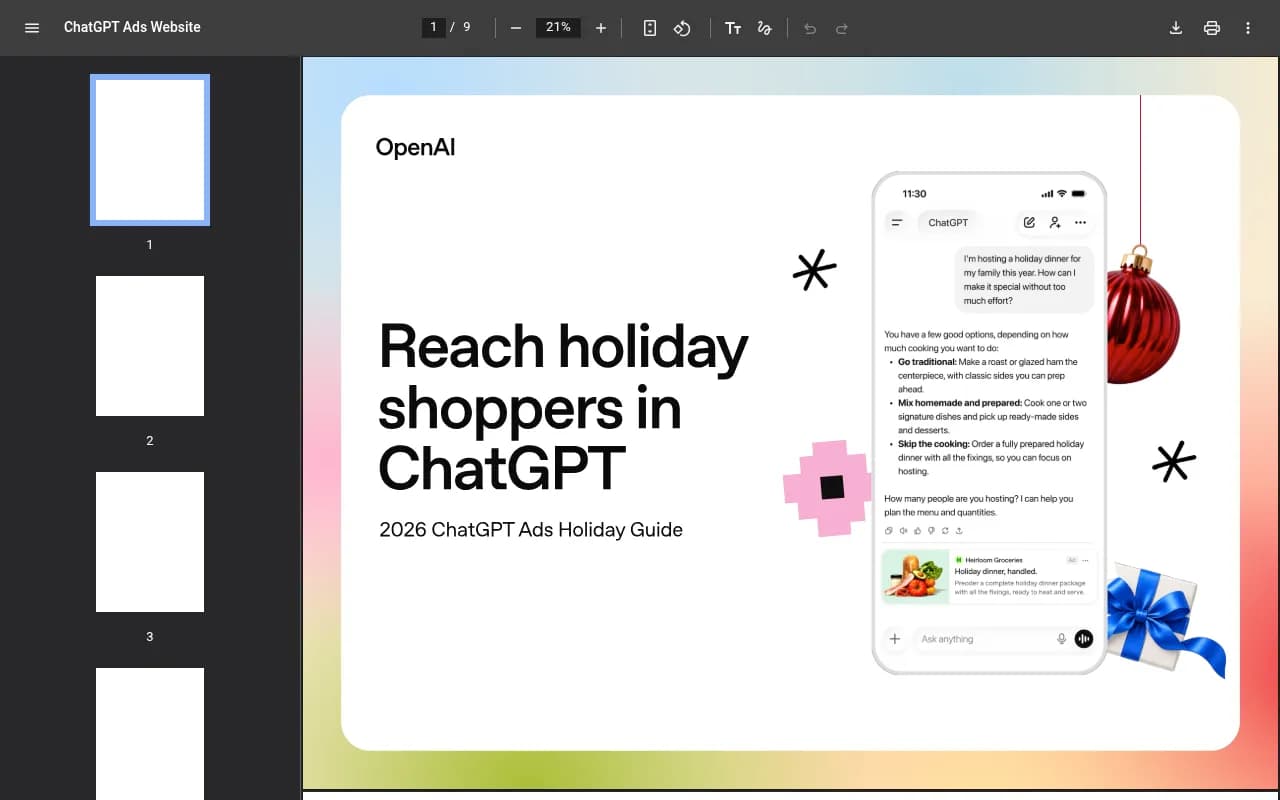
The source above is an ads guide, so read the numbers as OpenAI's framing of its own opportunity. Still, the behavior is real: comparison-heavy, research-first shopping that happens before anyone clicks a retailer link.
What ChatGPT actually cites for shopping prompts
Promptwatch Data's report on ChatGPT citation share by content type (Sep 28 to Oct 4, 2026) is the best starting point for deciding what to build or fix.
| Content type | Share of all citations | Share on commercial prompts |
|---|---|---|
| Product pages | 22.4% | 26.0% |
| Landing pages | 16.8% | 20.6% |
| Listicles | 13.6% | 15.0% |
| Comparisons | 5.9% | 7.9% |
| How-tos | 8.7% | n/a |
| News | 5.7% | n/a |
| Reviews | 1.7% | n/a |
Product pages, landing pages, listicles, and comparisons make up almost 70% of commercial citations. Comparisons punch above their weight on commercial prompts (7.9% against 5.9% overall), which matches the 43% comparing-and-evaluating figure from OpenAI.
On branded prompts, such as someone asking about your store by name, reviews jump to 5.6%, more than three times their overall share, and social posts rise to 3.0%. FAQ pages get 4.8%. So what third parties say about you matters most once the shopper already knows your name.
Step 1: Make sure ChatGPT can read your site
Before content, check access. The research for this guide points to OAI-SearchBot as the crawler that matters for ChatGPT search, and OpenAI states placement is never guaranteed. A page that bots can't fetch can't be cited, whatever its quality.
A quick checklist:
- Open robots.txt and confirm OAI-SearchBot and ChatGPT-User aren't blocked. Blocking GPTBot only stops training use, which is a separate decision.
- Check that your CDN or firewall isn't challenging bots with captchas or returning 403s during traffic spikes. Black Friday is exactly when rate limiting gets aggressive.
- Make sure product and collection pages render their key content in HTML, not only after JavaScript runs.
- Confirm your sitemap is current and includes the holiday landing pages.
Promptwatch has IP-verified AI crawler logs that show which bots hit which pages and where they hit errors, and its free Agentic Readiness Check gives you a fast read on crawler access. The AI Crawler URL Inspector is handy for checking a single page.

Step 2: Rebuild product pages for comparison
The Promptwatch report's advice is plain: make product pages easy to compare, with clear pricing, specs, and target buyer. Shoppers ask ChatGPT about materials, dimensions, compatibility, and weather resistance. If those details live in a PDF or inside an image, the model can't quote them.
For each of your top 20 revenue products:
- State the price, availability, and what the product is for in the first screen of text.
- List specs in plain text or a simple table: materials, sizes, compatibility, warranty, shipping time.
- Say who it's for and who it isn't for. "Best for small kitchens" gives ChatGPT something to match against a prompt.
- Add complete Product schema with accurate price and availability. Promptwatch's shopping data recommends this plus a clean merchant feed.
- Make sure out-of-stock items say so. Stale availability is a good way to get skipped.
A note on shopping cards. Promptwatch's ChatGPT shopping usage data shows product cards attach to only a low single-digit percentage of web-search responses overall, concentrated on commercial and transactional prompts. That page is dated November 2025, so treat the rate as a rough guide, but the pattern held up: the rate moves in steps, which Promptwatch reads as OpenAI tuning when cards appear. You can't count on cards, so don't build a plan that needs them.
Step 3: Build holiday landing pages that last
The content half-life report tracked every page ChatGPT cited on July 6, 2026 for 90 days. News lost half its pages within about 36 days. Landing pages and docs kept most of their citations for months.
That changes how to structure Black Friday content. A post titled "Black Friday deals 2026" is news-shaped and will decay by early January. A stable landing page that you update each year does not.
The discussion from the Black Friday SEO episode with Gagan Ghotra, Harpreet Singh, and David Quaid (Oct 2026) lands in the same place:
- Use a durable URL such as /black-friday and keep it year after year instead of publishing /black-friday-2026 and starting over.
- Target specific buyer searches in the format "Black Friday + product category + deals" instead of one giant page.
- Don't create many near-identical sale pages that compete with each other.
- Own searches for your discount codes and coupons, even outside sale periods.
- Link to the page from your strongest product and collection pages. Internal links from high-authority pages help it rank faster and more stably.
The speakers argue February is a better starting point than October. That's no help now, but it's worth a calendar reminder for next year.
If you're starting late
With days left, skip new content and do this instead:
- Update your existing best-selling category pages with Black Friday offers in the first paragraph.
- Use Google's People Also Ask questions to add short Q&A sections to existing pages.
- Add an FAQ block covering shipping cutoffs, returns, and price matching. Holiday shoppers ask those questions constantly, and FAQ pages pick up citations on branded prompts.
- Submit changed URLs via IndexNow if your stack supports it so search engines notice the updates sooner.
Step 4: Get into the roundups and comparisons ChatGPT already cites
Listicles are 13.6% of citations overall and 15.0% on commercial prompts. For gift guides and "best X for Y" prompts, the page that gets cited is often someone else's roundup. Your job is to appear in it.
Practical moves:
- Run your target prompts and note which roundups get cited. Pitch those publishers with a sample, a discount code, or a data point.
- Publish your own honest comparison pages. Comparisons over-index on commercial prompts, and an honest page that names competitors is more citable than a sales page.
- Collect reviews on third-party sites. Reviews rise sharply on branded prompts.
- Don't ignore Reddit, YouTube, and creator reviews. Social platforms are a small share of ChatGPT citations, and Promptwatch's November 2026 social citations report put them at 0.64% (Oct 11 to Nov 9), with Reddit back as ChatGPT's most cited social platform at 0.4%. They matter far more for Google AI Overviews, where YouTube alone was 6.71%. So treat social as an AI Overviews play first and a ChatGPT play second.
Step 5: Decide how ads fit in
ChatGPT now shows ads. Promptwatch's ChatGPT ads data shows no ads until May 27, 2026, then an average of 20.1% of web-search responses over the following 90 days (32.4% in the last 7 days of that window). Nearly three quarters of ad-bearing responses, 73.3%, were on organic prompts. That data runs through August 17, so check for newer figures, but the implication stands: ads and organic citations compete for the same shopper questions.
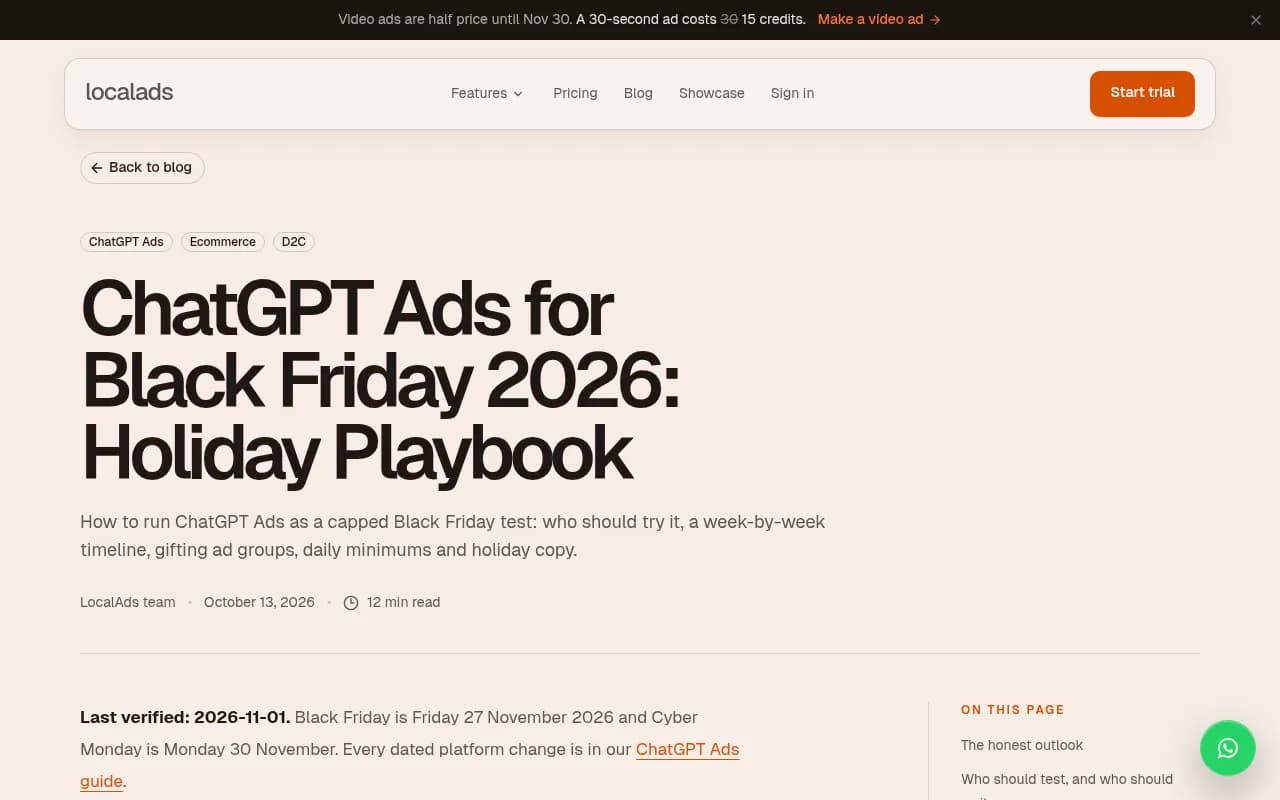
The LocalAds playbook (Oct 13, 2026) takes a sober view. It treats ChatGPT Ads as a capped Black Friday test, not a primary channel, with one ad group per gifting moment and the offer in the short copy line instead of the image. OpenAI's own guide recommends launching two to three weeks before your first key shopping day, which for most advertisers has already passed. If you haven't launched, a capped test for the post-Cyber Monday gifting window is more realistic than a rushed Black Friday start.
My take: organic and paid answer different questions. Organic tells you whether ChatGPT considers you a credible option. Ads buy a slot. If you're absent from the organic answer, ads can paper over it for a while, but you're paying for every click.
Step 6: Build a fixed prompt set and measure
One point from the research is worth repeating: there's no published timeline for ranking in ChatGPT, and results vary run to run. The only honest approach is to track the same prompts repeatedly.
Build 30 to 50 prompts across these buckets:
- Gift prompts: "best gifts for a home cook under $100"
- Category comparisons: "best robot vacuum for pet hair"
- Deal prompts: "best Black Friday deals on headphones"
- Brand prompts: "is [your brand] worth it?"
- Competitor comparisons: "[your brand] vs [competitor]"
Then record whether you're mentioned, where you land in the list, which pages get cited, and what the answer says about you. Also look at query fan-outs, the web searches ChatGPT runs behind the scenes, because they show which phrasing your pages need to match. The query fan-out generator is a free way to start.
| Need | What to use |
|---|---|
| Free first look at brand visibility | Promptwatch's free AI visibility report |
| Prompt tracking and citation analysis, plus content fixes | Promptwatch (Essential from $95/mo; confirm at promptwatch.com/pricing) |
| Shopping cards and sponsored placements | Promptwatch's ChatGPT Shopping and Ads Radar on Business |
| Monitoring-only prompt tracking | Peec AI, Otterly.AI |
| Enterprise AI visibility | Profound |
| Ecommerce-specific AI shopping optimization | Azoma, Goodie AI |



The difference between these categories is what happens after you see a gap. A pure tracker tells you you're missing. Promptwatch also traces the citations behind each answer, flags content gaps against the prompts AI answers, and its Content Agent can draft and publish pages to WordPress, Webflow, or Framer, then check whether they got crawled and cited. For a deeper tool comparison, see Promptwatch's 2026 GEO platform comparison or browse the GEO software directory at bestgeosoftware.com.
Attribution after the rush
Tracking citations is half the job. The other half is knowing whether any traffic came through. ChatGPT stopped sending a referrer on October 8, 2026, so tag links where you can and count visits with utm_source=chatgpt.com. Promptwatch's visitor analytics has a setting for this, and its guide to attributing AI traffic explains the options. Expect undercounting regardless.
A week-by-week plan for what's left of Q4
| When | What to do |
|---|---|
| Now through Nov 26 | Fix crawler access, update top 20 product pages, add FAQ blocks, refresh Black Friday landing pages |
| Nov 27 to Nov 30 | Run your prompt set daily, watch for stock and price errors, keep offers current |
| Dec 1 to Dec 10 | Review which pages got cited, pitch roundup publishers for gift guides |
| Dec 10 to Dec 20 | Shipping cutoff content, last-minute gift pages, stocking stuffer comparisons |
| January | Keep the evergreen landing pages, retire news-style posts, plan next year's February start |
Promptwatch's own Black Friday offer (30% off, ending November 30) is listed at promptwatch.com/black-friday if you want to start tracking before the weekend. It also offers a 7-day free trial on monthly plans.
Common mistakes
- Publishing a dozen near-identical sale pages that cannibalize each other.
- Putting the offer only inside an image where text-based crawlers can't read it.
- Leaving expired prices or sold-out items live.
- Judging success from a single ChatGPT run. Answers vary, so use a prompt set and average over time.
- Treating a deals post as an evergreen asset when it decays in about five weeks.
- Assuming schema alone wins citations. Schema and merchant feeds help shopping features, but they won't rescue a thin page.
FAQ
Can you pay to rank in ChatGPT answers?
You can buy ad placements through ChatGPT Ads, but those are labeled and separate from organic citations. Organic placement can't be bought and isn't guaranteed.
How long does it take to appear in ChatGPT recommendations?
There's no published timeline. A page has to be discovered, judged useful for the prompt, and chosen over other sources. Measure the same prompts on a schedule instead of expecting an instant result.
Which pages matter most for Black Friday prompts?
Product pages and landing pages carry the largest citation shares, followed by listicles and comparisons. Fix those before writing anything new.
Is it too late to start before Black Friday?
For new content, mostly yes. For crawler access, product page details, FAQ blocks, and landing page updates, no. Those can ship in a day or two, and they keep paying off through the December gifting window.
Should I still bother after Cyber Monday?
Yes. OpenAI reports that 2025 product-search activity rose 52% across the full November and December period, not just Cyber Five. Gifting prompts keep coming until late December.