Key takeaways
- Pages labelled "Comparison" are only 3.6% of AI Overviews citations in July 2026. Listicles (18.0%), product pages (16.3%) and how-tos (15.1%) did most of the work, so a good X vs Y page borrows from all of them.
- Lead each page with a short verdict, then a side-by-side table, then detail. Extraction is the goal, not scroll depth.
- Video matters more than most comparison writers assume. YouTube is the largest social source in AI Overviews at 4.28% of citations.
- Citations across AI platforms overlap very little, so measure Google AI Overviews separately from ChatGPT and Perplexity.
- Track which of your comparison queries trigger an overview, whether you are cited, and who is cited instead. Fix the gaps page by page.
Why comparison queries are their own problem
A search like "Notion vs Obsidian" or "HubSpot vs Salesforce" has a different shape from "what is a CRM." The searcher already knows the options. They want a verdict, or at least a framework for deciding. AI Overviews answer this by pulling a few attributes per option, lining them up, and often adding a "best for" line.
That means your page is not competing to be the one result people click. It is competing to supply the individual facts the overview assembles. If your pricing, your limits and your honest tradeoffs are easy to lift, you get cited. If they are buried in 400 words of preamble, you do not.
The Pew Research Center's 2025 study of 68,879 real Google searches found that 8% of users who saw an AI Overview clicked a traditional result, against 15% without one (as summarized in the Devenup guide). Whatever your exact numbers, the click you do get from a citation is worth more because the reader arrives already interested in your option.
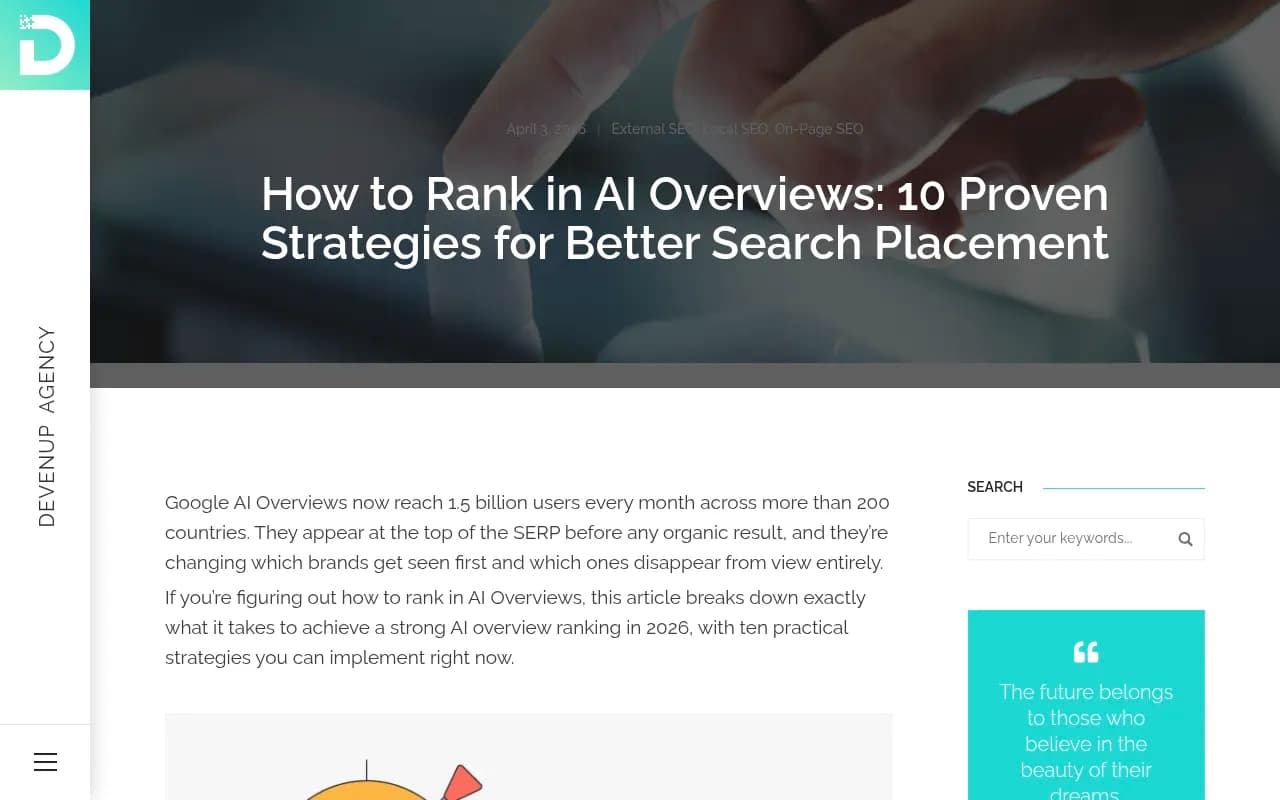
The Devenup piece makes a point worth keeping: comparison queries need "structured side-by-side treatment, ideally in a table," while definition queries need one clean sentence and how-to queries need distinct steps. Many X vs Y pages fail because they are written like essays.
What AI Overviews actually cite
Before designing a page, look at what gets cited. Promptwatch Data tracked citation types in Google AI Overviews for July 2026 (full report):
| Content type | Share of AI Overviews citations (Jul 2026) |
|---|---|
| Listicle | 18.0% |
| Product page | 16.3% |
| How-to | 15.1% |
| News article | 13.5% |
| Video | 5.9% |
| Social post | 5.1% |
| Landing page | 4.7% |
| Comparison | 3.6% |
Two things stand out. First, listicles lost the top spot for the first time. From July 28, product pages were the most cited format every day, ending the month at 17.9% against 16.2% for listicles. Listicles averaged about 26% in Q1 2026, so that is a real drop. Product pages were around 9% in January and have nearly doubled.
Second, the "Comparison" label is small. My read, and it is an inference rather than something the report states, is that comparison intent gets served by listicles, product pages and how-tos instead. A page does not need to be tagged as a comparison to be cited for one. It needs to contain the comparison facts in an extractable form.
So the practical lesson: do not build a thin "A vs B" page and hope the format name carries it. Build a page that works as a product page for both options, reads like a short list of criteria, and ends with a how-to-choose section.
The anatomy of an X vs Y page that gets cited
Open with the verdict
Put two or three sentences at the top that answer the query. Name both options, say who each is for, and state the deciding factor. For example: "Tool A is better for small teams that want a flat price. Tool B is better if you need advanced permissions and are willing to pay per seat."
This is the passage a model can quote. It also happens to be what a human wants.
Follow with a comparison table
Put a table directly under the verdict. Keep it to the criteria people actually search for: price, limits, integrations, learning curve, support, and one or two differentiators. Use real numbers and name the plan tier. "Starts at $29/mo per user, billed annually" is useful. "Affordable" is not.
A simple template:
| Criterion | Option A | Option B |
|---|---|---|
| Starting price | $29/mo per user | $49/mo flat |
| Free plan | Yes, 3 users | No, 14-day trial |
| Best for | Small teams | Larger orgs |
| Biggest limitation | No SSO below top tier | Steeper setup |
According to the Devenup guide, 78% of AI Overview responses feature ordered or unordered lists. Tables and lists are both easy to extract, so use them. I have seen pages jump simply because a buried paragraph was turned into a list of five labelled differences.
Give each criterion its own heading
Under the table, write one short section per criterion: "Pricing," "Ease of use," "Integrations," "Support." Start each with a one-sentence answer, then add detail. Passage-level clarity matters. The model may only lift one section, so each one has to stand on its own without "as mentioned above."
Be honest about tradeoffs
Pages that declare one option the winner on every axis read like ads, and they are rarely the best source for a neutral synthesis. State where the option you favor is worse. It makes the page more trustworthy to readers and gives a model balanced material to cite.
End with a decision section
A short "Which should you choose?" with three or four if-then lines. These double as the how-to-style content that makes up roughly 15% of AI Overviews citations.
Cover the neighbors of the query
People rarely stop at "A vs B." They also search "A alternatives," "is A worth it," "A pricing," and "A vs C." The overview for your main query often draws on pages answering these adjacent questions.
Build a small cluster:
- One head-to-head page for each pair that gets meaningful search interest
- A best-of list for the category, since listicles are still the largest single format
- Product or feature pages for your own offering with structured specs and clear pricing
- An alternatives page for each major competitor
Link these to each other with descriptive anchors. A LinkedIn write-up on ranking in AI Overviews makes a related point: rank on the visible query first, and get into the top 20 for the topic cluster, rather than assuming position 1 is required. Cluster strength helps more than one perfect page.
Product pages count as comparison content
If you sell one of the options, your own product page is probably under-built for this. Promptwatch's advice in the July report is to give product pages the same AI Overviews attention as editorial content: structured specs, clear pricing and fresh availability data. Add a short "How we compare" block with a few honest rows. Keep prices current. Stale pricing is the fastest way to lose a citation to a competitor's page that is updated.
Do not ignore video
Video is a bigger comparison route than most written-content teams realize. In Promptwatch's October 2026 data (Sep 28 to Oct 4), Google AI Overviews got 12.2% of its citations from social platforms, about 26 times ChatGPT's share. YouTube led at 4.28%, followed by Facebook (2.38%), Reddit (2.15%), Instagram (1.61%) and LinkedIn (1.55%). The full social citation report has the breakdown.
Video as a whole rose from about 2.7% of AI Overviews citations in January to over 6% by late July, per the July citation types report.
A practical move: for every high-value comparison page, record a 5 to 8 minute YouTube video that follows the same structure. Verdict first, then criteria, then recommendation. Put the table on screen. Add chapters with timestamps that match your page headings, and write a description that repeats the verdict. Embed the video on the page.
A note on Reddit: it still appears in AI Overviews at 2.15%, but Promptwatch Data shows ChatGPT has nearly stopped citing it (0.09% in that week). Do not build a comparison strategy that depends on Reddit threads reaching ChatGPT.
Google is not the only audience
The Ahrefs AEO course makes a point I agree with: citation overlap across AI platforms is tiny. Per the course description, AI Overviews favor established authorities and surface a lot of YouTube and Reddit, ChatGPT leans toward high-DR publishers and licensed media, and Perplexity tracks traditional Google results more closely. Optimizing identically everywhere leaves visibility on the table.
For comparison content this means checking each platform separately. A page that wins in AI Overviews may be invisible in ChatGPT. Promptwatch's data on ChatGPT also shows mid-authority sites (DR 46 to 75) earned almost half of citations in August 2026, while DR 91 to 100 fell to about 3% (report). So a mid-size site with a sharp comparison page has a real shot.
Technical hygiene that comparison pages tend to skip
- Keep the table in real HTML, not an image or a JavaScript widget that does not render without interaction
- Use plain headings for each criterion so passages are easy to isolate
- Add structured data where it fits (Product, FAQ) and keep it consistent with the visible content
- Show an updated date and mean it. Prices and features change
- Make sure AI crawlers are not blocked in robots.txt, and check server logs for errors on these pages
- Skip markdown file tricks for this purpose. Promptwatch Data found markdown files are only 0.05% of AI search citations (report)
Measuring whether it works
Ranking for comparison queries is hard to eyeball because overviews vary by location, wording and time. You need a repeatable list of queries and a way to see, for each one, whether an overview appears, whether you are cited, and which pages are cited instead.
Build your query list from the real variants: "A vs B," "A versus B," "A or B," "A compared to B," "is A better than B for [use case]," and "A vs B pricing." Add your own brand against each major competitor.
Then pick a tracker. Several tools in our catalog cover this. Promptwatch tracks the real UI of Google AI Overviews, AI Mode, ChatGPT, Perplexity and others, and shows prompt volumes, citations and the sources that win, which makes the gap analysis for comparison queries concrete. It also has an Action Board and a Content Agent for the follow-up work, which most pure trackers do not.

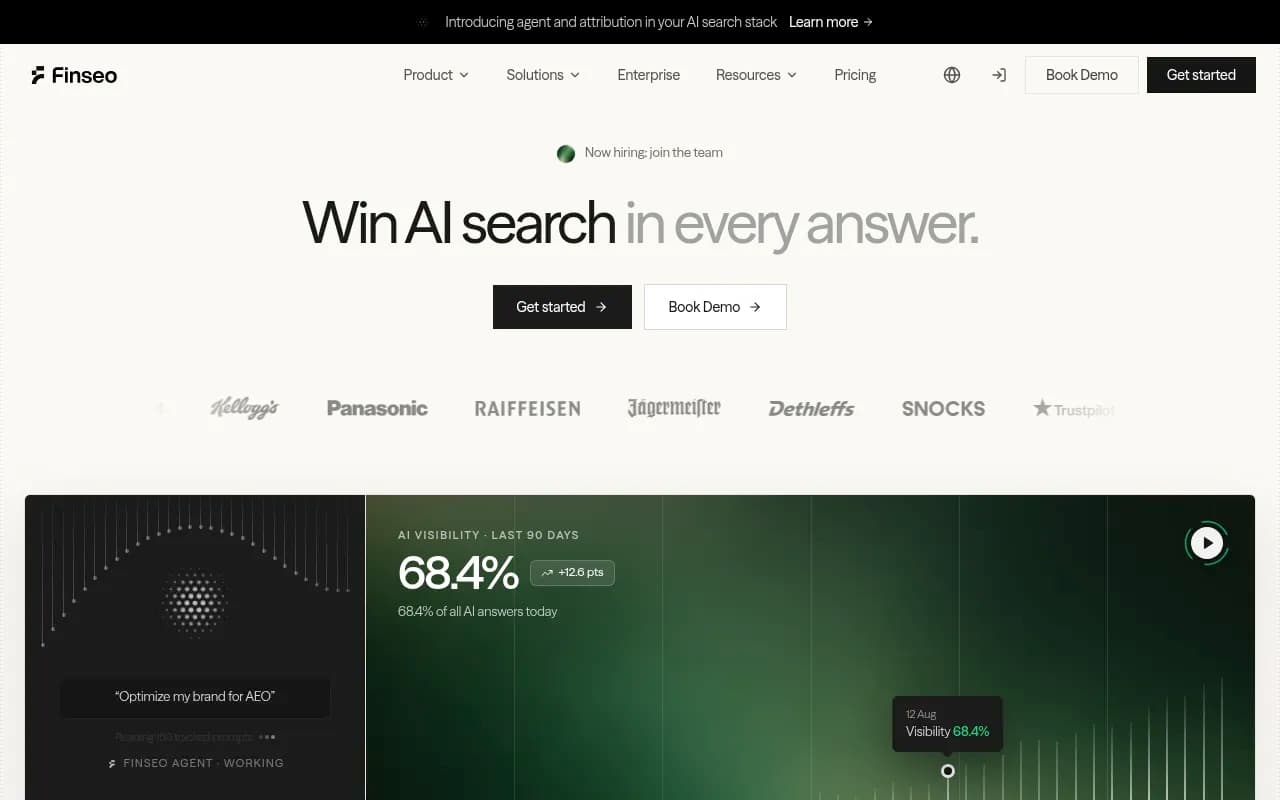
If you want a lighter or differently-priced option, a few others are worth a look. Finseo is built around AI Mode and AI Overviews tracking specifically.
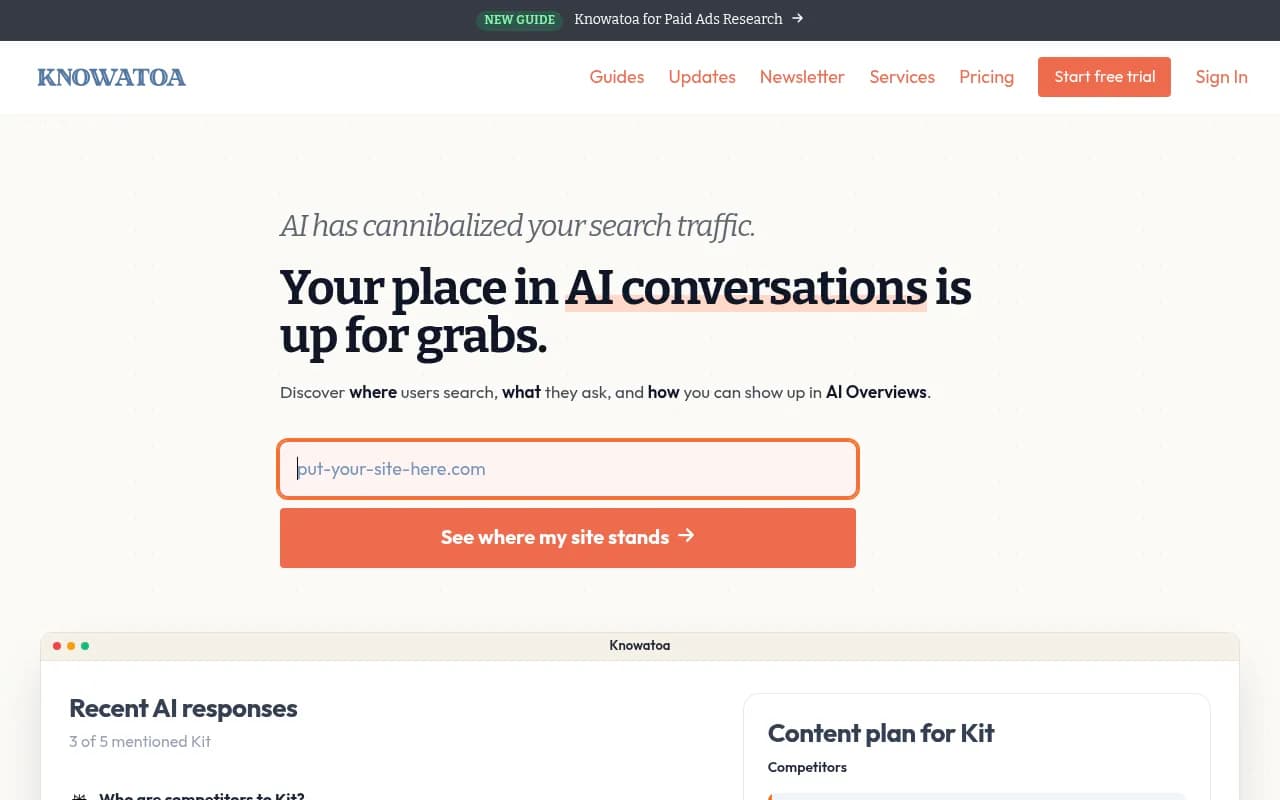
Knowatoa also focuses on AI Overviews and AI Mode brand monitoring.
Thruuu is aimed at content teams that want to monitor AI Overviews alongside their briefs.
If you already pay for a classic SEO suite, check what it offers before adding another subscription. Semrush and Ahrefs Brand Radar both added AI features, though prompt sets and depth are more limited than in dedicated platforms.
| Tool | Best fit for comparison tracking | Notes |
|---|---|---|
| Promptwatch | Tracking plus fixing gaps | Real-UI tracking, citation data, content agent, crawler logs |
| Finseo | AI Overviews and AI Mode only | Narrow focus |
| Knowatoa | AI Overviews and AI Mode brand monitoring | Monitoring-oriented |
| Thruuu | Content teams doing briefs | AI Overview monitoring in a content workflow |
| Semrush | Existing Semrush users | AI tracking bolted onto an SEO suite |
| Ahrefs Brand Radar | Existing Ahrefs users | Good for seeing which domains cite your brand |
For more options, the GEO software directory at bestgeosoftware.com lists the wider field.
A workflow you can run this month
- List your 20 most valuable comparison queries, including your brand against each main competitor.
- Check which trigger an AI Overview and who is cited. Save the cited pages.
- For each, compare the cited page to yours. Is theirs table-first? Fresher? Does it have a video?
- Rewrite your page: verdict, table, one section per criterion, decision guide.
- Update product pages with structured specs and current pricing.
- Record a companion YouTube video and embed it.
- Re-check in two to four weeks. Citations move faster than rankings, but do not expect overnight change.
- Watch for decay. Promptwatch Data on ChatGPT found news lost half its cited pages within 36 days while landing pages and docs lasted longest (report), so evergreen comparison pages that you keep updated should hold up better than anything dated.
Mistakes that keep pages out of overviews
- Opening with 300 words of background before any comparison
- Writing "both are great options" with no verdict
- Tables with vague cells like "good" and "better"
- Pricing that is a year old
- One page trying to compare six tools, so no pair is covered properly
- Treating Google, ChatGPT and Perplexity as one channel
Bottom line
A comparison page that wins in AI Overviews is not mysterious. It answers in the first lines, puts facts in a table, gives each criterion its own passage, stays current, and has a video and a strong product page behind it. Then you track real queries and fix what the data shows. The format label matters less than the extractable content inside it.