Key takeaways
- A one-page AI Overviews audit works because it answers five questions in order: why you audited, what you tested, what you found, what it means for the business, and what to do next. Write it last, put it first.
- Pull data from at least two places: Google Search Console's generative AI performance data (free, first-party) and an AI visibility platform that tracks citations across engines.
- Always benchmark against named competitors. A visibility score with no reference point tells your boss nothing.
- One-shot audits go stale fast. Citation shares swing 40%+ in a single month, so build the report with a monthly refresh cadence in mind.
- Agencies commonly charge $500–$1,500 for a branded AI visibility audit as a standalone deliverable, so a good one-pager has real monetary value beyond internal reporting.
Why one page, and why now
Your boss or client does not want a 40-slide deck about generative engine optimization. They want to know one thing: are we showing up when AI answers questions about our category, and if not, what are we going to do about it?
The stakes are real. AI Overviews now appear in roughly half of Google searches, and a majority of searches end without any click. Meanwhile, the citation slots are scarce. Promptwatch's data on average sources per response shows Google AI Overviews cite about 10 sources per answer, ChatGPT around 5, and Perplexity almost exactly 10. Compare that to Google's traditional 10 blue links plus ads, and you can see the inventory shrank while the number of contestants grew.
A one-pager forces you to cut the noise. If an executive can read it in two minutes and act on it, you've done your job. Everything else lives in an appendix you never present unless someone asks.
Step 1: Set the scope before you touch a tool
Skipping this step is how audits end up messy and incomparable month to month. Decide three things first:
- The prompt set. Pick 20–50 prompts that mirror how real people ask AI about your category. Mix discovery prompts ("best CRM for small nonprofits"), comparison prompts ("[Competitor] vs [You]"), and factual prompts ("how much does [product] cost"). Testing only one style under-represents how buyers actually search.
- The platforms. At minimum: Google AI Overviews, ChatGPT, and Perplexity. Add Gemini and Claude if budget allows. Testing a single model gives you a partial, sometimes flatly wrong picture.
- The competitors. Name 2–4. Without a competitive baseline, your visibility numbers have no reference point. "We appear in 12% of AI Overviews" means nothing until the client hears "your top competitor appears in 41%."
One more scoping decision that trips people up: keep native mode and web-search mode separate. ChatGPT answering from its own training data and ChatGPT with live search triggered are two different systems with two different citation behaviors. Blend them into one score and you'll hide where visibility is actually coming from.
Step 2: Gather the data
Google Search Console (free, first-party)
Since June 2026, Google has been rolling out a dedicated Generative AI performance report in Search Console, covering how your URLs appear in AI Overviews, AI Mode, and generative AI features in Discover. If your site has it, this is your best free source for impressions and clicks from AI surfaces.
If it hasn't rolled out to you yet, the interim method works: Performance → Search Results, then use the search type dropdown, which now includes AI Overviews and AI Mode as selectable segments. Drill into queries and pages from there.
One caveat worth putting in a footnote of your report: Google only counts an AI Overview impression when the citation link is actually scrolled or expanded into view. So GSC likely undercounts your true appearance rate. Say this out loud in the presentation, because someone will ask why the numbers look low.
An AI visibility platform
Search Console tells you that you appeared somewhere. It does not tell you who else appeared, what content types are winning, or whether AI describes your brand accurately. For that you need a visibility platform. Promptwatch is the one I'd point to here, because it tracks citations across AI Overviews, AI Mode, ChatGPT, Perplexity, Claude, and Gemini from real UI data, and it includes crawler logs that show whether AI bots can even read your pages in the first place.

If budget is tight, there are cheaper single-engine options. Thruuu monitors AI Overviews specifically from $19/mo, which is the cheapest entry point if Google's surfaces are all you care about right now.
Manual spot checks
Even with a platform, run 10–15 prompts by hand in an incognito window the day before you present. Screenshots of real AI Overviews and ChatGPT answers are the most persuasive artifacts you can put on a page. A chart says "we have a problem"; a screenshot of a competitor getting recommended while you're absent says "fix this."
Step 3: The one-page structure, block by block
Here is the layout I'd use. Seven blocks, top to bottom.
Block 1: Header and verdict (2 lines)
Company name, audit period, your name, and one sentence: "We appear in X% of tracked AI Overviews prompts vs. Competitor A at Y%. Primary gap: commercial comparison content."
That last clause matters. A verdict without a diagnosis is just a number.
Block 2: The headline metric
One big number, centered. I'd use AI Overview citation rate across your prompt set (percentage of prompts where at least one of your pages is cited). Below it, two smaller numbers: your rate last month (trend) and the competitor average (context).
Block 3: Platform snapshot
A small table, one row per engine:
| Engine | Your visibility | Top competitor | Trend vs. last month |
|---|---|---|---|
| Google AI Overviews | 14% | 38% | +3 pts |
| ChatGPT (web search) | 9% | 44% | flat |
| Perplexity | 11% | 29% | +2 pts |
| Gemini | 6% | 31% | -1 pt |
This block usually generates the most conversation, because the spread between engines is often surprising. Clients assume visibility is uniform. It never is.
Block 4: Competitive benchmark
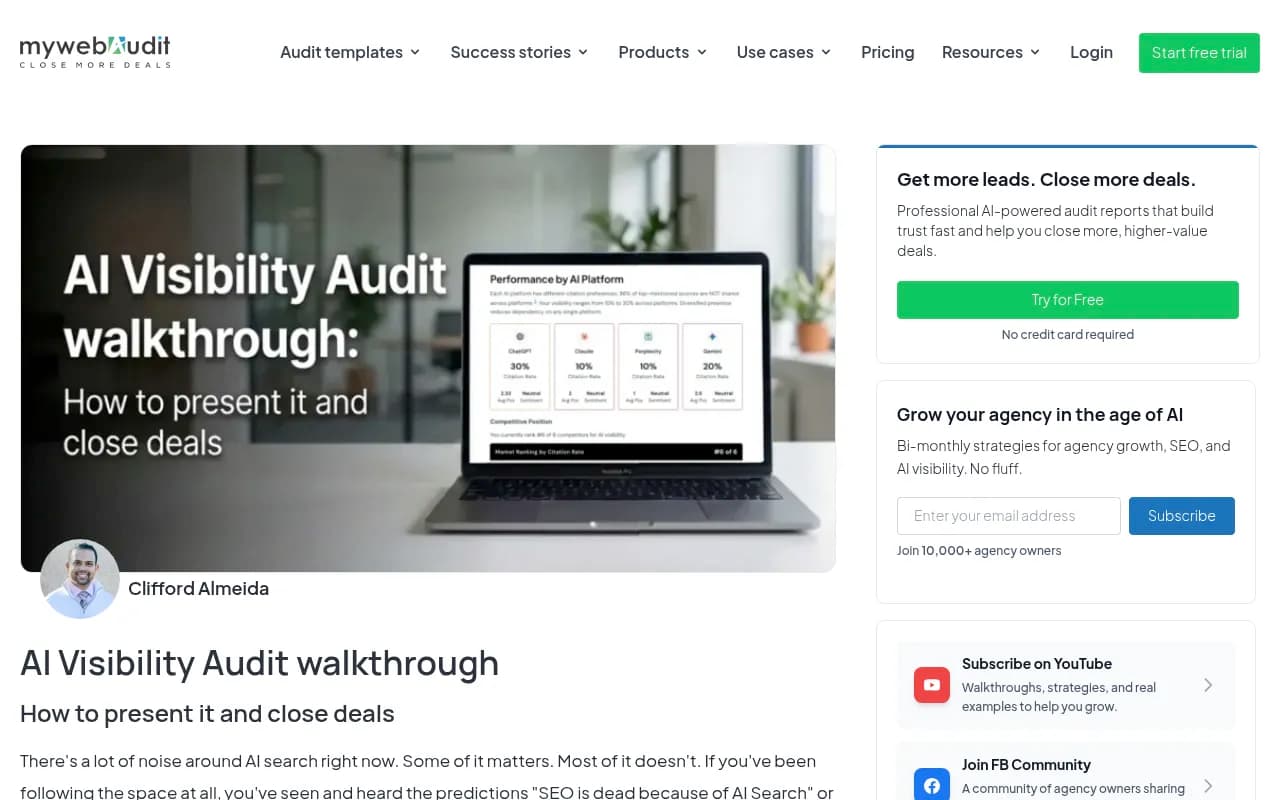
A share-of-voice bar comparing you against your named competitors across the full prompt set. This is where the emotional punch lives. One agency walkthrough I read described a client's reaction perfectly: "So my competitor is showing up on ChatGPT for every search term I care about, and I'm not on there at all?" That sentence closes deals. Your job is to make that gap visible.
Block 5: What AI is citing (and what it's citing instead of you)
This is the diagnostic block, and it's where you earn your fee. Two things to show:
Content types. The mix of content AI Overviews cite has shifted hard in 2026. Per Promptwatch's July 2026 citation-type data, the breakdown was roughly: listicles 18%, product pages 16%, how-tos 15%, news 13.5%, video 6%, social posts 5%. Notably, product pages overtook listicles as the most-cited format on July 28, 2026, the first time that's happened since tracking began. If your audit shows you're investing in listicles while competitors have citation-worthy product pages, that's a finding your boss can act on.
Who's winning in your category. For context, Google AI Overviews' top cited domains in June 2026 were YouTube (4.16%), Reddit (2.72%), and google.com (2.30%), with the top three holding over 9% of all citations, roughly double their January share. On ChatGPT, Reddit led at 3.71% in June, but that was actually a ~40% drop from May, a reminder that these shares move fast. Use these as a frame for "here's the kind of source AI engines reward in your niche," not as a template, since the mix varies heavily by category.
Block 6: Business impact
Tie visibility to something the finance team recognizes. Three lines is enough:
- AI referral sessions and conversions this month (GA4)
- GSC AI Overviews impressions and clicks
- One proxy metric, like branded search volume, if direct AI traffic is still small
Be honest about attribution gaps. Someone who sees your brand in ChatGPT and then googles you an hour later shows up in GA4 as organic or direct, not AI. A simple "How did you hear about us?" survey field with an AI-search option catches conversions that analytics misses. Mentioning this makes you look rigorous rather than making you look like you're inflating a weak channel.
Block 7: Next actions (max three)
Three items, each with an owner and a date. Not twelve. Good candidates:
- Fix the pages AI crawlers hit errors on (your platform's crawler logs will tell you which)
- Build or update the two comparison pages competitors are getting cited for
- Publish the product-page content that AI Overviews increasingly rewards
End with the re-audit date. A one-off audit is obsolete within about 30 days given how fast citation patterns drift, so state the cadence on the page itself: "Next audit: October 2026."
Tools worth putting in your stack
A quick comparison of the platforms I'd consider for producing this report monthly:
| Tool | Starting price | Engines covered | Best for |
|---|---|---|---|
| Promptwatch | $95/mo | 11+ including AI Overviews, AI Mode, ChatGPT, Perplexity, Claude, Gemini | End-to-end: tracking plus crawler logs and content fixes |
| Otterly.AI | $29/mo | 4 engines at entry tier | Budget monitoring |
| Peec AI | $95/mo | 3 engines at entry tier | Multi-language tracking |
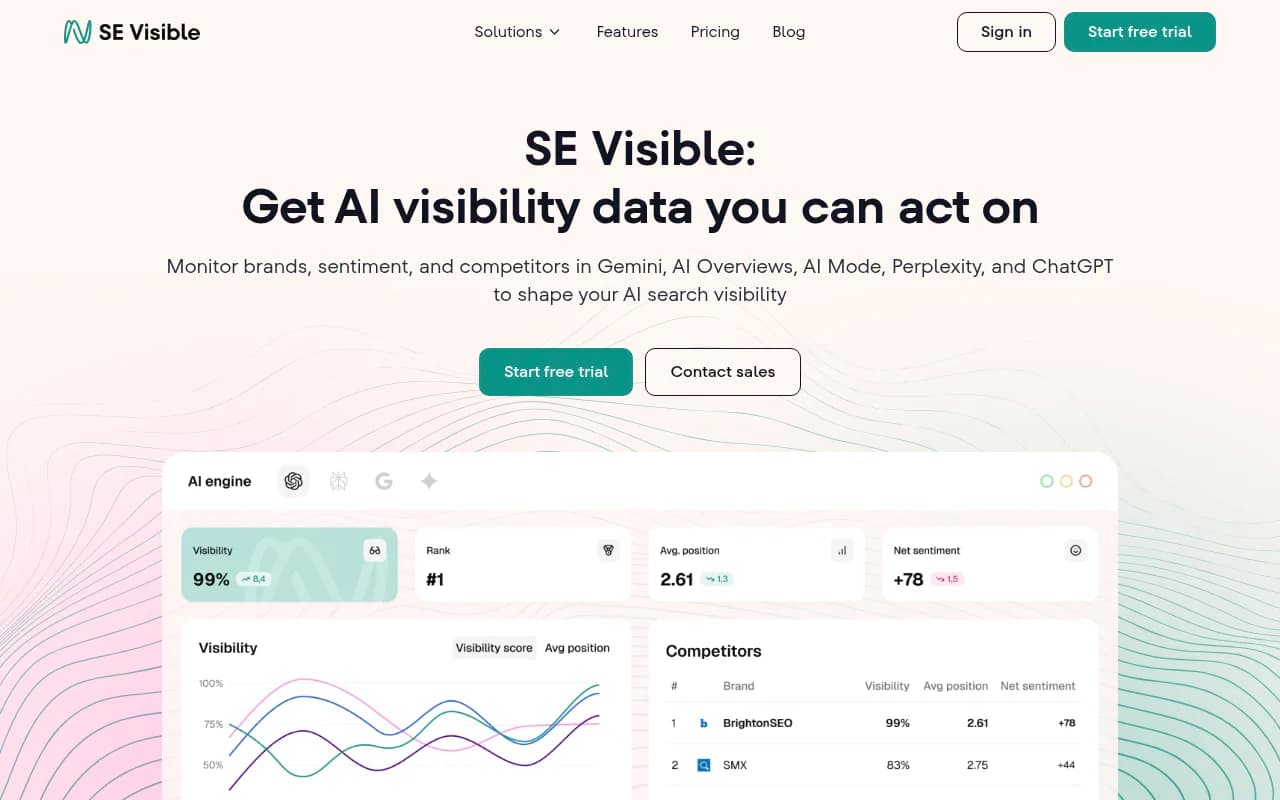
| SE Visible (SE Ranking) | ~$99/mo | 5 engines | Agencies already on SE Ranking |
| Semrush AI Visibility | $99/mo per domain | 6 engines | Teams already in Semrush |


If you're evaluating a wider field, the directories at ai-rank-tools.com and bestgeosoftware.com maintain current lists of AI rank trackers and GEO platforms with reviews.
Mistakes that sink these reports
I've seen (and made) most of these:
- Testing one model and generalizing. Visibility on ChatGPT does not predict visibility in AI Overviews. They cite different sources at different rates.
- Skipping hallucination checks. Check whether AI answers describe your brand accurately, not just whether you're mentioned. Being cited with wrong pricing or an outdated product description is worse than being absent. Practitioners call this the most dangerous shortcut in GEO audits, and they're right.
- Presenting a blended visibility score. One number across all engines hides the engine where you're actually winning or catastrophically losing.
- Reporting mentions without traffic. Mentions are a leading indicator, but at some point your boss will ask what it drove. Have the GSC and GA4 numbers ready even if they're small.
- Treating the audit as a one-time project. Models update, competitors adapt, and citation shares swing wildly month to month. Build the one-pager as a recurring artifact from day one.
Presenting it
Walk through the blocks in order, but spend 70% of your time on blocks 4 and 5 (the competitive gap and the diagnosis). Open with the verdict sentence, show the competitor screenshot, then land on the three actions. If you're an agency presenting to a prospect, this format is a proven foot-in-the-door: agencies commonly charge $500–$1,500 for a branded audit plus consultation, and use it to open conversations about implementation work in the $2,000–$10,000 range.
One last thing. The first version of this report will take you a full day. The second will take three hours. By month three, with your prompt set locked and a platform pulling the data automatically, you'll produce it in under an hour, and it will be the page your client reads before anything else you send them.