Key takeaways
- A single prompt in ChatGPT generates an average of 3.51 sub-queries, with 67.3% of prompts triggering more than one search behind the scenes.
- Commercial prompts (like "best dash cam") can fan out into 5-8 sub-queries that collectively map an entire buyer decision journey.
- ChatGPT, Perplexity, and Claude each have distinct fan-out behaviors -- Perplexity stays closest to the original query, while ChatGPT acts more like a researcher rewriting your question entirely.
- At scale, 34% of ChatGPT's fan-outs are exact repeats -- meaning there's a predictable, optimizable set of sub-queries for any given topic.
- If your content only answers the literal prompt, you're invisible to most of what the AI is actually searching for.
When you type a question into ChatGPT or Perplexity, you're not sending one search. You're triggering a cascade. The AI breaks your question apart, fires multiple searches in parallel, reads several pages, and synthesizes everything into one answer. The searches you never see are called query fan-outs -- and they're arguably the most important thing happening in AI search right now.
This analysis pulls together data from multiple studies covering hundreds of thousands of prompts to answer a simple question: how many sub-queries does one prompt actually generate, and what does that mean for anyone trying to show up in AI answers?
What query fan-out actually is
The term comes from Google. When it launched AI Mode, Google described the feature as using a "query fan-out technique, issuing multiple related searches concurrently across subtopics and multiple data sources and then brings those results together." ChatGPT and Perplexity do the same thing under different names.
The mechanics are straightforward. A user asks: "Compare Slack vs Teams for developers." The AI doesn't search for that exact phrase. Instead, it plans:
- What are the developer-specific features of Slack?
- What are the developer-specific features of Teams?
- What is the API rate limit for Slack?
- How does Teams integrate with GitHub?
- What is the pricing difference?
All five searches run in parallel. The AI reads the results, extracts the relevant facts, and writes a single synthesized answer. You see one response. Behind it was five separate retrieval operations, potentially pulling from five different websites.
This is chain-of-thought reasoning applied to search. The intermediate reasoning steps become the sub-queries. The final answer is grounded in retrieved passages rather than the model's training data alone -- a technique called retrieval-augmented generation (RAG).
The numbers: how many fan-outs per prompt?
Here's where it gets interesting, and where different data sources tell slightly different stories.
The Qwairy 102K study (Q3 2025)
The most comprehensive public dataset on this comes from Qwairy, which analyzed 102,018 queries. Their findings:
- ChatGPT averages 3.51 searches per prompt
- 67.3% of prompts trigger multiple sub-queries
- The remaining 32.7% of prompts get a single search (usually very simple, factual questions)
The Profound 10K study (April 2026)
Profound tracked 10,000 prompts across three AI engines over 14 days. Their headline finding was more conservative: about 1.4 to 2 searches per prompt run. But they were quick to point out that the raw count isn't where the interesting differences are. The gap between engines is in what they search for, not how many times they search.

The Peec AI 5M fanout study (April 2026)
Peec AI analyzed 5 million query fan-outs collected between April 1-21, 2026, across ChatGPT, Perplexity, and Grok. This is the richest dataset for understanding patterns rather than raw counts.
Key finding: a commercial prompt like "best dash cam" can produce 5-8 fan-outs that collectively map the entire decision journey a buyer would go through -- reviews, comparisons, specific models, current year results, price ranges.

The LinkedIn scale study (1,000+ runs)
David Konitzny published findings showing that at scale (1,000+ prompt runs), 34% of ChatGPT's query fan-outs are exact repeats. This is significant. It means ChatGPT's fan-out behavior isn't random -- there's a predictable core set of sub-queries that fire consistently for any given topic. You can identify them, and you can optimize for them.
Summary table: fan-out counts by engine
| Engine | Avg sub-queries per prompt | Notes |
|---|---|---|
| ChatGPT | 3.51 (Qwairy) / 1.4-2 (Profound) | Wide variance; commercial prompts reach 5-8 |
| Perplexity | ~1.4-2 | Closest to original query intent |
| Claude | Varies; lower than ChatGPT | Less aggressive decomposition |
| Google AI Mode | Multiple concurrent | Google's own "fan-out" term; parallel sub-topic searches |
The variance between studies is partly methodological -- Qwairy measured unique sub-queries, Profound measured search executions. Both are valid, they're measuring slightly different things.
How each engine behaves differently
The Profound research put it well: ChatGPT acts as a researcher. It casts a wide net of queries that are semantically similar to the user prompt but lexically different -- translating natural language into fact-retrieval strings. Perplexity is the closest to the original query. Claude tends to decompose less aggressively.
ChatGPT's rewriting behavior
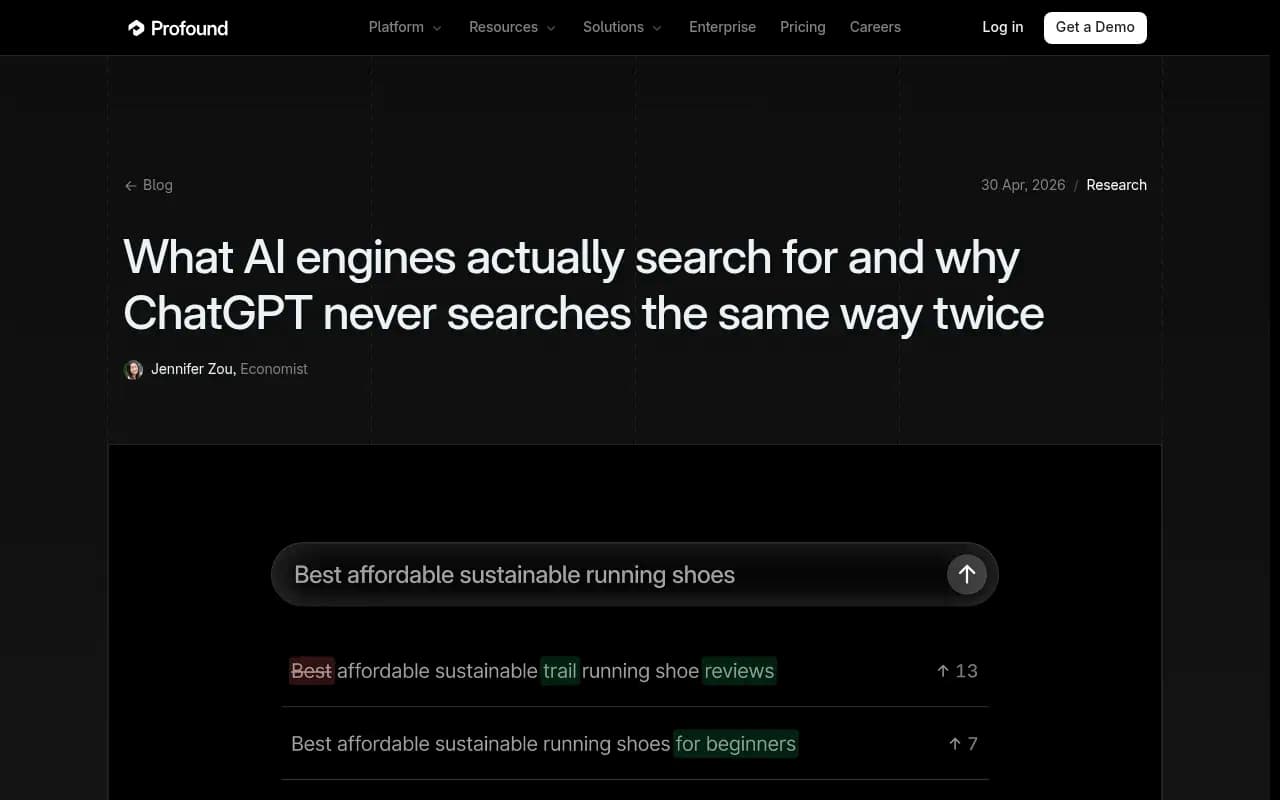
ChatGPT doesn't just break your question into parts -- it rewrites them. The Peec AI analysis of 5 million fan-outs found that ChatGPT consistently injects specific words that weren't in the original prompt. The top word ChatGPT secretly adds? "Best." The third most injected word: "reviews."
This tells you something concrete about how ChatGPT thinks about retrieval. It's not looking for your exact question. It's looking for the authoritative, evaluative content that would help it answer your question. "Best" and "reviews" are signals it uses to find comparison content and third-party evaluations.
Other patterns from the Peec AI data:
- ChatGPT adds the current year to many queries (it wants fresh content)
- It frequently adds brand names that weren't in the original prompt
- It breaks comparison queries into separate single-subject queries before recombining
Perplexity's behavior
Perplexity stays closer to the original query. It's more like a traditional search engine that happens to synthesize results -- it doesn't rewrite as aggressively. This means if you're optimizing for Perplexity, your content needs to match the user's actual phrasing more closely than it does for ChatGPT.
Grok's sourcing patterns
The Peec AI research noted that Grok has a distinct set of trusted sources it returns to consistently -- a "window into how it researches." Grok's fan-outs tend to be more news-oriented and real-time, reflecting its X (Twitter) integration and focus on current events.
What this means for content strategy
If you're only optimizing for the literal prompt, you're missing the majority of what the AI is actually searching for. Here's how to think about it differently.
Map the fan-out cluster, not just the keyword
For any target prompt, you need to identify the sub-queries that AI engines will fire. A prompt like "best CRM for small business" doesn't just trigger a search for that phrase. It probably triggers:
- "best CRM small business 2026"
- "CRM software reviews small business"
- "HubSpot vs Salesforce small business"
- "affordable CRM features comparison"
- "CRM ease of use small business"
Your content needs to address this cluster, not just the top-level question. The 34% repeat rate finding is useful here -- the core fan-outs for any given topic are predictable. You can reverse-engineer them.
The "best" and "reviews" injection problem
Since ChatGPT injects "best" and "reviews" into so many queries, content that positions itself as a definitive comparison or review tends to get cited more often. This isn't a hack -- it's alignment with how the AI retrieves information. Listicles, comparison pages, and review-style content aren't just popular with humans; they're structurally what ChatGPT is looking for when it fans out.
Fresh content gets prioritized
The Peec AI data showed that LLMs love fresh content -- ChatGPT frequently appends the current year to its fan-out queries. A page that was comprehensive in 2024 but hasn't been updated since will lose ground to a newer page that covers the same topic. This is a different dynamic than traditional SEO, where older pages with accumulated backlinks often outperform newer ones.
Depth beats breadth at the sub-query level
Because fan-outs decompose a question into specific sub-topics, shallow coverage of many topics performs worse than deep coverage of specific angles. A page that thoroughly answers "what is the API rate limit for Slack?" will get cited for that specific sub-query. A page that mentions it in passing probably won't.
How to find the fan-outs for your own prompts
The practical question is: how do you actually identify which sub-queries are firing for the prompts that matter to your brand?
A few approaches:
Manual inspection: In ChatGPT with web browsing enabled, you can sometimes see the search queries it fires. It's not always visible, but when it is, it's revealing.
Prompt intelligence tools: Several platforms now track fan-out behavior at scale. Promptwatch includes query fan-out tracking as part of its prompt intelligence features -- you can see how a prompt branches into sub-queries and use that data to prioritize content creation.

Competitor citation analysis: Look at which pages are actually being cited in AI answers for your target prompts. The pages that get cited are the ones that answered the sub-queries well. Work backward from citations to understand what the fan-outs were.
Pattern matching: Given the Peec AI findings on word injection, you can make educated guesses. For any commercial prompt, expect fan-outs with "best," "reviews," the current year, and major brand names in your category.
The 34% repeat rate and what to do with it
The finding that 34% of ChatGPT's fan-outs are exact repeats at scale is underappreciated. It means the fan-out space for any given topic isn't infinite -- it's a bounded set of predictable sub-queries with a long tail of occasional variations.
Practically, this means:
- There's a core set of sub-queries you should definitely be covering
- Once you cover those, you're capturing the majority of the fan-out traffic
- The remaining 66% of non-repeating fan-outs are harder to predict but still follow patterns (year injection, brand injection, comparison framing)
This is similar to how keyword research works in traditional SEO, but the unit of analysis is the sub-query cluster rather than the individual keyword. Tools that surface these clusters are going to become essential for AI content strategy.
Comparing tools that track fan-out behavior
Several platforms have started building fan-out analysis into their feature sets. Here's how the main options compare:
| Tool | Fan-out tracking | Prompt volume data | Content recommendations | Citation tracking |
|---|---|---|---|---|
| Promptwatch | Yes (query fan-outs) | Yes | Yes (Content Agents) | Yes |
| Profound | Yes | Yes | Limited | Yes |
| Peec AI | Yes | Partial | No | Partial |
| Qwairy | Yes | No | No | No |
| Otterly.AI | No | No | No | Partial |
The distinction that matters is whether a tool just shows you the fan-outs or helps you do something with them. Monitoring the sub-queries is step one. Creating content that covers the fan-out cluster is step two. Tracking whether that content gets cited is step three. Most tools stop at step one.
The bottom line
A single prompt in ChatGPT generates roughly 3-5 sub-queries on average, with commercial and comparison prompts reaching 5-8. Perplexity is more conservative. Claude decomposes less aggressively. Across all three, the behavior is consistent: the AI is not searching for what the user typed. It's searching for the cluster of questions that would help it answer what the user typed.
The 34% repeat rate means this is optimizable. The word injection patterns (especially "best" and "reviews") mean there's a predictable structure to how AI engines retrieve information. And the freshness preference means content strategy needs to treat updates as a continuous process, not a one-time effort.
If you're still thinking about AI visibility in terms of single keywords or exact-match prompts, the fan-out data suggests you're working at the wrong level of abstraction. The unit that matters is the cluster.