Key takeaways
- AI models guess when facts about your brand are thin, inconsistent, or hard to find. Rare entities get the most invented details.
- You cannot edit a model, but you can change what it reads: clear first-party pages, consistent third-party profiles, and crawlable content.
- Hallucinations can be reduced, not eliminated. Treat this as ongoing monitoring, not a one-time fix.
- Start by auditing what ChatGPT, Gemini, Perplexity, and AI Overviews say about you today, then trace each wrong claim to a source.
- Product pages, landing pages, and FAQ pages are the content types ChatGPT quotes most, so that is where accuracy matters most.
What a hallucinated brand fact looks like
Ask an AI assistant about your company and there is a real chance it states something false with complete confidence. A pricing tier you never offered. A founder who never worked there. A feature your product lacks. A partnership that does not exist. Sometimes it is subtler: an outdated positioning line, or a competitor's strengths quietly attributed to you.
IBM describes the underlying behavior plainly: when information is sparse or ambiguous, models make up details based on patterns they have seen. The output looks coherent and authoritative but does not correspond to real data. That is the part that makes brand hallucinations dangerous. They sound right.
It is also worth separating hallucinations from other failures. IBM notes that errors also include biased recommendations, overly generic answers, and subtle logic slips. A hallucination is specifically fabricated content with no grounding in real data. For brands, you will see both: invented facts and stale or misweighted ones.
Why AI gets your brand wrong specifically
Language models generate text by predicting the next token from prior context. They do not look up a fact and report it. They produce what fits the pattern. So the question is where the pattern is weakest, and for most companies that is their own brand.
A model has seen enormous amounts of text about "project management software" as a category. It has seen very little about your specific product. Asked a direct question, it fills the gap with plausible guesses drawn from competitors and category norms.
A few concrete mechanisms:
- Thin training data. Smaller or newer brands, and any company with little third-party coverage, give the model little to anchor on.
- Conflicting sources. If your pricing page says one thing, an old review says another, and a directory listing says a third, the model has no clear winner.
- Stale information. Old press, retired product names, and outdated listings keep circulating. Notified makes the point that hallucinations often show up as outdated, incomplete, or misweighted corporate content rather than pure fabrication.
- Retrieval gaps. When AI search pulls live pages, it can only use what it can fetch. If crawlers cannot read your current pages, the live truth never reaches the answer.
- Few citation slots. Promptwatch's data on sources per response shows ChatGPT cites about 5 sources per web-search answer, while Google AI Overviews and Perplexity cite about 10. With so few slots, being missing or misdescribed in the handful of retrieved sources matters a lot. That last inference is mine, not a measured finding, but it fits how the numbers work.
The uncomfortable corollary: the harder it is to find a written, third-party answer to a question about your company, the more likely an AI is to invent one. A decent self-test is whether a journalist could verify your pricing or your founder's bio from public sources in five minutes. If not, a model cannot either, and unlike the journalist it will not call you to check.
Models are getting better, not fixed
Newer models hallucinate less, but the failure mode persists. Research cited by GeoToolbox found that 47% of references produced by ChatGPT-3.5 in a 2023 Cureus study were entirely fabricated, and that on Vectara's harder hallucination leaderboard introduced in November 2025, frontier models still produced unsupported claims in more than 10% of summaries written from documents they were handed. References are just an easy thing to check. The same mechanism plausibly applies to facts about your business.
Why it matters: the cost is not hypothetical
Brand-fact errors are a reputation problem, not a trivia problem. A few documented examples from the research:
- Air Canada was ordered by a Canadian tribunal to honor a refund policy that its own chatbot invented, after arguing the bot was a separate entity responsible for its own answers (reported by Ars Technica, February 2024).
- UC Berkeley's SCET notes that Google lost roughly $100 billion in market value in a single day after a factual error from its Bard chatbot, and that DPD's chatbot was manipulated into disparaging the company.
Those are cases where the company ran the chatbot. Third-party assistants are a different exposure: you did not deploy them, you cannot configure them, and a prospect may read their answer about you before ever visiting your site.
Agents raise the stakes further. IBM describes cascading hallucinations, where one agent invents a fact and downstream agents treat it as verified input. As AI agents start shortlisting vendors on a buyer's behalf, a wrong claim about your product can quietly remove you from consideration without anyone seeing the answer.
Step 1: find out what AI says about you
You cannot fix what you have not read. Start with a manual pass, then automate.
- List the 20 to 50 questions a buyer would actually ask: pricing, features, integrations, who founded the company, whether you are legitimate, how you compare with named competitors.
- Run them in ChatGPT, Gemini, Perplexity, Claude, Copilot, and Google AI Overviews and AI Mode. Answers differ by interface, and user-facing answers can differ from API outputs.
- Log every claim. Mark each as accurate, inaccurate, outdated, or unverifiable.
- Note which sources the answer cites, if any. A wrong claim with a citation points straight at the page to fix.
Do this by country and language if you sell in multiple markets. A wrong claim in German may not exist in English.
Manual checks do not scale and answers change daily, which is why teams move to monitoring. Promptwatch pulls the individual claims AI makes about you out of tracked responses (its Brand Narrative feature), and on higher plans its Fact Check lets you mark a claim inaccurate and then finds the pages on your own site that state it or its opposite. That tells you whether the wrong fact is something your own content is teaching.

There are plenty of other options for tracking and auditing. A few worth a look depending on budget and focus:



For a wider view of the category, the GEO software directory at bestgeosoftware.com lists many more.
Step 2: trace each wrong claim to its source
A hallucination is a symptom. The cause is usually one of four things:
| Why AI gets it wrong | What to fix |
|---|---|
| Sparse or inconsistent brand data | One consistent name, description, and set of facts everywhere. Organization schema and sameAs links to verified profiles |
| No authoritative source for the fact | State pricing, leadership, and product facts plainly on first-party pages so there is a canonical page to cite |
| The fact only lives on your own site | Get corroboration: consistent descriptions on LinkedIn, Crunchbase, Wikidata (if you qualify), review sites, and reputable coverage |
| Crawlers cannot reach the current truth | Check that AI crawlers can fetch and render updated pages; fix robots rules, JavaScript-only content, and errors |
That last row is the one teams miss. If GPTBot, OAI-SearchBot, or PerplexityBot are blocked or hitting errors, the model falls back to whatever it remembered or found elsewhere. IP-verified crawler logs show whether bots actually read a page, and tools like Promptwatch's AI crawler logs separate an access problem from a content problem. The free AI Crawler URL Inspector and Agentic Readiness Check are quick starting points.
Also look at third-party pages. Outdated directory listings and old review posts are common culprits. Mention-tracking tools such as Brand24 or Mention can help you find pages that name you, and Promptwatch's Offsite Mentions report ranks third-party pages that AI cites about your brand.
Step 3: make the truth the easiest thing to find
You cannot edit the model. You can change what it reads. Google's own AI features guidance says AI answers draw from the normal Search index, and that helpful, well-structured content is how you influence them. There is no special override. The goal is to make the correct version of each fact the easiest one to retrieve.
Put facts on the page types AI quotes
Promptwatch Data's report on which content types ChatGPT cites (Sep 28 to Oct 4, 2026) found product pages are the most cited type at 22.4% of citations, followed by landing pages at 16.8% and listicles at 13.6%. For branded prompts like "is HubSpot good for startups", product and landing pages together earn almost half of citations, reviews rise to 5.6%, and FAQ pages earn 4.8%.
The practical read:
- Keep specs, prices, and positioning on product pages complete, current, and factual. ChatGPT quotes them directly.
- Add an FAQ page that answers the common questions about your brand in plain language. If AI keeps inventing your refund policy, write the refund policy in one unambiguous paragraph.
- Collect reviews on the sites people trust in your category, since reviews matter more for branded prompts.
- Keep documentation public and crawlable.
Keep it fresh
Content decays in AI citations. Promptwatch's content half-life data shows landing pages and docs stay cited longest, while news pages lose half their citations within about 36 days. Put your canonical facts on durable pages, not in announcements that fade.
Be consistent everywhere
Pick one description of what you do and one set of core facts: legal name, founding year, leadership, pricing model, key features. Use them on your site, LinkedIn, Crunchbase, app stores, and partner pages. Conflicting descriptions are what push a model to guess. Entity-focused tools like InLinks can help with schema and entity clarity.

Use structured data, but do not expect miracles
Organization schema, sameAs links, and clear authorship help machines resolve who you are. They do not guarantee a correction. Think of them as removing ambiguity, not issuing commands.
Step 4: correct a hallucination that is already live
There is no reliable form that makes ChatGPT forget something. Some vendors offer feedback channels, and it is worth using thumbs-down and report buttons, especially for defamatory or safety-relevant claims. But the dependable route is indirect:
- Identify which source the answer relies on (the citation, or the query fan-out searches the model ran).
- Fix or replace that source, or publish a clearer page that directly answers the question.
- Get the corrected fact repeated on trusted third-party pages.
- Wait for recrawl, then re-run the prompt and compare.
Query fan-outs are useful here because they show the exact web searches an AI ran to build its answer. The free ChatGPT Query Fan-Out Generator and the Academy guide on query fan-outs explain the idea. If the model searched "BrandX pricing 2025" and landed on a stale blog post, you know where to aim.
For a persistent wrong claim, publishing is part of the fix. Promptwatch's Content Agent and Content Refresh are built for this, writing and publishing pages against gaps and then tracking whether the new page is crawled and cited. Other content platforms can do the writing half:
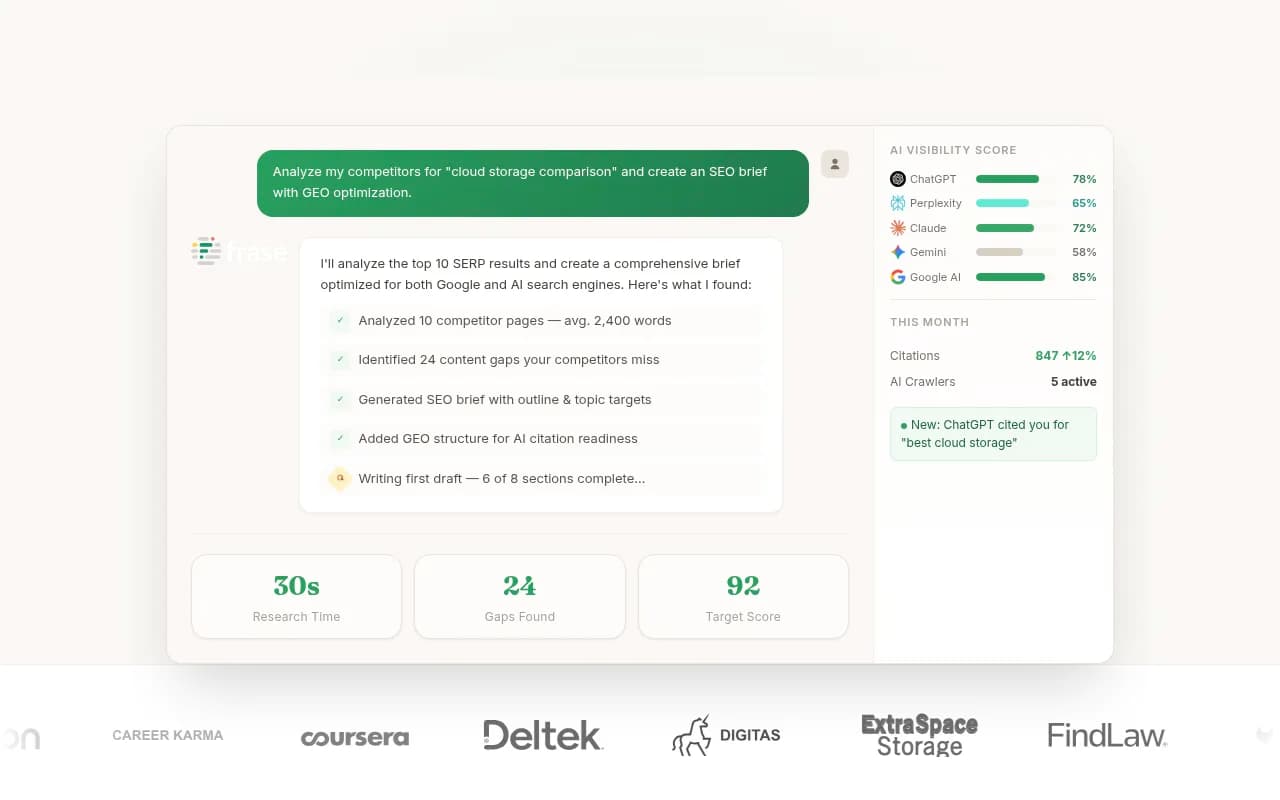
The difference worth caring about is whether the tool checks afterward. A page that nobody verified got cited is a guess.
Step 5: monitor continuously
IBM is blunt that reducing hallucinations is not a one-time fix and requires ongoing monitoring. Models update, retrieval changes, and one new article can reintroduce an error.
A workable cadence:
- Weekly: re-run your top 20 brand questions and check for new wrong claims.
- After any pricing, product, or leadership change: update first-party pages first, then third-party profiles, then re-check.
- Monthly: review which of your pages AI cites and what claim it attaches to your brand.
- Quarterly: audit sentiment and competitor comparisons, since AI often misattributes strengths.
A lightweight approach is a spreadsheet plus manual prompts. A dedicated platform pays off when you track many prompts across models and countries, need alerts, or report to stakeholders. Here is a rough comparison of approaches:
| Approach | Catches wrong claims | Finds the source | Helps fix it | Best for |
|---|---|---|---|---|
| Manual prompting | Yes, slowly | Partly | No | Small brands, first audit |
| Brand mention monitors (Brand24, Mention) | Web mentions, not AI answers | Yes for web pages | No | PR and reputation teams |
| Prompt trackers (Otterly.AI, Peec AI) | Yes | Limited | No | Teams that only need visibility reports |
| Full AI visibility platforms (Promptwatch, Profound) | Yes | Citations and crawler data | Varies; Promptwatch includes content creation and publishing | Teams that want to fix and measure |
Prices and features change, so confirm current details at promptwatch.com/pricing and on each vendor's site before buying.
Step 6: what to do if you run your own chatbot
The Air Canada ruling is the cleanest warning: you are responsible for what your own bot says. IBM and the Fisher Phillips legal guidance converge on a few controls:
- Use retrieval-augmented generation grounded in your own knowledge base, with source links shown to the user.
- Constrain the bot to answer only from retrieved context, and make it say it does not know otherwise.
- Run automated fact-checks that flag any claim not present in the retrieved context.
- Tier risk. Pricing, refund, legal, and medical statements need stricter verification than casual FAQs.
- Train staff to spot red flags: overconfident tone, fake citations, missing links.
This is separate from third-party AI answers, but the same principle applies: ground output in a source of truth.
A short checklist
- Write down your canonical facts in one document: name, description, pricing, leadership, features, policies.
- Run 20 to 50 buyer questions across the major AI assistants and log wrong claims.
- Trace each to a source: your page, a third-party page, or a gap.
- Fix first-party pages. Add an FAQ. Make facts plain and consistent.
- Correct or replace stale third-party listings and profiles.
- Verify AI crawlers can read your pages.
- Re-test after recrawl. Repeat weekly.
If you want a quick baseline before committing to anything, the free AI visibility report scans how ChatGPT, Gemini, and Perplexity talk about your brand, and the Academy has guides on citations versus mentions and how Promptwatch collects data.
What not to expect
Hallucinations can be reduced but not fully eliminated, in IBM's words. Do not expect a clean sweep. Expect fewer wrong claims, faster detection, and a shorter time between spotting an error and seeing it corrected. For niche brands the improvement can be large, because you are filling a data vacuum. For well-known brands, the work shifts toward staleness and competitor mix-ups.
The companies that handle this well are not doing anything exotic. They keep one source of truth, publish it clearly, keep it crawlable, and check what AI says on a schedule. If you are weighing outside help for the content and technical side, a GEO-focused agency such as 1001 SEO Media can run that audit-and-fix loop for you. For more tools in this space, the directory at ai-rank-tools.com compares AI rank and visibility trackers.