Key takeaways
- Most AI visibility tools only show you brand mentions -- they don't show you which bots actually crawled your site, when, or what they read.
- Hall AI is one of the few mid-market tools that blends server-level bot activity with LLM mention tracking, but it has meaningful gaps.
- Only a handful of platforms offer true crawler log monitoring: Promptwatch, Profound, Cloudflare AI Crawl Control, and a few others.
- The right choice depends on whether you need network-edge bot control, marketing-layer visibility, or a full optimization loop that goes from crawl data to content creation.
- If you want to not just see the gaps but actually fix them, you need a platform that combines crawler logs with content gap analysis and AI content generation.
Why crawler log monitoring matters more than you think
Here's a problem most marketing teams don't realize they have: AI crawlers may scrape a page thousands of times for every referral they actually send back. Cloudflare's own data shows this ratio is often wildly lopsided. TollBit has detected over 9 billion AI bot scrapes, with nearly 3 billion of those ignoring robots.txt entirely.
So when ChatGPT or Perplexity cites a competitor instead of you, the question isn't just "why didn't they mention us?" It's often "did their crawler even read our pages correctly? Did it hit errors? Did it crawl the right content?"
You can't answer those questions with a standard AI mention tracker. You need crawler log data.
Hall AI sits in an interesting middle ground -- it blends server-level bot activity monitoring with LLM mention tracking, which puts it ahead of pure monitoring tools like Otterly.AI or Peec AI. But it's not the only option, and depending on your team's size and goals, it might not be the best one.
This guide covers the platforms that actually show you what AI bots are doing on your site -- and what you can do about it.
What "crawler log monitoring" actually means
Before comparing tools, it's worth being precise about what this capability involves. There are three distinct layers:
Network edge (e.g. Cloudflare): Logs every bot hit at the CDN level before it reaches your server. Extremely granular, but requires technical setup and doesn't connect to AI mention data.
Server/application level (e.g. Hall AI, Profound, Promptwatch): Reads your actual server logs or integrates via a tracking snippet, Cloudflare worker, or CDN plugin. Shows which pages AI crawlers read, how often, what errors they encountered, and how crawl frequency correlates with citation frequency.
Simulation/inference (e.g. Otterly.AI, Peec AI): Doesn't actually monitor bots hitting your site. Instead, it queries AI models directly to see if your brand appears. Useful for visibility tracking, but tells you nothing about the crawl layer.
Most tools in the AI visibility space are in that third category. They're monitoring dashboards, not crawler analyzers.
Hall AI: what it does well and where it falls short
Hall AI targets mid-market teams that want a single dashboard combining agent analytics (bot activity) with LLM mention tracking. According to xSeek's April 2026 tool comparison, Hall sits in the "mid-market" tier and is one of the few tools that connects server-level bot activity to LLM mention data.
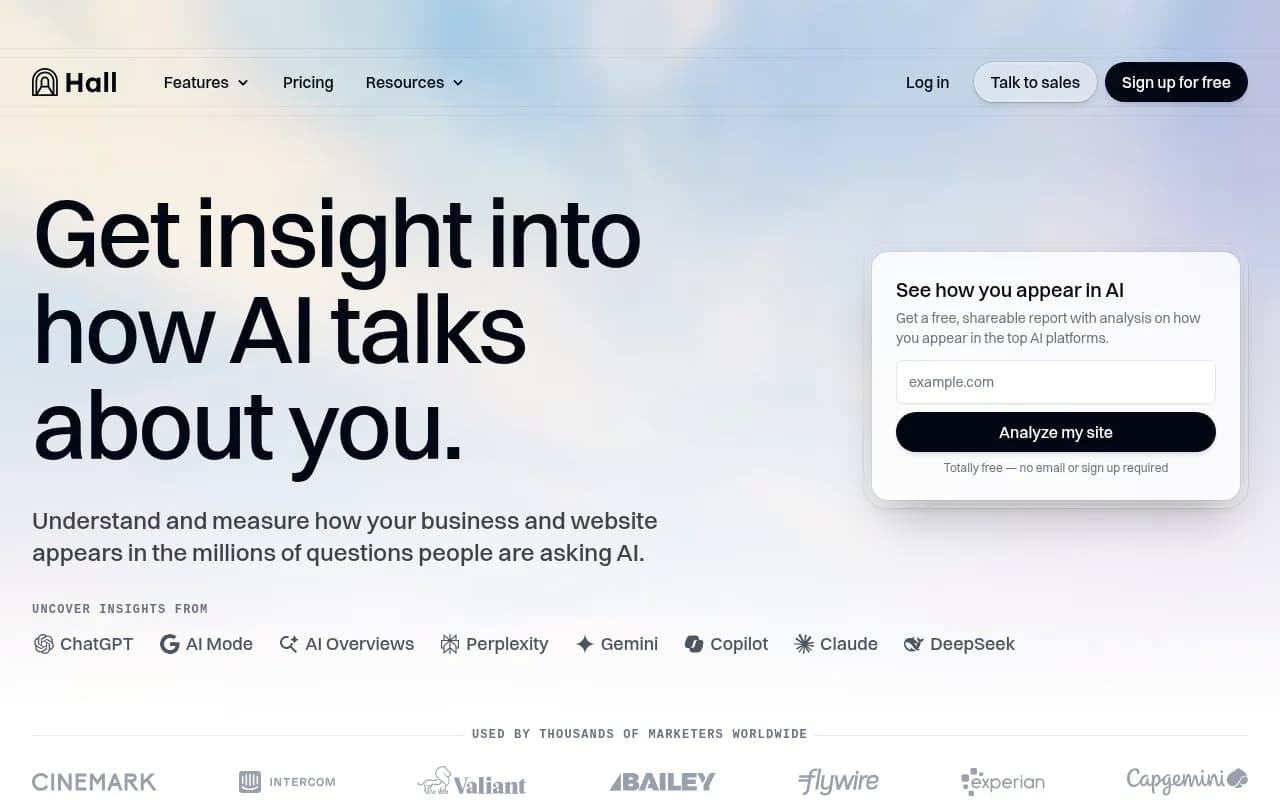
That's genuinely useful. Knowing that GPTBot crawled your /pricing page 47 times last month but your brand never appears in ChatGPT responses to pricing-related queries is actionable intelligence. Hall gives you that connection.
Where it falls short:
- No content gap analysis -- it shows you the problem but doesn't help you fix it
- No content generation or optimization tools
- Limited prompt intelligence (volume estimates, difficulty scoring, query fan-outs)
- No Reddit or YouTube citation tracking
- No ChatGPT Shopping monitoring
- Pricing is public but the feature set is narrower than enterprise-tier alternatives
If you're a mid-market team that just wants to understand bot behavior and mention frequency, Hall is a reasonable choice. If you want to turn that data into better AI visibility, you'll hit a wall quickly.
The best Hall AI alternatives with crawler log monitoring
1. Promptwatch -- best for teams that want to act on crawler data, not just see it
Promptwatch is the platform that most directly addresses the limitation above. It's not just a crawler log viewer -- it connects crawl data to content gaps to content creation, which is a fundamentally different workflow.

The crawler log feature (available on Professional and Business plans) shows real-time logs of AI crawlers hitting your website: which pages GPTBot, ClaudeBot, PerplexityBot, and others read, errors they encounter, how often they return, and crucially -- when a page moves from "crawled" to "cited." That last part is rare. Most tools show you crawl data or citation data. Promptwatch connects them.
On top of that, the Answer Gap Analysis shows which prompts competitors rank for in AI responses but you don't. You see the exact topics your site is missing. Then Content Agents generate articles, comparisons, and briefs grounded in that prompt data -- not generic SEO filler.
The result is a loop: find the crawl issues and content gaps, create content that addresses them, watch your citation scores improve. That's meaningfully different from a monitoring dashboard.
Pricing starts at $99/month (Essential), with crawler logs on the $249/month Professional plan. For teams that want the full optimization workflow, Business is $579/month.
2. Profound -- best for enterprise teams with budget for a full-stack solution
Profound is one of the few other platforms with genuine agent analytics -- their term for crawler log monitoring. It shows which AI agents visit your site, what they read, and how that connects to your brand's visibility in AI responses.

The platform is strong on enterprise reporting and stakeholder-ready dashboards. It's sales-led (no self-serve pricing), which means it's built for larger teams with dedicated budgets. If you're at a company like a Fortune 500 brand or a large agency, Profound is worth evaluating seriously.
The gap vs Promptwatch: Profound doesn't have the content generation layer. You get excellent visibility data but you're still on your own for figuring out what to create.
3. Cloudflare AI Crawl Control -- best for network-edge bot visibility
This isn't an AI visibility platform in the traditional sense -- it's a CDN-level tool that logs every bot hitting your origin server. If you're already on Cloudflare (and most sites are), you can enable AI Crawl Control to see exactly which AI bots visit, how often, and give you granular control over who gets access.
The free tier covers basic bot logging. Paid Cloudflare plans add more granular controls.
The limitation: it's purely infrastructure. It doesn't connect to LLM mention data, content gaps, or citation analysis. You'd need to pair it with a visibility platform to get the full picture. xSeek's 2026 comparison recommends pairing Cloudflare with a marketing-layer tool for exactly this reason.
4. DarkVisitors -- best for automatic robots.txt management based on crawler data
DarkVisitors (now also known as Known Agents) maintains a database of AI crawlers and their behaviors. It can automatically update your robots.txt based on which bots you want to allow or block, and it logs LLM referrals to your site.
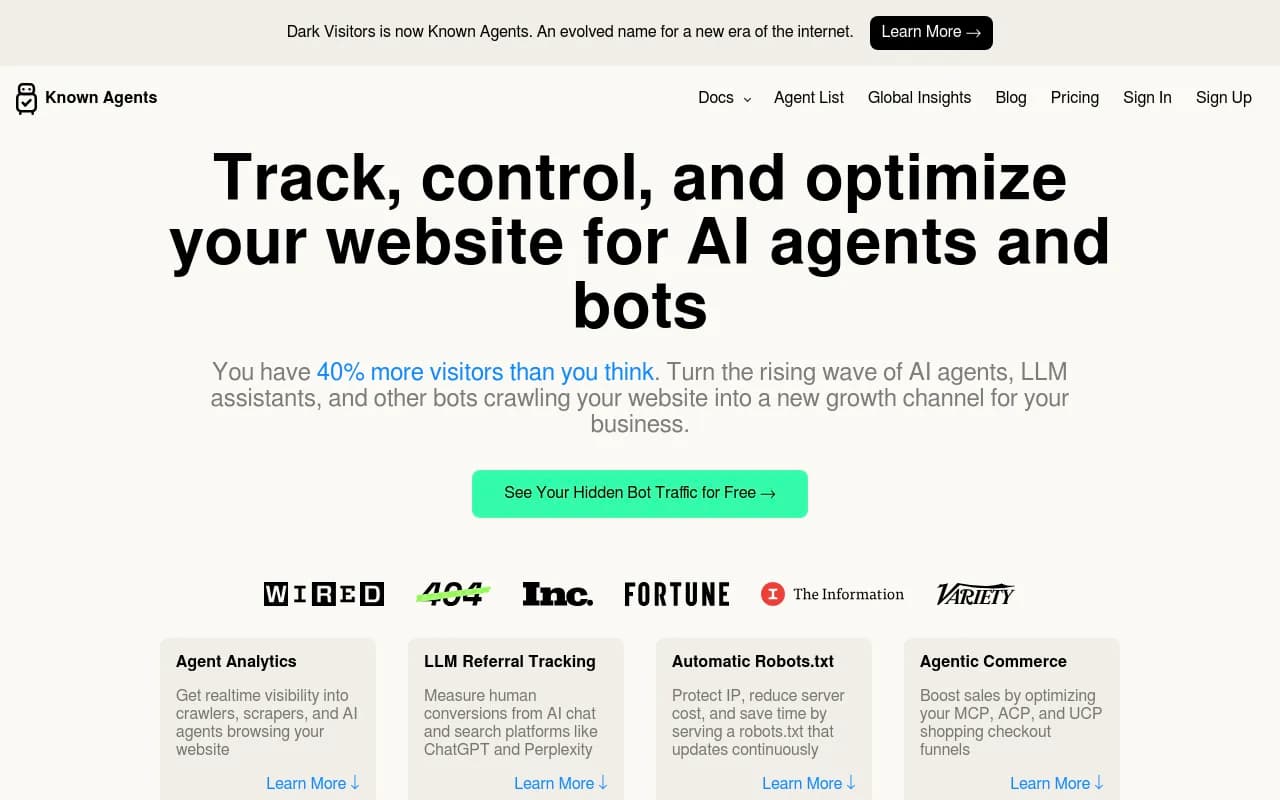
It's a more technical tool, better suited to developers and site owners who want precise control over AI bot access. The free tier covers basic crawler logging. It doesn't connect to brand mention tracking or content optimization -- it's focused on the access control and logging layer.
5. Scrunch AI -- best for teams focused on AI search visibility with some technical depth
Scrunch AI sits between pure monitoring tools and full-stack platforms. It has crawler and traffic insights that go beyond what Otterly.AI or Peec AI offer, and it's more action-oriented than a basic mention tracker.
It doesn't have the same depth of crawler log monitoring as Promptwatch or Profound, but it's a reasonable middle ground for teams that want more than brand mention counts without the full enterprise price tag.
6. AthenaHQ -- best for monitoring-focused teams that want clean dashboards
AthenaHQ tracks your brand across 8+ AI search engines with clean, well-designed dashboards. It's monitoring-focused rather than optimization-focused -- you'll see where you appear and where you don't, but the platform doesn't generate content or provide deep crawler log analysis.

Worth considering if your primary need is visibility reporting rather than technical bot monitoring.
7. Botify -- best for enterprise technical SEO teams adding AI crawler visibility
Botify is primarily an enterprise technical SEO crawler, but it's been expanding into AI search visibility. It has deep log file analysis capabilities that can surface AI bot behavior alongside traditional search bot data.
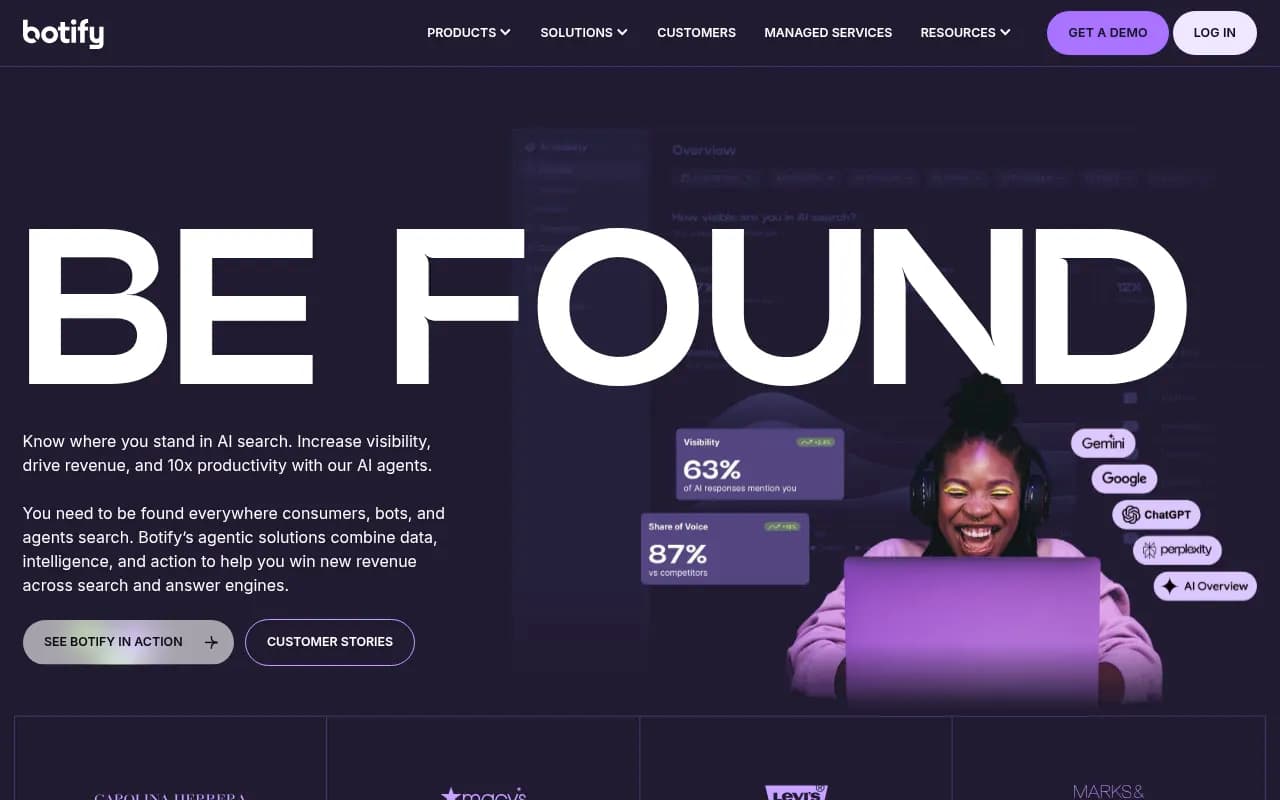
If you already use Botify for technical SEO, it's worth checking what their current AI crawler coverage looks like. For teams starting fresh specifically for AI visibility, it's probably more platform than you need.
Feature comparison: Hall AI vs alternatives
| Platform | Crawler log monitoring | LLM mention tracking | Content gap analysis | Content generation | Prompt volume data | Reddit/YouTube tracking | Starting price |
|---|---|---|---|---|---|---|---|
| Hall AI | Yes (server-level) | Yes | No | No | Limited | No | Public on /pricing |
| Promptwatch | Yes (real-time logs) | Yes (10 models) | Yes | Yes (Content Agents) | Yes | Yes | $99/mo |
| Profound | Yes (agent analytics) | Yes | Limited | No | Limited | No | Custom (sales) |
| Cloudflare AI Crawl Control | Yes (network edge) | No | No | No | No | No | Free+ |
| DarkVisitors | Yes (LLM referrals) | Limited | No | No | No | No | Free+ |
| Scrunch AI | Partial | Yes | Limited | No | No | No | Custom |
| AthenaHQ | No | Yes | No | No | No | No | Custom |
| Botify | Yes (log analysis) | Limited | No | No | No | No | Enterprise |
| Otterly.AI | No (simulation only) | Yes | No | No | No | No | $29/mo |
| Peec AI | No (simulation only) | Yes | No | No | No | No | $95/mo |
Three questions to find the right tool for your situation
Are you trying to control which AI bots access your site? Start with Cloudflare AI Crawl Control or DarkVisitors. These are infrastructure tools that give you network-edge visibility and access control. They're not marketing platforms -- they're bot management tools.
Do you need to understand the crawl-to-citation pipeline? This is where Hall AI, Profound, and Promptwatch differentiate themselves. All three connect bot activity to citation data. Promptwatch goes furthest by also showing you what content to create to close the gap between crawl and citation.
Do you want to actually improve your AI visibility, not just monitor it? Then you need a platform with content gap analysis and content generation. Right now, Promptwatch is the clearest option here -- it's the only platform that closes the loop from crawler log data through to content creation and citation tracking.
The crawl-to-citation gap: why it's the metric that matters
Here's something most teams miss when they first start looking at AI visibility data: getting crawled is not the same as getting cited.
AI models crawl your pages to build training data and to retrieve information for responses. But whether they actually cite your page in a response depends on whether your content clearly answers the question being asked, whether it's structured in a way the model can parse, and whether competitors have better answers to the same question.
This is why crawler log data alone isn't enough. You need to know:
- Which pages are being crawled (crawler logs)
- Which pages are being cited (citation tracking)
- Which prompts you're missing from (answer gap analysis)
- What content would close those gaps (content briefs and generation)
Hall AI covers steps 1 and 2. Promptwatch covers all four.
What to watch for when evaluating any platform
A few things that are easy to miss when comparing tools in this space:
"Crawler monitoring" can mean very different things. Some tools simulate crawls by querying AI models directly. Others read actual server logs. Others sit at the network edge. Make sure you know which layer a tool operates at before assuming it gives you real bot data.
API outputs vs real user interfaces. Some platforms query AI models via API to check for brand mentions. But what users actually see in ChatGPT or Perplexity's interface can differ from API outputs -- especially for shopping recommendations and local results. Platforms that monitor real user-facing interfaces give you more accurate data.
The monitoring-only trap. It's easy to spend months looking at dashboards that show your AI visibility score going up or down without knowing what to do about it. Before committing to any platform, ask: what does this tool tell me to do next? If the answer is "nothing -- it just shows you data," that's a monitoring tool, not an optimization platform.
Bottom line
Hall AI is a solid mid-market option if you specifically need the combination of server-level bot activity and LLM mention tracking in a single dashboard. It's genuinely ahead of pure monitoring tools like Otterly.AI or Peec AI on the technical side.
But if you want to understand why AI models aren't citing you and actually do something about it, Hall's feature set runs out quickly. The platforms that go further -- Profound for enterprise, Promptwatch for teams that want the full optimization loop -- give you a path from "I can see the bots" to "I'm now appearing in AI responses."
The crawl data is the starting point. What you build from it is what matters.