Key takeaways
- Hall AI is a lightweight, fast-setup monitoring tool best suited for agencies and teams that need shareable dashboards and a low barrier to entry
- Promptwatch covers everything Hall does, plus adds content gap analysis, AI content generation, crawler logs, prompt volume data, and traffic attribution
- The core difference isn't features -- it's the gap between monitoring and optimization. Hall shows you the problem; Promptwatch helps you solve it
- Teams migrating from Hall typically do so when they need to act on their data, not just report it
- If you're still deciding, Hall is a reasonable free starting point; if you're serious about improving AI visibility, you'll likely outgrow it
Why this comparison matters in 2026
AI search is no longer a niche concern. ChatGPT, Perplexity, Google AI Overviews, and a growing list of LLMs are now a meaningful part of how people discover brands, products, and services. If your brand isn't being cited in those responses, you're losing ground to competitors who are.
That shift has created a wave of new tools promising to help. Some are genuinely useful. Some are dashboards dressed up as platforms. The challenge for most marketing and SEO teams right now isn't finding a tool -- it's figuring out which one will actually move the needle.
Hall AI and Promptwatch are two of the more frequently compared options in this space. They overlap on the basics: both track brand mentions across major AI models, both show you citation data, and both are aimed at marketing teams rather than developers. But they diverge pretty sharply once you get past the surface level.
This guide breaks down exactly where they differ, who each tool is built for, and why a growing number of teams are switching from Hall to Promptwatch.
What Hall AI actually does
Hall AI is a monitoring tool. It tracks how AI platforms like ChatGPT, Perplexity, and Gemini cite and talk about your brand, surfaces that data in a clean dashboard, and makes it easy to share reports with clients or stakeholders.
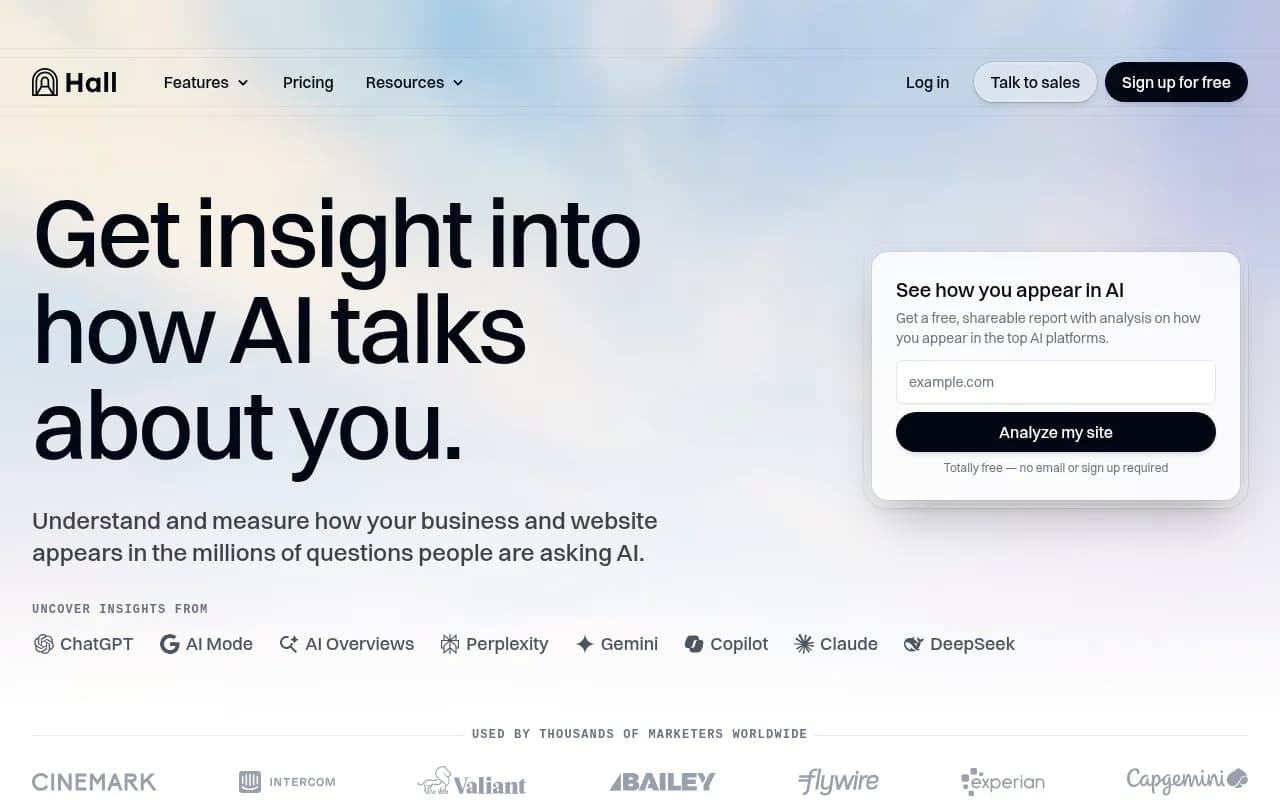
Its strengths are real: fast setup, a generous free tier, and a UI that doesn't require a lot of training to use. For agencies managing multiple clients who just need a quick read on AI visibility, Hall is a reasonable starting point. It's also one of the more accessible tools in the category -- you don't need to commit to a paid plan to get a feel for what it does.
What Hall doesn't do is help you act on what you find. You can see that a competitor is getting cited for a prompt you're not. You can see that your brand mentions dropped last week. But the tool stops there. What to do about it, what content to create, which gaps to prioritize -- that's left entirely to you.
For teams that are still in the "we need to understand what's happening" phase, that's fine. For teams that have moved past that and are asking "how do we fix this," Hall starts to feel like a rearview mirror without a steering wheel.
What Promptwatch does differently
Promptwatch is built around a different premise: visibility data is only useful if it leads to action.

The platform covers the same monitoring basics -- brand mentions, citation tracking, competitor comparisons across 10+ AI models -- but it layers on a set of capabilities that turn that data into something you can actually work with.
The core workflow looks like this:
Find the gaps. Promptwatch's Answer Gap Analysis shows you the specific prompts where competitors are being cited but you're not. Not vague categories -- the actual questions and topics that AI models are already answering with your competitors' content instead of yours.
Create content that fills them. Content Agents generate articles, comparisons, and briefs grounded in real prompt data, citation patterns, and competitor analysis. This isn't generic AI writing -- it's content built to answer the specific gaps the platform identified.
Track what changes. Page-level tracking shows which of your pages are being cited, how often, and by which models. Agent analytics shows the timeline from when you publish to when AI crawlers find the page to when it starts generating citations. Traffic attribution connects those citations to actual revenue.
That loop -- find gaps, create content, measure results -- is what separates Promptwatch from tools that stop at step one.
Beyond that core workflow, Promptwatch also includes:
- Real AI crawler logs showing which pages ChatGPT, Perplexity, Claude, and others are actually reading (and which they're ignoring)
- Prompt volume and difficulty scoring so you can prioritize high-value, winnable opportunities
- Reddit and YouTube tracking, since AI models frequently cite community content and video
- ChatGPT Shopping tracking for brands selling products
- Multi-language and multi-region monitoring
- Offsite citation analysis covering third-party pages, Reddit threads, and external mentions
The platform monitors OpenAI/ChatGPT, Perplexity, Google AI Overviews, Google AI Mode, Claude, Gemini, Meta/Llama, DeepSeek, Grok, Mistral, and Copilot -- 10 models in total.
Side-by-side comparison
| Feature | Hall AI | Promptwatch |
|---|---|---|
| Brand mention tracking | Yes | Yes |
| Citation analysis | Yes | Yes |
| Competitor visibility comparison | Basic | Detailed, with heatmaps |
| Answer gap analysis | No | Yes |
| AI content generation | No | Yes (Content Agents) |
| Crawler logs / agent analytics | No | Yes |
| Prompt volume & difficulty scores | No | Yes |
| Query fan-outs | No | Yes |
| Reddit & YouTube tracking | No | Yes |
| ChatGPT Shopping tracking | No | Yes |
| Traffic attribution | No | Yes |
| Multi-language / multi-region | Limited | Yes |
| Free tier | Yes | Free trial |
| Pricing starts at | Free | $99/mo |
| Best for | Agencies needing quick reports | Teams that want to improve, not just monitor |
The monitoring-only trap
There's a broader pattern worth naming here. A lot of the AI visibility tools that launched in 2024 and 2025 are monitoring dashboards. They show you data. They generate reports. They tell you that your brand visibility score went up or down. But they don't help you understand why, and they definitely don't help you fix it.
This isn't a knock on those tools specifically -- monitoring is a legitimate first step. The problem is when teams treat a monitoring dashboard as a complete solution and then wonder why their AI visibility isn't improving.
Microsoft's 2026 Work Trend Index made a related point about AI adoption more broadly: the gap between what employees can do with AI and what their organizations are actually built to support is the main constraint holding companies back. The same dynamic applies here. Having visibility data is not the same as having a system for acting on it.
Hall AI is a monitoring tool. It's good at what it does. But if your goal is to actually improve where you show up in AI responses -- not just track where you currently show up -- you need something that closes the loop.
Who should stay on Hall AI
Hall isn't the wrong choice for everyone. There are real use cases where it makes sense:
- Agencies that need a fast, low-cost way to show clients their AI visibility without a lot of setup overhead
- Teams in the early stages of AI visibility work who are still building the case internally for why this matters
- Smaller brands that just want a basic read on brand mentions and don't yet have the bandwidth to act on detailed gap analysis
- Anyone who wants to test the waters before committing to a paid platform
The free tier is genuinely useful for getting oriented. If you're not sure whether AI visibility is worth investing in, Hall gives you a low-stakes way to find out.
Who should migrate to Promptwatch
The teams switching from Hall to Promptwatch tend to share a common frustration: they've been looking at the data for months and nothing has changed. They know which prompts they're missing. They know competitors are getting cited more often. But without a clear path from insight to action, the dashboard just becomes a source of anxiety rather than a tool for improvement.
Promptwatch is the right move when:
- You've identified gaps and need help creating content to fill them
- You want to understand which of your pages AI crawlers are actually reading (and which they're skipping)
- You need to connect AI visibility to traffic and revenue, not just citation counts
- You're tracking multiple sites, markets, or languages
- You want prompt-level data -- volume, difficulty, query fan-outs -- to prioritize where to focus
- You're managing AI visibility for clients and need to show measurable progress over time
Pricing runs from $99/month for a single site with 50 prompts and 5 articles, up to $579/month for 5 sites with 350 prompts and 30 articles. Agency and enterprise plans are available with custom pricing. There's a free trial if you want to see the platform before committing.
What the migration actually looks like
Teams moving from Hall to Promptwatch typically go through a predictable sequence.
First, they connect their site and run the Answer Gap Analysis. This usually produces a list of 20-50 prompts where competitors are visible and they're not -- concrete, specific gaps rather than vague categories.
Second, they use Content Agents to generate briefs or full articles targeting those gaps. The content is grounded in the same prompt and citation data the platform tracks, so it's built to answer the specific questions AI models are already asking.
Third, they connect their site via Cloudflare, Vercel, server logs, or a tracking snippet to get crawler log data. This is where things get interesting: you can see exactly which pages ChatGPT's crawler has visited, how often it returns, and whether those visits are translating into citations.
Fourth, they track the results. Page-level visibility scores update as AI models start citing the new content. Traffic attribution shows whether that visibility is driving actual clicks and conversions.
The whole cycle -- from identifying a gap to seeing a citation -- typically takes a few weeks for fast-moving AI models like Perplexity and a bit longer for others.
Other tools worth knowing about
Hall and Promptwatch aren't the only options in this space. A few others worth considering depending on your needs:

Profound has a strong feature set and is particularly well-regarded for enterprise use cases. The price point is higher than Promptwatch, and it doesn't include Reddit tracking or ChatGPT Shopping monitoring.

Otterly.AI is a budget-friendly monitoring option with a clean interface. Like Hall, it's monitoring-only -- no content generation, no crawler logs, no traffic attribution.

Peec.ai is worth a look if multi-language tracking is your primary concern. It covers a solid range of languages and markets, though it lacks the content optimization capabilities of Promptwatch.

AthenaHQ covers 8+ AI search engines and has a clean interface for tracking brand visibility. It's monitoring-focused, without the content generation or gap-filling tools that Promptwatch offers.
The bottom line
Hall AI is a good tool for what it is: a lightweight, accessible way to monitor AI brand visibility. If you're just getting started or you need something you can spin up for a client in an afternoon, it does the job.
But monitoring is not optimization. Knowing you're invisible in AI search results is only useful if you have a way to do something about it. That's the gap Promptwatch fills -- and it's why teams that have been using Hall for a while tend to migrate once they're ready to move from tracking to improving.
The question to ask yourself is simple: are you trying to understand your AI visibility, or are you trying to change it? The answer determines which tool you actually need.