Key takeaways
- Hall AI is shutting down, leaving users without a way to track brand mentions across ChatGPT, Perplexity, Claude, and other AI engines
- Most alternatives fall into two camps: monitoring-only dashboards that show you data, and full-stack platforms that help you act on it
- The best replacement depends on your team size, budget, and whether you need content optimization alongside tracking
- Promptwatch is the only platform in this comparison rated as a "Leader" across all categories -- monitoring, content generation, crawler logs, and traffic attribution
- Free trials are available on most platforms, so there's no reason to go dark while you evaluate
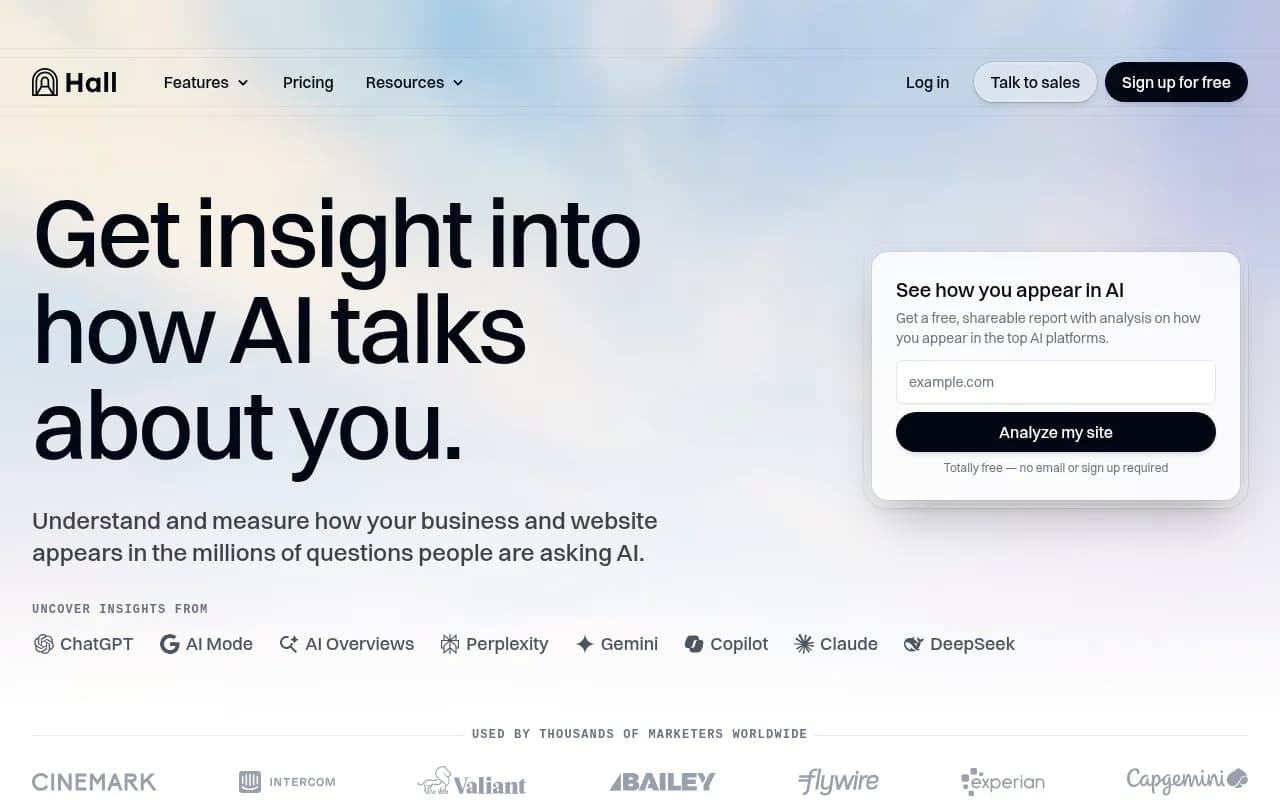
Hall AI built a clean, focused product: track how AI platforms cite and talk about your brand, surface the prompts where competitors show up instead of you, and give marketing teams a dashboard they could actually use. For a lot of teams, it was the first tool that made AI visibility feel manageable.
Now it's shutting down.
If you were using Hall AI, you're probably not looking for a philosophical debate about the future of AI search. You need a replacement, ideally one that doesn't require rebuilding your entire workflow from scratch. This guide covers nine platforms worth serious consideration -- what they're good at, where they fall short, and which type of team each one suits best.
Why switching matters right now
AI search isn't a trend you can monitor casually anymore. ChatGPT crossed 900 million weekly active users in early 2026. Google AI Overviews now appear across a significant share of high-intent queries. Perplexity has carved out the research and analyst segment. When a buyer asks "what's the best [your category] for [their use case]," they're not necessarily seeing your Google ranking -- they're seeing whatever the AI tells them.
The gap between "we have a tracking tool" and "we don't" is now a real competitive disadvantage. Every week without visibility data is a week where competitors could be pulling ahead in AI citations and you'd have no idea.
So let's get into the options.
The 9 best Hall AI alternatives in 2026
1. Promptwatch
If Hall AI was your primary AI visibility tool and you want a direct upgrade rather than a lateral move, Promptwatch is the most complete replacement available.
The core difference from most alternatives: Promptwatch isn't just a monitoring dashboard. It runs the full loop -- find gaps, create content, track results. The Answer Gap Analysis shows you exactly which prompts competitors are visible for that you're not. Then Content Agents generate articles and briefs grounded in that real prompt data. Then page-level tracking shows whether the new content actually gets cited.
That cycle is what separates it from the monitoring-only tools that dominate this space. Most competitors show you a visibility score and leave you to figure out what to do next.
Other things worth knowing: Promptwatch tracks 10 AI models (ChatGPT, Perplexity, Claude, Gemini, Google AI Overviews, Google AI Mode, Grok, DeepSeek, Copilot, Meta AI), has AI crawler logs that show which pages AI bots are actually reading on your site, tracks ChatGPT Shopping recommendations, and covers Reddit and YouTube as citation sources -- a channel most tools ignore entirely.
Pricing starts at $99/month for the Essential plan (1 site, 50 prompts, 5 articles). Professional is $249/month with crawler logs and multi-location tracking. Business is $579/month for 5 sites.
Promptwatch is used by 1,480+ brands and agencies including Booking.com and Center Parcs, and it's the only platform in a recent 12-tool comparison to be rated a "Leader" across all categories.

2. Profound
Profound is a strong choice if you're coming from Hall AI and want something with a polished enterprise feel. It tracks brand visibility across major AI engines, surfaces competitive positioning, and has decent prompt management.
Where it falls short: no content generation, no Reddit/YouTube tracking, and pricing sits higher than most alternatives in this list. It's a monitoring-first product, which is fine if that's all you need -- but if you want to close the loop between "we're not visible here" and "here's what to publish to fix that," you'll need to pair it with something else.

3. Otterly.AI
Otterly.AI is one of the more affordable options in this space and has a clean interface that Hall AI users will find familiar. It tracks brand mentions across ChatGPT, Perplexity, and Google AI Overviews, gives you sentiment analysis, and lets you monitor competitors side by side.
The honest limitation: it's monitoring-only. No crawler logs, no content generation, no traffic attribution. For teams that just want to know "are we showing up?" without needing to act on it immediately, Otterly is a reasonable starting point. For teams that want to improve their visibility, not just measure it, you'll hit a ceiling quickly.

4. Peec AI
Peec AI has carved out a niche with strong multi-language support, which makes it worth a look if your brand operates across multiple markets. It tracks AI visibility across the main engines, shows share-of-voice data, and has a reasonably clean competitive comparison view.
Like Otterly, it's primarily a monitoring tool. The multi-language angle is genuinely useful if you need it -- most platforms in this space are English-first and treat other languages as an afterthought.

5. AthenaHQ
AthenaHQ tracks your brand across 8+ AI search engines and has a solid interface for monitoring prompt-level visibility. It's a step up from the lightest tools in terms of data depth, and the competitive benchmarking features are well-executed.
The gap: like most platforms here, it's focused on tracking rather than optimization. There's no content generation, no crawler log data, and no path from "we're missing from this prompt" to "here's the content that would fix it." It's a good monitoring tool that stops short of being an optimization platform.

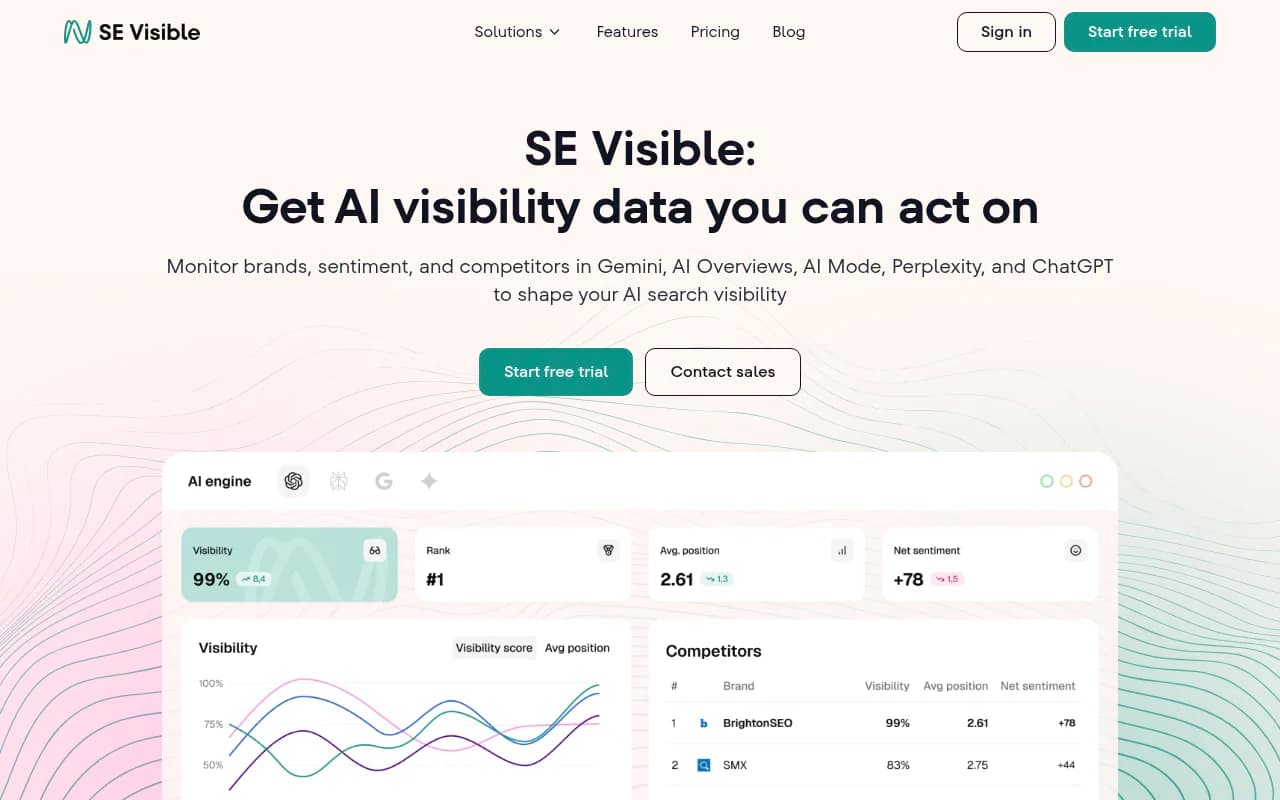
6. SE Visible (by SE Ranking)
SE Visible is SE Ranking's dedicated AI visibility product, and it's worth considering if you're already in the SE Ranking ecosystem or want a tool backed by an established SEO platform. It tracks citations across ChatGPT, Gemini, Perplexity, Google AI Mode, and Google AI Overviews, and the dashboard is genuinely clean and easy to set up.
The advantage here is integration -- if you're already using SE Ranking for traditional SEO, having AI visibility data in the same platform reduces tool sprawl. The limitation is that SE Visible is still primarily a monitoring layer; the broader SE Ranking platform handles SEO optimization but doesn't have AI-specific content generation.
7. Scrunch AI
Scrunch AI has been building out its AI search visibility features and has a reasonable feature set for mid-market teams. It covers the main AI engines, tracks citation sources, and has competitive monitoring built in.
It's a solid middle-ground option -- more capable than the lightest tools, less comprehensive than Promptwatch or Profound. Worth evaluating if you want something between "basic monitor" and "full platform" in terms of scope and price.
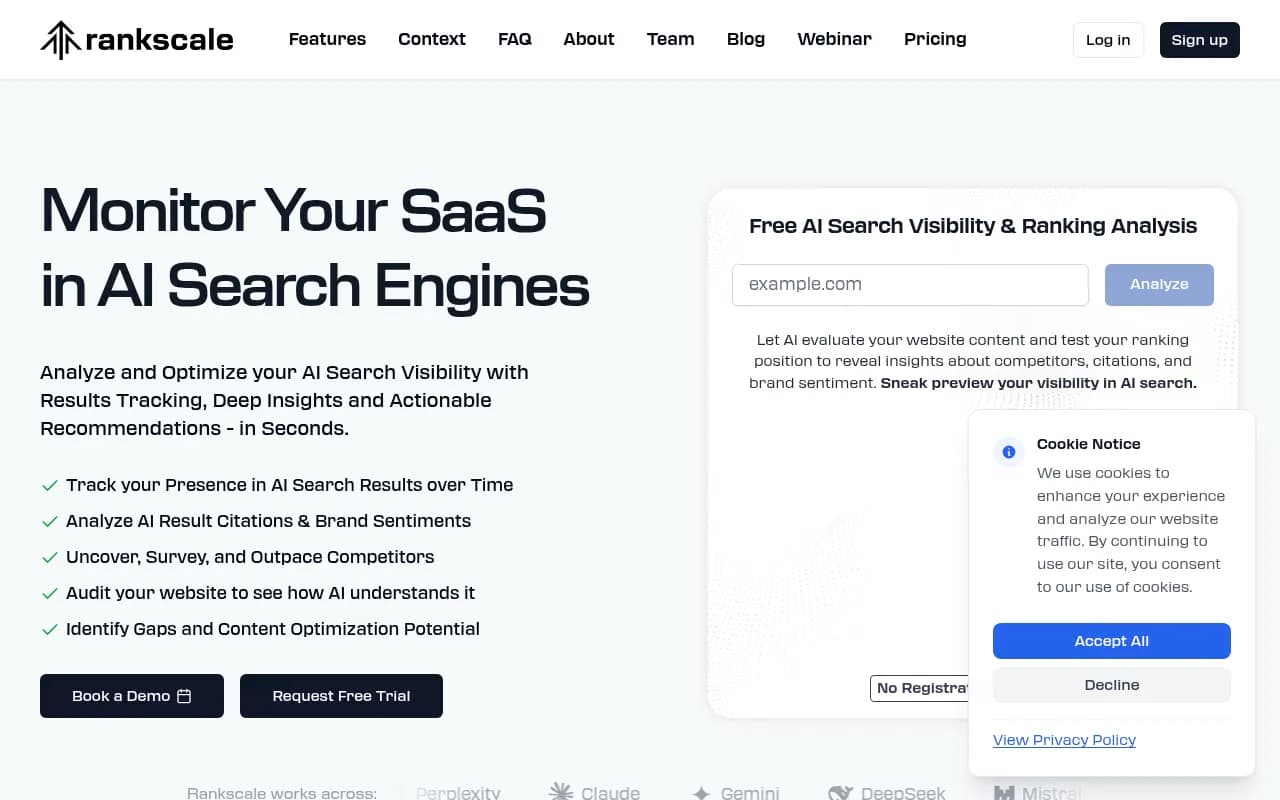
8. Rankscale
Rankscale focuses specifically on AI search ranking and visibility, with a clean interface and prompt-level tracking across the major engines. It's a newer entrant but has been adding features quickly.
Good for: teams that want focused AI visibility tracking without the complexity of a full GEO platform. The trade-off is the same as most alternatives here -- it tracks well but doesn't help you act on what it finds.
9. Semrush (with AI Toolkit)
Semrush is the obvious choice if you want to consolidate your SEO and AI visibility tracking into one platform. The AI Toolkit tracks brand mentions in AI-generated answers, and the broader Semrush platform covers keyword research, site audits, backlink analysis, and content optimization.
The honest caveat: Semrush's AI visibility features use fixed prompts rather than dynamic prompt tracking, and there's no AI traffic attribution. It's a reasonable option if you're already paying for Semrush and want to add AI monitoring without a new subscription. If AI visibility is your primary concern, a dedicated platform will give you more depth.
How these tools compare
Here's a quick reference across the features that matter most when replacing Hall AI:
| Tool | AI models tracked | Content generation | Crawler logs | Reddit/YouTube | Pricing starts at |
|---|---|---|---|---|---|
| Promptwatch | 10 | Yes (Content Agents) | Yes | Yes | $99/mo |
| Profound | 5+ | No | No | No | ~$200/mo |
| Otterly.AI | 4+ | No | No | No | ~$49/mo |
| Peec AI | 4+ | No | No | No | ~$79/mo |
| AthenaHQ | 8+ | No | No | No | ~$149/mo |
| SE Visible | 5 | No | No | No | Bundled with SE Ranking |
| Scrunch AI | 4+ | No | No | No | ~$99/mo |
| Rankscale | 4+ | No | No | No | ~$49/mo |
| Semrush | 3-4 (fixed prompts) | No | No | No | $165/mo (Semrush One) |
The pattern is pretty clear: most alternatives are monitoring tools. Promptwatch is the exception -- it's the only one in this list that closes the loop between finding visibility gaps and actually fixing them.
Which alternative is right for you?
The right choice depends on what you actually need.
If you want a direct Hall AI replacement that also helps you improve visibility (not just measure it), Promptwatch is the answer. The content generation and crawler log features alone justify the price difference over monitoring-only tools -- you're not just watching your score, you're moving it.
If you need the most affordable monitoring option and content optimization isn't a priority yet, Otterly.AI or Rankscale are reasonable starting points. Both are significantly cheaper than the full-stack platforms and cover the basics well.
If you're already in the SE Ranking ecosystem, SE Visible is the path of least resistance. You get AI visibility data without adding another tool to your stack.
If multi-language tracking is your main requirement, Peec AI is the strongest option in that specific area.
If you want enterprise-grade monitoring with a polished interface and budget isn't the constraint, Profound or AthenaHQ are worth evaluating -- just go in knowing you'll need separate tooling for content optimization.
What to look for in any replacement
Before you commit to a new platform, a few things worth checking:
Prompt flexibility. Some tools let you define your own prompts; others use fixed templates. Fixed prompts are easier to set up but miss the long-tail queries where a lot of real buying decisions happen. Make sure the tool tracks the specific questions your customers are actually asking.
Which AI models are covered. ChatGPT and Perplexity are table stakes. But Google AI Overviews, Google AI Mode, Claude, and Gemini are increasingly important depending on your audience. Check the model list before signing up.
Citation-level data. Knowing your brand appeared in an AI response is useful. Knowing exactly which page was cited -- and which competitor pages were cited instead -- is what lets you act on it.
The path from data to action. This is the question most tools don't answer well. When you find a visibility gap, what do you do next? If the tool just shows you the gap and stops there, you're back to guessing.
The bottom line
Hall AI shutting down is genuinely disruptive if you relied on it for AI visibility tracking. The good news is the alternatives have matured significantly in 2026, and there are real options at every price point.
The monitoring-only tools (Otterly, Peec AI, Rankscale) are fine if you just need to know where you stand. But if you want to actually improve your AI visibility -- not just watch it -- the gap between those tools and a full-stack platform like Promptwatch is significant. The ability to identify content gaps, generate content that fills them, and then track whether that content gets cited is the difference between a dashboard and a system that moves the needle.
Don't go dark while you evaluate. Most of these platforms offer free trials, and the data you'd lose during a gap in coverage is hard to reconstruct.