Key takeaways
- Otterly.AI starts at $29/month and is the easiest entry point for solo marketers or small teams who just want to know if they're showing up in AI search.
- Peec AI (from €89/month) sits a tier above -- faster data, smarter suggestions, and better suited to mid-market teams that need more than a dashboard.
- Rankscale is the broadest budget option for engine coverage and unlimited seats, but it's the least mature of the three.
- All three are monitoring-only tools. They'll tell you where you're invisible but won't help you fix it.
- If you need to act on the data -- not just look at it -- you'll eventually outgrow all three.
There's a version of this decision that feels simple: you want to track your brand in ChatGPT and Perplexity, you don't want to pay $499/month, and you've narrowed it down to Otterly.AI, Peec AI, and Rankscale. Pick one, move on.
But the choice is less obvious than it looks. These three tools are priced similarly and marketed similarly, yet they serve genuinely different use cases. Getting the wrong one means either paying for features you don't need or hitting a wall the moment you want to do anything beyond basic monitoring.
This guide breaks down exactly what each tool does, where it falls short, and which type of team should use which one.
What these tools actually do (and don't do)
Before comparing them, it's worth being clear about the category. Otterly.AI, Peec AI, and Rankscale are all AI visibility monitoring tools. You give them a list of prompts -- questions your customers might ask ChatGPT or Perplexity -- and they run those prompts across AI engines on a schedule, then report back on whether your brand appeared, how often, and alongside which competitors.
That's useful. Knowing you're invisible is step one.
The problem is that step one is where all three tools stop. None of them help you figure out what content to create to fix the gaps, generate that content, or track whether publishing new pages actually improved your citations over time. They're dashboards, not optimization platforms.
Keep that in mind as you read. The right question isn't just "which tool has the best dashboard?" It's "what do I actually need to do with this data?"
Otterly.AI: The most accessible entry point

Otterly.AI is the cheapest serious AI visibility tool on the market. Their entry plan starts at $29/month for 15 tracked prompts, and their standard plan runs $189/month for 100 prompts. For context, most competitors start at $99 or higher.
That price point attracts a specific type of user: solo marketers, early-stage startups, and consultants who want to prove AI visibility matters before asking for a bigger budget. If that's you, Otterly is a reasonable place to start.
What Otterly does well
The interface is clean and genuinely easy to use. You can set up prompt tracking in under 10 minutes, and the reporting is clear enough that you could share it with a non-technical stakeholder without much explanation. It covers the major AI engines -- ChatGPT, Perplexity, Google AI Overviews, Claude -- which is enough for most monitoring use cases.
The affordability also means you can track more prompts at a lower cost than you'd pay elsewhere. At $29/month, you're not going to break a budget while you figure out whether AI visibility tracking is worth investing in at all.
Where Otterly falls short
The depth just isn't there. Otterly shows you whether you appeared, but it doesn't give you much context about why you appeared (or didn't), which specific pages were cited, or how your visibility compares across different AI models. There's no prompt volume data, no difficulty scoring, and no content gap analysis.
For a team that wants to move from "we're invisible" to "here's what we're doing about it," Otterly leaves you stranded. You'll know the problem exists. You won't know how to solve it.
Reddit users who've tested it put it plainly: it's built for smaller budgets, and the feature set reflects that. That's not a criticism -- it's just an accurate description of what it is.
Peec AI: The mid-market challenger

Peec AI raised $29M and hit $4M+ ARR in roughly ten months, which is a strong signal that something is working. Their pricing starts at €89/month, putting them above Otterly but well below enterprise tools like Profound ($499/month).
What Peec does well
The main thing Peec does better than Otterly is speed and analytical depth. Responses refresh faster, the platform surfaces smarter suggestions about which prompts to prioritize, and the competitive benchmarking is more detailed. You can see not just whether you appeared, but how your share of voice compares to specific competitors across different prompt categories.
Peec also handles multi-language tracking better than most tools in this price range, which matters if you're running campaigns across European markets or targeting non-English-speaking audiences.
The "smart suggestions" feature is worth calling out specifically. Rather than dumping raw data on you, Peec surfaces prompts where you're close to appearing -- the gaps that are most winnable with relatively small content changes. That's a more actionable framing than a pure visibility score.
Where Peec falls short
Like Otterly, Peec is fundamentally a monitoring tool. The suggestions are helpful, but they stop at "here's what to work on." There's no content generation, no brief builder, no crawler log analysis. You still need to take the data back to your content team and figure out execution yourself.
At €89/month, Peec is also a harder sell for very small teams or individuals who just want a quick sanity check. If you're not going to act on the suggestions, you're paying for a more expensive dashboard.
Rankscale: The broadest budget option
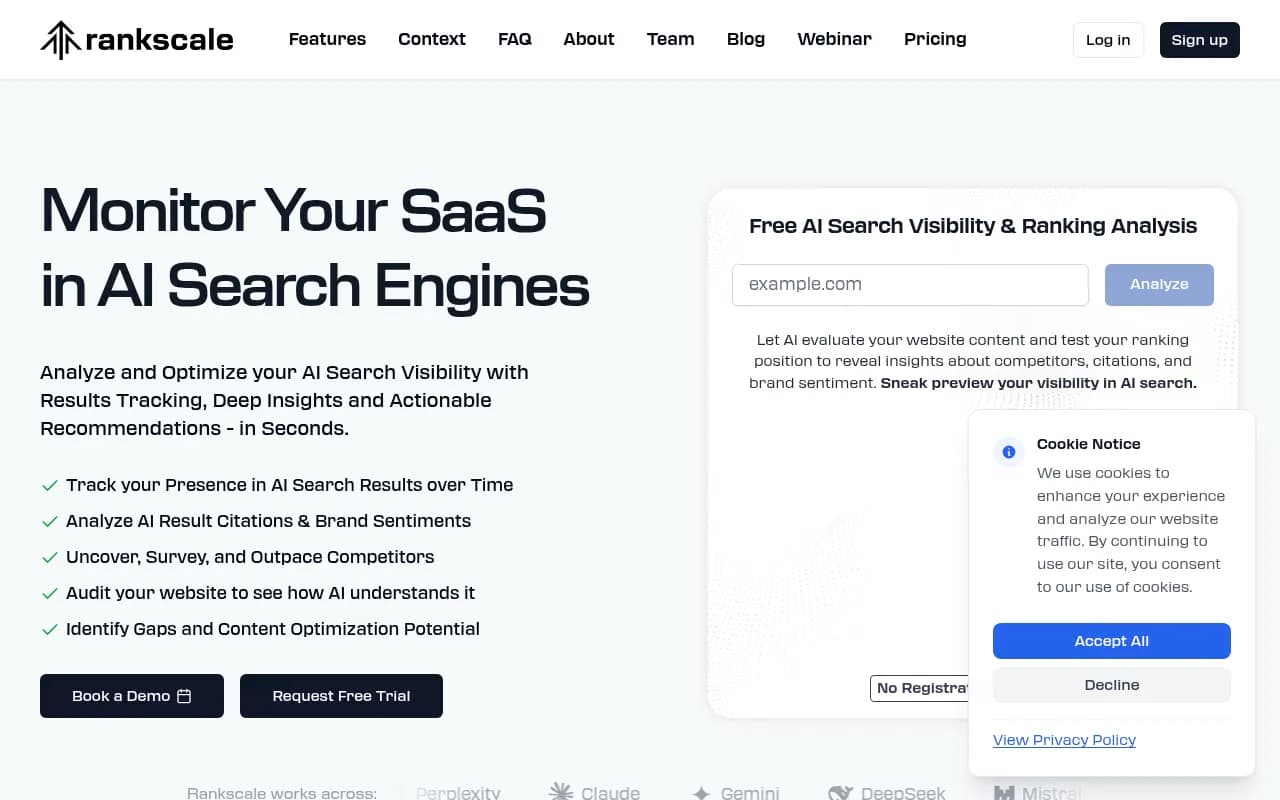
Rankscale positions itself as a budget AI rank tracker for lean teams. It's the newest of the three and the least mature, but it has a couple of genuine differentiators worth knowing about.
What Rankscale does well
Engine coverage is Rankscale's strongest card. It tracks more AI models than either Otterly or Peec, including some of the newer or less-covered engines. For teams that specifically need breadth -- say, you want to know how you appear in DeepSeek or Grok, not just ChatGPT -- Rankscale is worth a look.
Unlimited seats is the other differentiator. Most AI visibility tools charge per seat or limit users on lower-tier plans. Rankscale doesn't, which makes it practical for agencies or teams where multiple people need access to the same data without paying per head.
Where Rankscale falls short
Maturity is the honest concern here. Rankscale is newer, and the product reflects that. The interface is less polished, the data quality is less consistent, and the feature set is thinner than Peec's. Several independent comparisons note it as a "budget challenger" rather than a fully formed product.
If you're evaluating Rankscale, the question is whether the engine coverage and unlimited seats justify the trade-off in polish and depth. For some teams, yes. For most, Otterly or Peec will be the better default.
Side-by-side comparison
| Otterly.AI | Peec AI | Rankscale | |
|---|---|---|---|
| Starting price | $29/month | €89/month | Budget tier |
| Engine coverage | ChatGPT, Perplexity, Google AI Overviews, Claude | Major engines + multi-language | Broadest coverage including newer models |
| Prompt tracking | 15 prompts (entry) | Varies by plan | Unlimited seats |
| Competitive benchmarking | Basic | Detailed | Basic |
| Smart suggestions | No | Yes | No |
| Content generation | No | No | No |
| Crawler logs | No | No | No |
| Prompt volume/difficulty | No | Limited | No |
| Best for | Solo marketers, early-stage teams | Mid-market teams wanting more depth | Agencies needing broad engine coverage + multi-user access |
| Maturity | Established | Growing fast | Newest, least mature |
Which one should you actually pick?
The honest answer depends on what stage you're at and what you plan to do with the data.
Pick Otterly.AI if you've never tracked AI visibility before, you're working with a tight budget, and your main goal is to get a basic read on whether your brand appears in AI search. It's the lowest-risk way to start. You can always upgrade later.
Pick Peec AI if you're past the "does this matter?" phase and you want to understand the competitive landscape more seriously. The smart suggestions and deeper benchmarking are worth the higher price if you have a content team that can act on them. It's also the better choice for multi-language or multi-market monitoring.
Pick Rankscale if you specifically need broad engine coverage or unlimited user seats at a low price point. It's not the most polished tool, but those two features are genuine differentiators that the others don't match.
The gap all three tools share
Here's something worth saying directly: all three tools will show you a problem. None of them will help you solve it.
You'll see that a competitor appears in 70% of relevant ChatGPT responses and you appear in 12%. You'll know the gap exists. But Otterly, Peec, and Rankscale won't tell you which pages are being cited, which content gaps are driving the difference, or what to write to close it. That execution layer is entirely on you.
For teams with a content strategist who can take monitoring data and run with it, that's fine. For everyone else, it's a real limitation.
If you reach the point where monitoring data isn't enough -- where you need to understand why you're invisible and actually fix it -- tools like Promptwatch go further. It covers the monitoring side (10 AI models, prompt volume data, competitor heatmaps) but also includes content gap analysis, AI content generation, and crawler logs that show which pages AI engines are actually reading. It's a different price point than the three tools in this guide, but it's worth knowing the option exists when you're ready to move from tracking to optimizing.

A note on the broader market
The AI visibility tools market moved fast in 2025 and 2026. Profound raised $155M and became the clear enterprise leader. Peec raised $29M and grew quickly in the mid-market. Meanwhile, Otterly and Rankscale stayed in the budget tier, serving teams that aren't ready to commit to higher price points.
That segmentation is actually healthy. Not every team needs enterprise-grade depth. If you're a 5-person marketing team running a SaaS product, $29/month for Otterly is a completely reasonable way to start building intuition about AI search before you invest more.
The mistake is staying in the monitoring-only tier for too long. AI search is now influencing B2B buying decisions at scale -- research from Magenta Associates found that 66% of UK senior decision-makers use AI tools to research suppliers, and 90% trust those recommendations. Knowing you're invisible is useful. Staying invisible because your tool can't help you fix it is a different problem.
Bottom line
Otterly.AI, Peec AI, and Rankscale are all legitimate tools for what they do. The choice between them comes down to budget, depth, and what you need from the data.
Start with Otterly if you're new to AI visibility tracking. Move to Peec when you need competitive depth and actionable suggestions. Consider Rankscale if engine breadth and multi-user access are your priorities.
And when you're ready to stop just watching the numbers and start moving them, that's when you'll need something that goes beyond monitoring.