Key takeaways
- Hall AI was a brand monitoring tool that tracked how AI platforms cited and discussed brands -- but it stopped at observation, offering no path to improvement.
- The monitoring-only model has a retention problem: once users see their AI visibility scores, there's little reason to keep paying if the tool can't help them change those scores.
- The GEO platform market is consolidating around tools that close the loop between tracking and action -- content generation, gap analysis, and optimization.
- Several alternatives to Hall AI exist in 2026, ranging from lightweight trackers to full-stack GEO platforms, and the right choice depends on whether you need data or outcomes.
- If you're evaluating replacements, the most important question isn't "what does it monitor?" -- it's "what does it help me do next?"
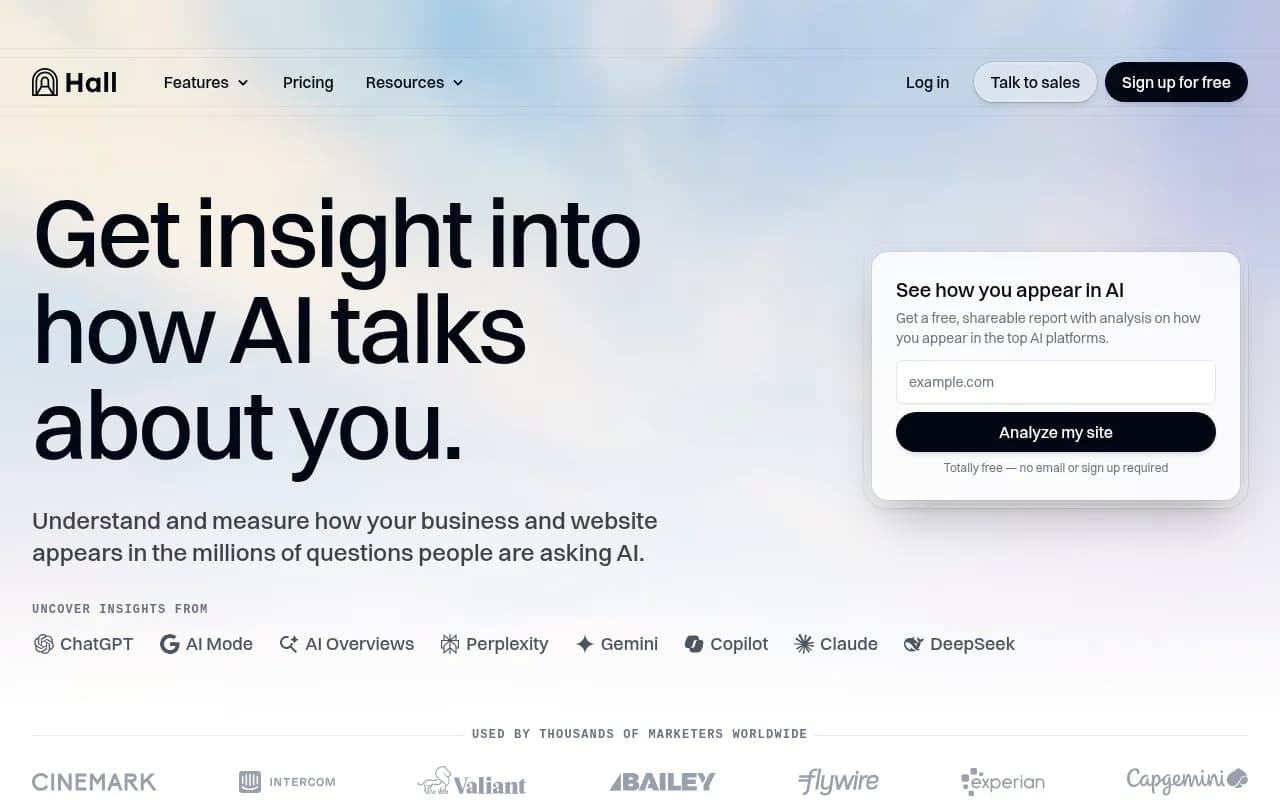
Hall AI had a clear pitch: track how AI platforms like ChatGPT, Perplexity, and Claude talk about your brand. It was clean, focused, and easy to understand. And then it shut down.
The shutdown wasn't a surprise to anyone watching the GEO space closely. Hall AI was a monitoring tool in a market that was rapidly figuring out that monitoring alone doesn't justify a recurring subscription. This guide breaks down what went wrong, why the monitoring-only model is structurally difficult to sustain, and what the shutdown means for teams trying to manage their AI visibility in 2026.
What Hall AI actually did
Hall AI sat in a category that's become crowded fast: AI brand visibility tracking. The core function was watching how large language models responded to prompts related to your brand or category, then surfacing whether you were being cited, mentioned, or ignored.
That's genuinely useful information. Knowing that ChatGPT recommends three competitors when someone asks "what's the best project management tool?" and your brand isn't one of them -- that's a real insight. The problem is what happens next.
Hall AI's answer to "what do I do with this?" was essentially: keep watching. The platform showed you the data. It didn't help you act on it.
The retention math doesn't work for monitoring-only tools
Here's the core business model problem. A user signs up for Hall AI, runs their brand through the monitoring setup, and gets their visibility scores. They see they're underperforming. They share the report with their team. Then what?
If the tool can't help them improve those scores, the user has two options:
- Keep paying to watch the same bad numbers month after month
- Cancel and check back manually every few months
Most users choose option two. This creates a churn pattern that's brutal for SaaS businesses. The initial "aha moment" -- seeing your AI visibility score for the first time -- is genuinely compelling. But it doesn't generate the kind of ongoing engagement that sustains a subscription.
Compare this to a tool like Semrush or Ahrefs in traditional SEO. Those platforms retained users because they were embedded in the workflow. You tracked rankings, found keyword gaps, built content briefs, monitored backlinks, and ran audits -- all in the same place. The tool was part of how you did your job, not just a dashboard you checked occasionally.
Monitoring-only AI visibility tools haven't cracked that workflow problem. They show you the problem. They don't help you solve it.
Why the GEO market is punishing passive tools
The broader AI search visibility market in 2026 is splitting into two tiers:
- Lightweight trackers that are cheap (or free) and do basic monitoring
- Full-stack platforms that combine monitoring with content generation, gap analysis, and optimization workflows
Hall AI was priced and positioned in the middle -- not cheap enough to be a no-brainer add-on, not capable enough to justify a serious budget. That's a difficult place to survive.
The tools that are growing in this market are the ones that close the loop. When you find out you're not being cited for a high-value prompt, the next question is: "What content do I need to create to change that?" Platforms that can answer that question -- and then help you create the content -- have a much stronger retention story.
Promptwatch is the clearest example of this approach. It tracks visibility across 10 AI models, but the core value proposition is the action loop: find gaps in your AI visibility, generate content that addresses those gaps using real prompt data, then track whether the new content gets cited. That cycle gives users a reason to come back every week, not just every quarter.

The difference between a monitoring dashboard and an optimization platform isn't just features -- it's whether the tool is embedded in your workflow or sitting outside it.
The "so what?" problem in AI visibility tools
There's a pattern in how teams interact with monitoring-only tools that's worth naming directly. It goes like this:
- Someone on the marketing team discovers AI visibility tracking and gets excited
- They sign up, run the initial audit, and present the results to leadership
- Leadership asks "what do we do about this?"
- The tool doesn't have a good answer
- The initiative stalls, the subscription gets deprioritized, and eventually cancelled
This isn't a failure of the team -- it's a failure of the product to answer the "so what?" question. Hall AI, like several of its peers, was good at generating the initial alarm but couldn't sustain the follow-through.
The tools that avoid this trap are the ones that turn visibility data into a content roadmap. When a platform can tell you not just that you're missing from AI responses, but which specific prompts you're missing from, what content your competitors have that you don't, and what you should write to close the gap -- that's a tool that earns its renewal.
What Hall AI's shutdown tells us about the broader market
Hall AI isn't the only monitoring-only tool that's struggled. The pattern is consistent: tools that launched in 2023 and 2024 as pure trackers are either shutting down, pivoting to add optimization features, or getting acquired by larger platforms that already have those capabilities.
The market is essentially running a natural experiment, and the results are coming in. Monitoring is table stakes. The question buyers are asking in 2026 is: "After I know I'm invisible, what does this tool help me do?"
A few categories of tools are handling this differently:
Tools that stayed monitoring-only
Some tools in this space remain focused on tracking and reporting. They're viable if they're priced accordingly -- as lightweight add-ons rather than primary platforms. But they face constant pressure from free tiers offered by larger tools.


Tools that added optimization features
Several platforms that started as trackers have added content gap analysis, brief generation, or optimization recommendations. This is the right direction, though the quality of these features varies significantly.


Full-stack GEO platforms
The strongest position in the market right now belongs to platforms that were built from the start around the full optimization workflow -- not just tracking, but finding gaps and fixing them.
Comparing the alternatives to Hall AI in 2026
If you were using Hall AI and need a replacement, here's a practical breakdown of the options:
| Tool | Monitoring | Content generation | Gap analysis | Crawler logs | Best for |
|---|---|---|---|---|---|
| Promptwatch | 10 AI models | Yes (Content Agents) | Yes (Answer Gap Analysis) | Yes | Teams that want to act, not just track |
| Profound | Strong | No | Limited | No | Brands needing deep monitoring |
| AthenaHQ | 8+ models | No | Limited | No | Monitoring-focused teams |
| Otterly.AI | Basic | No | No | No | Budget-conscious monitoring |
| Peec.ai | Multi-language | No | No | No | International brands |
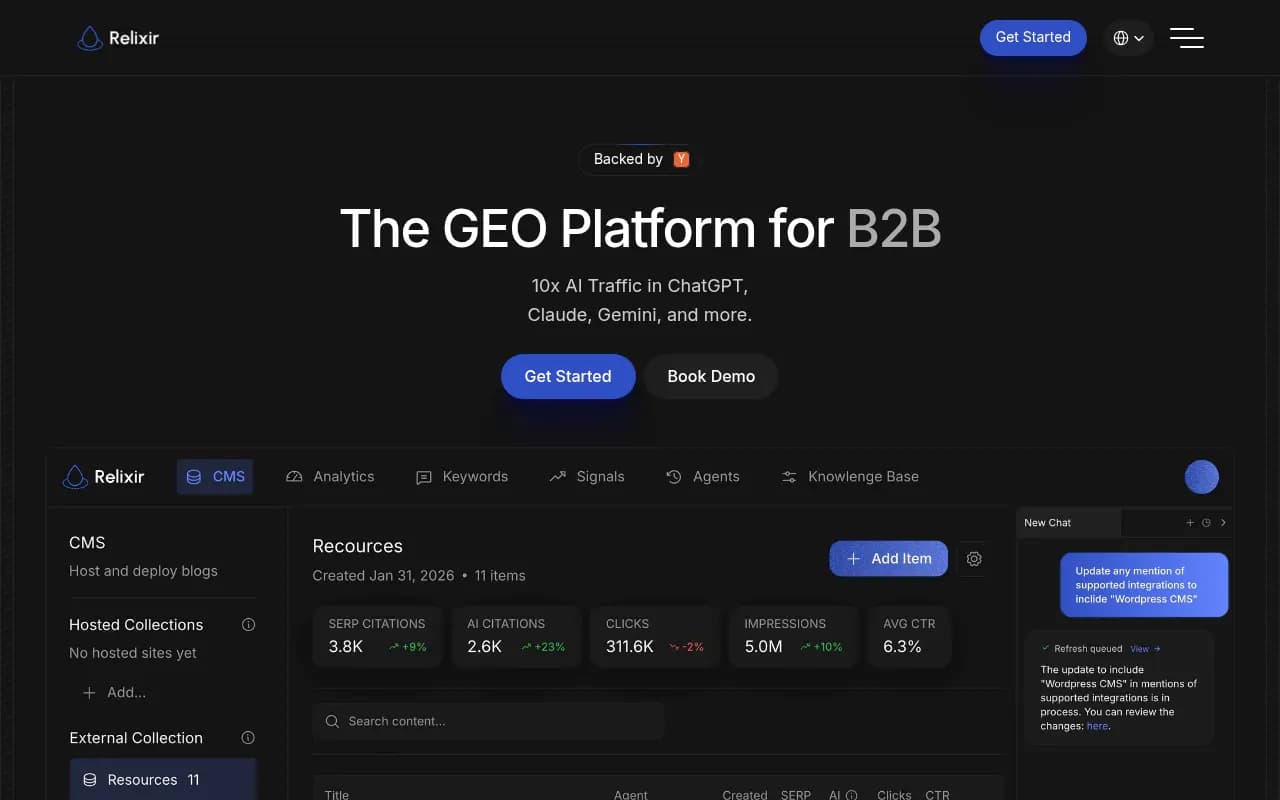
| Relixir | Yes | Yes | Yes | No | Teams wanting AI-native content |
The honest recommendation: if Hall AI's shutdown is prompting you to rethink your AI visibility strategy, don't just replace it with another monitoring tool. The market has moved. The value is in the optimization loop, not the dashboard.
What a functional AI visibility workflow actually looks like
For teams that want to get serious about AI search visibility in 2026, the workflow that works looks something like this:
First, you establish a baseline. Which prompts in your category are being asked? Which AI models are answering them? Where does your brand appear, and where are competitors showing up instead?
Second, you identify gaps. Not just "we're not visible" but specifically: which prompts are your competitors winning that you're not? What content do they have that you don't? What questions are AI models trying to answer that your site doesn't address?
Third, you create content to close those gaps. This isn't generic blog content -- it's content engineered around the specific prompts and questions that AI models are already fielding. The topics, angles, and formats that AI models cite are different from what ranks in traditional search.
Fourth, you track whether it works. Did the new content get crawled? Did it get cited? Which models picked it up, and how quickly?
Hall AI could help with the first step. It couldn't help with steps two through four. That's why it couldn't hold users.
The deeper lesson: data without action is a cost center
There's a broader principle here that applies beyond AI visibility tools. Any analytics product that generates data without helping users act on it is fighting an uphill battle. Users will tolerate a pure reporting tool if the reports are genuinely decision-changing. But in a competitive market where action-oriented alternatives exist, the pure data play is hard to sustain.
This is why the monitoring-only model for AI visibility is structurally weak. The data is interesting. The first report is genuinely eye-opening. But the second and third reports, showing the same gaps because the tool didn't help you close them, generate frustration rather than value.
The platforms that survive and grow in this market will be the ones that make the data actionable -- that turn "you're not visible here" into "here's what to write, here's how to write it, and here's how to track whether it worked."
Hall AI couldn't make that transition. That's the real story behind the shutdown.
What to do if you're evaluating replacements
A few practical questions to ask when looking at Hall AI alternatives:
- Does the tool track the specific AI models your customers are using? (ChatGPT and Perplexity are table stakes; Google AI Mode and Grok matter for some audiences)
- Can it show you which prompts competitors are winning that you're not?
- Does it help you create content to close those gaps, or just show you the gap exists?
- Can it track whether your new content gets crawled and cited by AI models?
- Does it connect AI visibility to actual traffic and revenue?
If the answer to most of those questions is "no," you're looking at a monitoring tool. That might be fine as a lightweight add-on, but it's not a strategy.
The GEO market in 2026 has enough mature options that there's no reason to settle for a tool that stops at the dashboard. Hall AI's shutdown is a data point, not an anomaly -- it's the market telling you where the value actually lives.