Key takeaways
- Most GEO tools look impressive in demos -- the real test is whether their data holds up when you cross-reference it against sources you already trust
- The biggest accuracy risks are prompt sampling methodology, citation freshness, and how tools handle AI model updates
- Before committing, run a parallel test: track 10-20 known prompts manually and compare what the tool reports
- Monitoring-only tools give you data but no path to action -- accuracy matters more when the platform can actually help you do something with it
- Ask vendors specific questions about data collection frequency, model coverage, and how they validate their own outputs
The GEO tool market has exploded. There are now dozens of platforms claiming to track your brand's visibility across ChatGPT, Perplexity, Claude, Gemini, and every other AI model that matters. Most of them have slick dashboards. Many of them have impressive-sounding numbers. A few of them have data you can actually trust.
The problem is that it's genuinely hard to tell which is which before you've signed up and spent a few months inside the platform. Unlike traditional rank tracking -- where you can verify a tool's data by just Googling the keyword yourself -- AI search visibility is harder to spot-check. Responses vary by session, by model version, by geography, and sometimes just by the phrasing of a question. That variability is exactly what bad vendors hide behind.
This guide is about how to cut through that. Before you commit to any GEO platform in 2026, here's what to look at, what to ask, and what to walk away from.
Why data accuracy is harder to evaluate in GEO than in traditional SEO
In traditional SEO, rank tracking is relatively straightforward. A tool checks where your page appears for a given keyword, and you can verify that by searching yourself. The data is deterministic enough that vendor accuracy is easy to audit.
GEO is different. AI models don't return the same answer every time. They vary by:
- The exact phrasing of the prompt
- The user's location and language
- The model version currently deployed
- Whether the model is in a "browsing" mode or relying on training data
- Personalization signals (in some models)
This means a GEO tool's methodology -- how it samples prompts, how often it queries models, how it handles response variation -- has an enormous effect on whether the data you see reflects reality. Two tools tracking the same brand across the same prompts can show wildly different visibility scores, and both might be technically "correct" given their methodology.
That's why due diligence here isn't just about checking if a tool has a nice UI. It's about understanding the engine underneath.
The core questions to ask any GEO vendor
How do you collect data, and how often?
This is the first thing to nail down. Some tools query AI models in real time when you check your dashboard. Others run batch queries on a schedule -- daily, weekly, or even less frequently. Some use cached responses.
Real-time querying sounds better but isn't always more accurate -- it can introduce more noise from model response variation. Scheduled batch queries, done correctly with multiple runs per prompt, can actually produce more reliable trend data.
Ask specifically:
- How many times do you query each prompt per measurement cycle?
- Do you aggregate multiple responses or report a single response?
- How do you handle response variation -- do you report the most common answer, an average, or something else?
- How quickly does the dashboard reflect changes in AI model behavior?
Vendors who can answer these questions precisely are the ones who've thought carefully about methodology. Vague answers like "we query continuously" or "we use advanced AI" are red flags.
Which AI models do you actually cover, and how?
The market leaders -- ChatGPT, Perplexity, Google AI Overviews, Claude, Gemini -- are the obvious ones. But coverage claims vary wildly. Some tools say they cover 10+ models but only have robust data for two or three. Others cover models that barely anyone uses while missing important regional players.
More importantly: how does the tool access each model? Direct API access gives you consistent, reproducible queries. Web scraping is cheaper but fragile -- it breaks when interfaces change, and it often can't replicate the experience real users have.
Ask:
- Do you use official APIs or scraping for each model?
- How do you handle models that don't have public APIs?
- When a model updates (like a GPT-4 to GPT-4o transition), how quickly does your data reflect the change?
How do you define and measure "visibility"?
This sounds basic, but the definition varies enormously between tools. Some measure whether your brand name appears anywhere in a response. Others look at whether you're cited as a source. Others track sentiment, ranking position within a list, or share of voice across a prompt set.
None of these is wrong, but they measure different things. A tool that counts any brand mention as "visibility" will show very different numbers than one that only counts direct citations with links.
Get the vendor to show you exactly what a "visibility event" means in their system, and make sure it maps to something you actually care about.
How do you validate your own data?
This is the question most vendors aren't prepared for, and the answer tells you a lot.
Good vendors have internal validation processes: they run known test cases, compare outputs across model versions, and have some mechanism for catching when their data collection breaks. They might cross-reference their citation data against actual traffic patterns. They might run human spot-checks on a sample of responses.
Bad vendors don't have a good answer. They'll say something like "our AI handles it" or deflect to talking about their data volume.
The OECD's guidance on responsible AI development makes a relevant point here: tools used to measure AI system behavior should themselves be tested and have proven accuracy. That principle applies directly to GEO platforms -- a tool that measures AI visibility should be able to demonstrate its own measurement accuracy.
How to run your own accuracy validation before committing
Don't just take a vendor's word for it. Most platforms offer free trials or demo access. Use that window to run your own parallel test.
Step 1: Pick 15-20 prompts you can verify manually
Choose prompts where you have some expectation of the answer -- either because you know your brand should appear, or because you know a competitor dominates. Keep the prompts simple and specific enough that you can manually check them.
Step 2: Query the AI models yourself
For each prompt, go directly to ChatGPT, Perplexity, Claude, and whatever other models the tool claims to cover. Run each prompt 3-5 times across different sessions. Note whether your brand appears, where it appears, and whether it's cited as a source.
This is tedious, but it's the only way to get ground truth data.
Step 3: Compare against what the tool reports
Load the same prompts into the GEO tool and see what it shows. The numbers won't match exactly -- you're comparing a handful of manual checks against the tool's larger sample -- but the directional story should be consistent.
If the tool shows you as highly visible for a prompt where you never appeared in your manual checks, that's a problem. If it shows you as invisible for prompts where you consistently appeared, that's also a problem.
Step 4: Check the citation sources
Many GEO tools show you which pages are being cited in AI responses. Cross-reference a sample of these against what you actually see when you run the prompts manually. Are the cited pages real? Are they the ones actually appearing in responses, or is the tool showing you pages that rank well in traditional search but aren't actually being cited by AI models?
This cross-referencing step is something practitioners on forums like Reddit's r/AskMarketing have flagged as one of the most reliable validation methods available -- comparing GEO tool outputs against analytics data you already trust.
Red flags that suggest a tool's data isn't reliable
Suspiciously smooth trend lines
Real AI visibility data is noisy. Models update, prompts shift, and your visibility fluctuates. If a tool shows you perfectly smooth upward trends with no variation, it's probably smoothing or interpolating data in ways that hide what's actually happening.
No transparency about prompt methodology
If a vendor can't or won't tell you how they select and structure the prompts they use to measure visibility, you have no way to assess whether those prompts reflect how real users actually ask questions. Some tools use overly branded prompts ("What is [Brand Name]?") that inflate visibility scores. Others use prompts so generic that they don't reflect any real purchase intent.
Coverage claims that don't hold up
A tool that claims to cover 12 AI models but whose dashboard shows thin or stale data for anything beyond ChatGPT and Google is overstating its capabilities. Check the data density for each model -- not just whether the model appears in the interface.
No data on when responses were collected
Every visibility data point should have a timestamp. If you can't tell when a response was collected, you can't assess whether it reflects current model behavior or something from three months ago.
Visibility scores with no underlying data
Aggregate scores and indices are fine for high-level reporting, but you should always be able to drill down to the underlying prompt-level data. If a tool gives you a "GEO score" of 67 but can't show you which prompts drove that number, you're trusting a black box.
What separates monitoring tools from optimization platforms
There's a meaningful distinction in the GEO tool market that affects how much data accuracy matters to you in practice.
Monitoring-only tools show you where you're visible and where you're not. That's useful, but it leaves you with a gap: you know the problem, but the tool doesn't help you fix it. For these tools, data accuracy is important but somewhat academic -- you're using the data to understand your position, not to take specific actions.
Optimization platforms go further. They identify content gaps, help you understand what topics and questions you're missing, and give you tools to create content that's more likely to get cited by AI models. For these platforms, data accuracy is critical -- because you're making content investment decisions based on what the tool tells you is missing.
Promptwatch is one of the few platforms that covers the full loop: finding gaps in your AI visibility, generating content designed to close those gaps, and then tracking whether that content actually gets cited. When a platform is driving content decisions, you need to be especially confident in the underlying data.

The distinction matters for due diligence too. When evaluating a monitoring-only tool, focus your accuracy checks on the visibility measurement itself. When evaluating an optimization platform, also check the quality of the gap analysis -- are the "missing" prompts actually ones where competitors are visible? Are the content recommendations grounded in real citation data or just keyword guesses?
A comparison of what to look for across tool types
| Evaluation criterion | Monitoring tools | Optimization platforms |
|---|---|---|
| Prompt methodology transparency | Essential | Essential |
| Citation source accuracy | Important | Critical |
| Data freshness / update frequency | Important | Critical |
| Model coverage depth | Important | Important |
| Gap analysis quality | N/A | Critical |
| Content recommendation grounding | N/A | Critical |
| Traffic attribution | Nice to have | Important |
| API / data export | Nice to have | Important |
Questions to ask about data infrastructure
Beyond the methodology questions, there are practical infrastructure questions that affect data reliability over time. These come up less often in GEO tool evaluations but matter a lot for long-term use.
How does the vendor handle AI model updates? When OpenAI releases a new model version, or when Google updates its AI Overview behavior, does the tool's data collection automatically adapt? Or does it take weeks for the vendor to catch up? Ask for a specific example of how they handled a recent major model update.
What happens when an AI model changes its citation behavior? Some models have shifted from citing external sources to generating more self-contained answers. A tool that doesn't account for this will show declining visibility scores that actually reflect a model behavior change, not a real change in your brand's position.
How is historical data handled? If the vendor changes their methodology -- which they will, as the market matures -- do they restate historical data, or does your trend line have a break in it? Neither approach is inherently wrong, but you need to know which one you're dealing with.
Practical checklist before you commit
Before signing any GEO platform contract, work through this list:
- Run a 2-week parallel test comparing tool data against manual prompt checks
- Ask the vendor to explain their prompt sampling methodology in writing
- Verify model coverage by checking data density for each claimed model, not just the model list
- Confirm data collection frequency and how response variation is handled
- Check whether citation sources in the tool match what you see in actual AI responses
- Ask how the vendor handled the last major AI model update
- Confirm you can export raw data or access it via API
- Understand exactly what counts as a "visibility event" in their system
- If it's an optimization platform, validate that gap analysis prompts reflect real user behavior
The GEO tool market is still young enough that methodology varies enormously between vendors. The platforms that will still be worth using in two years are the ones that can answer these questions clearly today.
Tools worth evaluating
The market has a lot of options at different price points and capability levels. Here are some worth looking at as part of your evaluation process:
Full-stack optimization platforms:
Promptwatch covers 10+ AI models with prompt-level tracking, citation analysis, content gap identification, and built-in content generation. Its data set -- over 1.1 billion citations processed -- gives it a meaningful edge in citation accuracy validation.


Monitoring-focused tools:


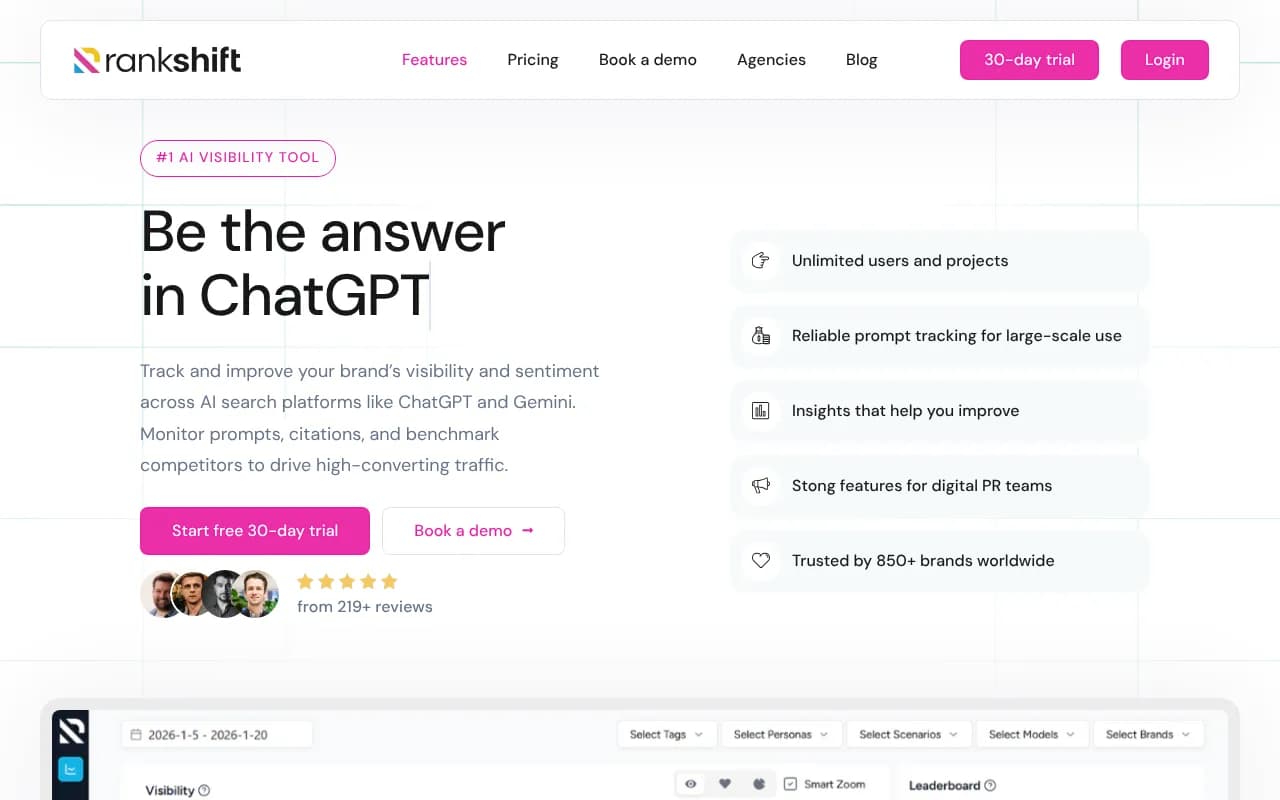
Enterprise-grade options:
Each of these has different strengths in terms of model coverage, data freshness, and methodology transparency. Run the validation process above on whichever ones make your shortlist -- don't skip it just because a tool has a well-known brand name.
The bottom line
GEO tool due diligence in 2026 comes down to one thing: can you verify the data independently, and does the vendor make that easy or hard?
The platforms worth trusting are the ones that show their work -- transparent about how they collect data, willing to explain their methodology, and able to give you the underlying prompt-level data rather than just aggregate scores. The ones to avoid are the ones that hide behind "proprietary AI" explanations and make it difficult to cross-reference their outputs against reality.
Spend two weeks doing parallel manual checks before you commit. It's tedious, but it's the only way to know whether you're buying real insight or a well-designed dashboard full of noise.