
Key takeaways
- A SOC 2 report or ISO 27001 certificate is the entry ticket, not the answer. It does not tell you where prompts, brand data and site logs go, who sub-processes them, or whether they train anything.
- AI visibility platforms touch less sensitive data than an LLM gateway, but they can still hold analytics scripts, crawler logs, Search Console data, CMS credentials and publishing rights. That last one is what security teams should worry about most.
- Ask every vendor for the same ten documents and compare them side by side. Missing documentation is a finding in itself.
- Treat vendor-sponsored rankings and third-party review summaries as leads, not evidence. Verify every certification claim on the vendor's own trust center.
- Monitoring-only tools and execution platforms need different reviews. The moment a tool can publish to your CMS, it belongs in the same risk tier as any other system with write access to your website.
Why the security review for GEO tools is different
Most procurement checklists for AI vendors were written for tools that ingest your prompts and documents: copilots, API gateways, internal search. An AI visibility platform is a different animal. It mostly sends prompts out to ChatGPT, Gemini, Perplexity, Claude and Google AI Overviews, then records what comes back about your brand.
So the headline data risk is lower. But the product category has moved fast, and I think a lot of security teams are still reviewing it as if it were a keyword rank tracker. That is a mistake, for three reasons.
- Many platforms now install a tracking script or read server and CDN logs to attribute AI traffic.
- Many connect to Google Search Console, Bing Webmaster Tools, analytics and your CMS.
- The newer ones write and publish content on your behalf, sometimes on a schedule with no human in the loop.
Each of those is a different review. Log access is a data-protection question. CMS write access is an access-control and change-management question. Content generation raises brand-safety and accuracy questions that no certificate covers.
The LinkedIn piece on what US enterprise buyers want from AI security vendors lists the themes buyers keep returning to: how AI tools are governed, how data is protected, how model exposure is controlled, how privacy is handled and how risk is reported. Those are good headings for the questionnaire below, even though the article is aimed at security vendors rather than marketing platforms.
What the certifications actually prove
Before the checklist, a quick calibration on what each document does and does not tell you.
| Document | What it proves | What it does not prove |
|---|---|---|
| SOC 2 Type II | An auditor tested the vendor's controls over a period (usually 6 to 12 months) | That the scope covers the product you are buying, or where data is processed |
| SOC 2 Type I | Controls were designed appropriately at one point in time | That they worked over time |
| ISO/IEC 27001 | An information security management system exists and is audited | That a specific feature or integration is in scope |
| ISO/IEC 42001 | An AI management system exists | That outputs are accurate or safe for your brand |
| GDPR compliance / DPA | The vendor will sign data processing terms | Where sub-processors operate, or how long data is retained |
| Penetration test summary | A tester attempted to break in at a point in time | That findings were fixed |
A point worth repeating from the xyc.ai vendor-assessment write-up in the research: SOC 2 and ISO 27001 don't tell you where your prompts go. For a GEO platform, swap "prompts" for "tracked prompts, site logs and CMS tokens" and the point stands. Always ask for the scope statement (or Statement of Applicability for ISO) and confirm the product and region you will use are inside it.
On regulation, I would not hard-code any single EU AI Act date into a contract or a risk register. One of the research sources states that high-risk enforcement begins August 2, 2026, but the research notes flag that this date may have shifted and was not verified. Ask your legal team for the current timeline. In practice, most visibility tools are unlikely to be high-risk systems themselves, but the vendor should be able to explain its classification in writing.
The procurement checklist
Use this as a questionnaire. Send it to every shortlisted vendor, and score answers on a simple scale: documented, verbal only, or missing.
Certifications and audit evidence
- Current SOC 2 Type II report (under NDA), with the audit period and scope.
- ISO/IEC 27001 certificate and Statement of Applicability, with the certifying body named.
- Latest independent penetration test summary and remediation status.
- Any ISO/IEC 42001 or NIST AI RMF alignment, if the vendor claims it. Ask what that means operationally.
- A public trust center or security page you can cite in your vendor file.
Data handling and residency
- What data is collected: tracked prompts, AI responses, citations, site analytics events, crawler logs, Search Console data, CMS content.
- Where it is stored and processed, by region, and whether you can choose EU or US.
- The full sub-processor list, with a notification process for changes.
- Retention periods and deletion on termination, with a deletion certificate if you need one.
- Whether any customer data is used to train models, by the vendor or by its LLM providers.
- How the vendor's own AI features (chat assistants, content writers) are covered by the same terms.
Access control and auditability
- SSO (SAML or OIDC) and whether it is gated to an enterprise tier.
- Role-based access with project-level scoping, so an agency or regional team sees only its own data.
- An audit log that records who changed what, and whether the change came from the UI, the API or an automation.
- Scoped, revocable API keys. Read-only keys matter more than most buyers realize.
- Session and token handling for connected CMS and analytics accounts.
Write access and publishing controls
This is the category-specific section most generic checklists miss.
- Can the platform publish to your CMS? If yes, can it be restricted to drafts only?
- Is there an approval inbox, and can you require human review before anything goes live?
- Can you set publish windows, volume caps and per-project budgets?
- Are brand facts, tone and banned claims enforced from a knowledge base you control?
- Is every published document traceable from draft to live URL?
If a vendor's answer to "can it publish without review?" is "yes, by default," that is not automatically a reason to walk away. It is a reason to change the default in the contract and the configuration.
Operational and commercial terms
- Uptime commitments and incident notification windows.
- Breach notification timeline in the DPA.
- Data export in open formats (CSV, API), so you can leave.
- Pricing model: per prompt, per response, flat fee, or quote-only. Hidden prompt caps are a common surprise at renewal.
- Whether the tier you need includes SSO, audit logs and API access, or whether those sit behind a custom quote.
Check the crawler and logging claims yourself
Security and marketing teams often disagree about whether AI crawlers should be allowed at all. Whatever you decide, make the decision with data rather than assumptions. Promptwatch Data's AI Crawler Traffic report (published September 9, 2026, covering June 8 to September 6, 2026) counts only requests whose source IP matches each operator's published ranges, which filters out spoofed user agents. In that data OpenAI accounted for 79.8% of verified AI crawler requests in the week of August 31 to September 6, down from 94.8% in the week of June 8.
The report's practical advice is good procurement hygiene too: check robots.txt, CDN and WAF rules for every provider in the chart, then compare your own logs against the public mix. A crawler that is large in the benchmark but near zero in your logs usually means you are blocking it. It is also a reasonable thing to ask any vendor that offers crawler analytics: are visits verified against published IP ranges, and which CDNs and hosts do you integrate with?
On the broader question of which sources AI engines lean on, see Promptwatch Data's domain rank distribution report (November 3 to 16, 2026). The median cited domain was DR 57 in ChatGPT and Perplexity and DR 56 in AI Overviews and AI Mode, which is a useful reminder that being cited depends on more than domain strength.
How to read vendor rankings with suspicion
When I went through the available research for this guide, the first thing I noticed was how many "best enterprise vendor" lists were written by vendors.
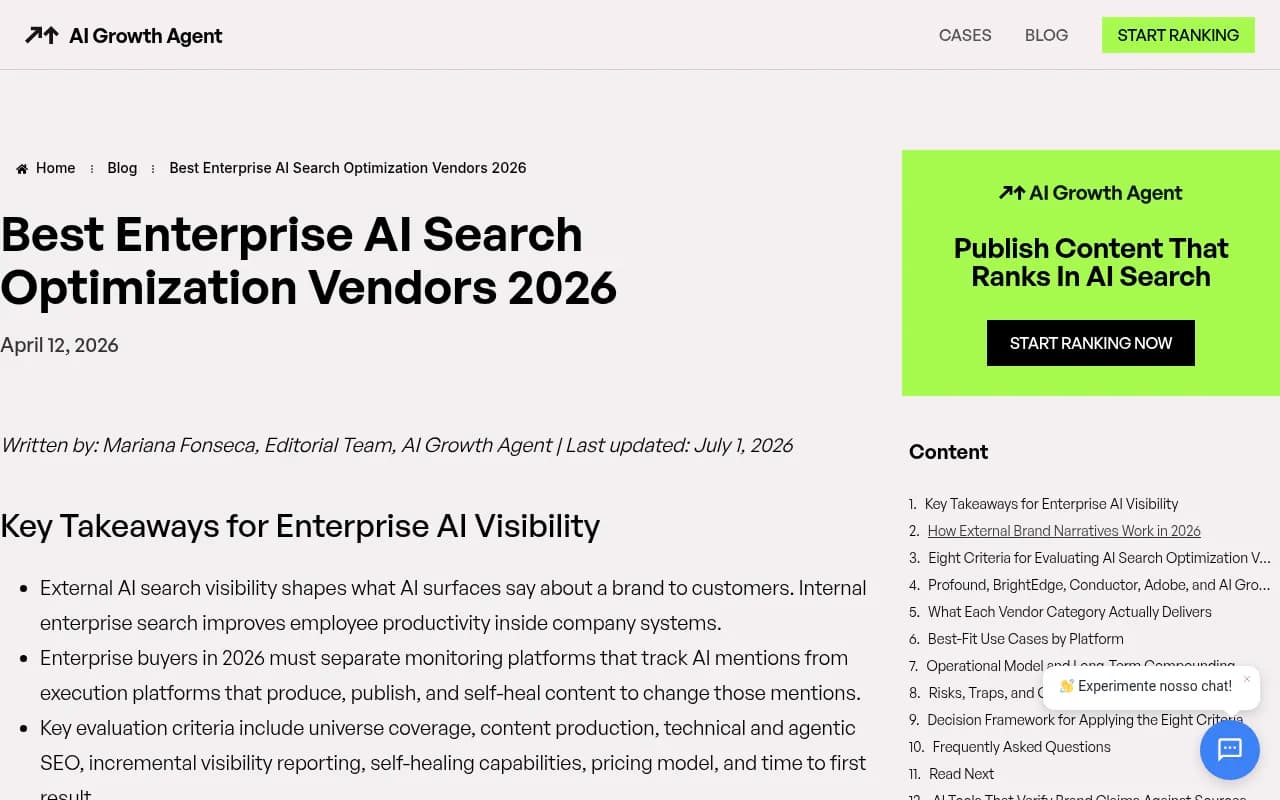
The AI Growth Agent ranking names AI Growth Agent as the only platform with full execution, and it is useful mainly for its evaluation criteria (universe coverage, content production, self-healing, reporting, pricing model, time to first result), not for its verdict. The buildmvpfast compliance roundup carries a sponsored banner and its statistics (a 56% rise in AI security incidents, $670,000 extra breach cost, 247 days to detect) need independent verification before you quote them to your board.
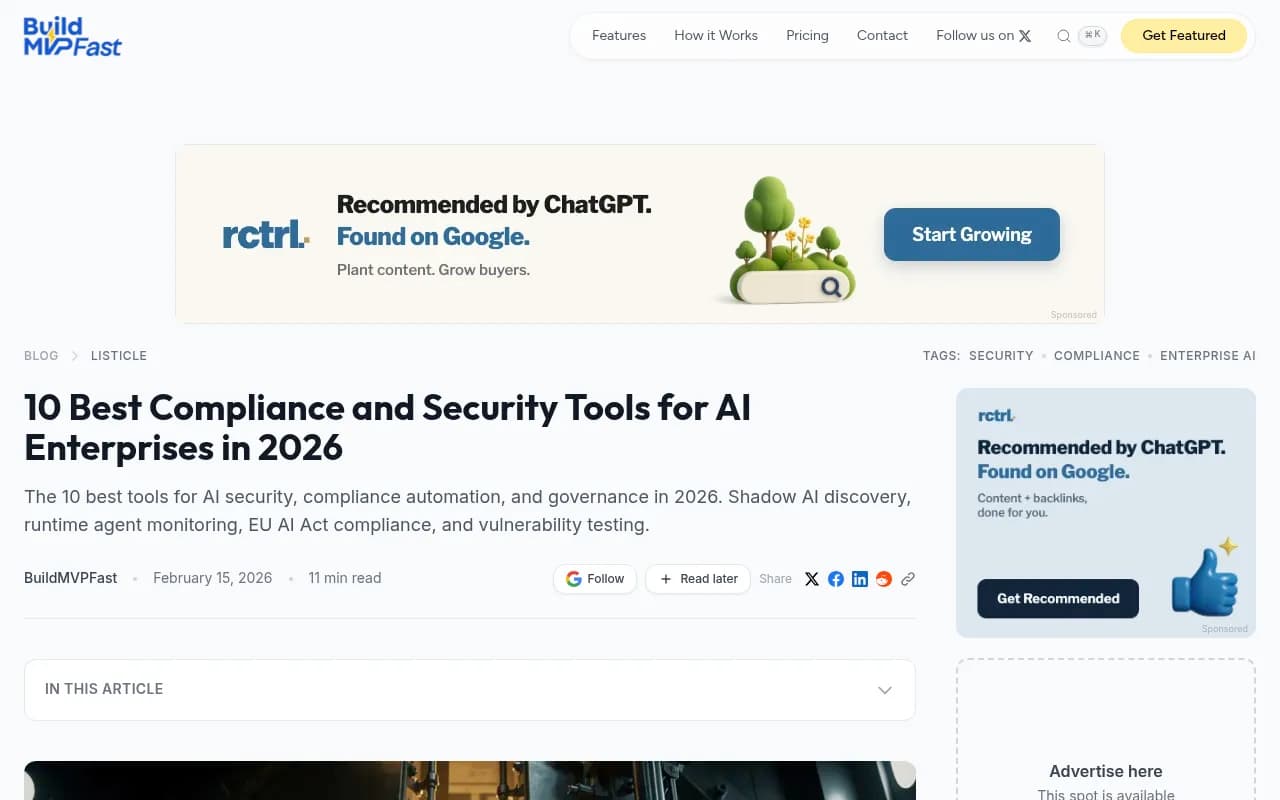
That roundup is about shadow-AI discovery and agent runtime security, a different product class from AI visibility. Useful context for your CISO, not a shortlist for your marketing team.
The same caution applies to secondhand vendor claims. A third-party review says Profound's Enterprise tier is quote-only, is the only tier with API access, and adds SSO/SAML, SOC 2 and dedicated Slack support. That may be accurate, but it is a secondary source. Confirm it on the vendor's trust page before it goes into a procurement file. I found no first-party SOC 2, ISO 27001, GDPR or DPA documentation in my research for Peec, Scrunch, Otterly, AthenaHQ or Semrush either, which means nothing here should be read as a claim that they lack it. Ask each one directly.
Where the main platforms sit
The table below summarizes what I could establish about positioning. It is not a security ranking. Security attributes marked "verify" must be confirmed with each vendor.
| Platform | Positioning | Execution (writes/publishes content) | Security documentation |
|---|---|---|---|
| Promptwatch | End-to-end AI visibility platform: monitoring, crawler logs, visitor analytics, content agents, CMS publishing | Yes | ISO/IEC 27001 certified and GDPR compliant, per the vendor; confirm scope and obtain reports |
| Profound | Enterprise-grade AI visibility and citation analytics | Primarily monitoring | Reported SSO/SAML and SOC 2 on Enterprise; verify on trust page |
| Scrunch | AI visibility monitoring and optimization | Verify | Verify |
| Peec AI | Multi-language AI visibility tracking | Monitoring-focused | Verify |
| Otterly.AI | Affordable AI visibility monitoring | Monitoring-focused | Verify |
| AthenaHQ | Visibility tracking across 8+ AI engines | Verify | Verify |
| Semrush | Established SEO suite with AI visibility tracking added | Limited | Verify |
Promptwatch is the one I would put at the top of a security-conscious shortlist, mainly because the combination of controls maps well to the checklist above. It is ISO/IEC 27001 certified and GDPR compliant with data handled by an EU-based company, offers an organization audit log on Business and above, scoped project, organization and read-only API keys, SSO on Enterprise, and owner, editor and viewer roles with project-level access. For the write-access concern, its Content Agent runs with a review inbox where pieces can be approved, edited or declined, with publish windows and a monthly budget, and each document is tracked from draft to live URL. Hands-off mode exists, but it is a setting you choose, not a default you inherit.

It is worth being honest about the pricing gates. SSO and white-label portals sit on Enterprise, and the audit log, Content Agent, Fact Check and faster-than-daily tracking start at Business ($579/mo). Confirm current terms at promptwatch.com/pricing. If you want a side-by-side before committing, the 2026 platform comparison covers the other vendors in the table, and there are head-to-head pages such as Promptwatch vs Profound.

Profound is the vendor most enterprise buyers will also invite to the RFP. It is strong on monitoring and citation analytics, but the research suggests enterprise features, including API access, sit behind a quote, so ask early what is in the tier you would actually use. A Reddit practitioner quote relayed in one review calls it "much more expensive" with limiting prompt batch sizes, which is a data point to test in negotiation rather than a conclusion.
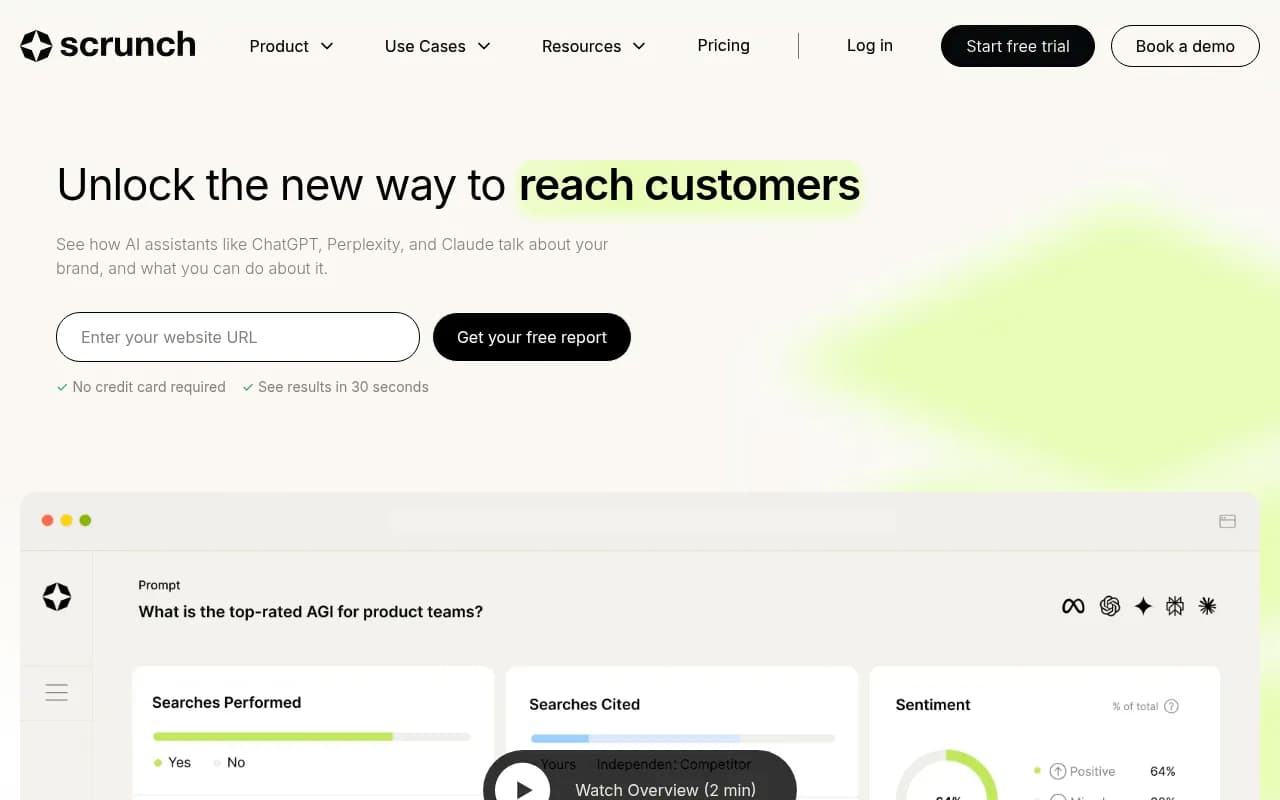


For the lighter-weight monitoring tools, the security review can be proportionate: if they only run prompts and store responses, with no script on your site and no CMS access, the exposure is mainly brand data and a few user accounts. Ask for the DPA and sub-processor list and move on. For anything that installs a script, reads logs or publishes, run the full checklist. If you want to scan the wider category first, the GEO software directory lists far more options than any shortlist should contain.
Run a proportionate review by tool type
Not every tool needs the same depth. A simple triage keeps the process from stalling.
| Tool type | Typical data touched | Review depth |
|---|---|---|
| Prompt monitoring only | Tracked prompts, AI answers, brand names | Light: DPA, sub-processors, SSO |
| Monitoring plus analytics or crawler logs | Above, plus site events, IPs, user agents | Medium: retention, residency, script and CSP review |
| Execution platform with CMS publishing | Above, plus CMS credentials and content | Full: access control, approvals, audit log, rollback |
| Agent platform with API or MCP write access | Above, plus programmatic changes | Full, plus key scoping and rate limits |
Two practical tests are worth doing in a trial. First, install any tracking script on a staging site with your real Content Security Policy and see what breaks. Second, connect a CMS sandbox, publish a draft, and check what the vendor's audit trail shows afterwards. If you can't reconstruct who did what from the log, that is your answer.
Contract clauses that matter more than the badge
A few terms are easy to skip and expensive to miss.
- Training and secondary use: a plain statement that your data is not used to train models.
- Sub-processor change notice, with the right to object or terminate.
- Breach notification inside a fixed window, ideally 72 hours or less.
- Data return and deletion on exit, in open formats.
- Liability for published content: if an agent publishes something inaccurate under your brand, who bears the cost? Most vendors will say you do, which is why approval workflows matter.
- Price protection on prompt and response volumes, since GEO costs scale with how many markets, languages and models you track.
Agencies buying on behalf of clients should also check client-data separation and white-label terms. If you need help turning findings into an actual GEO programme rather than just buying software, an SEO and AI search partner such as 1001 SEO Media can run the strategy side while your security team owns the vendor review.
A scoring template you can copy
Score each vendor 0 to 2 per line (0 missing, 1 verbal or partial, 2 documented). Weight the sections to your risk appetite.
| Section | Weight | Vendor A | Vendor B |
|---|---|---|---|
| Certifications and audit evidence | 25% | ||
| Data handling, residency, sub-processors | 25% | ||
| Access control and audit log | 20% | ||
| Publishing and approval controls | 15% | ||
| Contract and exit terms | 15% |
A vendor scoring below 1 on data handling should not advance, whatever its feature set. For execution platforms, do the same for publishing controls.
Frequently asked questions
Is SOC 2 enough for an AI visibility platform?
No. It tells you the vendor's controls were audited, not whether your specific data flows are covered. Ask for scope, region and sub-processors, then request ISO 27001 scope as well if the vendor claims it.
Do AI visibility tools send my confidential data to LLMs?
Usually they send tracked prompts (queries you chose) and receive public AI answers. The risk rises if the vendor's own AI features process uploaded documents or knowledge-base content. Ask what goes to which provider and under what terms.
Should security teams block AI crawlers?
That is a business decision, but make it with verified data. Compare your logs to public benchmarks such as Promptwatch Data's AI Crawler Traffic report before blocking or allowing anything, and review robots.txt, CDN and WAF rules together.
How long should a vendor security review take?
For monitoring-only tools, a week or two if documents arrive promptly. For platforms with CMS write access, plan for a month including a sandbox test of approvals and audit logs.
What is the single most useful question to ask?
"Show me the audit log entry for the last thing your own AI agent published or changed." A vendor that can answer that in a demo has probably thought about governance.