Key takeaways
- A good ecommerce prompt set mixes commercial, informational, and branded prompts, because each one pulls a different mix of cited pages.
- Forty prompts is enough to start: 10 category, 10 product-fit, 8 comparison and alternative, 6 informational, and 6 branded and trust prompts.
- Prompt tracking has no reliable volume or stable ranking, so track patterns over weeks, not single runs.
- Product pages are the most cited content type in ChatGPT (22.4% of citations, Sep 28 to Oct 4, 2026), so product page quality matters as much as category content.
- Track whether shopping cards appear and which brands fill them, not just whether you are mentioned.
Why a template beats ad hoc prompt picking
Most ecommerce teams start tracking AI search the same way. Someone types "best running shoes" into ChatGPT, sees a competitor, panics, and adds five similar prompts to a tracker. A month later the set is lopsided and nobody trusts it.
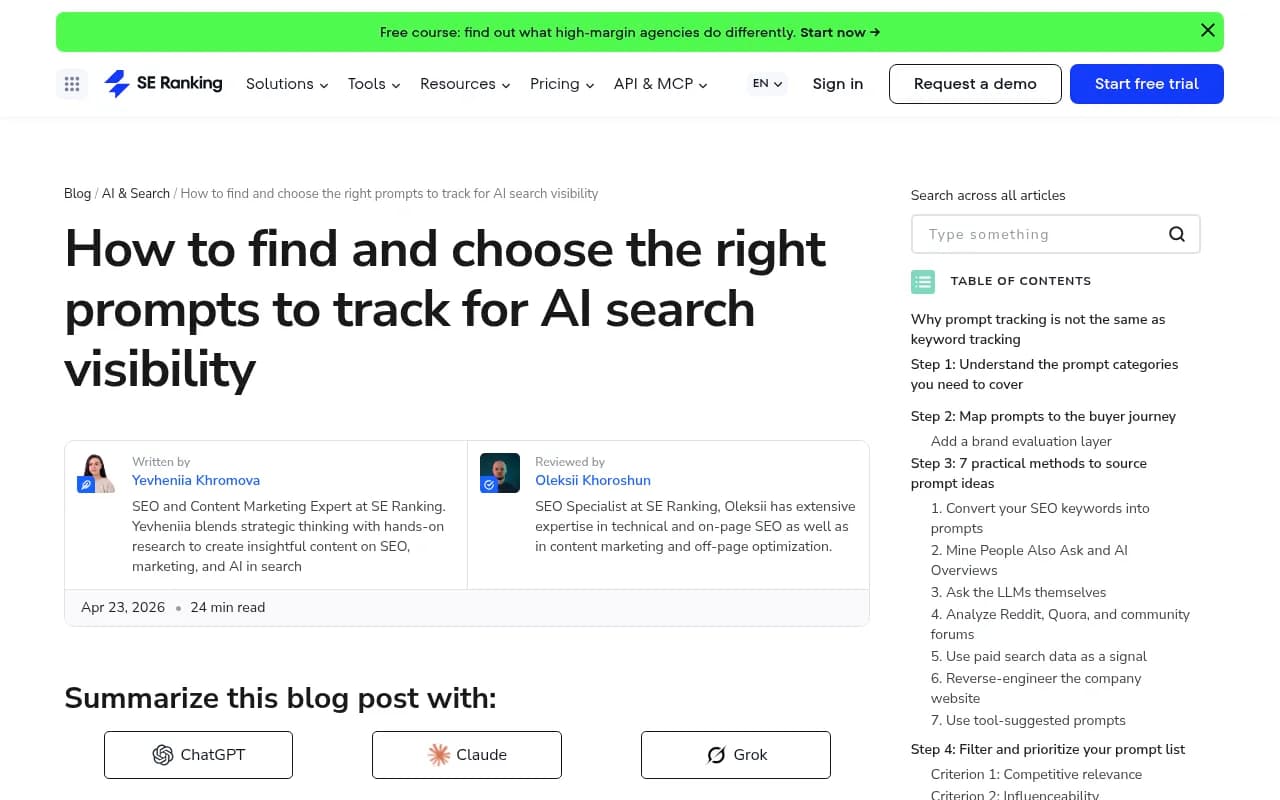
There is a real reason this is hard. As SE Ranking points out in its guide to choosing prompts to track (Apr 2026), prompt tracking gives you no reliable volume, no stable positions, and effectively infinite variations. The same question can return different brands depending on session context, location, or history. Defaulting to "best [category] tool" style prompts, they note, covers only a thin slice of how buyers actually use AI.
So the goal is not to track everything. It is to build a small, balanced set you can run repeatedly and compare over time. That is what this template does.
One clarification before we start. Some popular "ecommerce prompt" pages, like the Founderz ecommerce prompt generator, are about prompts you give an AI to write product copy. This guide is about the opposite: the questions shoppers ask AI, which you monitor to see whether your store shows up.
How the 40 prompts are structured
Promptwatch Data splits ChatGPT citations by prompt intent, and the differences are large. In its content type report (Sep 28 to Oct 4, 2026):
- Commercial prompts, where people compare options before buying, cite product pages 26.0% of the time, landing pages 20.6%, listicles 15.0%, and comparisons 7.9%. Those four types make up almost 70% of commercial citations.
- Informational prompts still lean on product pages (19.1%), but how-tos (10.7%), docs (8.5%) and articles (7.7%) matter more.
- Branded prompts cite product pages (23.3%) and landing pages (22.8%), and reviews jump to 5.6%, more than three times their overall share.
That tells you what to build the set around: three intents, each rewarding different pages. The table below shows the split I recommend.
| Prompt group | Count | Intent | Pages that tend to win |
|---|---|---|---|
| Category discovery | 10 | Commercial | Category pages, listicles, product pages |
| Product fit and use case | 10 | Commercial | Product pages, landing pages |
| Comparison and alternatives | 8 | Commercial | Comparison pages, listicles |
| Informational and how-to | 6 | Informational | How-tos, guides, docs, FAQs |
| Branded and trust | 6 | Branded | Product pages, reviews, FAQs |
Replace the bracketed placeholders with your own categories, products, and brand. Keep the wording close to how a real shopper types, and include a few short keyword-style versions too. Promptwatch's query fanout data shows average query length dropping from about 117 characters in December to about 53 in April 2026, so the searches AI runs behind your prompt are often short.
Category discovery prompts (10)
These measure non-branded discovery: do you get named when someone has not picked a brand yet? They are the closest ecommerce equivalent to head-term rankings.
- What are the best [product category] brands right now?
- Where can I buy [product category] online?
- Best [product category] for beginners
- Best [product category] under $[price]
- Best premium [product category] worth the money
- Top-rated [product category] with free shipping
- Best [product category] for [audience, e.g. small apartments, kids, athletes]
- Which online stores have the best selection of [product category]?
- Best sustainable or ethical [product category] brands
- What [product category] should I buy as a gift for [recipient]?
Prompts 2, 6, and 8 are retailer-oriented. They tell you whether AI sends shoppers to stores like yours or to marketplaces.
Product fit and use case prompts (10)
This is where ecommerce wins or loses. Buyers describe a situation and AI picks the product. Each prompt names a constraint, which is why these are worth tracking separately from head terms.
- Best [product] for [specific use case]
- Best [product] for [skin type, body type, room size, or skill level]
- Which [product] lasts the longest?
- Best [product] for [constraint, e.g. wide feet, hard water, small budget]
- Most durable [product] for daily use
- Best [product] with [specific feature, material, or certification]
- What [product] do you recommend for [season or event]?
- Best [product] for someone who [situation, e.g. travels a lot]
- Best lightweight or compact [product]
- Best [product] that ships to [country or region]
If you sell in several markets, run prompt 20 and its variants per country. Monitors in most tracking tools are fixed to a language and location once created, so build one per market rather than mixing them.
Comparison and alternative prompts (8)
Buyers narrowing down a shortlist ask AI to do the comparing. Keep these separate from category prompts. SE Ranking makes the same point: branded comparisons skew category metrics when mixed in.
- [Your brand] vs [competitor]: which is better?
- [Your product] vs [competitor product] for [use case]
- Alternatives to [competitor brand]
- [Competitor brand] alternatives that are cheaper
- Is [product A] or [product B] better for [use case]?
- [Your brand] vs [marketplace, e.g. Amazon] for [product category]
- Compare the top 3 [product category] brands by price and quality
- What is the difference between [product type A] and [product type B]?
Prompt 26 is the uncomfortable one, and worth it. Marketplaces dominate many categories. In Promptwatch's automotive citation data (Aug 2026), marketplaces like Autotrader and Cars.com outranked every car brand, and travel prompts show a similar pattern with booking and search sites earning more than half of citations.
Informational and how-to prompts (6)
These catch people earlier in the journey. Fewer of these end in a purchase, but they decide which brand the buyer already trusts when they get to the commercial question.
- How do I choose a [product category]?
- What should I look for when buying [product]?
- How do I care for or clean [product]?
- What size or fit of [product] do I need?
- Is [product type] worth it?
- What are common mistakes when buying [product category]?
How-tos make up 8.7% of ChatGPT citations overall and 10.7% for informational prompts, per the same Promptwatch report. A buying guide or care guide on your site is a legitimate way into these answers.
Branded and trust prompts (6)
These show what AI says once someone already knows you. Wrong claims about shipping, returns, or quality show up here first.
- Is [your brand] legit?
- [Your brand] reviews
- What is [your brand] return policy?
- Does [your brand] ship to [country], and how long does it take?
- Is [your brand] good quality for the price?
- Where is [your brand] based, and who makes their products?
Watch the sources behind these answers. Reviews rise to 5.6% of citations on branded prompts, so third-party review sites carry real weight. If AI states the wrong return window, find which page it learned that from and fix it.
Adapting the template to your store
Swap placeholders with real data
Pull categories and products from your top sellers and Search Console queries. Use the phrases customers use in reviews and support tickets, not your internal taxonomy. A shopper says "waterproof hiking boots for wide feet", not "footwear SKU group 14".
Tag every prompt
Give each prompt an intent (commercial, informational, branded), a funnel stage, a product line, and a country. Without tags you cannot answer the basic question: where exactly are we weak? A low overall number is useless. A low number on commercial prompts in one category is a to-do item.
Add persona variants
Run your three or four most important prompts again with a persona prefix, like "I'm a first-time buyer on a tight budget" or "I'm buying for a professional kitchen". Brands often rank very differently by persona.
Keep the set stable
Resist the urge to edit the wording every week. If you change the prompts, you cannot tell whether visibility moved or the question did. Add new prompts in batches, quarterly, and leave the originals alone.
What to record for each prompt
A yes or no on mentions is not enough. For ecommerce, log these:
- Whether your brand appears, and at what position among brands
- Whether your own domain is cited, and which page
- Which competitors and marketplaces are named instead
- Whether shopping cards or product carousels appear
- Sentiment and any specific claims AI makes (price, shipping, quality)
The shopping point matters. Promptwatch's ChatGPT Shopping usage data shows shopping features attached to only a low single-digit percentage of web-search responses overall, concentrated on commercial and transactional prompts, and the trigger rate moved in steps, roughly doubling overnight in late May before falling back weeks later. OpenAI is clearly tuning it. So record card appearances over time rather than assuming they are always there.
Turning results into fixes
Tracking is only half the job. Once you see gaps, the fixes tend to map to the page type that wins that intent:
| If you are weak on | Likely fix |
|---|---|
| Category discovery prompts | Strengthen category pages, get into "best of" roundups AI cites |
| Product fit prompts | Make product pages specific: clear specs, audience, price, use cases |
| Comparison prompts | Publish honest comparison pages, add structured specs |
| Informational prompts | Add buying guides, how-tos, and FAQ pages |
| Branded prompts | Fix inaccurate pages, collect reviews on trusted sites |
| Shopping cards | Complete Product schema, accurate price and availability, clean merchant feed |
These are the same recommendations Promptwatch Data gives in its reports on content types and shopping: make product pages easy to compare, get listed in roundups, publish comparisons, collect reviews, add FAQs, and keep feeds clean.
Tools to run the set
You can run 40 prompts by hand once. You cannot do it weekly, across models and countries, and compare trends. A tracker handles that.
Promptwatch is the one I would look at first for ecommerce because it covers more than monitoring: it tracks real ChatGPT, Gemini, Perplexity, and AI Overviews interfaces by country, covers ChatGPT Shopping visibility, shows which of your pages AI cites, and has content agents that help close the gaps it finds. Plans start at $95/mo, with a 7-day free trial; confirm details at promptwatch.com/pricing. You can also start with the free AI visibility report.

Other options worth a look depending on budget and focus:



| Tool | Type | Good fit |
|---|---|---|
| Promptwatch | End-to-end AI visibility with shopping, crawler logs, content agents | Ecommerce teams that want to track and fix |
| Peec AI | Multi-language prompt tracking | Multi-market monitoring |
| Otterly.AI | Affordable monitoring | Small stores starting out |
| SE Ranking | SEO suite with AI toolkit | Teams already on SE Ranking |
| Profound | Enterprise AI visibility | Large brands with bigger budgets |
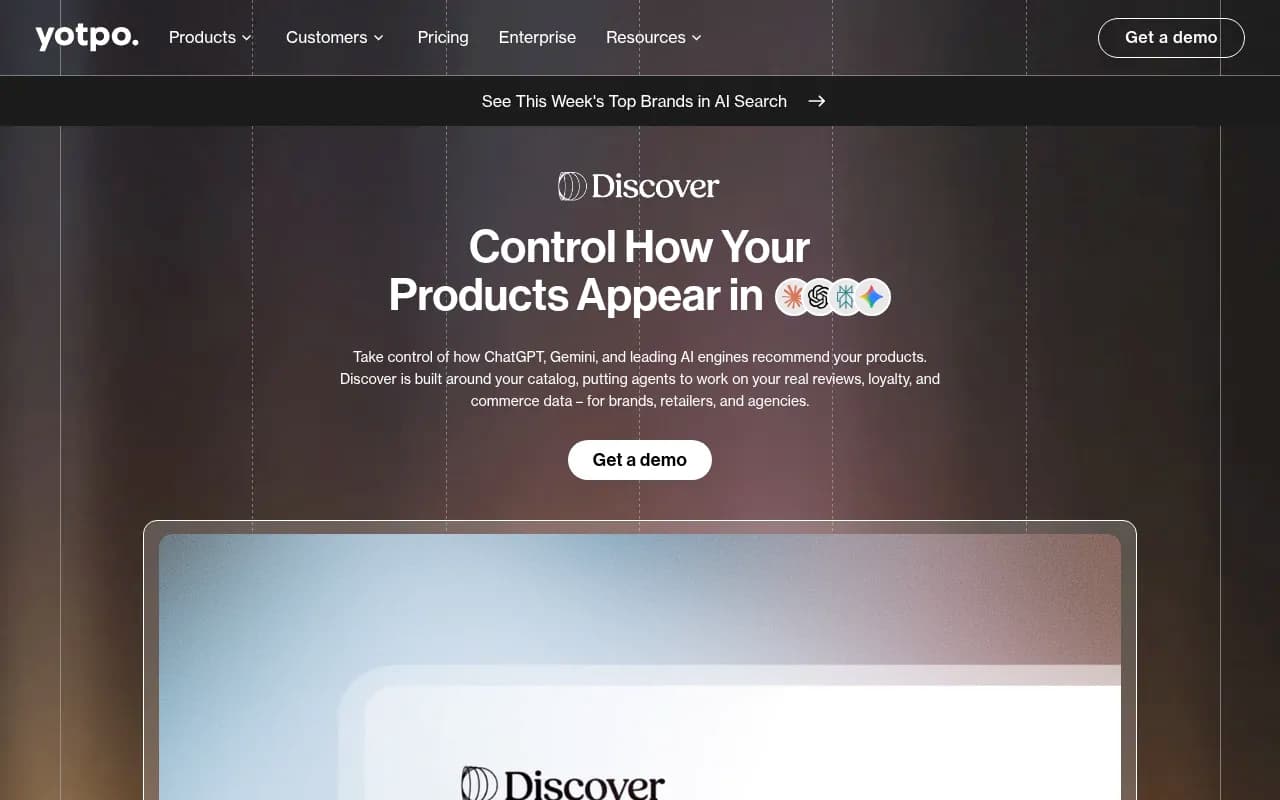
| Yotpo Discover | Ecommerce product discovery focus | Shopify-style merchants wanting a commerce angle |
For wider lists, the GEO software directory covers more trackers by category.
A simple review rhythm
Run the full set weekly, or daily if your tool supports it. Review in three passes:
- Weekly: scan for sudden drops, new competitors, and wrong claims.
- Monthly: compare visibility by intent and category. Pick the two weakest prompt groups and ship fixes.
- Quarterly: retire dead prompts, add a batch of new ones, and rerun persona variants.
Keep expectations realistic. Results vary by session and location, so a single bad run proves nothing. Three weeks of the same pattern does.
Final checklist
- Replace every placeholder with real categories, products, and competitors
- Tag each prompt by intent, stage, product line, and country
- Include a few short, keyword-style variants
- Log citations, competitors, shopping cards, and claims, not just mentions
- Keep the wording fixed between review cycles
- Fix pages by intent: product pages for fit, comparisons for shortlists, FAQs for trust
Start with the 40 above, run them for a month, and let the gaps tell you which pages to write next.