Key takeaways
- ChatGPT's brand recommendations change significantly based on phrasing, geography, and whether web search is active -- a single manual check tells you almost nothing useful.
- Research from SparkToro found that AI models are "highly inconsistent" when recommending brands, with the same prompt returning different results across repeated runs.
- Prompt framing (transactional vs. informational, branded vs. category-level) triggers different response modes, which changes which brands appear and how they're described.
- Tracking AI visibility properly requires testing many prompt variants systematically, not spot-checking one or two queries.
- Tools built for AI visibility monitoring can automate this across dozens of prompt variations and multiple models simultaneously.
If you've ever Googled your own brand and felt a small jolt of anxiety, you know the feeling. Now imagine doing the same thing in ChatGPT -- except the answer changes every time you ask. Different phrasing, different result. Different location, different result. Different time of day, possibly different result.
That's not a bug. It's how these systems work. And if you're trying to understand your brand's visibility in AI search, it's the single most important thing to wrap your head around.
Why ChatGPT doesn't give one consistent answer
Traditional search engines return a ranked list. You type a query, you get a SERP. The positions shift over time, but there's a stable structure you can audit.
ChatGPT doesn't work that way. It generates a response based on the specific input it receives, the context it infers from that input, the data sources it decides to use, and -- in some configurations -- whether it pulls from the live web or relies on its training data. Change any one of those variables and you can get a meaningfully different answer.
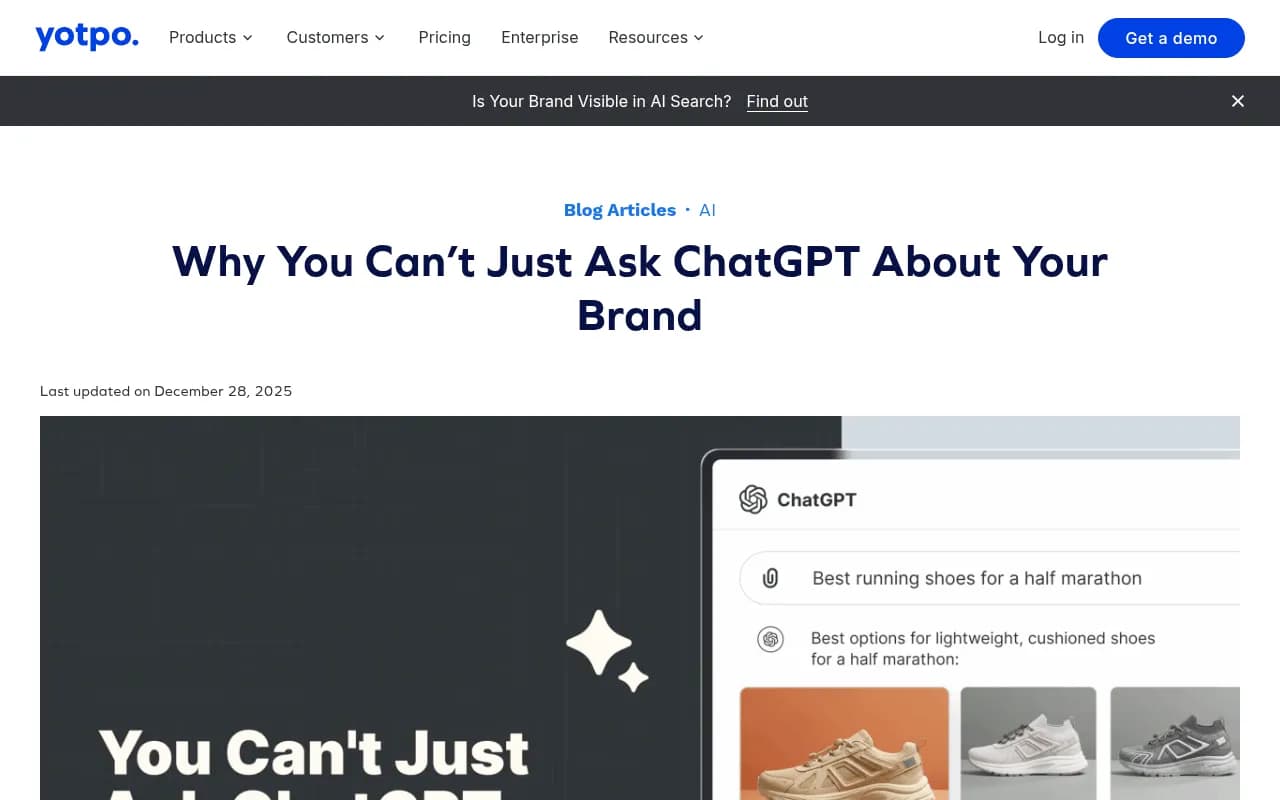
Yotpo's LLM discoverability team put it plainly: what ChatGPT says about your brand depends entirely on how you ask, where you're asking from, and what answer mode the model decides to use.
That's three independent variables, each capable of shifting your brand's visibility on its own.
The web search switch changes everything
One of the biggest sources of inconsistency is whether ChatGPT uses its web browsing capability or relies on its training data.
When web search is off, ChatGPT answers from what it learned during training. Your brand's visibility in that mode depends on how much your content was indexed and absorbed before the training cutoff -- and how authoritatively you were represented across the web at that time.
When web search is on, ChatGPT fetches live results and synthesizes them. Suddenly, your recent content, your current reviews, your latest press coverage -- all of that becomes relevant. A brand that was invisible in the training data might appear prominently if it's been generating strong web signals recently. And vice versa.
The problem: users don't always know which mode they're in, and ChatGPT doesn't always signal it clearly. So when someone asks "what's the best project management tool for remote teams?" they might get a training-data answer or a web-search answer, and those can look quite different.
If you're manually checking your brand visibility by typing a few prompts into ChatGPT, you have no reliable way to know which mode fired -- or to replicate the conditions your actual customers experience.
How prompt phrasing shifts brand recommendations
This is where it gets genuinely interesting. The same underlying question, phrased differently, can produce different brand recommendations -- not just different wording, but different brands appearing or disappearing entirely.
Here are the main dimensions that matter:
Transactional vs. informational framing
"What's the best CRM for small businesses?" is transactional. The model treats it as a recommendation request and tends to produce a list of named tools with brief descriptions.
"How do small businesses manage customer relationships?" is informational. The model might explain the concept, mention categories of tools, and only incidentally name specific products -- or none at all.
If your brand only shows up in transactional prompts but not informational ones (or the reverse), you have a visibility gap that a single spot-check won't reveal.
Specificity and persona framing
"Best email marketing tool" and "best email marketing tool for e-commerce brands doing over $1M in revenue" are very different prompts. The second one narrows the context, which can surface niche players that wouldn't appear in a generic query -- and push out generalist tools that dominate the broad version.
Your brand might rank well for the specific prompt and be invisible for the generic one, or the other way around. Both matter, because different customers ask both ways.
Comparative framing
"Compare [Competitor A] and [Competitor B]" is a prompt type that many brands overlook entirely. If a user is comparing two of your competitors and you're not mentioned as a third option, that's a missed opportunity -- and it's a prompt type you'd never catch unless you're specifically testing it.
Geographic and language variation
SparkToro's research on AI recommendation inconsistency found that the same prompt can return different brand sets depending on where the query originates. A user in Germany asking about accounting software may get different recommendations than a user in the US asking the same question -- even in English.
This matters enormously for brands with international ambitions. Your visibility in one market tells you nothing about your visibility in another.
The inconsistency problem is worse than you think
SparkToro ran a study asking AI models for brand recommendations 100 times using the same prompt. The results were striking: the recommendations varied significantly across runs. Not just in ranking -- in which brands appeared at all.
This means that even if you ask the "right" prompt, a single run gives you a snapshot of one possible response, not a reliable picture of what your customers are seeing. To get a statistically meaningful view of your visibility, you need to run the same prompt many times and aggregate the results.
Multiply that by the number of relevant prompts in your category, the number of AI models you care about, and the number of geographies you operate in -- and you quickly see why manual checking doesn't scale.
What a proper prompt variation test looks like
If you want to actually understand how ChatGPT represents your brand, here's a structured approach:
Step 1: Build a prompt matrix
Start by mapping out the different ways a real customer might ask about your category. Think about:
- Generic category queries ("best [category] tool")
- Persona-specific queries ("best [category] tool for [specific user type]")
- Use-case queries ("how do I [specific task]")
- Comparison queries ("[Competitor A] vs [Competitor B]")
- Problem-first queries ("I need help with [problem]")
For a mid-sized SaaS company, this matrix might produce 30-50 distinct prompts before you even account for geographic or language variation.
Step 2: Run each prompt multiple times
Because of the inconsistency SparkToro documented, a single run per prompt isn't enough. Running each prompt 5-10 times and tracking how often your brand appears gives you a "mention rate" that's far more meaningful than a yes/no from a single query.
Step 3: Track across modes
If possible, test with web search both enabled and disabled. The gap between your training-data visibility and your live-web visibility tells you whether your recent content efforts are paying off -- or whether you're coasting on historical authority.
Step 4: Note how you're described, not just whether you appear
Appearing in a response isn't the same as appearing favorably. ChatGPT might mention your brand as a budget option when you're positioning as premium, or describe you as a tool for beginners when you're targeting enterprise. How the model describes you matters as much as whether it mentions you.
Step 5: Repeat over time
AI models update. Web search results change. Your competitors publish new content. A prompt test from three months ago may not reflect your current visibility. This needs to be an ongoing process, not a one-time audit.
The tools that can help
Running this kind of systematic prompt variation testing manually is genuinely painful. It's repetitive, time-consuming, and hard to keep consistent across team members. A few categories of tools can help.
Promptwatch is built specifically for this kind of systematic AI visibility tracking. It runs prompts across multiple AI models (ChatGPT, Claude, Perplexity, Gemini, and others), tracks how often your brand appears, and shows you which competitors are winning the prompts you're not. The answer gap analysis is particularly useful here -- it shows you the specific prompts where competitors are visible and you're not, which is exactly the kind of insight that prompt variation testing is trying to surface.

For teams that want to track AI visibility alongside traditional SEO metrics, a few other platforms are worth knowing about:

Otterly.AI focuses on monitoring brand mentions across AI models and is a reasonable starting point for teams that want visibility data without a large budget.

Peec AI handles multi-language tracking well, which matters if you're testing geographic prompt variation across different markets.
Rankscale tracks AI search rankings and can help you understand how your position shifts across different prompt types over time.
Omnia focuses on share of voice analytics across AI responses -- useful for understanding not just whether you appear, but how prominently relative to competitors.
Here's a quick comparison of what these tools cover:
| Tool | Prompt variation testing | Multi-model tracking | Content gap analysis | Geographic/language variation |
|---|---|---|---|---|
| Promptwatch | Yes | Yes (10 models) | Yes | Yes |
| Otterly.AI | Basic | Limited | No | Limited |
| Peec AI | Basic | Yes | No | Yes |
| Rankscale | Yes | Yes | No | Limited |
| Omnia | Yes | Yes | No | Limited |
The core difference between Promptwatch and most of the others is that Promptwatch doesn't stop at showing you the data -- it helps you act on it. Most monitoring tools tell you where you're invisible. Promptwatch also tells you what content to create to fix it.
What the data actually tells you
Once you've run a proper prompt variation test, the patterns that emerge are usually more actionable than you'd expect.
You might find that you appear consistently for transactional prompts but rarely for informational ones -- which suggests you need more educational content that AI models can cite when answering "how do I" questions.
You might find that you appear in the US but not in the UK or Australia -- which points to a gap in regionally-relevant content or off-site mentions in those markets.
You might find that you appear when web search is active but not in training-data mode -- which means your recent content is working, but you haven't yet built the kind of durable authority that gets baked into model weights.
Or you might find the opposite: strong training-data visibility but weak live-web visibility -- which could mean your older content is doing the heavy lifting but your recent output isn't generating the signals AI models care about.
Each of these patterns suggests a different fix. But you can only see the patterns if you're testing systematically across enough prompt variations to get a real picture.
The manual check trap
There's a specific failure mode worth naming: the "I just asked ChatGPT and it mentioned us" false confidence trap.
Someone on your marketing team types one prompt, sees your brand in the response, and concludes that your AI visibility is fine. This is about as reliable as checking your Google rankings by searching one keyword from your office computer and assuming the result represents what everyone sees.
The Yotpo research makes this point directly: a single run doesn't tell you what your customers see. It tells you what one instance of ChatGPT said in one context on one occasion. That's not nothing, but it's not a visibility strategy.
The brands that are winning in AI search right now are the ones treating prompt variation testing as a systematic, repeatable process -- not a spot check.
Building this into your workflow
The practical question is how to make prompt variation testing sustainable. A few approaches that work:
Running a monthly audit across your core prompt matrix gives you trend data without requiring daily attention. Pairing that with automated monitoring tools means you catch significant changes between audits. And treating the results as content briefs -- each gap in your visibility is a piece of content that needs to exist -- turns the data into a production queue rather than just a report.
The brands that are building this into their regular workflow are the ones that will compound their AI visibility over time. The ones doing occasional manual checks will keep getting inconsistent data and drawing unreliable conclusions from it.
Prompt variation testing isn't complicated. But it does require treating AI visibility with the same rigor you'd apply to traditional SEO -- systematic, repeatable, and tied to action.