Key takeaways
- Coding agents are now part of the default developer workflow. JetBrains' Developer Ecosystem Survey 2026 (15,000+ developers, fielded May to July 2026) found 90% use them at work weekly and 68% daily.
- Agents recommend libraries, SDKs and docs while they work, so they behave like a discovery channel. Most teams have no dashboard for it yet.
- Measure five things: crawler access, citation and mention share, recommendation quality, referred traffic and signups, and docs freshness.
- No public dataset isolates coding-agent citations yet. Promptwatch Data on ChatGPT software prompts is a useful proxy, not a direct measurement.
- Developers trust output they can verify, so reliability, docs and transparent pricing matter more than clever positioning.
Why coding agents became a discovery channel
A few years ago a developer picking a payments SDK would search Google, skim Stack Overflow and open three tabs. Now a lot of them type the question into an agent and let it pick.
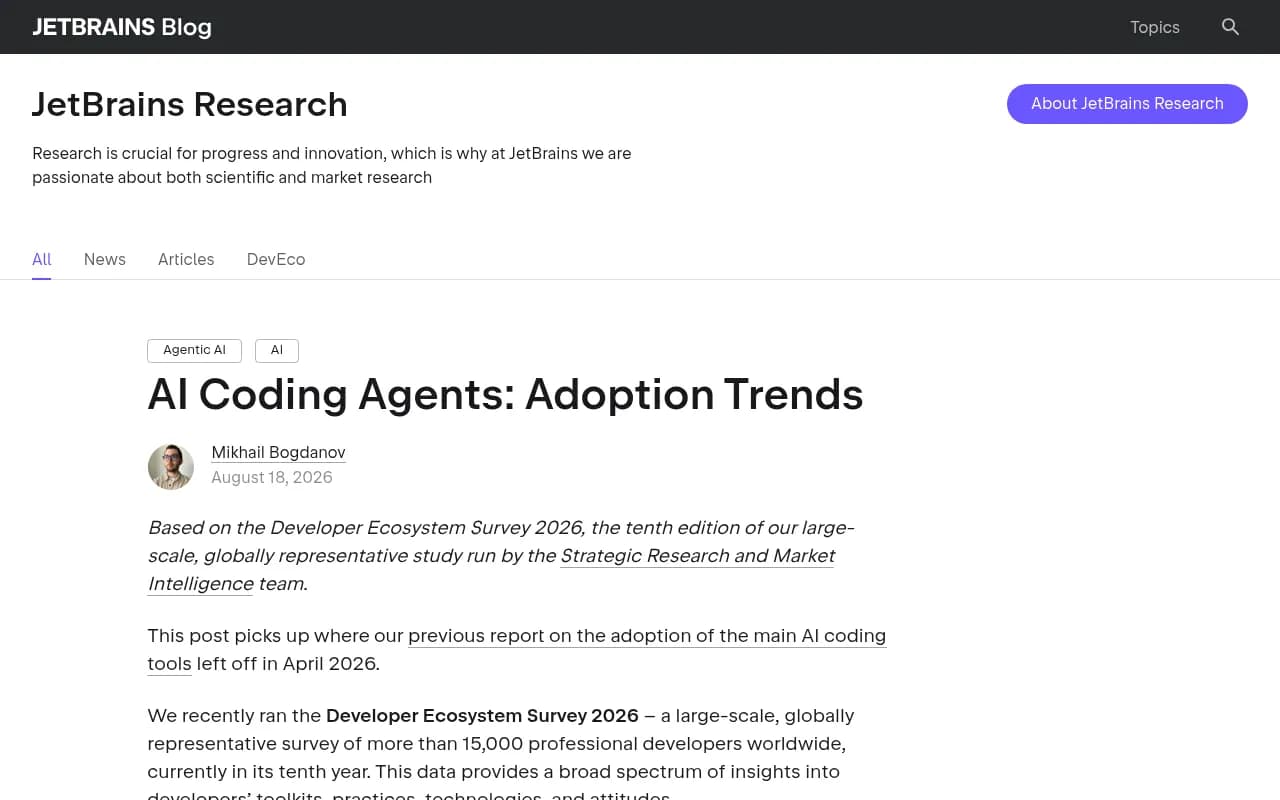
The adoption numbers are hard to ignore. In the JetBrains survey, around 39% of professional developers used Claude Code at work in May to July 2026, up from 18% in January. Codex went from 3% to 16% adoption, and its awareness jumped from 27% to 65%. OpenCode, with no giant brand behind it, reached 7% adoption and 42% mindshare.
That is the supply side. On the demand side, DevMarkLab's roundup of Stack Overflow's 2026 survey says 69.9% of developers name asking an AI agent among their first three moves when they need an answer. Searching online is still first at 82.7%, but the gap is small.
Here is why this matters for marketers. When an agent scaffolds a project, it picks a database client, an auth library, an observability SDK. Nobody saw an ad. Nobody read your comparison page. Either the agent knew about you, found your docs, and judged you a safe pick, or it did not.
The buyer is still human
DevMarkLab also reports that almost half of developers evaluate, recommend or shortlist tools, yet fewer than one in five makes the final purchase decision. So the agent influences the shortlist, a developer vouches for it, and someone with a budget signs. Your measurement has to cover that whole chain, not just the first hop.
And developers are skeptical. Only 6.6% trust AI output for important work decisions, while 48% trust it when they can easily verify it (Stack Overflow 2026, as cited by DevMarkLab). An agent recommendation that can't be checked against your docs gets dropped.
How agents actually find and pick tools
I should be upfront: nobody publishes a clean breakdown of this. What we can say is based on how these systems work.
- Model memory. Training data shapes which tools an agent suggests by default. You can't edit this directly, but you can influence what gets written about you over time.
- Live retrieval. Agents with web access search, then fetch pages. Claude Code, Codex and OpenCode (which searches through Exa) can all pull documentation mid-task.
- Project context. The repo itself, existing dependencies and config files steer choices. If a project already uses your competitor, the agent tends to stay with it.
- Tool protocols. MCP servers, llms.txt files and similar standards give agents a structured way to read your docs.
Only the second one is measurable from the outside today, and only if you have the right logs.
What the closest public data says
There is no Promptwatch report on citations or crawls by coding agents specifically, so treat the following as a proxy. Promptwatch Data looked at ChatGPT organic software prompts from Sep 28 to Oct 4, 2026. GitHub was the most cited domain at 1.2% of software citations, then learn.microsoft.com at 0.98% and G2 at 0.73%. By source type, docs and help centers earned the largest share (2.64%), ahead of vendor sites (2.01%) and review sites and analysts (1.57%). Vendor sites and docs together earned about three times the share of review sites.
Those percentages are shares of all software citations, so they look small. The ordering is the useful part: documentation and a public GitHub presence beat review profiles. That matches how developers describe their own habits.
One more behavior change worth knowing. On August 8, 2026, ChatGPT started using the site: operator at scale. Promptwatch's data shows site:-scoped fan-out queries jumped from 0.37% to 16.8% of all fan-outs in a day, and average fan-out queries per response rose from about 1.08 to 1.83. In practice, your own domain is now something AI searches directly. Thin docs pages, broken internal search and unindexed content cost you answers.
What to measure: five layers
Most teams start with "are we mentioned?" That is the least useful question on its own. Work through these layers in order.
1. Crawler access
If AI crawlers can't reach your docs, nothing downstream matters. Check robots.txt, CDN and WAF rules for each provider. Promptwatch's AI crawler report (IP-verified requests, Jun 8 to Sep 6, 2026) found OpenAI accounted for 79.8% of verified AI crawler requests in the week of Aug 31 to Sep 6, down from 94.8% in early June. Its advice is simple: compare your own logs against that mix. A provider that is big in the benchmark but near zero in your logs suggests you are blocked or unreachable.
Watch out for spoofed user agents. Only count requests that match the operator's published IP ranges. Also separate training crawlers from answer-time fetchers, because they mean very different things for discovery.
Tools that help here include Promptwatch, which has IP-verified crawler logs and plain-language crawl error explanations, and DarkVisitors for tracking agent and bot visits.

2. Citation and mention share
Next, track how often your docs, repo and brand show up when developers ask relevant questions. Build a prompt set that mirrors real developer intents:
- "What is the best library for X in TypeScript?"
- "How do I add Y to a Next.js app?"
- "Compare A vs B for Z"
- "Alternatives to [competitor]"
Run them daily, across models and countries, and record mention rate, position in the answer, and whether your own domain is cited or only a third party. Mentions without self-citations usually point at a content or crawlability gap. Late position is a prominence problem.
Promptwatch tracks coding agents (Codex, Claude Code and OpenCode) alongside ChatGPT, Gemini and Perplexity, which is the main reason to look at it for this use case. Most prompt trackers on the market monitor chat assistants only. If you want to compare options, the GEO software directory at bestgeosoftware.com lists a lot of them.
3. Recommendation quality
Being mentioned is not the same as being recommended correctly. Read the actual answers. Is the agent suggesting a deprecated API? Recommending an old package name? Quoting last year's pricing? Does it describe your free tier accurately?
I would sample 20 to 30 responses a month by hand. Automated sentiment scores help with trends, but a human reading "use v1 of the SDK" catches a problem a score never will. Tools like Profound, Peec AI and Otterly.AI offer monitoring, though they stop short of crawler logs and content workflows.



4. Referred traffic and signups
This is where most developer-tool teams go blind. An agent reads your docs and the developer then types your URL, runs npm install, or copies a snippet. None of that shows as a referral.
What you can instrument:
- AI referral traffic from ChatGPT, Perplexity, Claude and Copilot, using a visitor analytics script or your regular analytics.
- Direct and branded search lift after you improve visibility. It is indirect but real.
- Package install and download trends (npm, PyPI, crates) compared against visibility score changes.
- A "how did you hear about us?" field with an option for AI assistants or coding agents. Crude, but it catches what logs miss.
- User-Agent strings on your docs and API endpoints. Some agent fetches identify themselves.
Promptwatch's visitor analytics covers AI-referred traffic and conversions, and Mixpanel or Amplitude can take the product-side events from there.
TreeHouse, the company behind Pararius, reported AI search reached about 25% of its organic conversions, nearly all from ChatGPT, after fixing crawler access and publishing proprietary data. That is a rental marketplace, not a dev tool, but the pattern is the same: access first, content second, attribution third.
5. Docs freshness and structure
Agents quote what they find. Stale docs produce stale recommendations. Promptwatch's content half-life report tracked pages ChatGPT cited on July 6, 2026 for 90 days. Landing pages and docs stayed cited longest, while news lost half its pages within 36 days. Evergreen documentation is the asset that lasts.
A practical checklist:
- Each docs page answers one question and has a clear title.
- Code samples are copy-paste correct and versioned.
- Pricing explains a typical month in dollars, not just credits or tokens.
- A changelog with dates, so agents can tell what's current.
- An llms.txt file is cheap to add. Don't expect miracles, but it costs an hour. The free llmtxt.info generator is one way to start.
One caution on file formats. Promptwatch's data finds markdown files make up just 0.05% of AI search citations. Markdown serves agents reading your docs directly, not AI search citations. Don't expect a markdown mirror to earn citations in ChatGPT.
A measurement scorecard
| Layer | Question | Example metric | Where to get it |
|---|---|---|---|
| Crawler access | Can agents read our docs? | Verified bot requests, error rate per provider | CDN logs, Promptwatch, DarkVisitors |
| Citation share | Do we show up? | Mention rate, self-citation rate, position | Prompt tracker with coding agent coverage |
| Recommendation quality | Is it accurate? | Share of answers with correct version and pricing | Manual sampling plus sentiment |
| Traffic and signups | Does it convert? | AI-referred sessions, trial starts, installs | Visitor analytics, product analytics |
| Docs freshness | Is the source current? | Days since last update, crawl-to-citation rate | Site audits, page tracking |
Which tools fit which job
| Job | Option | Note |
|---|---|---|
| Coding agent tracking plus crawler logs plus content actions | Promptwatch | Tracks Codex, Claude Code and OpenCode, with IP-verified logs and an Action Board |
| Bot and agent visit tracking | DarkVisitors | Narrower, focused on who is visiting |
| Prompt monitoring only | Peec AI, Otterly.AI | Good for basic mention tracking |
| Enterprise monitoring | Profound | Strong monitoring, higher price tier |
| Product analytics after the click | Mixpanel, Amplitude | Connect visibility to activation |
For a wider list of options, ai-rank-tools.com covers AI rank trackers, and agenticseotools.com covers agent-driven SEO tools.
What developers say drives their recommendations
It helps to remember what a human wants once the agent has narrowed the field. DevMarkLab, drawing on Stack Overflow's survey data, reports that reliability is the top reason developers recommend a tool (17.3%), followed by saving time (15.9%). AI features are the main reason for only 2.3%. Security or privacy concerns and prohibitive pricing top the reasons to reject one.
That has a direct consequence. If your tool is billed by tokens or requests, show what a typical month costs. One developer-reported case in the Developers Digest ROI guide describes a bill going from $29 to $750 after a move to usage-based billing with agentic workflows. Buyers have seen that story, and 38.1% say their organization limits AI spending.
A 30-day starting plan
- Week 1: audit access. Check robots.txt and CDN rules. Pull a week of logs and see which AI crawlers visit your docs and which get errors.
- Week 2: build a prompt set of 30 to 50 developer questions, including competitor comparisons and "alternatives to" queries. Record a baseline.
- Week 3: fix the top gaps. Update stale pages, add a pricing example, publish one comparison page that tells the truth about trade-offs.
- Week 4: wire up attribution. Add the survey field, tag AI referrals, and set a weekly report.
Then repeat. Platform behavior moves fast, as the site: operator change showed. Anything you measured in July may be wrong by September.
What this data can't tell you yet
Be honest with stakeholders about limits. Public datasets mostly describe ChatGPT and Google surfaces, not coding-agent sessions. Adoption surveys come from self-reported usage. Attribution from agent to signup is partly guesswork. Productivity claims are also shaky: the Developers Digest guide cites a median PR throughput gain of 7.76% across 400+ organizations, far below vendor claims.
So report ranges, label proxies as proxies, and keep your own prompt set and logs as the source of truth. The teams that get ahead in 2026 will be the ones who started measuring agent discovery while everyone else was still debating whether it counts.