Key takeaways
- Birdeye Search AI and Yext Scout are location-first tools. Both score AI visibility per store, then connect to listings, reviews, and local pages. Promptwatch is prompt-first and content-first, with city and state targeting rather than per-store management.
- Most of what is public about Birdeye vs Yext comes from Birdeye's own marketing pages, which rank Birdeye #1. Treat those claims as vendor positioning, not test results.
- Neither Birdeye nor Yext publishes Scout or Search AI pricing. Promptwatch's plans are public, starting at $95/month for Essential.
- If you run 100+ physical locations and need listings and review operations tied to AI visibility, shortlist Birdeye and Yext. If you want deep citation analysis, crawler logs, and content production, Promptwatch is the stronger fit. Many chains will end up using one of each.
Why local AI visibility is its own problem
Ask ChatGPT for the best urgent care near you and the answer is built from a handful of sources: map listings, review sites, a few local landing pages, and whatever the model already believes. Your brand can be well covered nationally and still be missing in Tulsa.
That is why a category of tools has grown up around per-location AI visibility. A national brand-level score hides the fact that 30 of your 400 stores never get recommended. The tools below take different bets on how to fix that.
One data point worth knowing before you buy anything. In Promptwatch Data's analysis of ChatGPT citations (Sep 28 to Oct 4, 2026), product pages made up 22.4% of classified citations and landing pages 16.8%. For branded prompts, reviews rose to 5.6% of citations, more than three times their share across all prompts, and FAQ pages reached 4.8%. For a local brand, that points at three assets: location landing pages, FAQs, and review profiles. All three tools say they work on those, in different ways.
The three tools at a glance
| Birdeye Search AI | Yext Scout | Promptwatch | |
|---|---|---|---|
| Core idea | Per-location AI visibility plus agents that fix listings, reviews, and local pages | Per-location and brand-level AI and Google visibility inside the Yext platform | Prompt-level AI visibility platform with content and crawler analytics |
| Granularity | Location-level (vendor claim) | Location-level, win rate by location | Country, language, optional city or US state per monitor |
| Engines named | ChatGPT, Gemini, Perplexity, Google AI Overviews and AI Mode, Claude, Grok | Google Search, Maps, AI Overviews, ChatGPT, Gemini, Claude, Perplexity | ChatGPT, Google AI Overviews and AI Mode, Gemini, Perplexity, Copilot, Alexa, Claude, Grok, DeepSeek, Mistral and more |
| Listings and reviews management | Yes, native | Yes, via Yext platform | No |
| Content creation | Blog and FAQ agents, listings optimization | Brand and third-party content creation (newly announced) | Content Agent with CMS publishing, content gap analysis |
| AI crawler logs | Not documented in our sources | Not documented in our sources | Yes, IP-verified |
| Public pricing | No | No | Yes, from $95/month |
Yext Scout
Scout is Yext's AI search visibility agent. Yext's own page lists 10B signals, 5 AI models, 12M+ locations, 150 visibility metrics, and up to 20 competitors per scan. Those are vendor numbers, but they tell you the scale it is designed for.
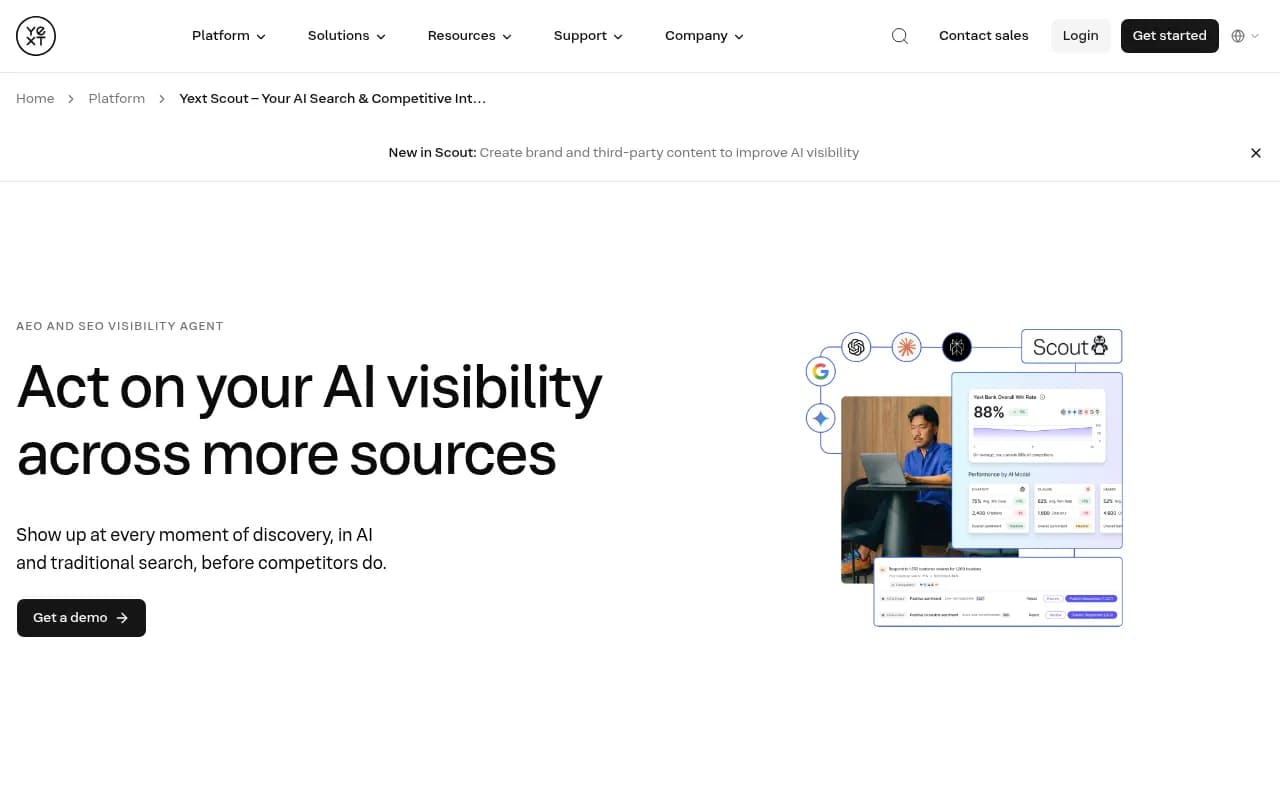
What it does well, based on Yext's description:
- Shows how you appear across Google Search, Google Maps, and AI Overviews, plus ChatGPT, Gemini, Claude, and Perplexity, with trends by location and competitor.
- Reports win rate by location and head-to-head results against local competitors.
- Surfaces recurring themes in how AI describes you. The example Yext gives is "long wait times", which is exactly the kind of thing a location manager can act on.
- Hands recommendations to an Action Center, where agents update listings, correct business information, respond to reviews, and manage social content.
The real advantage is the platform underneath. Yext has spent years as a listings and knowledge graph vendor, with a directory network spanning Google, Apple Maps, Bing, Facebook, Yelp, and Amazon Alexa. If your data accuracy is already managed there, Scout reads and writes to the same source of truth.
The downsides are mostly about access and fit. There is no public self-serve pricing, so expect a sales process. Birdeye also argues that Scout's hybrid view of Google rankings and AI results dilutes an AI-first strategy, and that Yext is built for power users who regional managers and franchise operators find hard to use on their own. Both points come from competitors (Birdeye and Alchemer), so test them yourself in a demo.
Birdeye Search AI
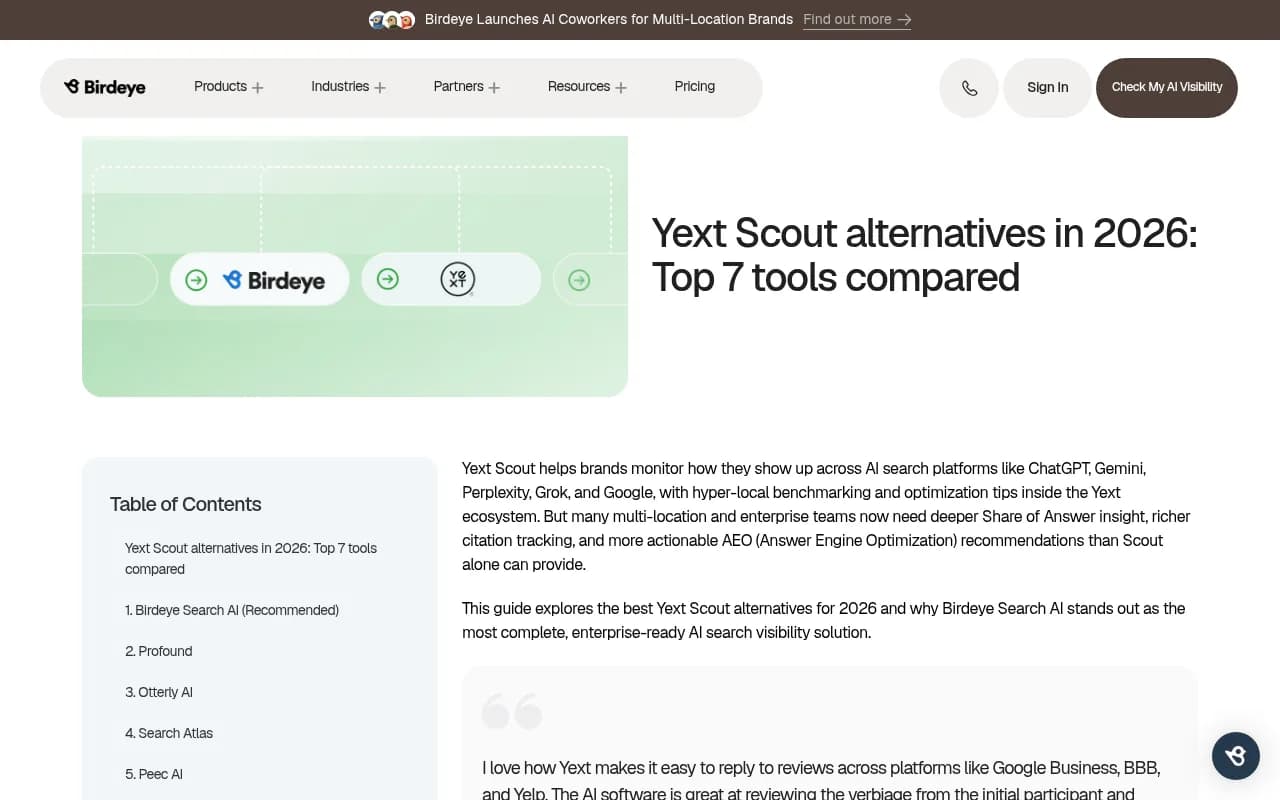
Birdeye started as a reviews and reputation platform and has pushed hard into AI visibility. Search AI tracks brand and location-level visibility, rankings, citations, and sentiment across ChatGPT, Gemini, Perplexity, Google AI Overviews, Google AI Mode, Claude, and Grok. You configure the queries, Birdeye sends them to the selected models, and it measures visibility from the responses.
The pitch is closing the gap between measurement and action. Per Birdeye, ranked recommendations by location and impact feed agents (Blog Creation, FAQ Creation, Listings Optimization) that can execute fixes, with you choosing how much needs approval. Because Birdeye already owns reviews, listings, and local pages, the loop from "this store is invisible" to "here is the review and listing work to fix it" lives in one product.
Birdeye's case study numbers on its Search AI page are a 30% AI visibility increase, a 53% increase in lead volume, and 74% of recommendations accepted. Those are marketing figures with no methodology attached, so ask for customer references with comparable location counts.
A few honest caveats:
- Birdeye's comparison pages say Yext's Scout and Action Center execute fixes without verifying that a location's score improved, and that Yext built its capability through acquisitions (Places Scout in 2025, GoShine in 2026). That is Birdeye describing a competitor. Treat it as a question to put to Yext, not a fact.
- Pricing is customized by location count, products, and agents activated. Nothing is public.
- Birdeye's own roundups rank Birdeye first. We found no independent test of its per-location accuracy.

Promptwatch
Promptwatch comes at the problem from a different side. It is not a listings or reviews platform, and it does not manage individual store profiles. It is an AI visibility and generative engine optimization platform: you track prompts across AI engines, see which pages get cited, and use that to plan and publish content.

Where it matters for local and multi-location teams:
- Geo-targeting per monitor. You set country, language, and an optional city or US state, and Promptwatch runs the query through a residential proxy with a matched locale and timezone. This is on every plan. It is city-level targeting, not a view of each store with listings attached.
- Real interface data. Promptwatch monitors the actual UIs of ChatGPT, Google AI Overviews, AI Mode, Gemini, Perplexity, and others, since user-facing answers can differ from API outputs.
- Citation and crawler evidence. IP-verified AI crawler logs show whether AI systems are even reading your location pages, and citation analytics show which pages and third-party sources (including Reddit, YouTube, and LinkedIn) get cited.
- Content that closes the gap. Content gap analysis, the Content Agent, and publishing to WordPress, Webflow, or Framer cover the local landing page and FAQ work that the citation data above says matters.
Where it falls short for a 500-store chain: no listings sync, no review solicitation, no per-store scorecards for franchisees. If a regional manager needs a dashboard for store 214, this is not that tool.
Public pricing (confirm on promptwatch.com/pricing): Explore is free (10 prompts, ChatGPT only), Essential $95/month, Professional $245/month, Business $579/month, and agency plans from $199/month. Annual billing gives 12 months for the price of 10. Third-party pages list $99 and $249 for the first two tiers, which likely reflects monthly versus annual billing.
How to choose
You run hundreds of stores and own the operations
Shortlist Birdeye and Yext, and run the same proof of concept on both. Pick 20 locations, including some you know are weak, and compare:
- Does the per-location score match what you see when you run the prompts by hand in each city?
- How many recommendations are specific to a location rather than generic?
- What happens after you accept a fix, and does anything verify the result?
- How much of the work can a non-specialist franchise operator do?
If you already run listings on Yext, Scout is the lowest-friction start. If reviews are your main lever, Birdeye's native review stack is a reasonable reason to lean that way. Neither choice is obvious from public information.
You are a brand with a few dozen locations or a service-area business
Per-location enterprise tooling may be overkill, and the contracts are likely sized for much larger networks. A prompt-level platform with city targeting often covers the need. You track "best [service] in [city]" prompts, see who gets cited, and fix your location pages.
You care about the content and crawler side
This is where Promptwatch is distinctive. Crawler logs, citation trends, and the content workflow answer questions location tools tend not to: are AI bots reaching these pages, which page types get cited, and how long do they stay cited? For context, Promptwatch Data's content half-life report found that landing pages and docs stayed cited longest, while news lost half its pages within 36 days. Evergreen location pages are a safer bet than news-style posts.
You want both
A common setup is a location operations platform (Birdeye or Yext) for listings, reviews, and per-store data, plus a prompt-level tool for content strategy and citation analysis. They overlap on monitoring but not on what they do next.
Other tools in this space
If none of the three fit, a few other options exist in the catalog:
- SOCi, an agentic platform that runs local search, social, and reviews for multi-location brands.
- Profound and Peec AI, centralized-brand AI visibility tools that Birdeye itself says suit single-brand companies better than franchises.
- Otterly.AI, a low-cost monitor. Birdeye lists it from $29 to $489/month, and Otterly's own page shows Lite at $29 for 15 prompts.
- Semrush, which charges $99/month per extra Brand Performance location according to Promptwatch's comparison. Check the current price yourself.



For a wider survey of this category, the GEO software directory lists dozens more.
What we could not verify
Worth being plain about the gaps:
- No public pricing for Birdeye Search AI or Yext Scout.
- No independent testing of per-location accuracy for any of the three. Everything about Birdeye and Yext capabilities comes from the vendors or from each other.
- Birdeye's claims about Yext's acquisitions and missing outcome verification are competitor statements.
- Promptwatch's city targeting is documented by Promptwatch, and we did not test it against store-level ground truth.
The practical advice: treat every location-level claim as a hypothesis and test it on a sample of your own stores before signing a multi-year contract.
Bottom line
Pick Yext Scout if your listings already live in Yext. Pick Birdeye Search AI if reviews and local pages are your main levers and you want agents to execute. Pick Promptwatch if you want to understand why AI does or does not cite you, and fix it with content, without buying a location operations suite. Sort out which problem you actually have first, then run a 20-location pilot.