Key takeaways
- Birdeye AI Search is built for multi-location brands (100 to 10,000+ locations) and measures AI visibility per location. It is a reputation and listings platform first, not an SEO suite.
- Semrush has the deepest AI visibility dataset and ties it to keyword, backlink and audit data. The AI Visibility Toolkit costs $99/month as an add-on, or comes bundled in Semrush One from $199/month.
- SE Ranking is the cheaper all-rounder (from about $129/month) with AI tracking across five engines and a more generous seat and project allowance.
- None of the three is a complete answer alone. Most multi-location teams end up pairing a local operations layer with an SEO suite, and sometimes a dedicated AI visibility tracker.
- Much of the available comparison material comes from Birdeye's own blog. Treat its competitive claims with the skepticism you would give any vendor's comparison page, and verify pricing on each vendor's site.
Why this comparison is harder than it looks
These three tools are not really competing for the same job. Semrush and SE Ranking are SEO suites that added AI visibility tracking. Birdeye is a customer experience, reviews and listings platform that added AI search measurement aimed at locations rather than domains.
That difference matters more than any feature checkbox. If you run 400 dental clinics, your problem is not "what is my domain's share of voice in ChatGPT." It is "why does ChatGPT recommend the competitor's Tulsa clinic and not ours, and which of our 400 listings has the wrong hours." If you run a SaaS blog, the reverse is true.
One more caveat up front. A lot of the public comparison content on this exact matchup is written by Birdeye. The line "where Birdeye wins" appears under every competitor in its roundup. That is normal vendor content, but it means the claims about Semrush and SE Ranking need checking against their own documentation.
What local visibility means in AI search
Classic local SEO was about the map pack: Google Business Profile, citations, reviews, proximity. AI answer engines lean on some of the same inputs (reviews, listing consistency, structured data, profile completeness) but assemble them into a single recommendation, often with a handful of cited sources.
Two data points are worth keeping in mind. First, Birdeye's State of AI Search 2026 research reports that 80% of brands are cited at least once in AI answers, but only 15% hold the top position with their own domain. That is vendor research, so read it as directional. Second, Promptwatch Data found that for branded prompts, reviews rise to 5.6% of ChatGPT citations, more than three times their share across all prompts, and product and landing pages together take roughly 46% (Sep 28 to Oct 4, 2026). See the ChatGPT citation share by content type report. For a multi-location brand, those product and landing pages are your individual location pages. They are the main citation surface.
Citation slots are also scarce. Promptwatch's average sources per response data shows ChatGPT citing around 5 sources per web-search answer, while Google AI Overviews and Perplexity cite about 10. That report is dated September 2025, so treat the exact numbers as possibly stale, but the pattern holds: fewer slots means each location page competes harder.
The three tools at a glance
| Birdeye AI Search | Semrush AI Visibility | SE Ranking (AI Results Tracker / SE Visible) | |
|---|---|---|---|
| Core identity | Reputation, listings and local ops platform | Full SEO and marketing suite | All-in-one SEO platform, agency friendly |
| Unit of measurement | Per location | Per domain and prompt | Per domain and prompt |
| Engines (per vendor claims) | ChatGPT, Gemini, Perplexity, AI Overviews, AI Mode, Claude, Grok | ChatGPT, Google AI, Gemini, Perplexity, plus others | AI Overviews, AI Mode, ChatGPT, Perplexity, Gemini |
| Fixes things for you | Yes, via agents that update listings, reviews and local pages | Recommendations and AI-readiness checks in site audit | Recommendations in AI tracker |
| Pricing | Custom quote, based on locations, queries and LLMs | $99/mo add-on, or Semrush One from $199/mo | From about $129/mo bundle; SE Visible about $99/mo standalone |
| Best fit | 100 to 10,000+ locations | SEO teams and agencies | Small to mid agencies, SMBs |
Pricing note: these figures come from third-party reviews and the research notes behind this guide. Semrush and SE Ranking change plans often, so confirm on their pricing pages before buying.
Birdeye AI Search
Birdeye sends customer-configured queries to the selected LLMs and measures visibility from the responses. The point is per-location output: which AI answers a given location appears in, which competitors get recommended instead, and which sources the AI cited.
The interesting part is what happens next. Birdeye ties those findings to its agents and workflows, so a gap can turn into an updated listing, a review request campaign or a revised local page. If your bottleneck is operational (inconsistent hours, thin location pages, review volume), that is a real advantage over tools that only report.
Where it is strong
- Location-level reporting. Nothing else in this comparison treats a location as the unit of analysis.
- It sits on top of listings (Google and 100+ sites) and reviews, which are inputs AI engines weigh for local queries.
- Birdeye publishes original research on AI local search, which is unusual for this category.
- G2 rating of 4.7/5 across 4,000+ reviews, per Birdeye's own local SEO roundup.
Where it is weaker
- No public pricing. DashThis reports quotes per location, in bands from 1-3 locations up to 1,000+. The 30-day free trial applies to Birdeye Social AI only, not the full platform.
- You will need separate tools for content, technical SEO and broader AI visibility, according to DashThis.
- Not for single-site businesses. DashThis says to skip it entirely if you run one site.
- One independent roundup (Data-Mania) says Birdeye does not track AI citations at all and ranks it low for that reason, only crediting its reputation data as an input. That contradicts Birdeye's own description of AI Search, which may reflect timing, since AI Search is a newer module. Ask for a live demo of the AI Search module on your own locations and check what is actually measured.
Semrush
Semrush is the heavyweight. One independent review puts its AI search database at 261 million prompts, 36 million brands and 32 regional databases. Its keyword database sits around 28.5 billion keywords and its backlink index at 43 trillion links.
The real draw is integration. Domain Overview reports show AI visibility score, mentions and cited pages next to authority score, organic traffic and rankings. The toolkit covers prompt tracking, citation analysis, share of voice, sentiment and competitor benchmarking, and Site Audit now includes an AI Search Health score that flags issues blocking AI crawlers.
Adobe acquired Semrush in April 2026 for $1.9 billion, according to DemandSage, and it now sits inside Adobe's Digital Experience business. Worth watching if you care about roadmap and pricing stability.
Pricing, as best it can be pinned down
- AI Visibility Toolkit: $99/month, per Semrush's knowledge base. Extra domains cost $99/month each and an extra 50 prompts $60/month.
- Starting limits are reported inconsistently: Rankability says 1 domain and 25 custom prompts, while a competitor's review mentions 50 prompts. Check the pricing page.
- Semrush One plans run $139, $199 and $299 monthly, or lower billed annually. Classic SEO plans start around $139.95/month, and the toolkit is paid on top if you are not on Semrush One.
- Seats are tight. One review notes Semrush limits you to one seat across plans, with extra users at $45/month on Semrush One.
Local features
Semrush has a local toolkit with Google Business Profile optimization, listing management and a Map Rank Tracker. But it works at the keyword and domain level. It does not give you a per-location AI visibility view across hundreds of locations, and that is the key gap for franchise and enterprise local teams. I could not verify how its local tools handle AI-specific reporting, so test that in a trial.
SE Ranking
SE Ranking is no longer the cheap alternative it used to be, with plans starting around $129/month. What you get for that: rank tracking that reviewers consistently rate as reliable, site audits, backlink analysis, a marketing plan tool that helps beginners, and AI tracking across AI Overviews, AI Mode, ChatGPT, Perplexity and Gemini.
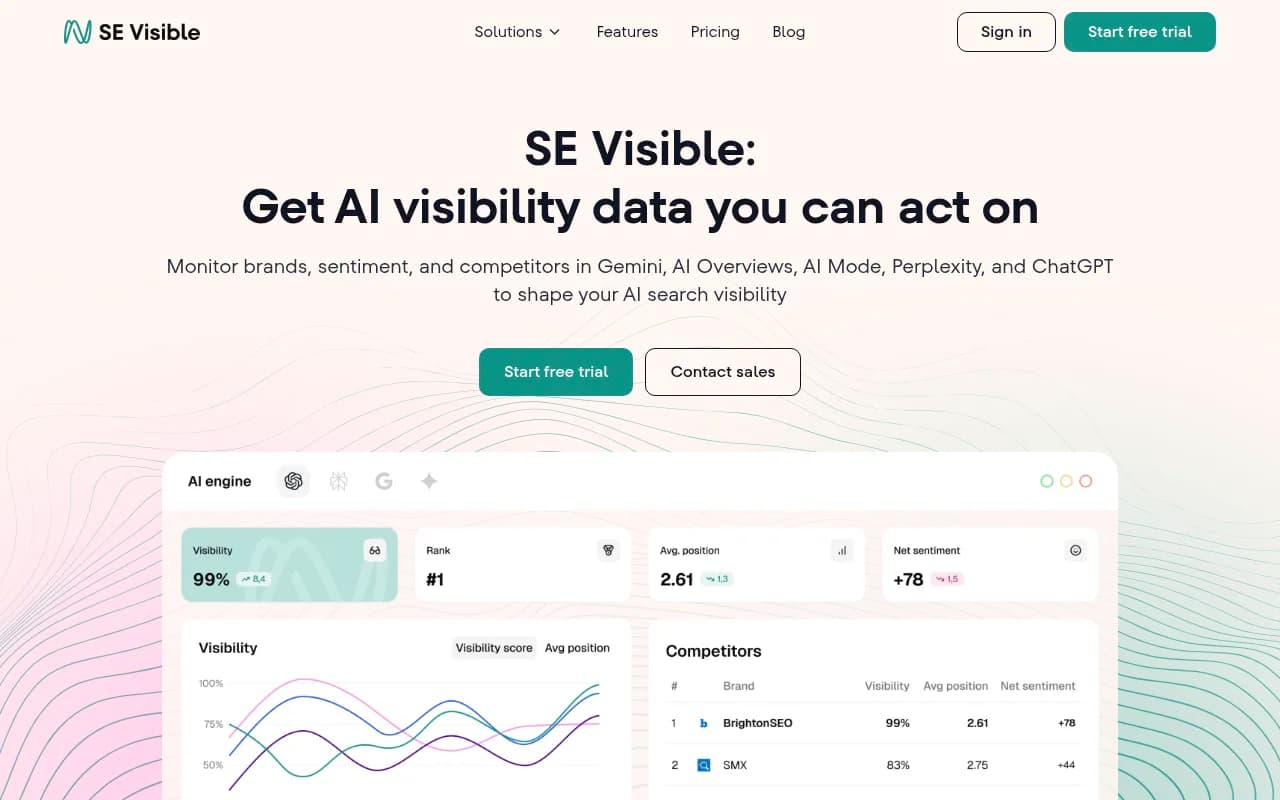
There are two AI products to keep straight. The AI Results Tracker lives inside the main platform. SE Visible is the separate AI-visibility product, listed at $99/month with 200 recurring prompts and daily tracking across five engines (per Rankability). One review cites a larger add-on price of about $71.20/month on annual billing, so again, confirm which version you are quoted.
Strengths
- Better value on seats: the Growth + AI SEO plan includes three users, and extras cost about $16/month.
- Agency Pack add-on with white-label reporting and client access.
- Local rank tracking for up to 1,500 keywords and listing management across 100+ directories, per DemandSage.
- 188 geo databases versus Semrush's 142.
Limits
Smaller datasets (around 25.5 million AI prompts tracked and a 5.4 billion keyword database), and no per-location AI scorecards for large footprints. For a 15-location regional chain, that is fine. For 1,500 locations, you will feel it.
Head to head on what matters for local
| Question | Birdeye | Semrush | SE Ranking |
|---|---|---|---|
| Can I see AI visibility per location? | Yes, core feature | Not natively; domain and prompt based | Not natively; domain and prompt based |
| Does it fix listing and review problems? | Yes, through agents | No, it is a measurement and SEO tool with GBP and listing features | Partial, listing management on 100+ directories |
| Technical SEO and AI crawler checks | Limited, needs other tools | Strong (140+ checks, AI Search Health) | Solid site audit |
| Prompt research database | Customer-configured queries | Largest of the three | Smaller |
| Cost predictability | Custom quote | Published, but add-ons stack | Published, lowest entry |
| Multi-user and agency fit | Enterprise teams | Seat-limited | Good seat pricing, white-label |
Which stack for which team
50 to 10,000+ locations (franchise, healthcare, auto, retail)
Start with Birdeye as the operational layer, since location consistency and reviews are probably your actual problem. Add Semrush or SE Ranking for the domain-level SEO work Birdeye does not cover. If budget is limited, SE Ranking is the lighter companion.
Agency serving a mix of local and national clients
SE Ranking gives better seat economics and white-label options. Semrush is the pick if the clients are large and you need the deepest keyword, backlink and AI data. You can layer Birdeye in when a specific client has a big location footprint.
In-house SEO team, one or a few sites
Semrush if you can afford the stack and want everything in one place. SE Ranking if you want decent AI tracking without paying extra. Skip Birdeye.
1 to 10 locations
None of these may be the right first purchase. A cheaper rank tracker plus disciplined Google Business Profile management gets you most of the way there.
The gap all three leave open
If you read the feature lists closely, there are things AI visibility work needs that none of these three centers on: IP-verified AI crawler logs (is GPTBot or ChatGPT-User actually hitting your location pages, and are they erroring?), AI-attributed traffic and conversions, and content production grounded in citation data.
This is where a dedicated AI visibility platform fits. Tools like Promptwatch cover crawler logs, visitor analytics and a content workflow that tracks whether published pages get crawled, cited and clicked. That is a different layer from Birdeye's location operations or Semrush's SEO suite, and it can sit alongside either.

If you want to browse more options, the GEO software directory at bestgeosoftware.com is a reasonable place to compare dedicated trackers, and the tools in this space are changing fast enough that it is worth rechecking every quarter.
How to run a fair trial
Vendor claims are the weakest part of this category, so test with your own data:
- Pick 5 to 10 real locations: a mix of strong and weak performers, plus a competitor in each market.
- Write 20 to 30 prompts people would actually use ("best urgent care near me", "who does same-day brake repair in Austin").
- Run the same prompts manually in ChatGPT, Google AI Mode and Perplexity, and record who gets recommended and which sources are cited.
- Compare what each tool reports against your manual results. Disagreements tell you how reliable the tool is.
- Ask each vendor what the action path is. If a tool finds a gap, what is the next click, and who does the work?
- Get written pricing at your scale, including add-ons, extra domains, extra prompts and extra seats.
Verdict
For true multi-location brands, Birdeye is the only one of the three built around the location as the unit, and the ability to act on gaps is worth real money if listing and review hygiene is your weak spot. Just confirm the AI Search module's measurement depth in a demo, given the conflicting independent reports.
For everyone else, the decision is Semrush versus SE Ranking, and it is mostly budget. Semrush has the bigger dataset, better integration and, by most reviewers' accounts, the deeper AI visibility tooling. SE Ranking gives you most of what a typical team needs for less, with friendlier seat pricing.
The honest answer to "which stack handles AI search best" is that no single product does. Pair an operational local layer with an SEO suite, add AI crawler and traffic visibility if AI search is becoming a real revenue channel, and verify every price before you sign.
If you want help choosing and implementing a stack rather than just licensing one, an agency like 1001 SEO Media works on technical SEO, local SEO and generative engine optimization for brands that need to show up in both Google and AI answers.