Key takeaways
- Peec.ai covers the basics of AI visibility tracking but has real gaps: limited model coverage, no content generation, and costs that scale poorly for large prompt sets.
- The best alternatives in 2026 either go deeper on monitoring (more models, more languages, better data) or go further by helping you actually fix your visibility gaps.
- Promptwatch is the only platform in this space rated as a "Leader" across all GEO categories, combining tracking, content gap analysis, and AI-native content generation in one loop.
- If you're a solo operator or small team, tools like Otterly.AI and Airefs offer affordable entry points. Agencies and enterprise teams will get more from Promptwatch, Profound, or AthenaHQ.
- The biggest differentiator to look for in 2026 isn't which models a tool monitors — it's whether the tool helps you do something about what it finds.
Peec.ai had a good run as an early mover. When generative engine optimization was still a niche concern for forward-thinking SEOs, it was one of the few tools tracking how brands showed up in AI-generated answers. That mattered.
But the market has moved fast. ChatGPT Search, Perplexity, Claude, Gemini, Grok, DeepSeek — AI search is now fragmented across a dozen surfaces, and the teams actually winning in this space aren't just monitoring their visibility. They're diagnosing gaps, creating content engineered for AI citation, and closing the loop with traffic attribution. Peec.ai, for most teams, stops well short of that.
The complaints that keep surfacing in SEO communities are consistent: costs climb quickly as you add prompts, model coverage is limited, and there's no real path from "here's your visibility score" to "here's what to do about it."
This guide covers 9 alternatives worth considering in 2026, with honest takes on what each one actually does well.

What Peec.ai does well (and where it falls short)
To be fair: Peec.ai does some things well. Its Google AI Overview tracking is solid. It handles multi-language prompts better than several competitors. And for teams just getting started with AI visibility, the interface is approachable.
The problems show up when teams try to scale or go deeper:
- Model coverage is narrow. If you need visibility data across ChatGPT, Claude, Perplexity, Gemini, Grok, and DeepSeek simultaneously, Peec.ai doesn't cover all of them.
- No content optimization layer. The tool tells you where you're invisible but doesn't help you fix it.
- Pricing scales poorly. Large prompt sets get expensive fast, which is a real issue for agencies managing multiple clients.
- No crawler logs. You can't see which AI bots are actually hitting your site, which pages they're reading, or whether they're encountering errors.
If any of those gaps are blockers for your team, read on.
The 9 best Peec.ai alternatives in 2026
1. Promptwatch
Promptwatch is the most complete platform in this space right now. It monitors 10 AI models (ChatGPT, Perplexity, Claude, Gemini, Grok, DeepSeek, Copilot, Google AI Overviews, Google AI Mode, and Meta/Llama), but the monitoring is almost the least interesting part.
What sets it apart is the action loop: find gaps, create content, track results. The Answer Gap Analysis shows you exactly which prompts your competitors are visible for that you're not. Then the built-in AI writing agent generates articles, listicles, and comparisons grounded in real citation data — content engineered to get cited, not generic SEO filler. Then you track whether it worked, down to the page level, with traffic attribution via GSC integration, a code snippet, or server log analysis.
On top of that: real-time AI crawler logs (so you can see ChatGPT and Perplexity's bots hitting your site), prompt volume and difficulty scores, Reddit and YouTube citation tracking, ChatGPT Shopping monitoring, and competitor heatmaps across LLMs.
In a 2026 comparison of 12 GEO platforms, it was the only one rated as a "Leader" across all categories. Most competitors stop at monitoring. Promptwatch is built around what comes after.
Pricing starts at $99/mo for the Essential plan (1 site, 50 prompts, 5 articles), $249/mo for Professional, and $579/mo for Business. Free trial available.

2. Profound
Profound has built a strong reputation for precise AI Overview tracking and entity extraction. It's particularly good at attribution mapping — understanding which entities and topics are driving your visibility (or your competitors') in AI responses.
Teams doing entity-driven SEO, or those who need to monitor competitor presence in AI-generated answers at a granular level, tend to like it. The data quality is high. The interface is clean.
Where it falls short: no content generation, no crawler logs, and pricing is on the higher end for what's essentially a monitoring tool. It's a strong choice if you want deep tracking and you're comfortable handling optimization work elsewhere.

3. AthenaHQ
AthenaHQ covers more AI engines than most — Google AI Overviews, Perplexity, ChatGPT, and Claude are all in scope. It's built for teams competing in AI-native search who need multi-engine visibility data in one place.
The competitive intelligence features are solid. You can see how your brand's presence compares across models, track share of voice over time, and identify where competitors are pulling ahead. It's a good fit for CI teams and analysts who need breadth.
The gap: like Profound, it's monitoring-focused. There's no content optimization or generation layer, so the workflow still requires you to take insights and act on them in separate tools.

4. Scrunch AI
Scrunch AI takes a slightly different angle — it focuses on brand narrative analysis. Rather than just tracking whether your brand appears in AI responses, it looks at how your brand is described: the language used, the sentiment, the associations being made.
That's genuinely useful for brand teams and CMOs who care about perception, not just presence. If a competitor is being described as "the industry standard" and you're being described as "a cheaper alternative," that's worth knowing even if your visibility scores look similar.
The trade-off is that Scrunch AI is narrower in scope than some alternatives. It's a strong complement to a broader GEO stack, but probably not a standalone solution for teams that need prompt-level analytics and traffic attribution.
5. SE Visible
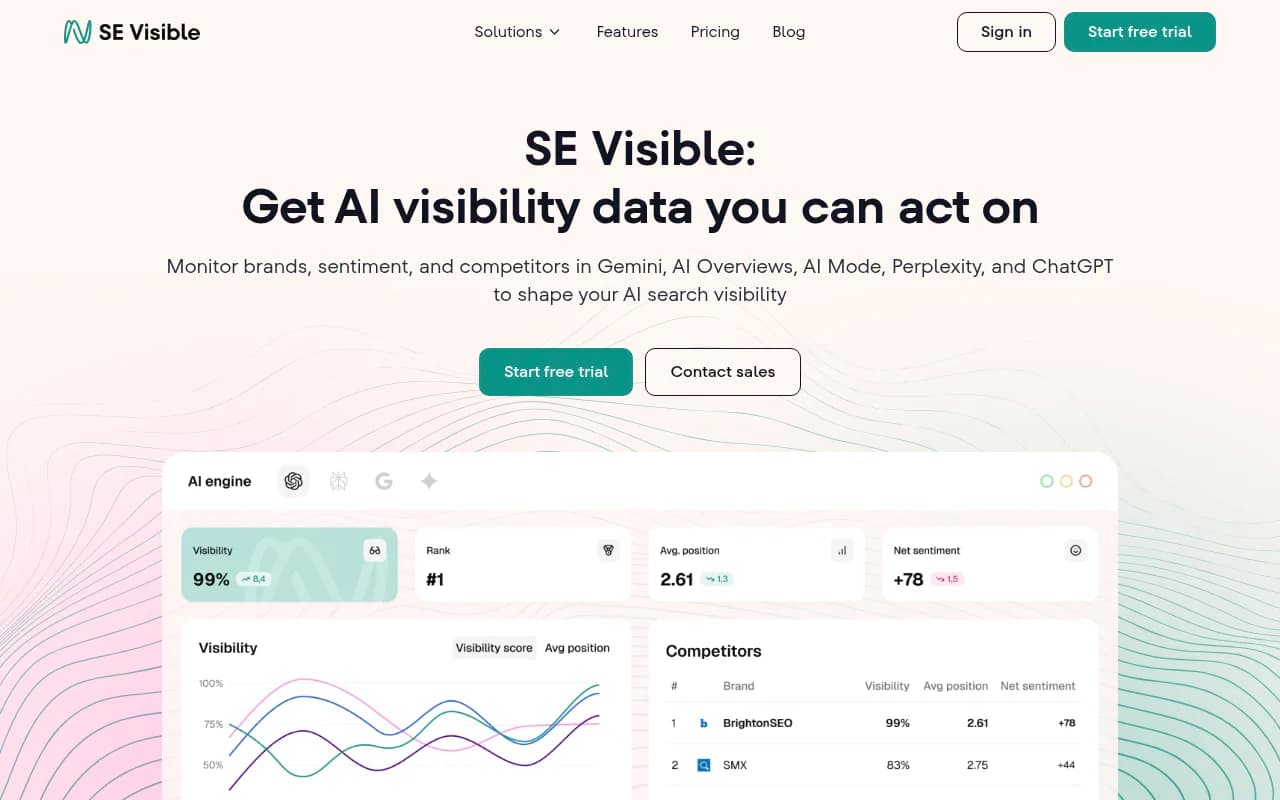
SE Visible is SE Ranking's dedicated AI visibility product. If your team already uses SE Ranking for traditional SEO, the integration makes it a natural extension — you get AI visibility data alongside your existing keyword rankings, site audits, and backlink data.
For teams that want a single platform covering both traditional and AI search, this is one of the more practical options. The AI visibility features include brand mention tracking across multiple models, sentiment analysis, and competitor benchmarking.
It's not the deepest AI visibility tool on the market, but it's well-built and the pricing is reasonable relative to standalone GEO platforms.
6. Otterly.AI
Otterly.AI is the budget-friendly option in this space. It covers the core use case — tracking brand mentions across ChatGPT, Perplexity, and a handful of other models — at a price point that makes sense for small teams and solo operators.
The interface is simple. Setup is fast. If you just need to know whether your brand is showing up in AI answers and you don't need deep analytics, Otterly.AI gets the job done without the overhead.
The limitations are real though: no crawler logs, no content generation, no traffic attribution, and model coverage is narrower than the more expensive alternatives. It's a starting point, not a complete solution.

7. Rankscale
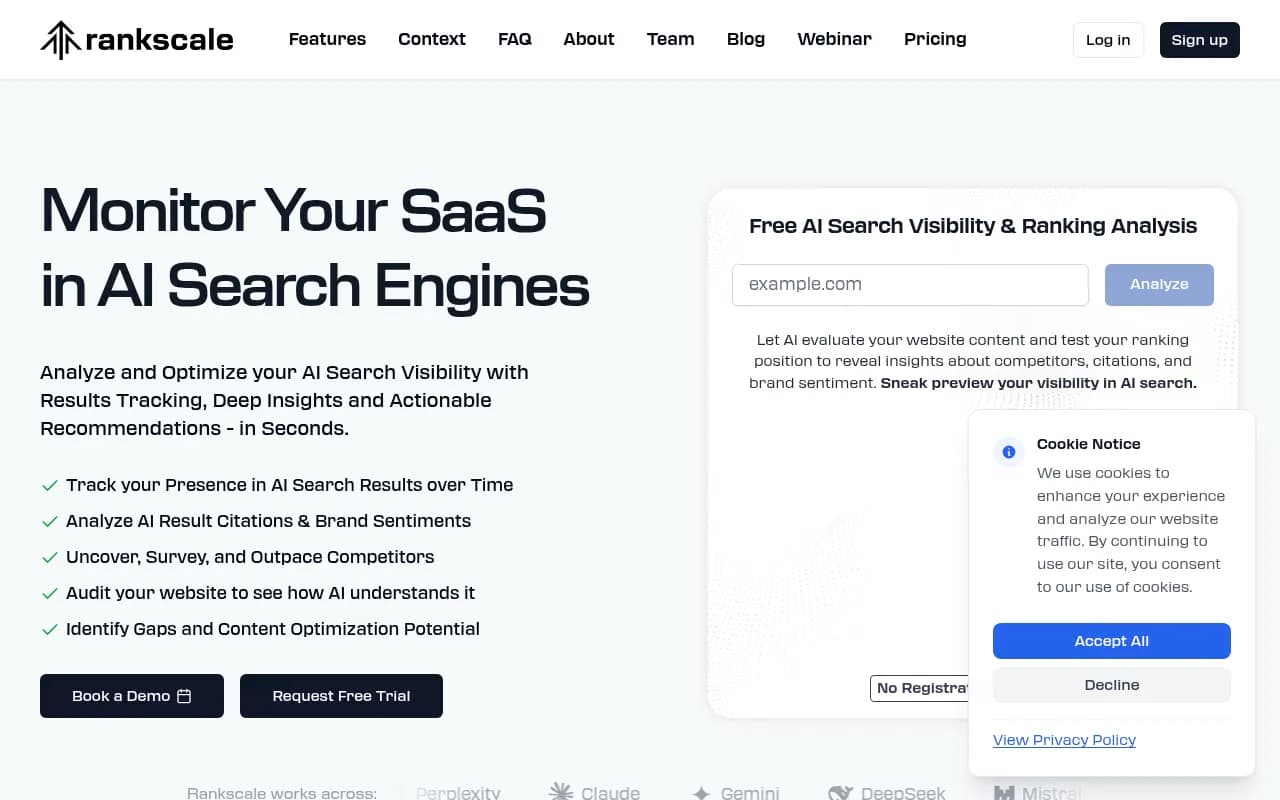
Rankscale focuses on AI search ranking and visibility tracking with a clean, data-forward interface. It covers multiple LLMs and gives you visibility scores, prompt-level tracking, and competitor comparisons.
It's a solid mid-tier option — more capable than Otterly.AI, less expensive than Profound or AthenaHQ. Teams that need reliable tracking across several AI models without the full price tag of an enterprise platform tend to find it a reasonable fit.
8. Airefs
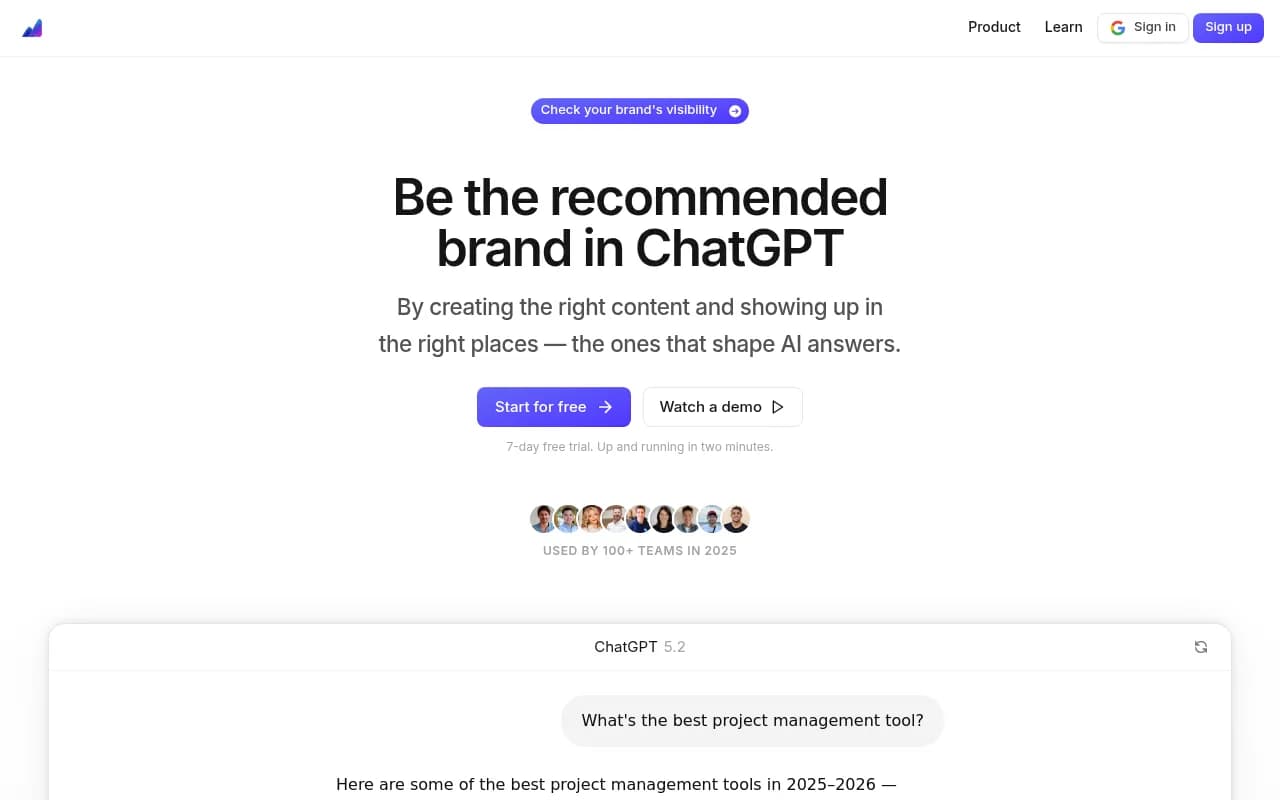
Airefs is another affordable entry point, starting at $24/mo with a ChatGPT-first focus. It's built for teams that want to track AI visibility without committing to a larger platform budget.
The feature set is basic — brand mention tracking, visibility scores, some competitor data — but it's honest about what it is. For early-stage companies or individual practitioners testing the waters on AI search optimization, it's a low-risk way to start collecting data.
9. Semrush
Semrush isn't a dedicated GEO platform, but it's worth including here because many teams already use it and its AI visibility features have improved. The AI Overview tracking in particular is useful for teams that want to monitor Google's AI search features alongside their traditional SEO data.
The honest caveat: Semrush uses fixed prompts for its AI monitoring, which limits flexibility. It doesn't have traffic attribution for AI search, and the AI visibility features feel like an add-on to a traditional SEO tool rather than a purpose-built GEO solution. But if you're already paying for Semrush and don't want to add another platform, it's a reasonable starting point.
How these tools compare
| Tool | AI models covered | Content generation | Crawler logs | Traffic attribution | Starting price |
|---|---|---|---|---|---|
| Promptwatch | 10 (ChatGPT, Claude, Perplexity, Gemini, Grok, DeepSeek, Copilot, Google AIO, Google AI Mode, Meta) | Yes (built-in AI writing agent) | Yes | Yes (GSC, snippet, server logs) | $99/mo |
| Profound | 4-5 | No | No | No | $99/mo |
| AthenaHQ | 4-5 | No | No | No | $295/mo |
| Scrunch AI | 3-4 | No | No | No | Custom |
| SE Visible | 4-5 | No | No | Limited | $189/mo |
| Otterly.AI | 3-4 | No | No | No | ~$49/mo |
| Rankscale | 4-5 | No | No | No | Custom |
| Airefs | 2-3 | No | No | No | $24/mo |
| Semrush | 2-3 (fixed prompts) | No | No | No | $139/mo |
What to actually look for when choosing
The model coverage question is real but it's not the whole story. Most of the AI search traffic that matters right now flows through ChatGPT, Perplexity, and Google AI Overviews. If a tool covers those three well, you're tracking the majority of the opportunity.
The more important question is: what happens after you get the data?
Most tools in this space will show you a visibility score. Some will show you which prompts you're winning or losing. Very few will tell you specifically what content you're missing and help you create it. That gap is where most GEO programs stall — teams have dashboards full of data and no clear path to improving the numbers.
A few other things worth checking before you commit:
Multi-language and multi-region support. If your business operates in multiple markets, you need a tool that can monitor AI responses in different languages and from different geographic contexts. Not all tools handle this well.
Prompt flexibility. Some tools (Semrush, Ahrefs) use fixed prompt sets. That's fine for a quick snapshot but limiting if you want to track the specific questions your customers are actually asking.
Reddit and YouTube tracking. AI models cite Reddit threads and YouTube videos heavily. If your tool isn't surfacing which discussions are influencing AI recommendations, you're missing a real optimization channel.
Pricing structure. Per-prompt pricing can get expensive fast. Understand how costs scale before you commit, especially if you're an agency managing multiple clients.
The bottom line
Peec.ai is a reasonable starting point but it's no longer the most capable option in a field that's grown significantly. The teams getting the most out of AI search optimization in 2026 are using tools that close the loop between visibility data and content action.
If you want the most complete platform, Promptwatch covers more models, more actions, and more of the optimization workflow than anything else in this space. If budget is the primary constraint, Otterly.AI or Airefs will at least get you tracking. And if you're already deep in the SE Ranking or Semrush ecosystem, their AI visibility features are worth exploring before adding a new tool.
The one thing that won't work: treating AI visibility as a passive monitoring exercise. The data is only useful if it leads somewhere.