Key takeaways
- Peec AI tracks brand mentions across AI engines like ChatGPT and Perplexity, but its monitoring-only approach leaves e-commerce brands without a clear path to improving visibility.
- The best alternatives in 2026 go beyond dashboards -- they help you find content gaps, generate AI-optimized content, and track which pages AI models actually cite.
- For e-commerce specifically, look for tools that cover ChatGPT Shopping, product-level tracking, and multi-engine coverage (Google AI Overviews, Gemini, Perplexity, Copilot).
- Promptwatch is the only platform in 2026 rated as a "Leader" across all GEO categories, combining monitoring, content generation, and crawler analytics in one place.
- Budget matters: options range from free tiers (Otterly.AI, SE Ranking) to enterprise contracts (Scrunch AI, AthenaHQ), so there's a fit for most team sizes.
Why e-commerce brands are outgrowing Peec AI
Peec AI does one thing reasonably well: it shows you how often your brand appears in AI-generated answers. For a team that's just waking up to the fact that ChatGPT and Perplexity are sending (or not sending) traffic their way, that's a useful starting point.
But e-commerce has a specific problem that generic AI visibility trackers weren't built to solve. When a shopper asks an AI assistant "what's the best running shoe under $150," the assistant doesn't return a list of links. It names products, cites prices, and often recommends a place to buy. If your brand isn't in that answer, you've lost the sale before the customer ever reached your site.
Gartner estimated traditional search volume would drop around 25% by 2026, and that shift is already showing up in e-commerce analytics. The brands winning in AI search aren't just the ones being monitored -- they're the ones actively optimizing. That's the gap Peec AI doesn't close.
So if you're an e-commerce team that's hit the ceiling with Peec AI -- whether because you need product-level tracking, content optimization, ChatGPT Shopping visibility, or just better data -- here's what's actually worth switching to.
What to look for in a Peec AI alternative
Before jumping into the list, it helps to know what separates a useful tool from a dashboard that just looks impressive.
For e-commerce brands specifically, the criteria that matter most are:
- Multi-engine coverage across ChatGPT, Google AI Overviews, Perplexity, Gemini, and Copilot at minimum
- Product and SKU-level tracking, not just brand-level mentions
- ChatGPT Shopping and product carousel monitoring
- Content gap analysis that shows you what topics competitors rank for but you don't
- Crawler logs so you know which pages AI bots are actually reading
- Traffic attribution that connects AI visibility to real revenue
- Actionable output -- briefs, content suggestions, or generated articles -- not just data
With that in mind, here are the strongest alternatives.
The best Peec AI alternatives for e-commerce in 2026
Promptwatch -- best for end-to-end AI visibility optimization
Promptwatch is the most complete option on this list. Where most tools (including Peec AI) stop at monitoring, Promptwatch runs a full loop: find the gaps, create content to fill them, then track whether it worked.

For e-commerce brands, a few capabilities stand out. The Answer Gap Analysis shows you exactly which prompts competitors are appearing for but you're not -- specific questions, product comparisons, and buying intent queries that AI models are already answering without citing your site. The Content Agents then generate articles, listicles, and comparison pages grounded in that real prompt data, not generic SEO filler.
Promptwatch also tracks ChatGPT Shopping and product carousels, which is rare. If you sell physical products, knowing when ChatGPT recommends your brand (or doesn't) in a shopping context is genuinely useful data. Add in AI crawler logs that show which pages AI bots are reading and when they move from crawl to citation, and you have a level of transparency that most competitors simply don't offer.
It monitors 10 AI models including ChatGPT, Perplexity, Google AI Overviews, Google AI Mode, Gemini, Claude, DeepSeek, Grok, Copilot, and Meta AI. Pricing starts at $99/month for the Essential plan (1 site, 50 prompts), with a free trial available.
Profound -- best for enterprise-level AI search intelligence

Profound is a strong choice for larger e-commerce teams that need deep analytics and are willing to pay for them. It's particularly good at predictive AI search insights -- surfacing trends in how AI models are starting to answer questions in your category before those trends fully mature.
The platform covers the major AI engines and offers solid competitor benchmarking. The trade-off is price: Profound sits at a higher price point than most alternatives here, and it doesn't have the content generation capabilities that close the loop from insight to action.
Scrunch AI -- best for enterprise-wide monitoring
Scrunch AI is built for large organizations that need to monitor AI visibility across multiple brands, regions, and business units. If you're running a multi-brand e-commerce operation or a retail group with several distinct product lines, Scrunch's enterprise architecture makes more sense than most tools on this list.
It's strong on monitoring breadth and reporting, but like Profound, it's primarily a tracking platform. You'll still need a separate content workflow to act on what it finds.
AthenaHQ -- best for brand sentiment and AI answer quality
AthenaHQ takes a slightly different angle. Beyond tracking whether your brand appears in AI answers, it looks at how your brand is described -- the sentiment, the framing, and whether AI models are associating you with the right attributes.
For e-commerce brands where perception matters (fashion, beauty, premium goods), that's a meaningful distinction. Their "State of AI Search 2026" report introduced the concept of "answer-share" as the metric replacing clicks, which is a useful frame for thinking about AI visibility.
The limitation is the same as most monitoring tools: AthenaHQ shows you the problem but doesn't generate the content to fix it.
Otterly.AI -- best affordable option for smaller teams
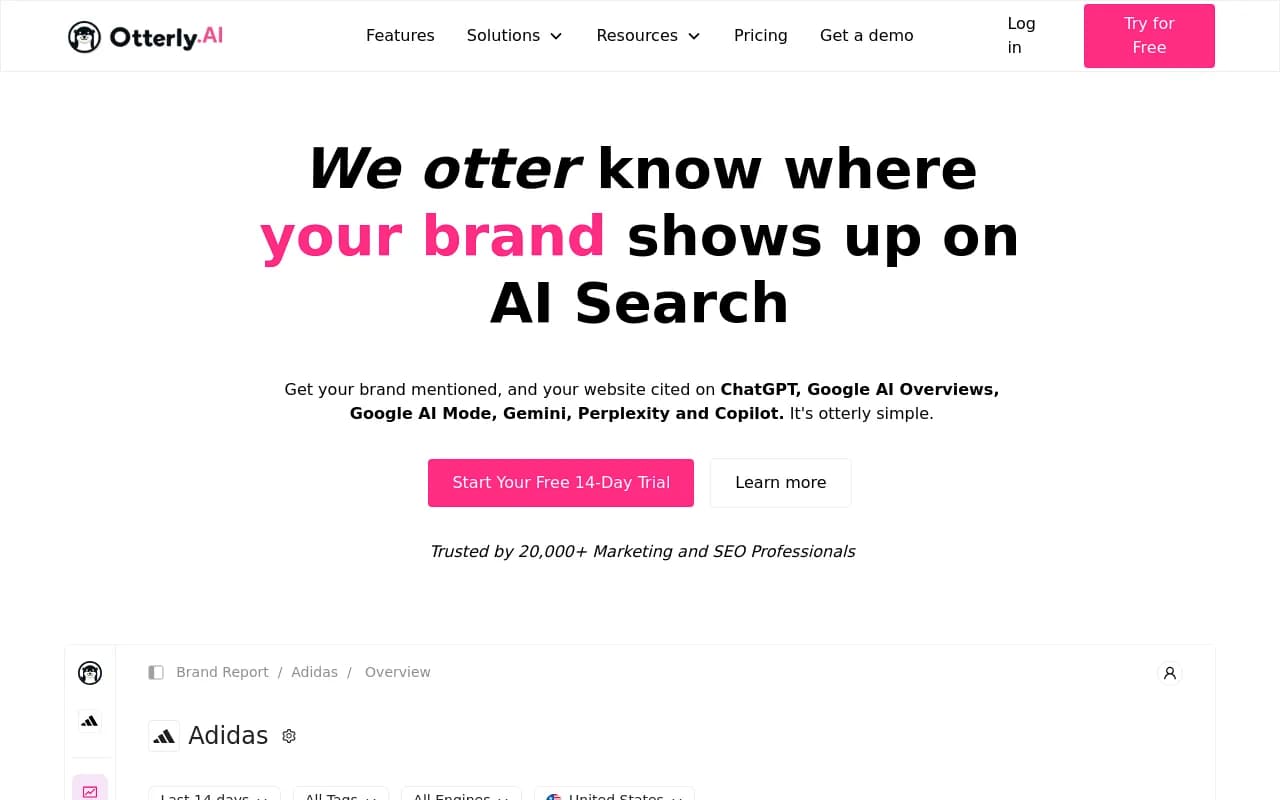
Otterly.AI tracks brand citations across six AI platforms: ChatGPT, Perplexity, Google AI Overviews, AI Mode, Gemini, and Microsoft Copilot. It's one of the more affordable options in the space and has a free tier, which makes it a reasonable starting point for smaller e-commerce brands or solo operators.
The interface is clean and the data is reliable. What it doesn't have is depth -- no crawler logs, no content generation, no ChatGPT Shopping tracking. For a brand that just wants to know "are we showing up?", it works. For a brand that wants to know "why aren't we showing up and how do we fix it?", you'll outgrow it quickly.
SE Ranking / SE Visible -- best for teams already using traditional SEO tools
SE Ranking has built AI visibility tracking into its broader SEO suite, which is genuinely convenient if your team is already using it for keyword research and rank tracking. The AI visibility module (branded as SE Visible) covers the major engines and integrates with the rest of the platform's data.
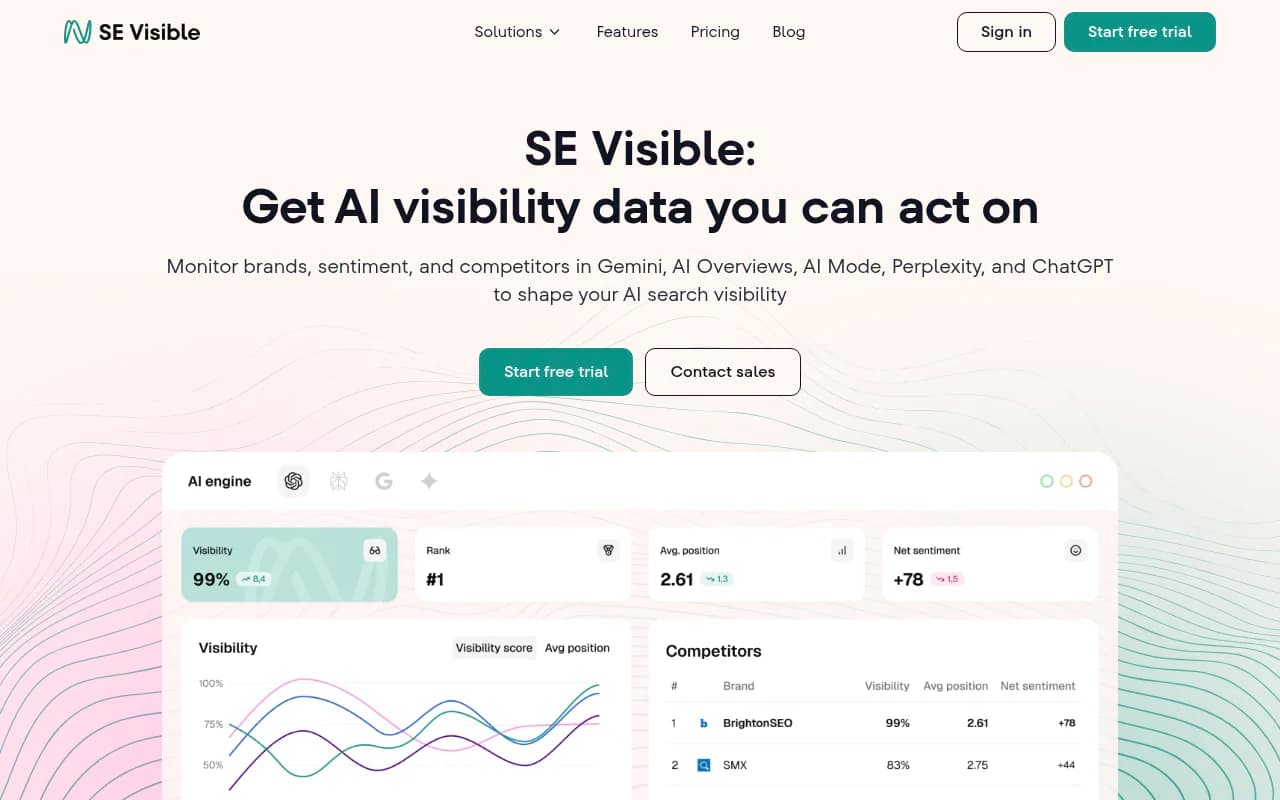
The advantage here is consolidation -- one platform, one bill, one place to see both traditional rankings and AI visibility. The downside is that the AI tracking features are less mature than dedicated tools, and there's no content generation or crawler log capability.
Rankscale AI -- best for competitive AI visibility benchmarking
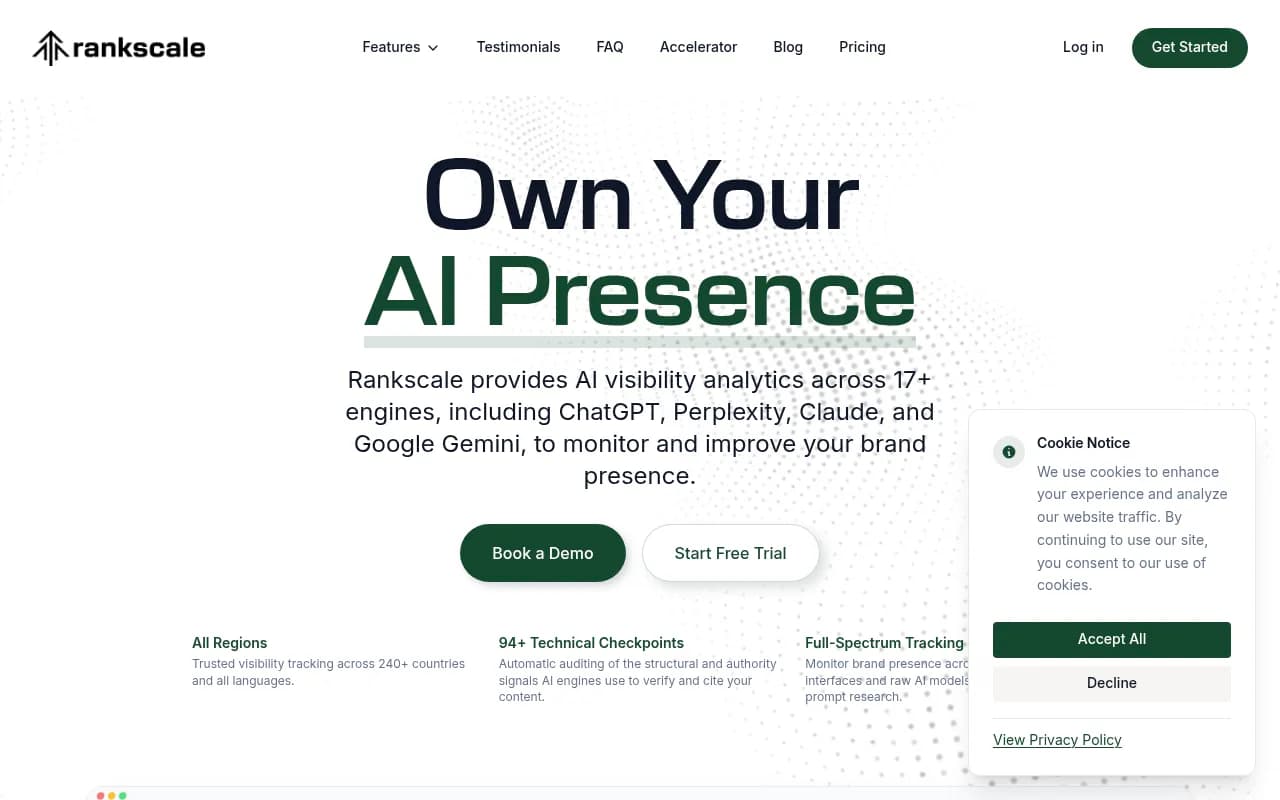
Rankscale AI focuses on competitive benchmarking -- showing you where you stand relative to specific competitors across AI engines. For e-commerce brands in crowded categories (consumer electronics, apparel, home goods), knowing that Competitor A is appearing in 40% of relevant AI answers while you're at 12% is motivating data.
It's a narrower tool than Promptwatch or Profound, but it does its specific job well.
Omnia -- best for scaleups focused on share of voice
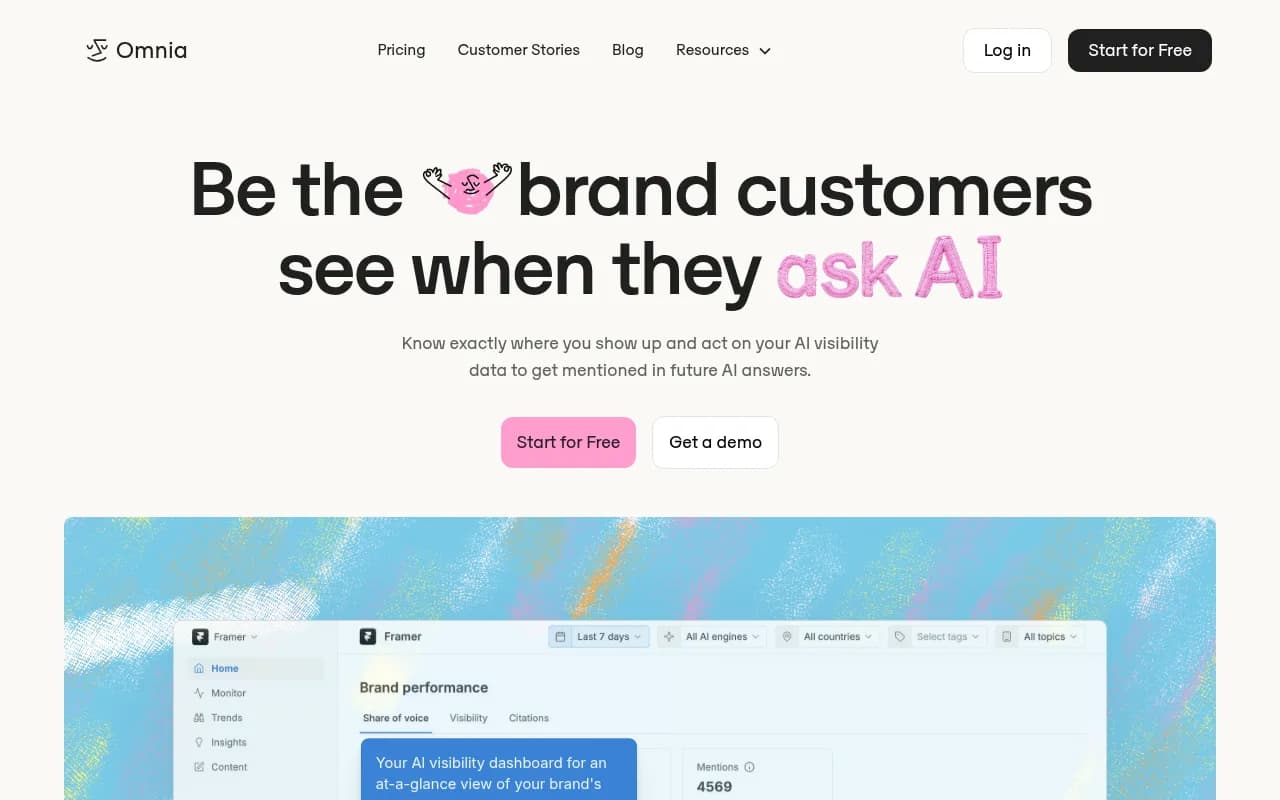
Omnia positions itself specifically at scaleup-stage companies and focuses heavily on share of voice metrics in AI answers. If your e-commerce brand is in a growth phase and you want to track how your AI visibility is trending relative to the market, Omnia's reporting is well-suited to that narrative.
Ranketta -- best for product-feed-level AI visibility
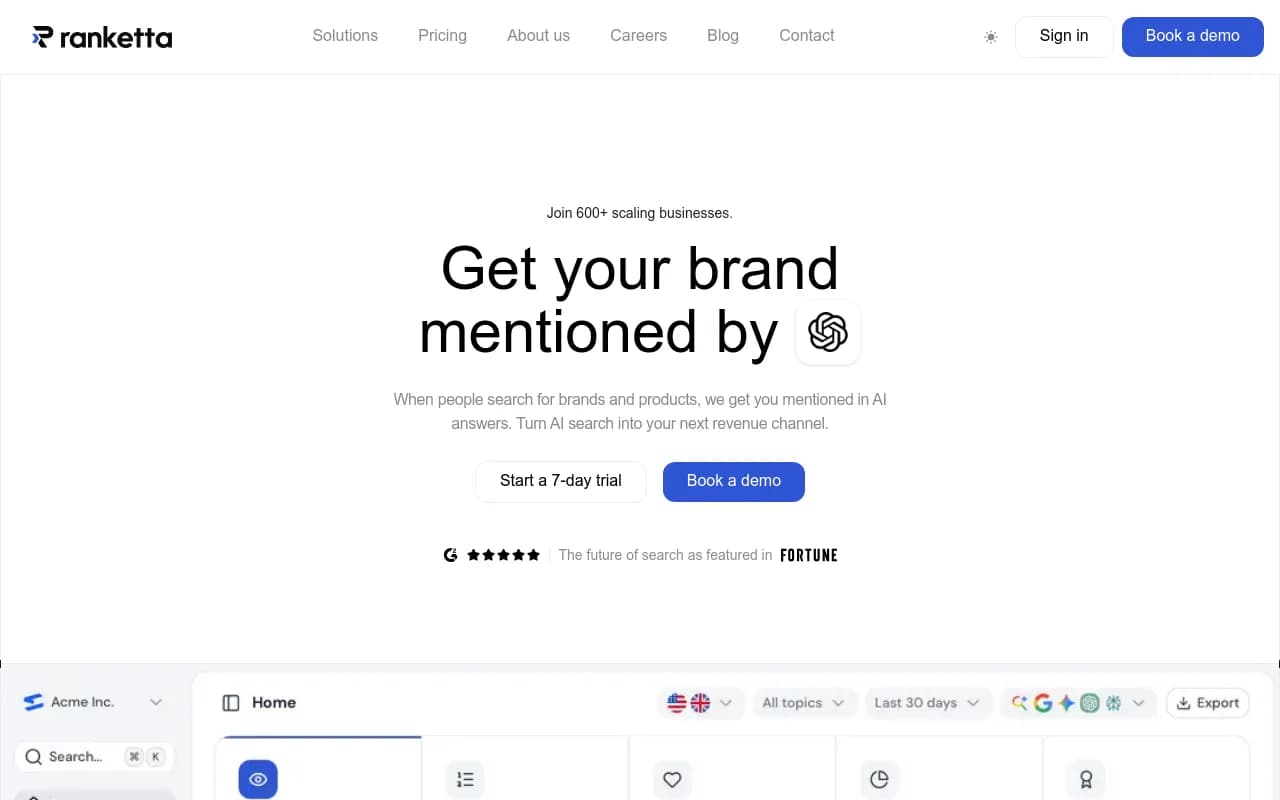
Ranketta takes a different approach than most tools here. It's built specifically for e-commerce and focuses on the product feed layer -- the structured data that AI agents parse when making product recommendations. If an AI assistant is recommending products based on GTIN, price, and availability data, Ranketta helps you make sure your catalogue is readable and optimized at that level.
This is a more technical tool and requires more setup, but for e-commerce brands selling through multiple channels (Shopify, Google Shopping, Amazon), it addresses a gap that brand-level monitoring tools completely ignore.
Comparison table
| Tool | AI engines covered | Content generation | Crawler logs | ChatGPT Shopping | Best for | Starting price |
|---|---|---|---|---|---|---|
| Promptwatch | 10 (ChatGPT, Perplexity, Gemini, Claude, Grok, DeepSeek, Copilot, Meta AI, AI Overviews, AI Mode) | Yes | Yes | Yes | Full optimization loop | $99/mo |
| Profound | 6+ | No | No | No | Enterprise analytics | Higher tier |
| Scrunch AI | 6+ | No | No | No | Multi-brand enterprise | Custom |
| AthenaHQ | 8+ | No | No | No | Brand sentiment tracking | Mid-tier |
| Otterly.AI | 6 | No | No | No | Small teams, budget | Free tier available |
| SE Ranking | 5+ | No | No | No | SEO suite consolidation | From ~$44/mo |
| Rankscale AI | 5+ | No | No | No | Competitive benchmarking | Mid-tier |
| Omnia | 5+ | No | No | No | Scaleup share of voice | Mid-tier |
| Ranketta | 5+ | No | No | No | Product feed optimization | Mid-tier |
| Peec AI (baseline) | 5+ | No | No | No | Basic brand monitoring | From €89/mo |
How to choose the right tool for your e-commerce team
The honest answer is that it depends on where you are in your AI visibility journey.
If you're just starting out and want to know whether you're showing up at all, Otterly.AI or SE Ranking's AI module will give you that data without a big commitment. They're not going to help you improve, but they'll tell you where you stand.
If you're a mid-size e-commerce brand that's already convinced AI search matters and you want to do something about it, Promptwatch is the clearest choice. The combination of gap analysis, content generation, and crawler logs means you can run a full optimization cycle -- find what's missing, create the content, watch the citations improve. Most other tools give you the first step and stop there.
If you're an enterprise with multiple brands or a complex product catalogue, Profound or Scrunch AI have the depth and infrastructure to handle that scale. Ranketta is worth evaluating if product-feed-level optimization is a priority.
One thing worth noting: the tools that only monitor are becoming less defensible as a category. Knowing you're invisible in ChatGPT is useful for about five minutes. What you actually need is a path to fixing it.
The e-commerce AI visibility problem nobody talks about
Most AI visibility tools were built with B2B SaaS brands in mind -- companies that want to know if ChatGPT recommends their software. E-commerce has a harder version of the same problem.
A shopper asking "what's the best moisturizer for dry skin under $30" isn't going to click through to your category page. The AI assistant will name three products, explain why, and potentially link directly to a purchase page. If your product isn't named, you're invisible. If your product is named but the AI has the wrong price or an outdated description, you might lose the sale anyway.
That's why product-level tracking and feed optimization matter for e-commerce in a way they don't for other industries. It's also why tools like Ranketta exist as a separate category from general AI visibility platforms.
The brands that are winning in AI search right now aren't just the ones with the most citations. They're the ones that have made their product data readable and trustworthy to AI systems, and that are consistently publishing content that answers the specific questions shoppers are asking.
That's a content and technical problem, not just a monitoring problem. The tools you choose should reflect that.
Final recommendation
For most e-commerce brands evaluating Peec AI alternatives in 2026, the shortlist looks like this:
- Start with Promptwatch if you want a single platform that monitors, identifies gaps, and helps you create content to fill them. The ChatGPT Shopping tracking and crawler logs are particularly relevant for e-commerce.
- Consider Ranketta if your primary concern is product-feed-level AI visibility and you sell across multiple channels.
- Use Otterly.AI if budget is tight and you just need basic monitoring while you build the case internally for a larger investment.
- Look at Profound or Scrunch AI if you're at enterprise scale and need the infrastructure to match.
The market is moving fast. A tool that was adequate six months ago may already be behind. The question to ask any vendor is simple: "After I see the data, what does your platform actually help me do about it?"