Key takeaways
- Elmo is the most mature open-source AI visibility tracker right now: MIT license, Docker Compose self-hosting, your own PostgreSQL, and a repo with 1,100+ commits and activity as recent as Oct 13, 2026.
- Voyage (OnVoyage) positions itself as open-source GEO infrastructure. Our research agent could not independently verify much about it, so test it yourself before committing.
- GetCito, OneGlanse, and geo-aeo-tracker are the main DIY alternatives. They suit developers who are happy to tinker.
- Self-hosting gives you data ownership and auditable scoring, but you take on scraping maintenance, proxies, API keys, and uptime.
- If you need crawler logs, traffic attribution, and content execution, a hosted platform like Promptwatch covers ground that open-source trackers mostly don't.
Why self-host an AI visibility tracker at all
Most AI visibility tools are closed SaaS. You send them your prompts, they run them against ChatGPT, Perplexity, Gemini and the rest, and you get a dashboard. Fine. But you can't see how the score is calculated, you can't export everything on your terms, and the bill grows with every prompt you add.
Open-source trackers flip that. You run the code, you own the database, and you can read the scoring logic. For agencies with client confidentiality concerns, developer-tool companies who like to poke at internals, and small teams with more engineering time than budget, that trade is attractive.
It isn't free, though. You pay in setup time, API costs, and maintenance. I'll be blunt about that throughout this guide, because most roundups gloss over it.
What a tracker actually has to do
Before comparing tools, it helps to know what you're evaluating. A useful AI visibility tracker runs a set of prompts against several AI engines on a schedule, records whether your brand is mentioned, where it appears, and which sources get cited, then trends that over time.
Two details separate good trackers from toy ones.
First, citation behavior differs by engine. According to Promptwatch's average sources per response data, ChatGPT cites about 5 sources per web-search answer, Google AI Overviews about 10, and Perplexity almost exactly 10 every day. Copilot swung from under 2 to nearly 17 within weeks before settling low. The practical lesson for DIY tracking: compare each engine against its own baseline, never against a blended average.
Second, retrieval behavior matters. Promptwatch's ChatGPT query fanout data shows average web searches per response fell from 2.15 in early December to about 1.84 by early March, and average query length dropped from roughly 117 characters to about 53 from April. A tracker that logs fan-out queries records real retrieval behavior, not just final answers. Elmo has a dedicated Query Fan-Out page for this.
Elmo: the open-source pick
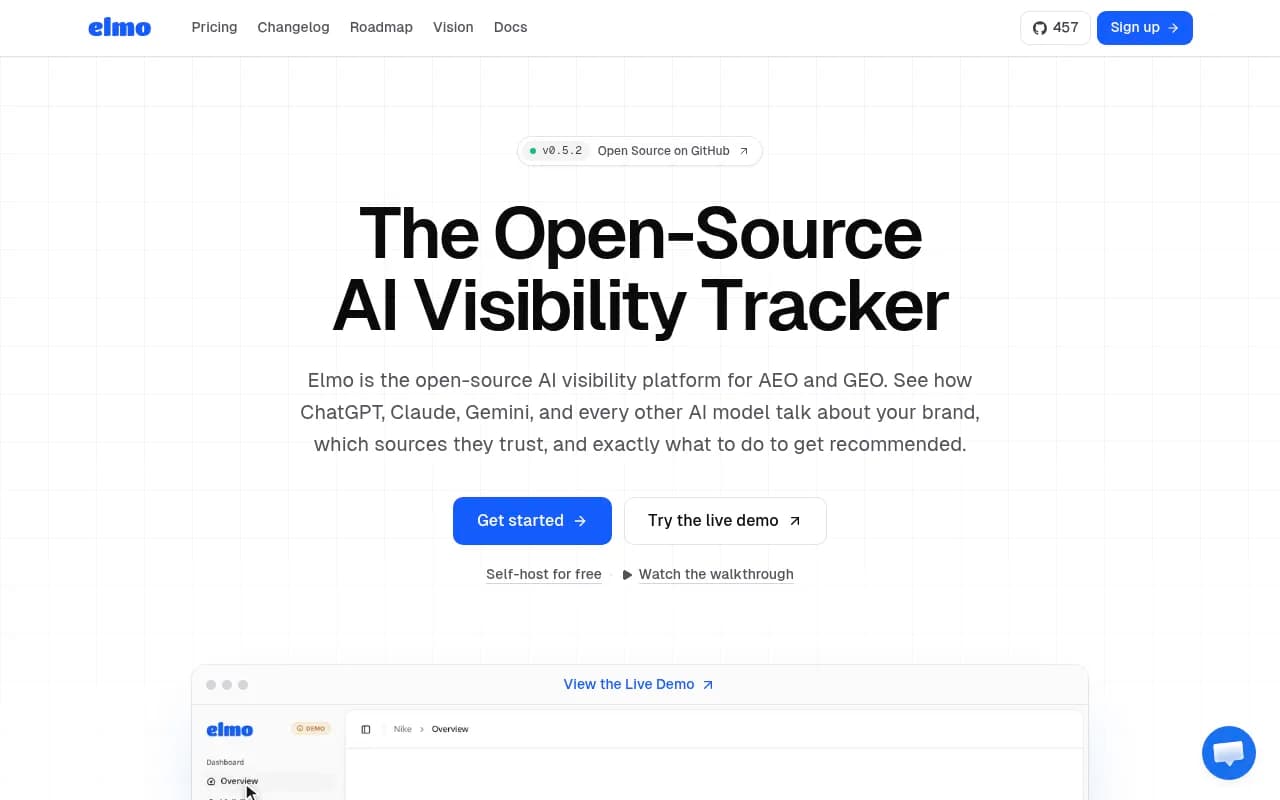
Elmo is an MIT-licensed AEO/GEO platform you can self-host for free or run on Elmo Cloud. It positions itself as an alternative to Profound, Peec, and Otterly.

What you get
The interface covers the pages you'd expect: an Overview with share of voice, a Visibility view per prompt and model, Share of Voice against competitors, Query Fan-Out, Citations, and an Opportunities page that ranks next steps by impact.
Engine coverage is broad: ChatGPT, Claude, Gemini, Perplexity, AI Overviews, AI Mode, Copilot, Grok, DeepSeek, Mistral, Qwen, and any OpenRouter model. According to the Elmo site, it scrapes what real users see in the popular AI search tools and uses direct API calls and OpenRouter for the rest. That distinction matters because user-facing answers and citations can differ from API output.
Why it stands out
- Scoring code is public, so you can audit how visibility is calculated.
- Your data lives in your own PostgreSQL database.
- A live demo is available at demo.elmohq.com, so you can look before you install anything.
- The GitHub repo shows 1,104 commits, 85 branches, 27 tags, and a latest commit on Oct 13, 2026. Recent work includes an evidence-based "aeo" agent skill and MCP tooling with a REST fallback.
- Elmo says 200+ brands use it, with Speakeasy among the named customers.
Caveats worth knowing
The site shows v0.4.5. That's pre-1.0, so expect things to move and occasionally break between releases.
The "Recommended by AI" quotes on the homepage are marketing, not independent reviews. One is labeled "Asked Sept 2026" and it's ChatGPT telling you Elmo is good. Take it with a grain of salt.
Elmo Cloud starts from $29/mo according to the project's README, but I couldn't verify full pricing, so check the site. Self-host setup is documented at elmohq.com/docs/getting-started, and you should expect to need Docker Compose, a PostgreSQL database, and API keys for the models you want to query.
One more general risk: any tool that scrapes engine UIs can break when those pages change. I don't have a source quantifying how often that happens, so treat it as a maintenance expectation, not a statistic.
Voyage (OnVoyage): open-source GEO infrastructure
Voyage, listed in our catalog as Voyage (OnVoyage), describes itself as open-source GEO infrastructure for growing LLM mindshare.

Here's where I have to be honest. Our research pass did not turn up substantive independent coverage of it, so I can't tell you about its engine coverage, scoring approach, or how active the repo is. Check the project's site and repository for license, last commit date, and setup docs before you evaluate it seriously. If you're shortlisting open-source options, it belongs on the list to test, just not on a recommended-without-reservations list.
The DIY options on GitHub
The GitHub topic "ai-visibility-tracking" lists 23 public repos as of this writing. Three stood out in our research.
GetCito
GetCito is a TypeScript/Next.js project with 488 stars and a last update on Sep 28, 2026. It calls itself the world's first open-source AIO/AEO/GEO tool. It's the most-starred repo in the topic, which suggests a real user base.
OneGlanse
OneGlanse is MIT-licensed, written in TypeScript, and self-hostable, with 219 stars and an update on Oct 4, 2026. It tracks ChatGPT, Perplexity, Gemini, Claude, and Google AI Overview through the real product UIs. Its Product Hunt page is upfront that it's mainly for developers and tinkerers who can support their teams, since it runs locally or self-hosted. I like that honesty.
geo-aeo-tracker
This one is local-first and free, at v1.5.1 as of Oct 9, 2026. A few details from its changelog are instructive:
- It now tracks 5 engines. The README previously said 6, and Grok was dropped from the test scraper. That's exactly the sort of churn you sign up for with UI scraping.
- Optional Supabase cloud persistence arrived in v1.2.0.
- Its AEO audit parses robots.txt per RFC 9309 and fails only for answer-engine crawlers such as OAI-SearchBot, PerplexityBot, Claude-SearchBot, Googlebot, and Bingbot. Training-only crawlers are listed without failing.
- It fixed an older regex check that wrongly reported GPTBot as blocked. If you've ever hand-rolled a robots.txt checker, you know how easy that mistake is.
Comparison table
| Tool | License / cost | Hosting | Engines | Maturity signal |
|---|---|---|---|---|
| Elmo | MIT, free self-hosted; cloud from $29/mo | Docker Compose + PostgreSQL | ChatGPT, Claude, Gemini, Perplexity, AI Overviews, AI Mode, Copilot, Grok, DeepSeek, Mistral, Qwen, OpenRouter | v0.4.5, 1,104 commits, active Oct 2026 |
| Voyage (OnVoyage) | Open source, details unverified | Check project docs | Unverified | Verify before adopting |
| GetCito | Open source | Self-hosted, Next.js | AI search engines (check repo) | 488 stars, updated Sep 28, 2026 |
| OneGlanse | MIT | Local or self-hosted | ChatGPT, Perplexity, Gemini, Claude, AI Overviews | 219 stars, updated Oct 4, 2026 |
| geo-aeo-tracker | Free, local-first | Local, optional Supabase | 5 engines | v1.5.1, Oct 9, 2026 |
The real cost of self-hosting
The license is free. The rest is not.
- Model and API costs. Every prompt run against every engine costs money, whether through API calls, OpenRouter, or scraping infrastructure.
- Maintenance. When an engine changes its UI, scrapers break. geo-aeo-tracker dropping Grok support is a small live example.
- Prompt design. A tracker is only as good as the prompts you feed it. No tool picks prompts that mirror your buyers for you.
- No crawler visibility. None of the open-source trackers above, as far as our research shows, give you IP-verified AI crawler logs or traffic and conversion attribution from AI platforms. You'll see mentions, not revenue.
- Action gap. Elmo's Opportunities page gets closest, but writing, publishing, and measuring the fix is still on you.
For a quick sanity check of your own setup, you can compare a month of self-hosted data against a hosted tool's free scan. Promptwatch Data also publishes first-party citation research that is useful as a baseline for what normal looks like.
When a hosted platform is the better call
Self-hosting makes sense when data ownership, auditability, or budget is the deciding factor, and you have someone who enjoys maintaining it. It makes less sense when the goal is to grow AI-driven traffic and you need to know why you are or aren't being cited.
Promptwatch sits at the other end of the spectrum. It monitors the real UIs of ChatGPT, AI Overviews, AI Mode, Gemini, Perplexity, and Copilot, adds IP-verified AI crawler logs and visitor analytics, and then goes further with an Action Board and a Content Agent that plans, writes, and publishes content. Plans start at $95/mo, with a free Explore tier, so check promptwatch.com/pricing for current details.

A sensible hybrid: self-host Elmo or OneGlanse for raw tracking you control, and use a hosted platform where you need crawler logs and execution. Plenty of teams will find one tool is enough, though.
Other hosted trackers in our catalog worth a look if you want a cheaper managed option include Peec AI, Otterly.AI and Profound, though most are monitoring-focused.



For a broader view of the category, the GEO software directory at bestgeosoftware.com lists far more options than fit here.
How to choose
- Need a mature, documented open-source option you can trial in a live demo first? Start with Elmo.
- Want something lightweight and local on a laptop? Try geo-aeo-tracker or OneGlanse.
- Comfortable with Next.js and want to hack on the code? GetCito.
- Want an open-source infrastructure play and willing to do your own due diligence? Evaluate Voyage.
- Need traffic attribution, crawler logs, and content execution without an engineering project? Go hosted.
A quick evaluation checklist
Whichever you pick, spend an afternoon on this before trusting the numbers:
- Run the same 20 prompts manually in each engine and compare to the tracker's output.
- Check the last commit date and open issues.
- Confirm which engines are scraped through the UI and which are API-only.
- Look at how mentions are scored and whether the code is readable.
- Budget API costs for a month at your intended prompt volume.
If the tracker's output matches what you see by hand, you've got something worth building on. If not, you've lost an afternoon instead of a quarter.
Bottom line
Elmo is the clear open-source default in October 2026 because it combines an MIT license, broad engine coverage, public scoring, and visibly active development. The smaller repos are good for tinkerers. Voyage deserves a hands-on test rather than a leap of faith. And if you find yourself spending more time maintaining scrapers than improving your content, that's the signal to move to a hosted platform.