Key takeaways
- Course buyers increasingly ask AI assistants "what's the best course for X," and those answers lean on product pages, landing pages, listicles and comparisons, not blog posts alone.
- A GEO tool should do three things for a course business: show which prompts mention you, show which pages get cited, and tell you what to publish next.
- Monitoring-only trackers are fine for a solo creator on a budget. Teams selling several courses benefit more from a platform that also covers crawler logs, AI traffic and content creation.
- Your course platform (Teachable, Thinkific, Kajabi and so on) matters too, because it controls how crawlable and citable your sales pages are.
- YouTube is the social platform worth investing in for Google AI Overviews. Reddit has largely dropped out of ChatGPT citations.
Why course creators should care about GEO
Here is a pattern I keep seeing. A prospective student used to type "best Python course for beginners" into Google, click three blog posts, and compare. Now a lot of them ask ChatGPT or Gemini and get a shortlist of three or four names. If you are not on that shortlist, you never got the chance to compete.
That is what generative engine optimization (GEO) is about: getting your course, your brand and your instructors named and cited in AI answers. Online education is a good fit for this problem because the buying question is almost always a recommendation question. "Which course should I take" is exactly what people ask a chatbot.
There is a data point worth noticing from outside the commercial world. Class Central, a course discovery site, reported that ChatGPT became its second-highest source of traffic in May of last year (via a Class Central report on learning GEO). Education discovery is already moving to AI answers.
What AI actually cites for "best course" prompts
Before picking a tool, it helps to know what you are optimizing. Promptwatch Data's ChatGPT citation share by content type report (Sep 28 to Oct 4, 2026) breaks down what ChatGPT cites:
| Content type | Share of all ChatGPT citations | Share for commercial prompts |
|---|---|---|
| Product pages | 22.4% | 26.0% |
| Landing pages | 16.8% | 20.6% |
| Listicles | 13.6% | 15.0% |
| Comparisons | 5.9% | 7.9% |
| How-to guides | 8.7% | n/a (10.7% for informational) |
| Documentation | 7.5% | n/a |
For commercial prompts like "best X courses," product pages, landing pages, listicles and comparisons add up to almost 70% of citations. For a course creator, that means your course sales page is the main citation surface. Not your blog. Your sales page, with pricing, curriculum, outcomes and "who this is for" spelled out.
Two other findings matter here:
- Branded prompts (someone asking about your course by name) lean on reviews at 5.6%, more than three times their share across all prompts. Collect reviews on trusted third-party sites.
- Promptwatch's content half-life study found that landing pages and docs stay cited longest, while news loses half its pages within 36 days. Evergreen course pages beat timely announcements.
Where social fits
The social media citations by AI model report (Sep 28 to Oct 4, 2026) shows how different the engines are. ChatGPT got only 0.46% of its citations from social platforms, with Reddit at 0.09%. Google AI Overviews got 12.2% from social, led by YouTube at 4.28%. Perplexity sat at 2.7%.
For course creators the takeaway is concrete. If you teach on YouTube already, keep doing it, because Google AI Overviews cites it. Do not build a strategy around Reddit threads for ChatGPT visibility. Promptwatch's Reddit citation drop data shows reddit.com falling from roughly 4% to 0.5% of ChatGPT citations on August 14, 2026.
What a GEO tool should do for an education business
A few criteria, in rough order of how much they matter for course sellers:
- Prompt tracking from real interfaces, across ChatGPT, Gemini, Perplexity, AI Overviews and AI Mode, in the languages and countries of your students.
- Citation reporting, so you can see which of your pages (and which third-party listicles and review sites) get cited.
- Competitor visibility. In education you are often compared against Udemy, Coursera, and other creators. You need share of voice against them.
- Crawler and traffic data. Many course platforms hide or block things you cannot see. Knowing whether AI bots can read your sales page is basic.
- Content help. Most small teams have no capacity to write comparison pages and FAQs by hand.
- Price that fits a creator business. Many solo educators cannot justify enterprise pricing.
Best GEO tools for course creators in 2026
Promptwatch: best end-to-end option for teams
Promptwatch is the one I would put first for a course business with more than one product or a content team, mainly because it goes past tracking. It monitors ChatGPT, Gemini, Perplexity, Google AI Overviews, AI Mode, Copilot and others through their real interfaces, then shows which pages get cited, and its Content Agent writes and publishes pages to WordPress, Webflow or Framer to fill the gaps. That matters because most course creators know they are missing from AI answers but do not have time to produce the comparison pages and FAQs that fix it.

Specific features that matter for education sellers:
- AI crawler logs show whether GPTBot, ClaudeBot or PerplexityBot can actually read your sales and curriculum pages. Course platforms sometimes put key content behind scripts or login walls.
- Visitor analytics attribute AI-referred traffic and conversions, so you can tell whether ChatGPT visitors buy.
- Brand Narrative pulls out the claims AI makes about your course ("too expensive," "great for beginners") so you can fix the pages that feed them.
- Personas let you prompt like a career-switcher versus a hobbyist.
- Crisp, a customer of Promptwatch, reported 2x higher conversion from AI traffic than from traditional channels (case study). That is a SaaS company, not a course business, so treat it as directional.
Pricing as listed on promptwatch.com/pricing: Essential is $95/month (50 prompts, 1 project), Professional is $245/month (150 prompts, 5 AEO articles), and Business is $579/month and is the first plan with the automated Content Agent. Annual billing gives 12 months for the price of 10, and there is a 7-day free trial on monthly plans. Confirm current numbers on the pricing page before you buy.
Before paying for anything, run the free AI visibility report on your course brand. It takes a few minutes and tells you whether you are visible at all.
Peec AI: lean tracking with multi-language support
If you sell in several languages, Peec AI is a reasonable monitoring option. It is a tracker. You will see where you show up, but you will do the fixing yourself.

Otterly.AI: affordable monitoring for solo creators
Otterly.AI is on the cheaper end and works if you only need to know "did my course get mentioned this week." It lacks crawler logs and content generation, so expect to pair it with your own publishing workflow.

Profound: enterprise-style monitoring
Profound targets larger brands and has a deep monitoring feature set. For an online university or a large edtech company it is a credible shortlist entry. For an independent course creator it is probably more than you need. See the Promptwatch vs Profound comparison for specifics.

AthenaHQ: tracking across multiple engines
AthenaHQ tracks visibility across 8+ AI search engines and suits teams that mostly want a monitoring dashboard.

Semrush and Ahrefs Brand Radar: if you already pay for them
If your marketing team already lives in Semrush or Ahrefs Brand Radar, the AI add-ons are convenient. They work off fixed prompt sets and are shallower on AI-specific data, such as crawler logs and AI traffic attribution.

Frase and AirOps: content-side tools
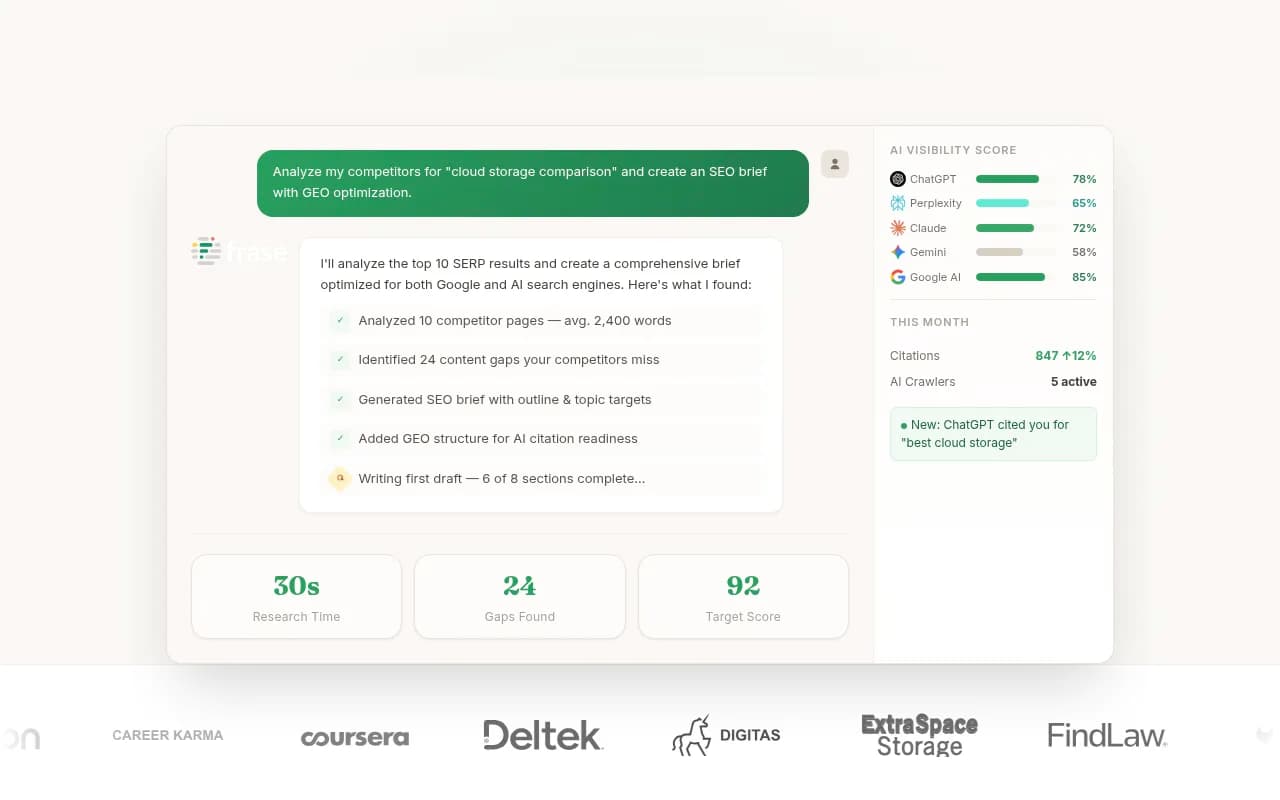
If your bottleneck is producing optimized pages rather than measuring them, Frase and AirOps lean toward content. They do not replace citation tracking, so pair them with a monitor.
Comparison table
| Tool | Best for | Tracking | Crawler logs | Content creation | Budget fit |
|---|---|---|---|---|---|
| Promptwatch | Teams that want to track and fix | Real-UI, many engines | Yes | Yes (Content Agent on Business) | From $95/mo |
| Peec AI | Multi-language tracking | Yes | No | No | Low to mid |
| Otterly.AI | Solo creators | Yes | No | No | Low |
| Profound | Large edtech brands | Yes | Limited | Limited | High |
| AthenaHQ | Dashboard-focused teams | Yes | No | Limited | Mid |
| Semrush / Ahrefs | Existing SEO suite users | Fixed prompt sets | No | Separate tools | Varies |
For more options, the GEO software directory at bestgeosoftware.com lists dozens of trackers by category.
Your course platform affects GEO more than you think
The Storyflow roundup of course creator tools ranks platforms like Kajabi, Teachable, Thinkific, Podia, Mighty Networks and LearnWorlds by how well they host and sell. That is a vendor-authored list (Storyflow names itself as one of the picks), so read it with that in mind, but the categories are useful.
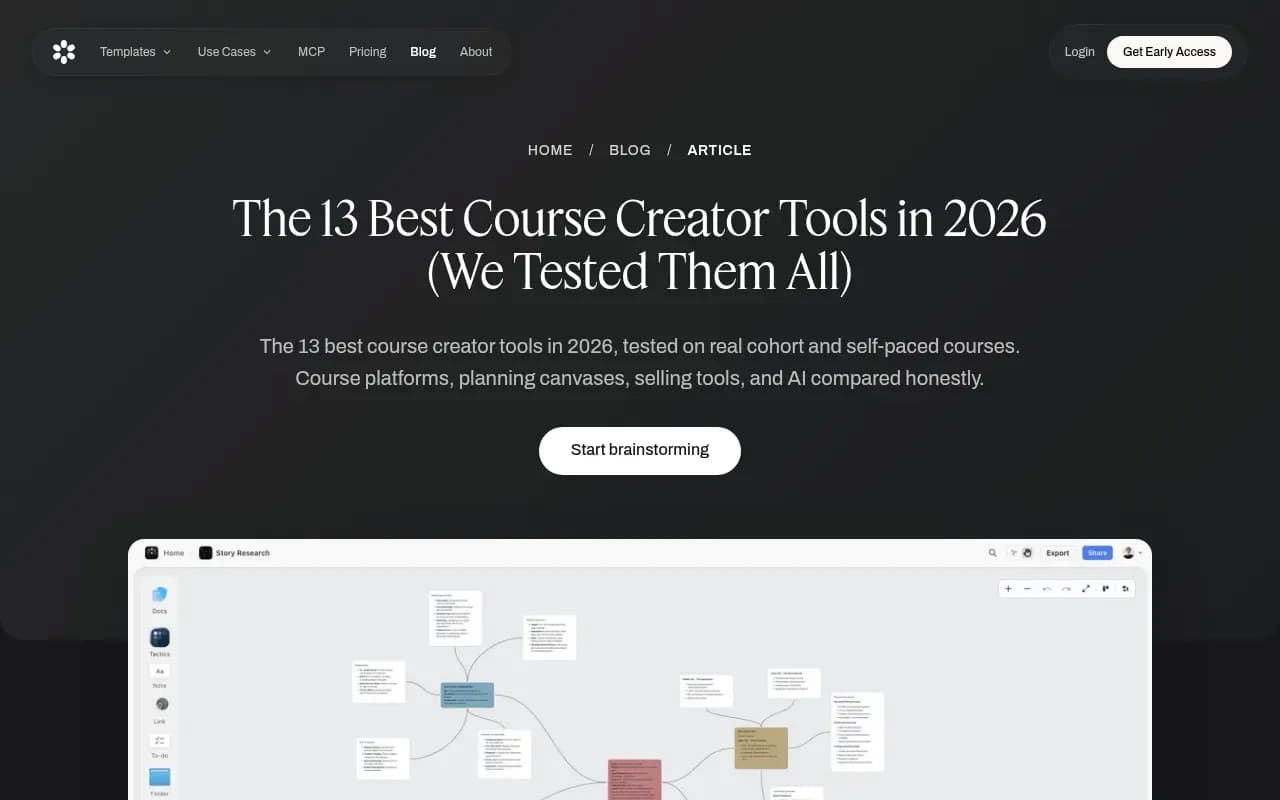
None of those rankings cover GEO. I could not find reliable, sourced details on how each platform handles llms.txt, schema markup or bot access, so I will not make claims about them. What I can tell you is what to test yourself:
- Can AI crawlers fetch your course sales page with plain HTML, or does it render only through JavaScript?
- Does the page state price, duration, prerequisites and outcomes as text, not images?
- Is your robots.txt blocking GPTBot, ClaudeBot or PerplexityBot by accident?
- Are reviews and testimonials on the page in crawlable text?
The free Agentic Readiness Check and the AI Crawler URL Inspector answer the first two questions in minutes. If you need a robots.txt that welcomes AI bots, the robots.txt generator for AI helps.
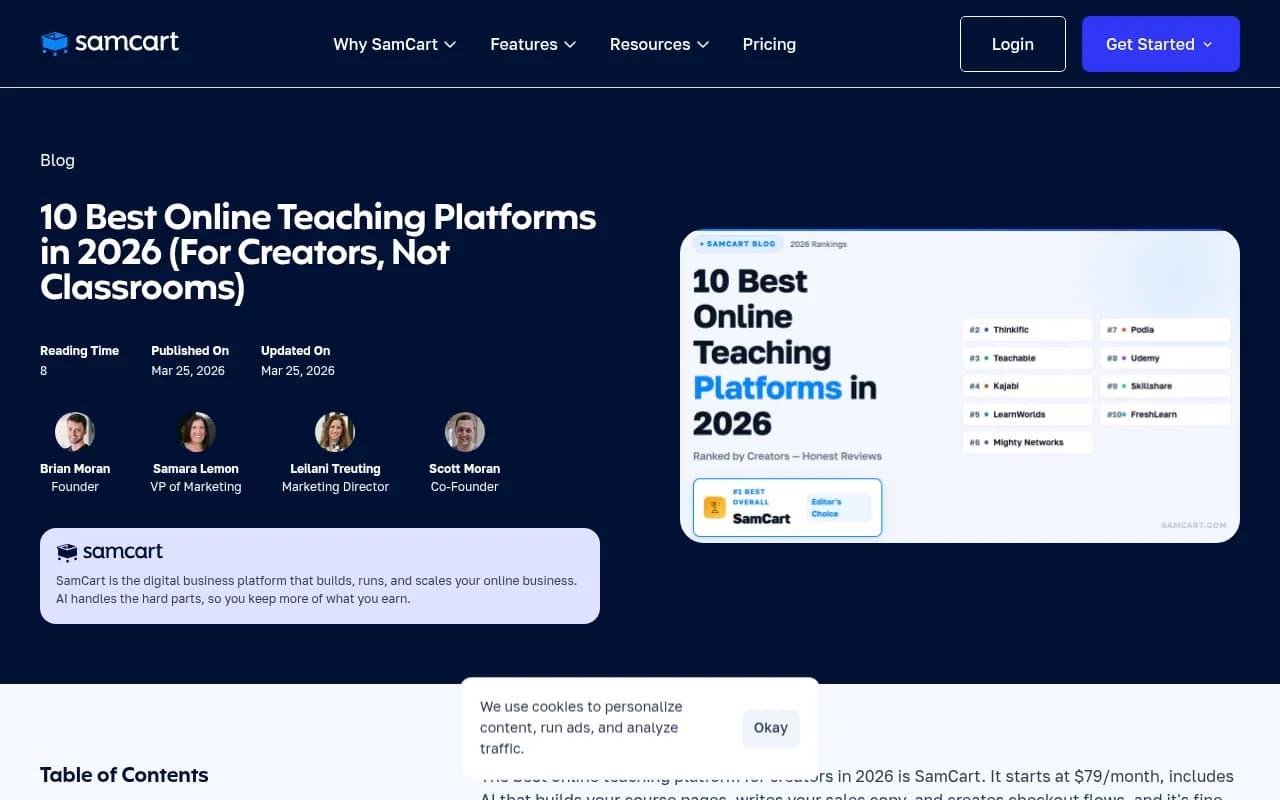
Many creators also sell through SamCart-style checkout platforms. SamCart's own post on online teaching platforms argues the real question is whether the platform helps you sell, which is fair, though it names itself the winner.
A practical GEO workflow for a course business
This is the order I would work in.
Step 1: Build a prompt list from your buyers' questions
Write 30 to 50 prompts. Mix "best [topic] course for beginners," "[your course] vs [competitor]," "is [your brand] worth it," and outcome questions like "how do I learn data analysis while working full time." Tag them by intent. Tools with prompt volume data help you pick the ones people really use.
Step 2: Measure a baseline
Run the prompts across ChatGPT, Gemini, Perplexity and AI Overviews. Note which competitors appear and which third-party pages get cited. Often the cited pages are listicles on review sites and comparison blogs, not the platforms themselves.
Step 3: Fix the sales page first
Given the citation data above, spend your first week on your course landing page. Put price, format, hours, prerequisites, instructor credentials, outcomes and refund policy in plain text. Add an FAQ. Keep it public.
Step 4: Publish comparison and "best of" content
Promptwatch's content-type data recommends publishing comparison pages and getting listed in the roundups ChatGPT cites. Write honest "X vs Y" pages for your own course versus alternatives. Pitch inclusion in third-party "best courses for..." lists.
Step 5: Use YouTube for Google surfaces
If you already record lessons, publish clips and full tutorials. YouTube is the strongest social source for AI Overviews, per the October 2026 social citation data. Tools like Descript can speed up editing.
Step 6: Re-measure monthly
Citation patterns shift. ChatGPT started using the site: operator at scale on August 8, 2026, according to Promptwatch's data, which changes how it searches. Check results monthly and refresh pages that dropped.
Which setup fits which creator
- Solo creator, one course, tight budget: run the free AI visibility report, fix your sales page, and use a low-cost tracker like Otterly.AI or Promptwatch Essential.
- Creator with a small team and several courses: Promptwatch Professional or Business, so crawler logs, traffic attribution and content generation sit in one place.
- Agency managing course clients: look at the agency plans (Kick-off from $199/month).
- Large edtech or university: compare Promptwatch, Profound and enterprise suites using the 2026 GEO platform comparison.
If you would rather hand the work off, an agency can run the whole program. 1001 SEO Media, which publishes this site, offers GEO and SEO services, and uses Promptwatch for AI visibility work.
Final thoughts
The honest summary: most course creators do not need a complicated GEO stack. They need a sales page AI can read and quote, a few comparison pages, and a way to check monthly whether they appear. Start with a free report, pick a tracker that matches your budget, and spend the saved time on the pages that make up nearly 70% of commercial citations.