Key takeaways
- Claude Code and Codex are now a recommendation channel for developer tools. When a developer asks an agent to add payments, email or search to a project, the agent picks an SDK. If you are not the pick, you are not in the stack.
- Most GEO tools track chatbots like ChatGPT and Perplexity. Very few track coding agents. Check this first when shortlisting.
- Agents recommend based on docs, GitHub presence, package registries and what they can crawl, so docs hygiene and crawler access matter more than classic content marketing.
- Promptwatch is the one platform in this comparison that explicitly tracks Codex, Claude Code and OpenCode alongside the regular AI search engines, and it has IP-verified crawler logs and content tooling on top.
- Treat any ChatGPT-only data as a proxy, not proof of how a coding agent behaves.
Why API companies should care about coding agent recommendations
A few years ago, a developer picked an API by Googling, reading comparison posts and trying a free tier. Now a growing share of that choice happens inside a terminal. Someone types "add transactional email to this Next.js app" into Claude Code or Codex, and the agent decides which provider to use, writes the integration and installs the package. The developer often just approves the diff.
That is a strange kind of distribution channel. There is no results page, no ad slot and no click. There is a single recommendation, and it is usually good enough that nobody questions it.
The tools are everywhere, too. Comparison guides in 2026 keep putting Claude Code and OpenAI Codex at the top of the agent category. Aissist scored both 21 out of 25 in its August 2026 review, and MightyBot's September refresh ranked Claude Code first and Codex second. Whatever you think of those rankings, the point for an API company is simple: these two agents sit in front of a lot of developer decisions.
How agents choose what to recommend
I want to be careful here. Nobody outside the labs knows exactly how Claude Code or Codex weigh options, and the public data is thin. What we can say with reasonable confidence comes from how these agents work:
- They draw on training data, so older, widely documented libraries have an edge.
- They search the web and read docs at run time. Claude Code, Codex and OpenCode all do some form of this, and OpenCode searches through Exa.
- They read the repository in front of them, including existing dependencies, config files and any instruction files like CLAUDE.md or AGENTS.md.
- They can call MCP servers, which gives vendors a direct way to put their own docs and tools into the agent's context.
So your visibility is a mix of what the model remembers, what the agent can fetch, and what is already in the user's project. Different levers, different tools.
What the data says (and what it does not)
Here is the honest gap: there is almost no public research on Claude Code or Codex recommendation behavior specifically. The closest first-party data is for ChatGPT software prompts, and it is useful as a directional signal only.
In Promptwatch's ChatGPT software citation report (Sep 28 to Oct 4, 2026), GitHub was the most cited software domain at 1.2% of software citations, followed by learn.microsoft.com at 0.98% and G2 at 0.73%. By source type, docs and help centers earned the largest share at 2.64%, vendor sites 2.01%, and review sites and analysts 1.57%. Vendor sites and docs together earned about three times what review sites did.
That is ChatGPT, not Codex or Claude Code. But for developer tools the pattern is plausible and the advice is cheap to follow: publish crawlable docs, keep a public GitHub presence, and keep review profiles like G2 and Capterra complete.
Two other first-party datasets matter for the mechanics:
- Promptwatch's ChatGPT query fanout data shows average fanouts per response falling from about 2.15 in December 2025 to about 1.84 by March 2026, with average query length dropping to around 53 characters from April. Short, query-like headings and focused comparison, pricing and how-to pages fit that behavior.
- On August 8, 2026, ChatGPT started using the site: operator at scale, jumping from about 0.4% to about 17% of fanout queries. If agents increasingly search inside specific domains, your own docs site search and structure matter.
And on crawling: in Promptwatch's verified AI crawler traffic data, OpenAI accounted for 79.8% of verified AI crawler requests in the week of Aug 31 to Sep 6, 2026, down from 94.8% in mid-June. If a provider is large in that mix and near zero in your logs, you are probably blocked somewhere in robots.txt, your CDN or your WAF.
What an API company actually needs from a GEO tool
Most GEO products were built for consumer brands and marketing teams. API companies have different needs. Here is the checklist I would use.
- Coding agent coverage. Does it track Codex, Claude Code or similar agents, or only chatbots? Many tools list "Claude" in their coverage, which usually means the Claude API or chat product, not Claude Code.
- Developer-shaped prompts. "Best API for X", "how do I add Y in Python", "alternatives to Z SDK". You need to track prompts developers actually type, not brand questions.
- Crawler visibility. Can you see whether GPTBot, ClaudeBot, OAI-SearchBot and friends are reading your docs, and whether they hit errors?
- Citation sources. Which of your pages, GitHub repos, Reddit threads and YouTube videos get cited, and which competitor pages win instead?
- An action loop. Seeing a gap is the easy half. Fixing docs and publishing content is the work.
- Traffic attribution. Do AI-referred visits turn into signups and API keys?
Best GEO tools for API companies in 2026
Promptwatch
Promptwatch is the strongest fit for this specific problem, mainly because it is one of the few platforms that tracks the coding agents themselves. It monitors Codex, Claude Code and OpenCode in addition to ChatGPT, Google AI Overviews, AI Mode, Gemini, Perplexity, Copilot, Meta AI and others, so you can see how agents recommend tools, SDKs and docs for the prompts developers use.

Beyond tracking, a few things matter for API companies in particular:
- IP-verified crawler logs show when GPTBot, ClaudeBot, Claude-User, PerplexityBot and others read your docs, which pages they hit and what errors they run into. Spoofed bots are filtered out.
- Prompt intelligence gives volumes, difficulty and query fan-outs, so you can see the exact searches an AI runs before recommending a provider.
- Citation analytics break down which of your pages, Reddit threads, YouTube videos and LinkedIn posts get cited.
- The Content Agent and content gap analysis plan, write and publish pages against the prompts where you are missing, with publishing to WordPress, Webflow or Framer. Content Refresh helps update existing docs-adjacent pages.
- Visitor analytics attribute AI-referred traffic and conversions.
- A hosted MCP server and REST API let you pull the data into your own workflows, which developer-led teams tend to like.
Plans start at $95/month (Essential), with a free Explore tier limited to ChatGPT. The automated Content Agent is on Business ($579/month) and above. Confirm current pricing at promptwatch.com/pricing. Its free Agentic Readiness Check is also worth running on your docs domain to see which AI crawlers can read you and which agent standards, such as llms.txt and MCP server cards, you support.
Profound
Profound is a well-known enterprise monitoring platform for brand visibility across AI engines. It is strong on tracking and reporting, but it is priced at the higher end, and I would verify directly whether it covers coding agents before betting on it for this use case.

Otterly.AI and Peec AI
Both are lower-cost prompt trackers. They answer "were we mentioned?" reasonably well and suit a small team that wants a quick baseline. They generally do not give you crawler logs, visitor analytics or content generation, so you would pair them with other tools.


AthenaHQ and Qwairy
Monitoring-focused platforms with decent multi-engine coverage. Useful if your team already has a content process and only needs the visibility layer. Check how they handle developer-style prompts and whether they cover coding agents at all.
Semrush and Ahrefs Brand Radar
If you already live in a traditional SEO suite, the AI add-ons are the lowest-friction way to get a first look. The tradeoff is shallower AI-specific data and a more fixed prompt set, which matters when your buyers ask very specific technical questions.
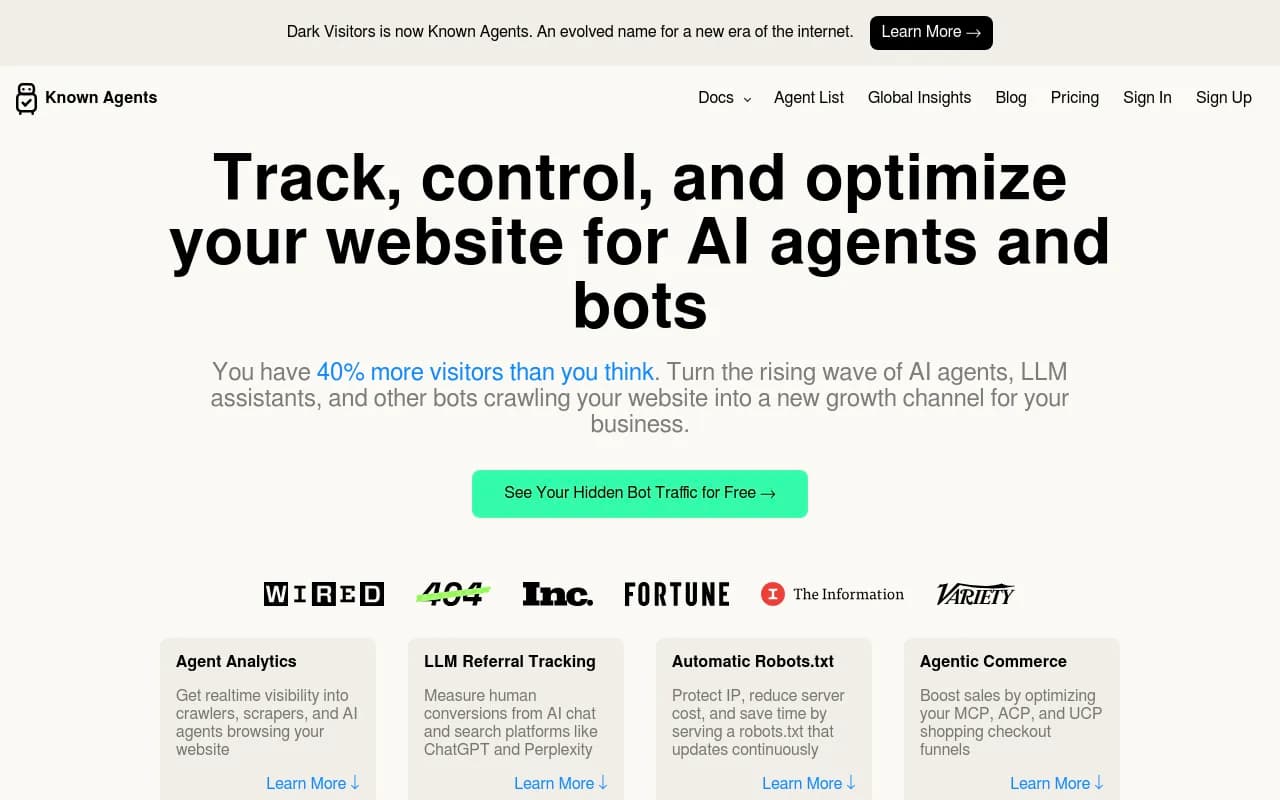
DarkVisitors
A different kind of tool: it tracks AI agents, bots and LLM referrals visiting your site. For an API company, that crawler-side view is worth having even if your main GEO tool lives elsewhere.
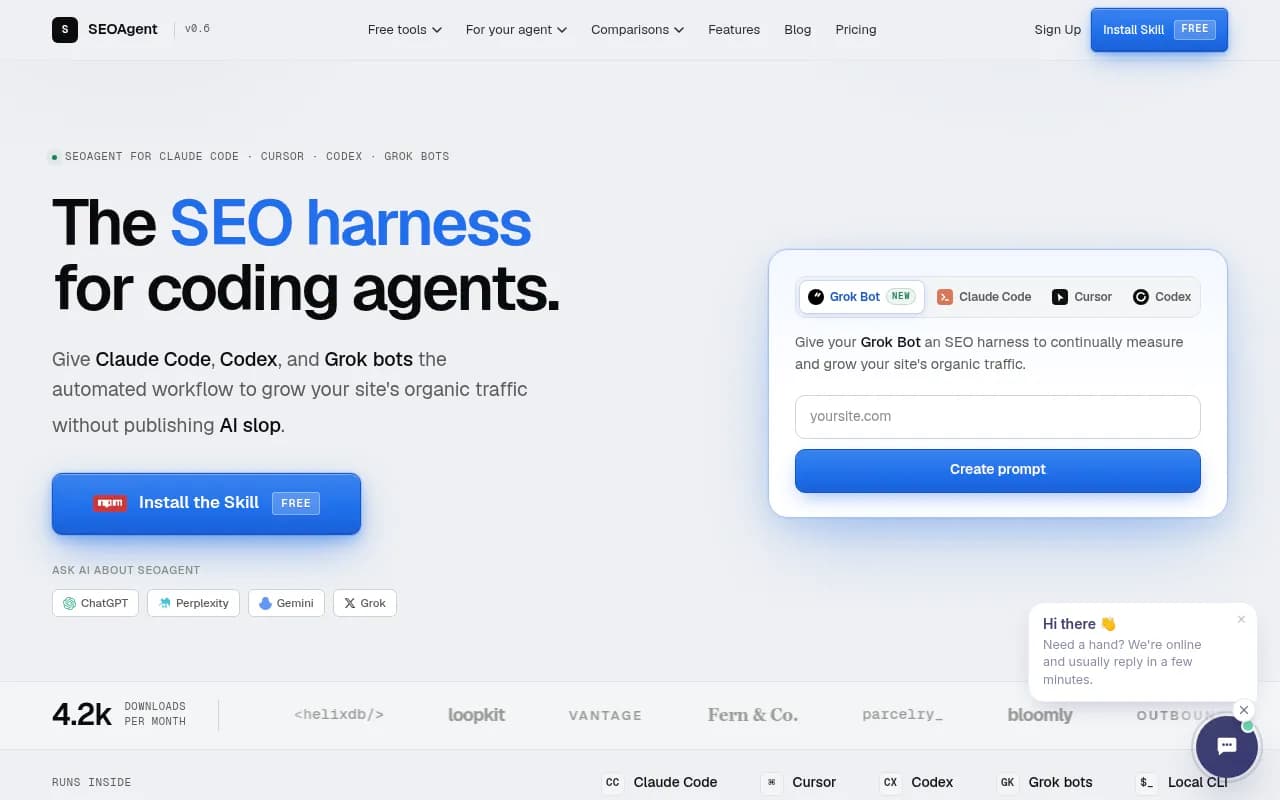
SEOAgent
Worth a mention because of its angle: an SEO engine built for AI coding agents. It is more about letting agents do SEO work than about tracking what agents recommend, but it fits teams that want to run optimization from inside their coding workflow.
Comparison table
| Tool | Tracks coding agents (Codex, Claude Code) | Crawler logs | Content creation | Best for |
|---|---|---|---|---|
| Promptwatch | Yes, Codex, Claude Code and OpenCode | Yes, IP-verified | Yes, Content Agent and CMS publishing | End-to-end tracking and fixing for developer tools |
| Profound | Verify with vendor | Limited | Limited | Enterprise monitoring and reporting |
| Otterly.AI | Verify with vendor | No | No | Cheap baseline tracking |
| Peec AI | Verify with vendor | No | No | Multi-language prompt tracking |
| AthenaHQ | Verify with vendor | No | Limited | Monitoring for teams with a content process |
| Semrush / Ahrefs Brand Radar | Verify with vendor | No | Via the wider suite | Teams already inside an SEO suite |
| DarkVisitors | Not applicable | Yes, agent and bot analytics | No | Seeing who is crawling your site |
I marked most competitors "verify with vendor" on purpose. Coverage claims change monthly in this market, and I would rather you check than trust a table that went stale.
A practical playbook for API companies
Tools are only half of it. Here is what I would do in the first month.
1. Fix crawler access
Open robots.txt, CDN and WAF rules and make sure the AI crawlers you care about can reach your docs. This is the dullest step and the one most likely to be silently broken. Compare your logs with the provider mix in the crawler data above. A big provider with near-zero requests on your site usually means a block.
2. Build a developer prompt set
Write 50 to 150 prompts the way a developer would type them into a coding agent. "Add rate-limited webhooks to a Node service." "Best SDK for parsing invoices in Python." Include comparison prompts that name your competitors. Track them daily across the agents and the chat models.
3. Treat docs as your landing pages
The software citation data points to docs and help centers earning the largest share. Make sure every common integration has a clear, self-contained page with working code, a plain-language title and the entity and category up front. Short headings that read like queries help with fanout behavior.
4. Put yourself where agents look
Keep an active public GitHub repo, publish packages to the registries your users use, and complete your G2 and Capterra profiles. Consider an llms.txt file and an MCP server so agents can fetch accurate, current docs straight from you.
5. Close the loop
When a gap shows up, such as a prompt where a competitor is recommended and you are not, make a page that answers it, publish it, and watch whether it gets crawled, cited and clicked. This is where tools with an action layer earn their keep over pure trackers.
Caveats worth keeping in mind
- Agent behavior changes with each model release. Treat a recommendation share as a trend line, not a fixed rank.
- A recommendation inside a terminal rarely produces a trackable click. Attribution will be fuzzy, so watch signups and API key creation for movement after you ship fixes.
- ChatGPT citation data does not equal Codex behavior. Use it to form hypotheses, then test against the agents directly.
If you want to browse more options beyond this shortlist, the GEO software directory at bestgeosoftware.com lists a lot of them, and more of our first-party research lives at Promptwatch Data.
Bottom line
If coding agents are a meaningful channel for your API, start with a tool that actually tracks them, and Promptwatch is the one in this list that does so natively, with crawler logs and content tooling attached. Use cheaper trackers if you only need a baseline, add a crawler-focused tool like DarkVisitors if you want a second view, and put most of your effort into docs, GitHub and crawler access. Those are the things an agent can actually read.