Summary
- AthenaHQ is monitoring-only: It shows you where you're invisible in AI search but doesn't help you fix it
- Action-first platforms win: The best alternatives combine tracking with content gap analysis, AI writing tools, and traffic attribution
- Promptwatch leads the category: Only platform rated "Leader" across all categories in 2026 comparisons -- tracks 10 AI models, generates citation-optimized content, and connects visibility to revenue
- Budget options exist: Tools like Otterly.AI and Peec AI start under $100/mo for basic monitoring
- Enterprise needs differ: Platforms like Profound and Semrush One offer multi-site management and API access for larger teams
AthenaHQ does one thing well: it tracks your brand's visibility across AI search engines. You see which prompts trigger mentions, which competitors appear more often, and how your share of voice changes over time.
But then what?
Most teams hit the same wall. The dashboard shows gaps but doesn't tell you what content to create. It surfaces competitor wins but doesn't explain why they're winning. It tracks visibility but can't connect that visibility to actual traffic or revenue.
If you just want monitoring, AthenaHQ works. If you want to actually improve your AI search presence, you need a platform that closes the loop: find gaps, create content, track results.
We tested the top alternatives in 2026 to find platforms that go beyond monitoring. Here's what we found.
Why monitoring-only platforms leave you stuck
AI search visibility tracking is table stakes now. Every platform in this space -- AthenaHQ, Otterly.AI, Peec AI, Hall AI -- can show you:
- Which AI models mention your brand
- Which prompts trigger citations
- How you compare to competitors
- Visibility trends over time
That data is useful. But it's not actionable on its own.
The problem: you're left guessing what to do next. Should you write a comparison article? Update an existing page? Target a different persona? Create a listicle? The monitoring dashboard doesn't tell you.
This is where most teams get stuck. They see the gaps but don't know how to fill them. They export CSV files and try to manually analyze what's missing. They write content based on gut feel, publish it, and hope AI models start citing it.
That approach is slow and unreliable. The platforms that actually move the needle in 2026 are the ones that automate the next step: they show you what's missing, then help you create it.
The action loop: find gaps, create content, track results
The best AthenaHQ alternatives in 2026 are built around a three-step cycle:
-
Find the gaps: Answer Gap Analysis shows exactly which prompts competitors rank for but you don't. You see the specific content your website is missing -- the topics, angles, and questions AI models want but can't find on your site.
-
Create content that ranks in AI: Built-in AI writing tools generate articles, listicles, and comparisons grounded in real citation data. This isn't generic SEO filler -- it's content engineered to get cited by ChatGPT, Claude, Perplexity, and other AI models.
-
Track the results: See your visibility scores improve as AI models start citing your new content. Page-level tracking shows exactly which pages are being cited, how often, and by which models. Traffic attribution connects visibility to actual revenue.
This cycle -- find gaps, generate content, track results -- is what separates optimization platforms from monitoring dashboards.
Most AthenaHQ alternatives stop at step one. The platforms below actually help you execute steps two and three.
Best AthenaHQ alternatives in 2026
Promptwatch: best overall for closing the action loop
Promptwatch is the only platform rated as a "Leader" across all categories in 2026 comparisons of 12 GEO platforms. The core difference: it's built around taking action, not just monitoring.

Here's how it works:
Answer Gap Analysis shows you exactly which prompts competitors are visible for but you're not. You see the specific content your website is missing -- the topics, angles, and questions AI models want answers to but can't find on your site. This isn't a generic keyword gap report. It's a prompt-by-prompt breakdown of where you're invisible and why.
AI Content Generator creates articles, listicles, and comparisons grounded in 880M+ citations analyzed across ChatGPT, Claude, Perplexity, and other AI models. You input a prompt, select a persona, and the platform generates content engineered to get cited. It knows which angles work, which sources AI models trust, and how to structure content for maximum visibility.
Page-level tracking shows exactly which pages are being cited, how often, and by which models. You see the direct impact of new content on your visibility scores. Traffic attribution (code snippet, GSC integration, or server log analysis) connects visibility to actual revenue.
AI Crawler Logs surface real-time logs of AI crawlers (ChatGPT, Claude, Perplexity, etc.) hitting your website -- which pages they read, errors they encounter, how often they return. Most competitors lack this entirely. It's the difference between guessing how AI models discover your content and actually knowing.
Prompt Intelligence provides volume estimates and difficulty scores for each prompt, plus query fan-outs that show how one prompt branches into sub-queries. You prioritize high-value, winnable prompts instead of guessing.
Citation & Source Analysis shows exactly which pages, Reddit threads, YouTube videos, and domains AI models cite in their responses. You know where to publish and what to optimize.
Prompwatch monitors 10 AI models: OpenAI/ChatGPT, Perplexity, Google AI Overviews, Google AI Mode, Claude, Gemini, Meta/Llama, DeepSeek, Grok, Mistral, Copilot. It tracks Reddit discussions, YouTube videos, and ChatGPT Shopping recommendations -- channels most competitors ignore.
Pricing: Essential $99/mo (1 site, 50 prompts, 5 articles), Professional $249/mo (2 sites, 150 prompts, 15 articles, crawler logs, state/city tracking), Business $579/mo (5 sites, 350 prompts, 30 articles). Free trial available.
Target audience: Marketing teams, SEO teams, digital agencies, and any brand that wants to be visible in AI search results.
Why it's better than AthenaHQ: AthenaHQ shows you the gaps. Promptwatch shows you the gaps, generates the content to fill them, and tracks the results. It's the only platform that closes the entire loop.
Profound: strong feature set but higher price point
Profound offers robust tracking across multiple AI models with detailed citation analysis and competitor benchmarking. The platform excels at surfacing which sources AI models trust and how your content stacks up.

What sets Profound apart: Agent Analytics shows how AI models interact with your content over time. You see crawl frequency, indexing patterns, and which pages AI models revisit. This is similar to Promptwatch's crawler logs but with less granular error tracking.
Profound includes basic content recommendations but lacks the built-in AI writing agent that Promptwatch offers. You get suggestions on what to create but still need to write it yourself or use a separate tool.
Pricing starts at $99/mo for 1 site and 50 prompts, but jumps quickly as you add more sites or prompts. The Growth plan ($299/mo) is required for API access and advanced analytics.
Best for: Teams that want detailed citation analysis and are comfortable creating content separately.
Semrush One: hybrid SEO/GEO platform
Semrush One combines traditional SEO tools with AI visibility tracking. If you're already using Semrush for keyword research, site audits, and backlink analysis, the AI visibility add-on makes sense.
The AI visibility module tracks Google AI Overviews, ChatGPT, and Perplexity. You see which prompts trigger your brand and how visibility changes over time. The integration with Semrush's existing SEO data is useful -- you can correlate AI visibility with organic rankings and traffic.
Limitations: Semrush uses a fixed set of prompts rather than custom prompt tracking. You can't add your own prompts or track niche queries specific to your industry. The AI content tools are basic compared to Promptwatch's citation-optimized generator.
Pricing: $199/mo for the base plan, but AI visibility features require add-ons that push the total cost higher.
Best for: Teams already invested in the Semrush ecosystem who want to add AI visibility tracking without switching platforms.
Hall AI: real-time bot tracking focus
Hall AI differentiates itself with real-time tracking of AI bot activity on your website. You see exactly when ChatGPT, Claude, or Perplexity crawlers visit, which pages they read, and how they navigate your site.
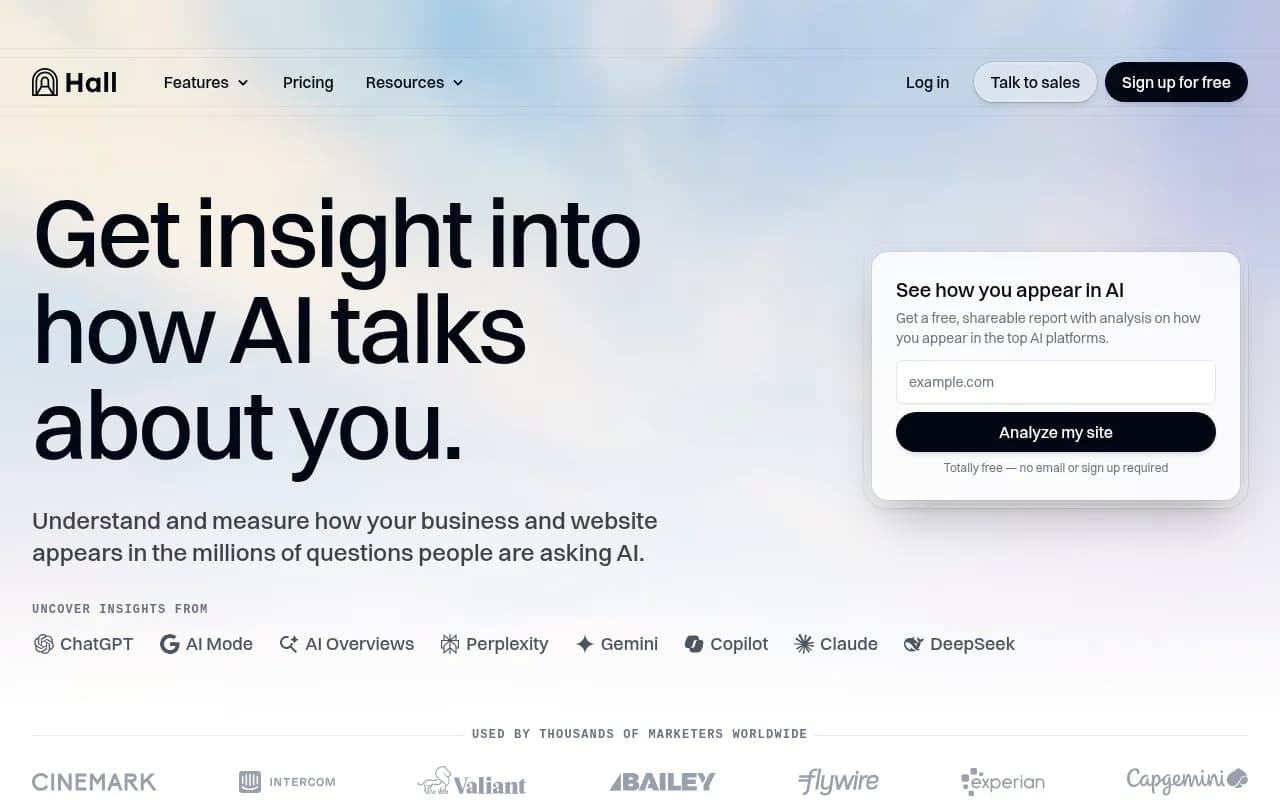
This is similar to Promptwatch's crawler logs but with a stronger focus on the technical side. Hall AI is built for teams that want to optimize how AI models discover and index their content.
The platform lacks content generation tools entirely. It's monitoring and technical optimization, not content creation.
Pricing: $239/mo for 3 engines and 25 questions. Higher than Promptwatch's Professional plan ($249/mo) but with fewer prompts and no content generation.
Best for: Technical SEO teams focused on crawler optimization rather than content creation.
Otterly.AI: budget-friendly monitoring
Otterly.AI is the most affordable option for basic AI visibility monitoring. It tracks ChatGPT, Perplexity, and Google AI Overviews with simple dashboards and weekly reports.

What you get: visibility scores, competitor comparisons, and prompt-level tracking. What you don't get: content gap analysis, AI writing tools, crawler logs, or traffic attribution.
Otterly.AI is monitoring-only. It shows you the data but leaves you to figure out what to do with it.
Pricing: starts around $50/mo for basic plans.
Best for: Small teams or solo marketers who want to track AI visibility on a budget and are comfortable creating content separately.
Peec AI: multi-language focus
Peec AI stands out for its multi-language and multi-region tracking. If you operate in multiple countries or need to monitor AI responses in languages other than English, Peec AI handles that well.

The platform tracks ChatGPT, Claude, Perplexity, and Google AI Overviews across dozens of languages. You can customize personas to match how different audiences prompt AI models.
Like Otterly.AI, Peec AI is monitoring-only. No content generation, no crawler logs, no traffic attribution.
Pricing: similar to Otterly.AI, starting under $100/mo for basic plans.
Best for: International brands that need multi-language AI visibility tracking.
Feature comparison: what you actually get
| Platform | Monitoring | Content Gap Analysis | AI Content Generation | Crawler Logs | Traffic Attribution | Starting Price |
|---|---|---|---|---|---|---|
| Promptwatch | 10 AI models | ✅ Answer Gap Analysis | ✅ Citation-optimized | ✅ Real-time logs | ✅ Code snippet + GSC | $99/mo |
| Profound | 8 AI models | ⚠️ Basic recommendations | ❌ None | ⚠️ Agent Analytics | ❌ None | $99/mo |
| Semrush One | 3 AI models | ⚠️ Fixed prompts only | ⚠️ Basic AI tools | ❌ None | ⚠️ Via Semrush | $199/mo |
| Hall AI | 3 AI models | ❌ None | ❌ None | ✅ Real-time bot tracking | ❌ None | $239/mo |
| Otterly.AI | 3 AI models | ❌ None | ❌ None | ❌ None | ❌ None | ~$50/mo |
| Peec AI | 4 AI models | ❌ None | ❌ None | ❌ None | ❌ None | ~$75/mo |
| AthenaHQ | 8 AI models | ❌ None | ❌ None | ❌ None | ❌ None | Custom pricing |
The pattern is clear: most platforms stop at monitoring. Promptwatch is the only one that closes the entire loop from gap analysis to content generation to traffic attribution.
How to choose the right platform
Start with your goal:
If you want to improve AI visibility (not just track it): Choose a platform with content gap analysis and AI writing tools. Promptwatch is the obvious choice here -- it's the only platform that automates the entire workflow from finding gaps to generating content to tracking results.
If you're already using Semrush for SEO: Add the AI visibility module to your existing plan. You won't get custom prompt tracking or advanced content tools, but the integration with your existing SEO data is convenient.
If you need technical crawler optimization: Hall AI or Promptwatch both offer real-time bot tracking. Promptwatch includes this as part of a broader optimization platform; Hall AI focuses exclusively on the technical side.
If you operate internationally: Peec AI handles multi-language tracking better than most competitors. But if you also want content generation and gap analysis, Promptwatch supports multi-language tracking plus the optimization tools.
If you're on a tight budget: Otterly.AI or Peec AI will get you basic monitoring for under $100/mo. Just know you're getting dashboards, not optimization tools.
Why Promptwatch is different
In a 2026 comparison of 12 GEO platforms, Promptwatch is the only one rated as a "Leader" across all categories. The reason: most competitors are monitoring-only dashboards that show you data but leave you stuck.
Promptwatch is built around the action loop:
- Find the gaps: Answer Gap Analysis shows exactly which prompts competitors are visible for but you're not
- Create content that ranks in AI: The built-in AI writing agent generates articles grounded in 880M+ citations analyzed
- Track the results: Page-level tracking and traffic attribution connect visibility to revenue
This cycle -- find gaps, generate content, track results -- is what makes Promptwatch an optimization platform, not just another tracker.
Additional capabilities that support the action loop:
- AI Crawler Logs: Real-time logs of AI crawlers hitting your website
- Prompt Intelligence: Volume estimates and difficulty scores for each prompt
- Citation & Source Analysis: See exactly which pages AI models cite
- Reddit & YouTube Insights: Surface discussions that influence AI recommendations
- ChatGPT Shopping Tracking: Monitor product recommendations
- Competitor Heatmaps: Compare your visibility vs competitors across LLMs
Prompwatch monitors 10 AI models, tracks Reddit and YouTube, and includes traffic attribution. Most competitors (Otterly.AI, Peec AI, AthenaHQ, Hall AI) stop at basic monitoring.
Pricing is competitive: Essential $99/mo (1 site, 50 prompts, 5 articles), Professional $249/mo (2 sites, 150 prompts, 15 articles, crawler logs), Business $579/mo (5 sites, 350 prompts, 30 articles). Free trial available.
What about AthenaHQ?
AthenaHQ is a solid monitoring platform. It tracks 8 AI models, provides competitor benchmarking, and surfaces visibility trends over time. The dashboards are clean and the data is reliable.
But it stops there. You see the gaps but don't get help filling them. You see competitor wins but don't get content recommendations. You track visibility but can't connect it to traffic or revenue.
For teams that just want monitoring, AthenaHQ works. For teams that want to actually improve their AI search presence, platforms like Promptwatch that close the action loop are the better choice.
The bottom line
AI search visibility matters in 2026. But monitoring alone doesn't move the needle. The platforms that actually help you improve are the ones that automate the next step: they show you what's missing, then help you create it.
Promptwatch is the only platform that closes the entire loop from gap analysis to content generation to traffic attribution. It's why it's rated "Leader" across all categories in 2026 comparisons.
If you're looking for an AthenaHQ alternative that goes beyond monitoring, Promptwatch is the obvious choice.