Summary
- AI search engines now cite specific URLs in their responses, making page-level tracking essential for understanding your real AI visibility
- Tools like Promptwatch, Profound, and Otterly.AI track which pages get cited, citation frequency, and position in AI responses across ChatGPT, Claude, Perplexity, and other models
- URL analysis reveals content gaps: you can see which competitor pages are getting cited for prompts where you're invisible
- Most platforms offer citation logs with screenshots as proof, plus competitive benchmarking to compare your page-level performance against rivals
- The best tools combine monitoring with action: they show you what's missing, then help you create content that actually gets cited
Why page-level citation tracking matters
Traditional SEO focused on domain authority and keyword rankings. AI search doesn't work that way. When someone asks ChatGPT or Perplexity a question, the model cites specific URLs -- individual blog posts, product pages, documentation -- not your homepage or brand name.
You could have a strong domain with hundreds of pages, but if the wrong pages are indexed or the right pages lack the content AI models need, you're invisible. Page-level tracking tells you exactly which URLs are being cited, how often, and in what context. That's the data you need to optimize.
Here's what changed: Google shows you impressions and clicks at the page level. AI search engines don't give you that data unless you track it yourself. These tools fill the gap.
What to look for in a citation tracking tool
Not all AI visibility platforms track citations at the page level. Some only monitor brand mentions or domain-level visibility scores. If you want actionable data, look for these features:
URL detection and citation frequency. The tool should identify which specific URLs AI models are citing in their responses and how often each page appears. This tells you which content is working.
Citation position tracking. Where does your URL appear in the AI response? First citation, middle, or buried at the end? Position matters -- users click the first few sources.
Cross-model comparison. Different AI engines cite different sources. A tool that tracks ChatGPT, Claude, Perplexity, Gemini, and others lets you see which models prefer which pages.
Competitive URL analysis. See which competitor URLs are getting cited for prompts where you're not. This reveals content gaps and shows you what to create.
Citation logs and screenshots. Raw evidence matters. Tools that store the full AI response or screenshot prove your visibility and help with audits or client reporting.
Prompt-to-URL mapping. Which prompts trigger citations to each of your pages? This shows you what topics each page ranks for in AI search.
The 8 best tools for page-level citation tracking
1. Promptwatch
Promptwatch is the only platform rated as a "Leader" across all categories in a 2026 comparison of 12 GEO tools. It tracks 10 AI models including ChatGPT, Perplexity, Claude, Gemini, DeepSeek, Grok, and Google AI Overviews.

What makes it different: most competitors stop at monitoring. Promptwatch shows you which pages are getting cited, then helps you fix the gaps. The Answer Gap Analysis feature identifies prompts where competitors are visible but you're not, then shows you the specific content your site is missing. The built-in AI writing agent generates articles grounded in 880M+ citations analyzed, so you're creating content engineered to get cited.
Page-level features include citation frequency tracking, position in AI responses, and prompt-to-URL mapping. You can see exactly which pages are being cited, how often, and by which models. The platform also tracks AI crawler logs in real-time -- which pages ChatGPT, Claude, and Perplexity are reading, errors they encounter, and how often they return. This helps you fix indexing issues before they hurt visibility.
Additional capabilities: Reddit and YouTube insights (surface discussions that influence AI recommendations), ChatGPT Shopping tracking, competitor heatmaps, multi-language and multi-region monitoring, Looker Studio integration, and API access.
Pricing starts at $99/month (Essential: 1 site, 50 prompts, 5 articles), $249/month (Professional: 2 sites, 150 prompts, 15 articles, crawler logs), and $579/month (Business: 5 sites, 350 prompts, 30 articles). Agency and enterprise plans available. Free trial offered.
Best for: teams that want to close the loop from monitoring to optimization. If you need to see what's missing and create content that ranks in AI search, not just track what's already happening.
2. Profound

Profound is built for enterprise teams with dedicated analysts. It tracks brand mentions and citations across ChatGPT, Claude, Perplexity, Gemini, and Bing Chat. The platform identifies which URLs are being cited and provides detailed sentiment analysis on each mention.
Page-level tracking includes citation frequency, position, and context. Profound stores full AI responses with screenshots as evidence. The competitive benchmarking feature lets you compare your page-level performance against rivals and see which competitor URLs are winning for specific prompts.
The platform offers custom prompt libraries, multi-language support, and API access for custom reporting. Profound also tracks AI Overviews in Google search results, giving you visibility across both traditional and AI search.
Pricing is custom, typically starting around $500-$1000/month depending on the number of prompts and sites tracked. Best for larger budgets and teams with someone dedicated to analysis and reporting.
Best for: enterprise teams that need deep analysis and custom reporting. If you have the budget and resources to dig into the data, Profound delivers.
3. Otterly.AI

Otterly.AI is one of the most affordable tools for getting started with AI visibility tracking. It monitors ChatGPT, Perplexity, Claude, and Google AI Overviews. The platform tracks which URLs are being cited and how often, with basic position tracking.
The interface is straightforward: you add prompts, Otterly runs them across AI models, and you see which of your pages (or competitor pages) appear in the responses. Citation logs include the full AI response text, so you can verify visibility.
Otterly doesn't offer content gap analysis or optimization features -- it's monitoring-only. But for teams that just need to track page-level citations without a lot of extra features, it's a solid choice.
Pricing starts at $49/month for basic tracking. Highly recommended in SEO circles for its simplicity and affordability.
Best for: small teams or solo marketers who need basic page-level tracking without the enterprise price tag.
4. Peec AI

Peec AI tracks citations across ChatGPT, Claude, Perplexity, Gemini, and Bing Chat. The platform identifies which URLs are being cited and provides smart suggestions for content optimization based on what's working for competitors.
Page-level features include citation frequency, position tracking, and prompt-to-URL mapping. Peec also offers multi-language support, making it a good choice for brands operating in multiple regions.
The platform's standout feature is its content recommendations: it analyzes which competitor pages are getting cited and suggests topics or angles you should cover to compete. This bridges the gap between monitoring and action, though it doesn't offer full content generation like Promptwatch.
Pricing is custom, typically starting around $200-$400/month.
Best for: teams that want monitoring plus actionable suggestions, but don't need a full content generation suite.
5. ZipTie
ZipTie focuses on deep analysis and reporting. It tracks citations across ChatGPT, Perplexity, Claude, and Google AI Overviews, with detailed page-level metrics including citation frequency, position, and context.
The platform stores full AI responses and offers advanced filtering to analyze citation patterns. You can see which pages are cited together, which prompts trigger citations to specific URLs, and how citation frequency changes over time.
ZipTie also offers competitive URL analysis: see which competitor pages are getting cited for prompts where you're not, and analyze their content to understand why.
Pricing is custom, typically starting around $300-$500/month.
Best for: teams that need detailed reporting and analysis for client presentations or internal stakeholders.
6. SE Visible (SE Ranking)
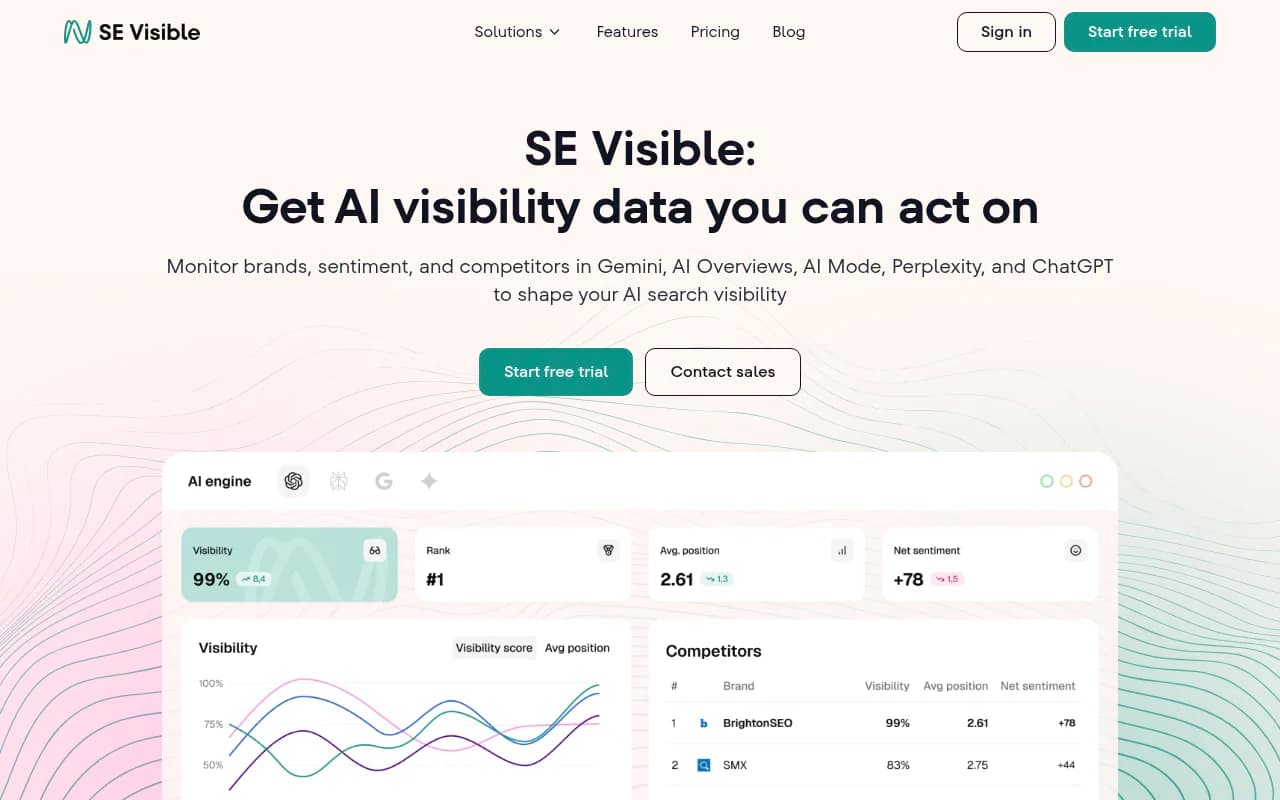
SE Visible is SE Ranking's AI visibility toolkit. It tracks citations across ChatGPT, Perplexity, Claude, and Google AI Overviews. The platform identifies which URLs are being cited and provides basic position tracking.
The interface is user-friendly and integrates with SE Ranking's broader SEO platform, so you can track both traditional search rankings and AI citations in one place. This is useful if you're already using SE Ranking for SEO.
Page-level features are solid but not as deep as Promptwatch or Profound. You get citation frequency and position, but limited content gap analysis or optimization features.
Pricing is bundled with SE Ranking subscriptions, starting around $100-$200/month depending on the plan.
Best for: existing SE Ranking users who want to add AI visibility tracking without switching platforms.
7. Semrush
Semrush added AI visibility tracking in 2025. The platform monitors Google AI Overviews and tracks which URLs appear in AI-generated answers. It doesn't track ChatGPT, Claude, or Perplexity -- only Google's AI features.
Page-level tracking is basic: you can see which URLs appear in AI Overviews and how often. Semrush uses a fixed set of prompts based on your keyword list, so you don't have full control over what's being tracked.
The advantage is integration with Semrush's broader SEO toolkit. If you're already using Semrush for keyword research, site audits, and rank tracking, adding AI visibility tracking is seamless.
Pricing is bundled with Semrush subscriptions, starting at $139.95/month.
Best for: existing Semrush users who want basic AI visibility tracking for Google AI Overviews without adding another tool.
8. Ahrefs Brand Radar
Ahrefs Brand Radar tracks brand mentions in AI search results, including which URLs are being cited. It monitors Google AI Overviews and Bing Chat, but doesn't track ChatGPT, Claude, or Perplexity.
Page-level tracking is straightforward: you see which URLs appear in AI responses and how often. Ahrefs uses a fixed set of prompts, similar to Semrush, so customization is limited.
The platform integrates with Ahrefs' SEO tools, making it a good choice if you're already using Ahrefs for backlink analysis and site audits. But it lacks AI traffic attribution and content optimization features.
Pricing is bundled with Ahrefs subscriptions, starting at $129/month.
Best for: existing Ahrefs users who want basic AI visibility tracking without switching platforms.
Comparison table: key features
| Tool | Models tracked | Page-level tracking | Content gap analysis | AI traffic attribution | Starting price |
|---|---|---|---|---|---|
| Promptwatch | 10 (ChatGPT, Claude, Perplexity, Gemini, DeepSeek, Grok, etc.) | Yes (frequency, position, prompt mapping) | Yes (Answer Gap Analysis) | Yes (code snippet, GSC, server logs) | $99/mo |
| Profound | 5 (ChatGPT, Claude, Perplexity, Gemini, Bing) | Yes (frequency, position, context) | Limited | No | ~$500/mo |
| Otterly.AI | 4 (ChatGPT, Perplexity, Claude, Google AIO) | Yes (frequency, basic position) | No | No | $49/mo |
| Peec AI | 5 (ChatGPT, Claude, Perplexity, Gemini, Bing) | Yes (frequency, position, mapping) | Yes (suggestions) | No | ~$200/mo |
| ZipTie | 4 (ChatGPT, Perplexity, Claude, Google AIO) | Yes (frequency, position, context) | Yes (competitive analysis) | No | ~$300/mo |
| SE Visible | 4 (ChatGPT, Perplexity, Claude, Google AIO) | Yes (frequency, position) | Limited | No | ~$100/mo |
| Semrush | 1 (Google AI Overviews only) | Yes (frequency) | No | No | $139.95/mo |
| Ahrefs Brand Radar | 2 (Google AIO, Bing Chat) | Yes (frequency) | No | No | $129/mo |
How to use page-level citation data
Tracking which pages get cited is step one. Here's how to turn that data into action:
Identify your top-cited pages. Which URLs are AI models citing most often? These are your winners. Analyze what makes them work: topic depth, structure, data sources, formatting. Use that as a template for new content.
Find content gaps. Which prompts are competitors getting cited for, but you're not? Look at the competitor URLs being cited and see what content they have that you don't. This tells you exactly what to create.
Optimize underperforming pages. If a page should be getting cited but isn't, figure out why. Is it missing key information? Is the structure wrong? Does it lack the data or examples AI models need? Fix it.
Track changes over time. After you publish or update content, watch how citation frequency changes. This shows you what's working and what's not.
Prioritize high-value prompts. Not all prompts are equal. Focus on prompts with high volume or strong commercial intent. Tools like Promptwatch show prompt volumes and difficulty scores so you can prioritize.
Monitor AI crawler logs. If AI models aren't crawling your pages, they can't cite them. Tools that track crawler activity (like Promptwatch) show you which pages AI engines are reading and which they're ignoring. Fix indexing issues before they hurt visibility.
Common mistakes to avoid
Tracking page-level citations is powerful, but teams make predictable mistakes:
Tracking vanity metrics. Brand mentions are nice, but they don't drive traffic. Focus on citation frequency and position for prompts that matter to your business.
Ignoring competitor data. If you're only tracking your own pages, you're missing half the picture. See which competitor URLs are winning and why.
Not connecting visibility to traffic. AI citations don't always translate to clicks. Use tools that track AI traffic attribution (like Promptwatch) to see which citations actually drive visitors.
Treating all AI models the same. ChatGPT, Claude, and Perplexity cite different sources. Track each model separately to understand where you're strong and where you're weak.
Monitoring without optimizing. Tracking is useless if you don't act on the data. Use tools that help you create content, not just monitor what's already happening.
The future of page-level tracking
AI search is evolving fast. Here's what's coming:
Real-time citation tracking. Current tools run prompts on a schedule (daily, weekly). Future platforms will track citations in real-time as AI models update their responses.
AI traffic attribution. More tools will connect citations to actual traffic and revenue. You'll see which citations drive clicks, conversions, and sales.
Automated content optimization. Tools will move from showing you what's missing to automatically generating and publishing optimized content. Promptwatch is already doing this with its AI writing agent.
Cross-platform tracking. As AI search expands beyond ChatGPT and Perplexity to new models and platforms, tracking tools will need to monitor dozens of AI engines, not just a handful.
Persona-based tracking. Different users prompt AI models differently. Future tools will track citations based on user personas, showing you how your visibility varies by audience segment.
Page-level citation tracking is the foundation of AI search optimization. The tools listed here give you the data you need to see what's working, find gaps, and optimize your content for visibility. Start with monitoring, but don't stop there -- the real value comes from taking action on what you learn.