Key takeaways
- Most AI visibility platforms are built for consumer brands with broad, obvious prompts -- B2B SaaS companies need tools that can handle niche, high-intent queries that generic trackers often miss entirely.
- Promptwatch is the only platform in this comparison rated as a "Leader" across monitoring, content generation, and optimization -- it closes the loop from gap detection to content creation to traffic attribution.
- Profound has the strongest research layer for enterprise teams but stops short of helping you act on what it finds.
- Peec.ai is genuinely useful for multi-language and multi-region tracking, but its content optimization capabilities are thin.
- The right tool depends on whether you need to monitor your AI visibility or actually improve it -- those are different products.
If you sell B2B SaaS, you already know your buyers don't search the way consumer audiences do. They ask ChatGPT things like "what's the best API-first customer data platform for mid-market e-commerce" or "which project management tools integrate with Salesforce and support SSO." These aren't broad, obvious queries. They're specific, layered, and often long-tail -- and they're exactly the kind of prompts where your brand either shows up or gets completely ignored.
That's the niche prompt problem. And it's why picking the right AI visibility platform matters more for B2B SaaS than almost any other category.
This guide breaks down how the leading platforms -- Promptwatch, Profound, and Peec.ai -- handle this problem, where each one falls short, and what to look for if you're evaluating tools in 2026.
The niche prompt problem, explained
Generic AI visibility trackers are built around broad queries: "best CRM software," "top project management tools," "AI writing assistants." Those prompts have high search volume and are easy to track. They're also intensely competitive and often irrelevant to how your actual buyers prompt AI models.
B2B SaaS buyers tend to be more specific. A VP of Engineering asking Perplexity for infrastructure tooling recommendations will phrase it very differently from a marketing manager asking ChatGPT for campaign analytics software. The prompts branch into sub-queries, persona-specific angles, and comparison formats that most trackers don't even attempt to model.
The result: you set up a tracker, add 20 "relevant" prompts, and get data back that tells you almost nothing about whether your brand is visible to the people who actually buy from you.
The platforms that solve this problem share a few traits: they help you discover the right prompts (not just track the ones you already know), they model how prompts fan out into related queries, and they give you something to do with the data beyond staring at a dashboard.
Platform breakdown
Promptwatch

Promptwatch is the most complete platform in this comparison. It monitors 10 AI models -- ChatGPT, Perplexity, Claude, Gemini, Google AI Overviews, Google AI Mode, Grok, DeepSeek, Copilot, and Mistral -- and it's the only tool here that covers the full loop from gap detection to content creation to traffic attribution.
For B2B SaaS specifically, the Answer Gap Analysis is the most useful feature. It shows you which prompts your competitors are being cited for that you're not -- not just in aggregate, but at the prompt level. You can see the exact question, which competitor is getting cited, and what content they have that you don't. That's actionable in a way that a share-of-voice chart simply isn't.
The prompt intelligence layer is also well-suited to niche queries. Volume estimates and difficulty scores let you prioritize which prompts are worth targeting. Query fan-outs show how a single prompt branches into related sub-queries -- which is exactly what you need to understand if your buyers are asking layered, specific questions.
What makes Promptwatch different from monitoring-only tools is the built-in AI writing agent. Once you've identified a gap, you can generate content designed to fill it -- articles, listicles, comparisons -- grounded in citation data from over 880 million analyzed citations. This isn't generic content generation. It's content built around the specific prompts and competitor gaps you've already identified.
The AI Crawler Logs feature is worth mentioning for technical teams. You can see exactly which pages ChatGPT, Claude, and Perplexity are crawling on your site, how often they return, and whether they're hitting errors. Most competitors don't offer this at all.
Pricing runs from $99/month (Essential: 1 site, 50 prompts, 5 articles) to $579/month (Business: 5 sites, 350 prompts, 30 articles). There's a free trial, and agency/enterprise pricing is available separately.
The main limitation: the prompt and article limits at lower tiers can feel constraining if you're tracking a complex product with many use cases. You'll likely want the Professional tier ($249/month) or higher for a typical B2B SaaS product.
Profound

Profound is the strongest research-layer tool in the category. Its analytics go deep -- prompt volume data, response quality scoring, share of voice across models, and detailed breakdowns of how AI models are representing your brand. For enterprise teams that need to build internal reports or justify AI visibility investment to leadership, Profound's data depth is hard to beat.
The platform also covers a wide range of AI models and has solid competitor comparison features. If you're a brand manager at a larger company who needs to present AI visibility trends to a CMO, Profound gives you the charts and data exports to do that credibly.
Where it falls short for B2B SaaS teams is the action side. Profound shows you what's happening but doesn't help you change it. There's no content generation, no built-in writing tools, and no direct path from "we're invisible for this prompt" to "here's the content we should publish." You get the diagnosis without the prescription.
It's also priced at the enterprise end of the market. For a lean SaaS marketing team, the cost-to-actionability ratio is harder to justify compared to platforms that include content optimization.
Peec.ai

Peec.ai's standout feature is multi-language and multi-region support -- 115+ languages, which is genuinely impressive and largely unmatched in the category. If you're a B2B SaaS company with meaningful international revenue, or if you're selling into markets where English isn't the primary language your buyers use when prompting AI models, Peec.ai is worth serious consideration.
The platform also has flexible model selection, which matters if you care about tracking specific AI engines that your audience actually uses. The interface is relatively clean and accessible compared to enterprise-heavy alternatives.
The limitations are real, though. Peec.ai is primarily a monitoring tool. Content optimization and generation aren't part of the product. The prompt discovery features are less sophisticated than Promptwatch's, and the platform doesn't offer anything like crawler logs or traffic attribution. For a B2B SaaS team that wants to move from visibility data to actual content strategy, you'll need to pair Peec.ai with other tools.
Other tools worth knowing
A few other platforms come up regularly in B2B SaaS evaluations:
Otterly.AI is the most affordable entry point in the category at $29/month. It's a solid monitoring tool for teams that are just getting started with AI visibility tracking and don't need advanced features. The GEO Audit feature is useful for identifying basic optimization opportunities.

AthenaHQ has a clean interface and covers 8+ AI search engines. It's monitoring-focused, which means it shares the same limitation as Profound and Peec.ai -- good data, limited action.

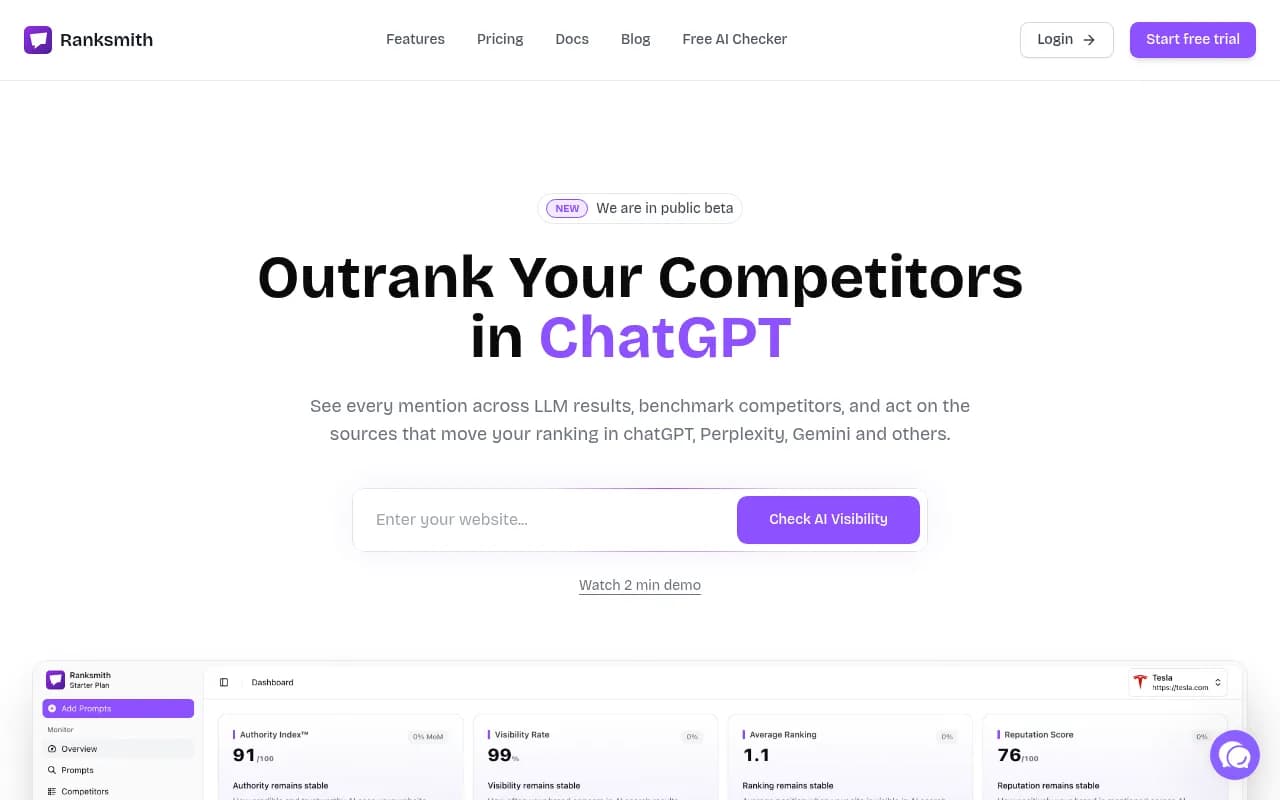
Ranksmith has been building a reputation for source attribution -- showing you which specific pages, Reddit threads, and domains are driving AI citations. That's useful context for B2B SaaS teams trying to understand why a competitor is being cited.
Scrunch AI is worth a look for teams that want a clean monitoring dashboard without a lot of complexity.
Feature comparison
| Platform | AI models tracked | Prompt discovery | Content generation | Crawler logs | Traffic attribution | Multi-language | Starting price |
|---|---|---|---|---|---|---|---|
| Promptwatch | 10 | Yes (gap analysis + fan-outs) | Yes (built-in AI writer) | Yes | Yes | Yes | $99/mo |
| Profound | Up to 10 | Limited | No | No | No | Limited | $99/mo |
| Peec.ai | Up to 10 | Basic | No | No | No | Yes (115+ languages) | ~$85/mo |
| Otterly.AI | 4-6 | No | No | No | No | Limited | $29/mo |
| AthenaHQ | 8+ | Limited | No | No | No | Limited | Custom |
| Ranksmith | Multiple | Partial (source attribution) | No | No | No | Limited | Custom |
How to choose
The honest answer is that the right tool depends on what you actually need to do.
If you're in "understand the problem" mode -- you want to know how visible your brand is across AI models, where competitors are winning, and what the data looks like -- Profound or Peec.ai are reasonable choices. Profound if you need depth and enterprise reporting, Peec.ai if international reach matters.
If you're in "fix the problem" mode -- you want to identify gaps, create content that gets cited, and track whether it's working -- Promptwatch is the only platform in this comparison that covers the full cycle. The Answer Gap Analysis finds the prompts you're missing, the AI writing agent helps you create content to fill those gaps, and the page-level tracking shows you whether it's working. That loop doesn't exist anywhere else at this price point.
For B2B SaaS specifically, the niche prompt problem makes the content generation and gap analysis features more valuable than they might be for a consumer brand. Your buyers are asking specific, layered questions. You need to know which ones, and you need content that actually answers them in a way AI models will cite.
What to watch for when evaluating any platform
A few things that often get overlooked in platform evaluations:
Prompt limits matter more than they look. A B2B SaaS product with multiple use cases, personas, and buyer stages can easily need 100+ prompts to get meaningful coverage. Check what you're actually getting at each tier before committing.
"Tracks X AI models" doesn't mean equal coverage. Some platforms technically track a model but only run queries infrequently or don't support that model's latest version. Ask how often prompts are run and whether the platform updates as models change.
Traffic attribution is the missing piece for most teams. Knowing your brand appears in AI responses is useful. Knowing that AI visibility is driving actual website traffic and pipeline is what gets budget approved. Most platforms don't offer this. Promptwatch does, via a code snippet, Google Search Console integration, or server log analysis.
Reddit and YouTube influence AI responses more than most people realize. AI models frequently cite Reddit threads and YouTube videos in their responses. If your platform doesn't surface which discussions are influencing recommendations in your category, you're missing a real optimization lever.
The bottom line
The AI visibility platform category has matured fast. In 2024, most tools were basic trackers that showed you a mention rate and called it a day. In 2026, the gap between monitoring-only tools and optimization platforms is significant -- and for B2B SaaS teams with niche, high-intent buyers, that gap translates directly to pipeline.
Promptwatch is the platform that most directly addresses the niche prompt problem: it helps you find the gaps, create content to fill them, and track whether it's working. Profound is the right choice if your primary need is deep analytics and enterprise reporting. Peec.ai earns its place if multi-language tracking is a genuine requirement.
Whatever you choose, the key question to ask is: "After I see the data, what does this tool help me do about it?" If the answer is "nothing," you're paying for a dashboard, not a solution.