Summary
- AI search engines now influence 40%+ of product discovery -- if you're not tracking how ChatGPT, Perplexity, and Google AI Overviews recommend your products, you're flying blind
- E-commerce brands need specialized AI visibility tools that track product mentions, shopping features (like ChatGPT Shopping), and competitor positioning across AI models
- The best platforms combine monitoring (see where you appear) with optimization (fix what's missing) -- tracking alone won't improve your AI rankings
- Promptwatch leads for e-commerce with ChatGPT Shopping tracking, Reddit/YouTube insights (where product recommendations originate), and content gap analysis that shows exactly what's missing from your product pages
- Budget-conscious brands can start with Otterly.AI or Peec AI for basic monitoring, then upgrade to platforms with content generation and optimization capabilities as AI traffic grows
Why e-commerce brands can't ignore AI search visibility
Your customers aren't just Googling "best running shoes" anymore. They're asking ChatGPT "what running shoes should I buy for flat feet under $150" or telling Perplexity "find me a sustainable yoga mat that doesn't smell like rubber." AI engines answer with specific product recommendations -- and if your brand isn't in those answers, you don't exist.
Traditional SEO tools track Google rankings. They don't tell you when ChatGPT recommends a competitor's product over yours, or when Perplexity cites a Reddit thread trashing your customer service. E-commerce is uniquely vulnerable here because AI models pull product recommendations from reviews, Reddit discussions, YouTube unboxings, and comparison articles -- not just your product pages.
The gap between "we rank #3 on Google" and "ChatGPT never mentions us" is real. I've seen brands with strong traditional SEO get zero AI visibility because their content doesn't answer the specific questions AI models want answered. Product pages optimized for Google's algorithm don't automatically work for Claude or Gemini.
What makes an AI visibility tool good for e-commerce
Not all AI visibility platforms are built for product-focused businesses. Here's what matters:
Product-level tracking: You need to see which specific products get mentioned, not just your brand. A tool that only tracks brand mentions misses the detail layer -- "Brand X makes great shoes" is less valuable than "Brand X Model Y is the best trail runner under $120."
Shopping feature monitoring: ChatGPT Shopping, Google's product carousels in AI Overviews, Perplexity's shopping integrations -- these are where purchase intent lives. If your tool doesn't track these, you're missing the conversion layer.
Reddit and YouTube insights: AI models cite Reddit threads and YouTube reviews constantly when recommending products. You need visibility into these discussions, not just your own website.
Competitor comparison: Knowing you appear 12% of the time means nothing without context. Are competitors appearing 60% of the time? What are they doing differently?
Content gap analysis: The best tools don't just show you where you're invisible -- they tell you why. What questions are customers asking that your product pages don't answer? What angles do competitors cover that you ignore?
Traffic attribution: Monitoring is pointless if you can't connect it to revenue. Can you track which AI mentions actually drive visitors and conversions?
The best AI search visibility tools for e-commerce in 2026
Promptwatch -- best overall for e-commerce brands
Promptwatch is the only platform built around taking action, not just watching dashboards. Most competitors show you data and leave you stuck. Promptwatch shows you what's missing, then helps you fix it.

The core workflow: Answer Gap Analysis identifies prompts where competitors appear but you don't. You see the exact content your product pages are missing -- the questions, comparisons, and use cases AI models want but can't find on your site. Then the built-in AI writing agent generates product descriptions, comparison pages, and buying guides grounded in 880M+ citations analyzed. This isn't generic SEO content -- it's engineered to get cited by ChatGPT, Claude, and Perplexity.
For e-commerce specifically, Promptwatch tracks ChatGPT Shopping -- when your products appear in ChatGPT's shopping carousels and product recommendations. No other platform monitors this feature. You also get Reddit and YouTube insights surfacing the discussions that directly influence AI recommendations ("best budget standing desk Reddit" queries pull from those threads).
The AI Crawler Logs feature shows real-time logs of ChatGPT, Claude, and Perplexity crawlers hitting your product pages -- which pages they read, errors they encounter, how often they return. Fix indexing issues before they cost you visibility.
Pricing: Essential $99/mo (1 site, 50 prompts, 5 articles), Professional $249/mo (2 sites, 150 prompts, 15 articles, crawler logs), Business $579/mo (5 sites, 350 prompts, 30 articles). Free trial available.
Best for: E-commerce brands serious about AI visibility who want optimization tools, not just monitoring dashboards.
Otterly.AI -- budget-friendly monitoring
Otterly.AI offers straightforward brand monitoring across ChatGPT, Perplexity, Google AI Overviews, and Gemini at a lower price point than most competitors.

You get basic visibility tracking, competitor mentions, and alert notifications when your brand appears in AI responses. The interface is clean and the data is reliable. What you don't get: crawler logs, content generation, Reddit/YouTube tracking, or shopping feature monitoring.
This is a monitoring-only tool. It tells you where you appear but doesn't help you improve. For small e-commerce brands just starting to track AI visibility, that might be enough. Once you need to optimize (not just observe), you'll outgrow it.
Pricing: Starts around $49/mo for basic monitoring.
Best for: Small e-commerce brands on tight budgets who want basic AI mention tracking.
Peec AI -- multi-language tracking for global brands
Peec AI stands out for its multi-language and multi-region tracking capabilities. If you sell internationally, you need to monitor how AI models recommend your products in French, German, Spanish, Japanese, etc.

The platform tracks visibility across major AI models and lets you customize personas ("budget-conscious millennial shopper in Berlin" vs "luxury buyer in Tokyo"). This matters for e-commerce because purchase behavior and product preferences vary wildly by market.
Like Otterly.AI, Peec is monitoring-focused. You see the data but don't get content optimization or generation tools. No Reddit tracking, no shopping feature monitoring, no crawler logs.
Pricing: Custom pricing based on number of languages and prompts tracked.
Best for: International e-commerce brands selling in multiple markets who need multi-language AI visibility tracking.
AthenaHQ -- solid monitoring with competitor benchmarking
AthenaHQ tracks your brand across 8+ AI search engines and provides detailed competitor comparison reports.
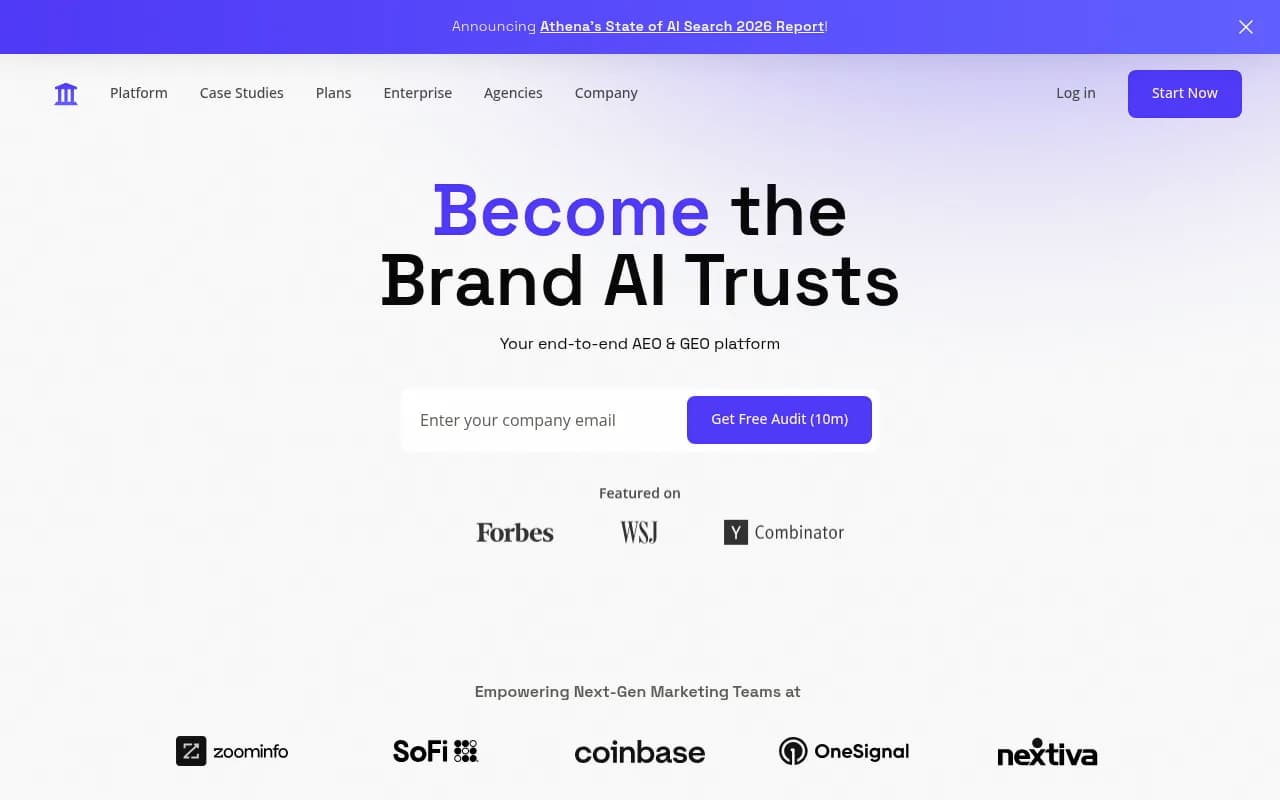
The competitor heatmaps are useful -- you can see exactly which prompts competitors dominate and where you have opportunities. The platform monitors ChatGPT, Perplexity, Google AI Overviews, Claude, Gemini, and others.
What's missing: content optimization tools, Reddit/YouTube insights, shopping feature tracking, and crawler logs. AthenaHQ is another monitoring-first platform. It gives you good data on where you stand vs competitors, but doesn't help you close the gap.
Pricing: Starts around $199/mo.
Best for: E-commerce brands who want detailed competitor analysis and are willing to handle content optimization separately.
Profound -- premium features at a premium price
Profound offers a comprehensive feature set including visibility tracking, competitor analysis, and content recommendations.
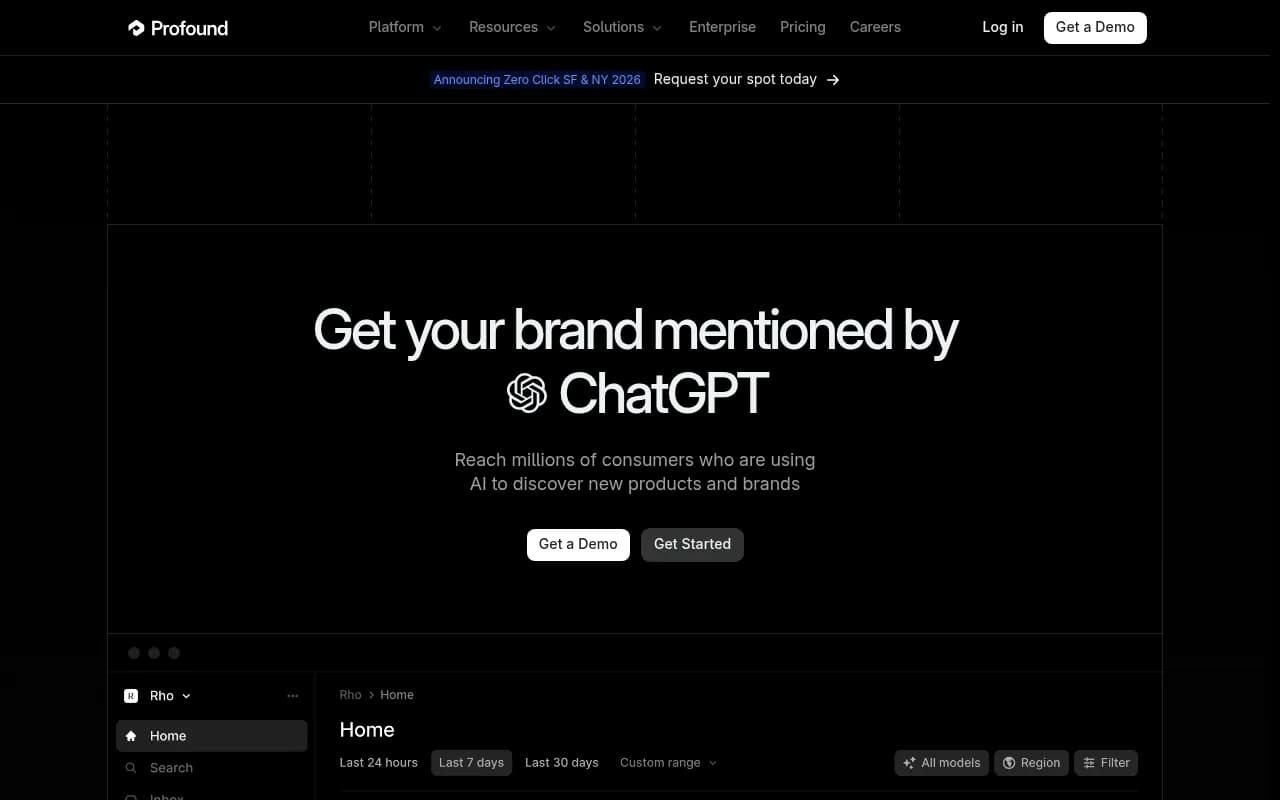
The platform tracks multiple AI models, provides prompt volume estimates, and suggests content improvements. The interface is polished and the data is detailed. For e-commerce, you get product-level tracking and can monitor how specific SKUs perform in AI recommendations.
The downside: higher pricing than most competitors, and still no Reddit tracking or ChatGPT Shopping monitoring. Profound is strong on traditional AI visibility metrics but misses some e-commerce-specific features.
Pricing: Starts around $399/mo for professional plans.
Best for: Mid-size to enterprise e-commerce brands with budget for premium tools and a focus on traditional AI search visibility.
SE Visible -- user-friendly interface for marketing teams
SE Visible (from the SE Ranking team) emphasizes ease of use and clean reporting dashboards.
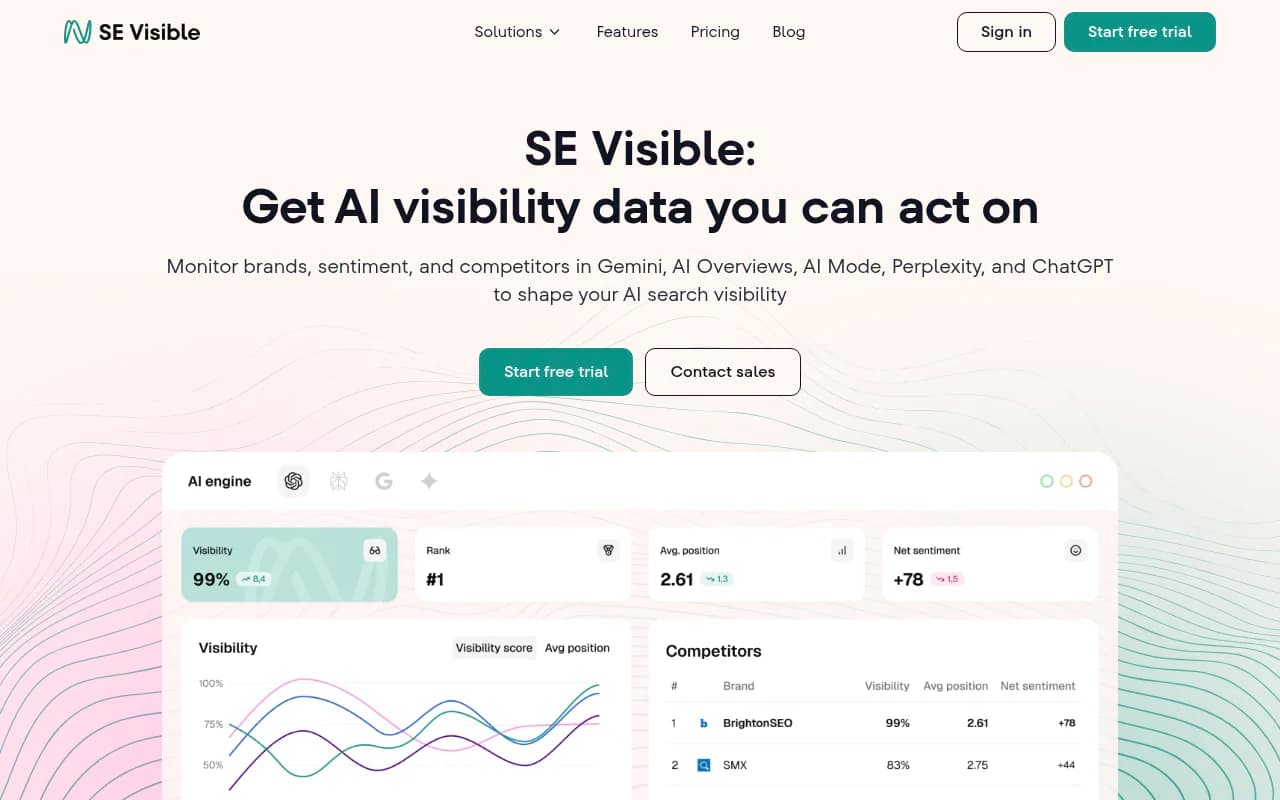
The platform tracks AI Mode visibility across Google, ChatGPT, Perplexity, and other models. Reports are visual and easy to share with stakeholders who don't live in SEO tools daily. For e-commerce teams where multiple people need access (product managers, content writers, executives), the interface matters.
Limitations: monitoring-focused with minimal optimization features, no Reddit/YouTube tracking, no shopping feature monitoring.
Pricing: Bundled with SE Ranking subscriptions or available standalone starting around $99/mo.
Best for: E-commerce marketing teams who prioritize user-friendly dashboards and easy reporting over advanced optimization features.
Feature comparison table
| Tool | ChatGPT Shopping | Reddit/YouTube | Content generation | Crawler logs | Starting price |
|---|---|---|---|---|---|
| Promptwatch | Yes | Yes | Yes | Yes | $99/mo |
| Otterly.AI | No | No | No | No | $49/mo |
| Peec AI | No | No | No | No | Custom |
| AthenaHQ | No | No | No | No | $199/mo |
| Profound | No | No | Limited | No | $399/mo |
| SE Visible | No | No | No | No | $99/mo |
What to look for when choosing a tool
Start with your budget and scale: If you're a small DTC brand doing $500K/year, a $399/mo tool is probably overkill. Start with basic monitoring (Otterly.AI, SE Visible) and upgrade as AI traffic grows. If you're doing $10M+/year and AI search is already driving meaningful traffic, invest in a platform with optimization capabilities (Promptwatch, Profound).
Prioritize action over data: Monitoring tools show you problems. Optimization platforms help you fix them. A dashboard showing "you appear in 8% of relevant prompts" is useless without guidance on how to improve. Look for platforms with content gap analysis, AI writing tools, or at minimum, actionable recommendations.
E-commerce-specific features matter: Generic AI visibility tools miss critical e-commerce touchpoints. ChatGPT Shopping tracking, Reddit/YouTube insights, and product-level (not just brand-level) monitoring are essential for product-focused businesses.
Integration with your existing stack: Can you connect the tool to Google Search Console, your CMS, or analytics platform? Traffic attribution (connecting AI visibility to actual revenue) requires integration. If the tool is a data island, you'll struggle to prove ROI.
Multi-model coverage: Don't optimize for ChatGPT alone. Your customers use Perplexity, Claude, Gemini, Google AI Overviews, and others. Make sure your tool tracks the models your audience actually uses.
How to actually use these tools (not just buy them)
Buying an AI visibility tool and logging in once a month is like buying a gym membership and never going. Here's a realistic workflow:
Week 1: Baseline audit
- Run your brand and top product names through the tool
- Identify your current visibility score across AI models
- Export a list of prompts where competitors appear but you don't
- Screenshot the worst gaps (prompts with high volume where you're invisible)
Week 2-4: Content gap analysis
- For each high-value prompt where you're missing, audit your existing content
- What questions does the prompt ask that your product pages don't answer?
- What comparisons, use cases, or specifications are missing?
- Create a prioritized list of content to create or update
Month 2: Content creation and optimization
- If your tool has AI content generation (like Promptwatch), use it to draft new pages
- If not, brief your content team with the specific gaps identified
- Focus on comparison pages ("Product A vs Product B"), buying guides ("best X for Y"), and detailed FAQ sections
- Update product pages with the missing information AI models want
Month 3+: Monitor and iterate
- Track visibility score changes weekly
- Identify which content updates drove improvements
- Double down on what works
- Set up alerts for new competitor mentions or drops in your visibility
Ongoing: Traffic attribution
- Connect visibility improvements to actual traffic and revenue
- Use UTM parameters, referral tracking, or the tool's built-in analytics
- Report on ROI to justify continued investment
The brands winning at AI visibility aren't just monitoring -- they're running a continuous optimization loop. Find gaps, create content, track results, repeat.
Common mistakes e-commerce brands make
Mistake 1: Treating AI visibility like traditional SEO
Optimizing for Google and optimizing for ChatGPT are different games. Google wants keyword-rich titles and backlinks. AI models want comprehensive answers to specific questions, structured data, and authoritative citations. Your product pages might rank #1 on Google but get zero AI mentions because they don't answer the questions AI users ask.
Mistake 2: Ignoring Reddit and YouTube
AI models cite Reddit threads and YouTube reviews constantly when recommending products. If there's a popular Reddit thread titled "Why Brand X customer service is terrible" and you're not monitoring it, you'll never know why ChatGPT stopped recommending your products. Track these platforms or stay blind to a major influence on AI recommendations.
Mistake 3: Monitoring without optimizing
Dashboards are useless if you don't act on the data. I've seen brands pay $200/mo for an AI visibility tool, check it monthly, shrug at the low scores, and do nothing. Monitoring is step one. Content optimization is step two. If you're not doing step two, save your money.
Mistake 4: Focusing only on brand mentions
Brand-level tracking misses the detail layer. "Brand X makes good laptops" is less valuable than "Brand X Model Y is the best budget laptop for students." Track product-level mentions, not just brand mentions.
Mistake 5: Expecting instant results
AI visibility takes time. You won't publish three new comparison pages and see your visibility score jump 50% overnight. AI models need to crawl your updated content, process it, and start citing it. Give it 4-8 weeks before judging results.
The future of AI search for e-commerce
ChatGPT Shopping is just the beginning. We're moving toward a world where AI engines don't just recommend products -- they complete purchases. Perplexity is testing buy buttons. Google is integrating Shopping directly into AI Overviews. Meta AI will likely add commerce features.
The brands that win will be the ones who start optimizing now, before AI commerce becomes saturated. Right now, most e-commerce brands aren't tracking AI visibility at all. You have a window to build authority before your competitors wake up.
The tools exist. The data is available. The question is whether you'll use them or keep optimizing for a search landscape that's already obsolete.
Start with one tool and one workflow
Don't try to implement five tools at once. Pick one platform that fits your budget and needs. For most e-commerce brands, I'd recommend starting with Promptwatch if you have the budget ($99-249/mo) and want optimization capabilities, or Otterly.AI if you just need basic monitoring to start.
Run the baseline audit. Identify your top 10 content gaps. Fix them over the next 60 days. Track the results. Then expand from there.
AI search visibility isn't a one-time project. It's an ongoing optimization loop. The sooner you start, the bigger your advantage.