Summary
- AI visibility tools track brand mentions and citations across ChatGPT, Perplexity, Claude, Google AI Overviews, and other AI search engines—traditional SEO metrics like SERP rankings no longer tell the full story
- B2B SaaS companies face unique challenges: long sales cycles, technical buyers, and complex products mean you need to appear in AI-generated answers at every stage of the buyer journey
- The market is split between monitoring-only dashboards and action-oriented platforms—tools like Promptwatch combine tracking with content gap analysis and AI-powered content generation to help you fix visibility issues, not just see them
- Pricing ranges from $49/month for basic tracking to $1,000+/month for enterprise solutions—but cost alone doesn't determine value; the right tool depends on team size, technical resources, and whether you need monitoring or optimization
- Most B2B SaaS teams should prioritize tools that track competitor visibility, provide prompt volume data, and integrate with existing SEO workflows—these features turn raw data into actionable strategies
Why B2B SaaS companies need AI visibility tools
Your buyers aren't starting their software search on Google anymore. They're asking ChatGPT "What's the best CRM for mid-market B2B companies?" or prompting Perplexity with "Compare project management tools for remote engineering teams." If your brand doesn't appear in those AI-generated answers, you're invisible to a growing segment of high-intent buyers.
Traditional SEO focused on ranking for keywords. AI search optimization—often called Generative Engine Optimization (GEO) or Answer Engine Optimization (AEO)—focuses on getting cited as a source in AI responses. The difference matters because:
- AI engines synthesize information from multiple sources instead of presenting a ranked list of links. Being mentioned once in position 3 of an AI answer can be more valuable than ranking #8 on a Google SERP.
- B2B buyers use AI search differently than consumers. They ask detailed, technical questions. They compare feature sets. They want proof points and case studies. Your content needs to answer those specific queries.
- AI crawlers behave differently than Googlebot. They prioritize structured data, clear authorship signals, and content that directly answers questions without marketing fluff.
AI visibility tools solve a measurement problem: you can't optimize what you can't track. These platforms run thousands of prompts across multiple AI engines, log which brands get mentioned, and show you where competitors are winning.
What AI visibility tools actually track
Not all AI visibility platforms measure the same things. Here's what the best ones monitor:
Brand mentions and citations
The core metric: how often does an AI engine mention your brand when answering relevant prompts? Tools track:
- Mention frequency: Total number of times your brand appears across all tracked prompts
- Citation position: Whether you're mentioned first, second, or buried at the end of a response
- Source attribution: Which of your URLs the AI engine cites (if any)
- Sentiment and context: Is the mention positive, neutral, or negative? Is it a recommendation or just a passing reference?
Competitor benchmarking
Seeing your own visibility means nothing without context. The best tools let you:
- Track 5-10 competitors simultaneously
- Compare share of voice across different prompt categories
- Identify prompts where competitors dominate but you're absent
- Analyze which competitor content gets cited most often
Multi-engine coverage
AI search isn't just ChatGPT. B2B buyers use multiple platforms. Look for tools that track:
- ChatGPT (OpenAI)
- Claude (Anthropic)
- Perplexity
- Google AI Overviews (formerly SGE)
- Google AI Mode
- Gemini
- Bing Chat/Copilot
- Meta AI
- Grok (X.ai)
- DeepSeek
Some platforms track 3-4 engines. Others monitor 10+. More isn't always better—focus on where your buyers actually search.
Prompt intelligence
Raw mention counts don't tell you which prompts matter. Advanced tools provide:
- Prompt volume estimates: How many people are asking this question?
- Difficulty scores: How competitive is this prompt?
- Query fan-outs: How does one broad prompt branch into dozens of specific sub-queries?
- Persona targeting: Which prompts align with your ICP (Ideal Customer Profile)?
This data helps you prioritize: chase high-volume, low-competition prompts first.
Content gap analysis
The most valuable feature for B2B SaaS teams. These tools show:
- Prompts where competitors rank but you don't: The exact questions your website fails to answer
- Missing content types: Do you need more comparison pages? Case studies? Technical documentation?
- Topic clusters with low coverage: Entire subject areas where your content is thin
Some platforms (like Promptwatch) go further and generate the missing content for you.

AI crawler logs
A feature most competitors skip: real-time logs of AI crawlers hitting your website. You see:
- Which pages ChatGPT, Claude, and Perplexity crawlers access
- How often they return
- Errors they encounter (404s, slow load times, blocked resources)
- Which content they prioritize
This helps you fix indexing issues before they hurt visibility.
Top AI visibility tools for B2B SaaS companies
Here's a breakdown of the leading platforms, ranked by use case.
Best overall: Promptwatch
Promptwatch is the only platform rated as a "Leader" across all categories in a 2026 comparison of 12 GEO tools. It's built around an action loop: find content gaps, generate optimized content, track results.
What makes it different: Most AI visibility tools are monitoring dashboards—they show you data but leave you stuck. Promptwatch combines tracking with execution. Its Answer Gap Analysis shows exactly which prompts competitors rank for but you don't, then its AI writing agent generates articles, listicles, and comparison pages grounded in real citation data (880M+ citations analyzed). You're not just seeing where you're invisible—you're fixing it.
Key features:
- Tracks 10 AI engines (ChatGPT, Claude, Perplexity, Google AI Overviews, Gemini, Meta AI, Grok, DeepSeek, Copilot, Mistral)
- AI crawler logs showing which pages LLMs access and errors they hit
- Prompt volume estimates and difficulty scores
- Reddit and YouTube citation tracking (channels most competitors ignore)
- ChatGPT Shopping monitoring for product recommendations
- Built-in AI content generator trained on citation patterns
- Multi-language and multi-region support
- Looker Studio integration and API access
Pricing: Essential $99/mo (1 site, 50 prompts, 5 articles), Professional $249/mo (2 sites, 150 prompts, 15 articles, crawler logs), Business $579/mo (5 sites, 350 prompts, 30 articles). Agency and enterprise plans available.
Best for: B2B SaaS teams that want to optimize, not just monitor. If you need to close content gaps fast and lack a full-time content team, Promptwatch's AI writer is a force multiplier.
Best for enterprise: Profound
Profound positions itself as the enterprise-grade solution for holistic AI search visibility. It's analyst-friendly with robust APIs, near real-time monitoring, and deep segmentation.

Key features:
- Tracks 10+ AI engines including shopping and agent analytics
- Prompt volume data and competitive benchmarking
- API access for custom reporting and integrations
- Multi-brand and multi-region tracking
- Advanced filtering and segmentation
Pricing: Starts around $500/mo. Enterprise plans scale based on prompt volume and number of brands tracked.
Best for: Large B2B SaaS companies with dedicated analyst teams. If you need raw data exports, custom dashboards, and the flexibility to build on top of the platform, Profound delivers.
Skip if: You're a small team without technical resources. Profound's power comes with complexity.
Best for agencies: SE Visible (by SE Ranking)
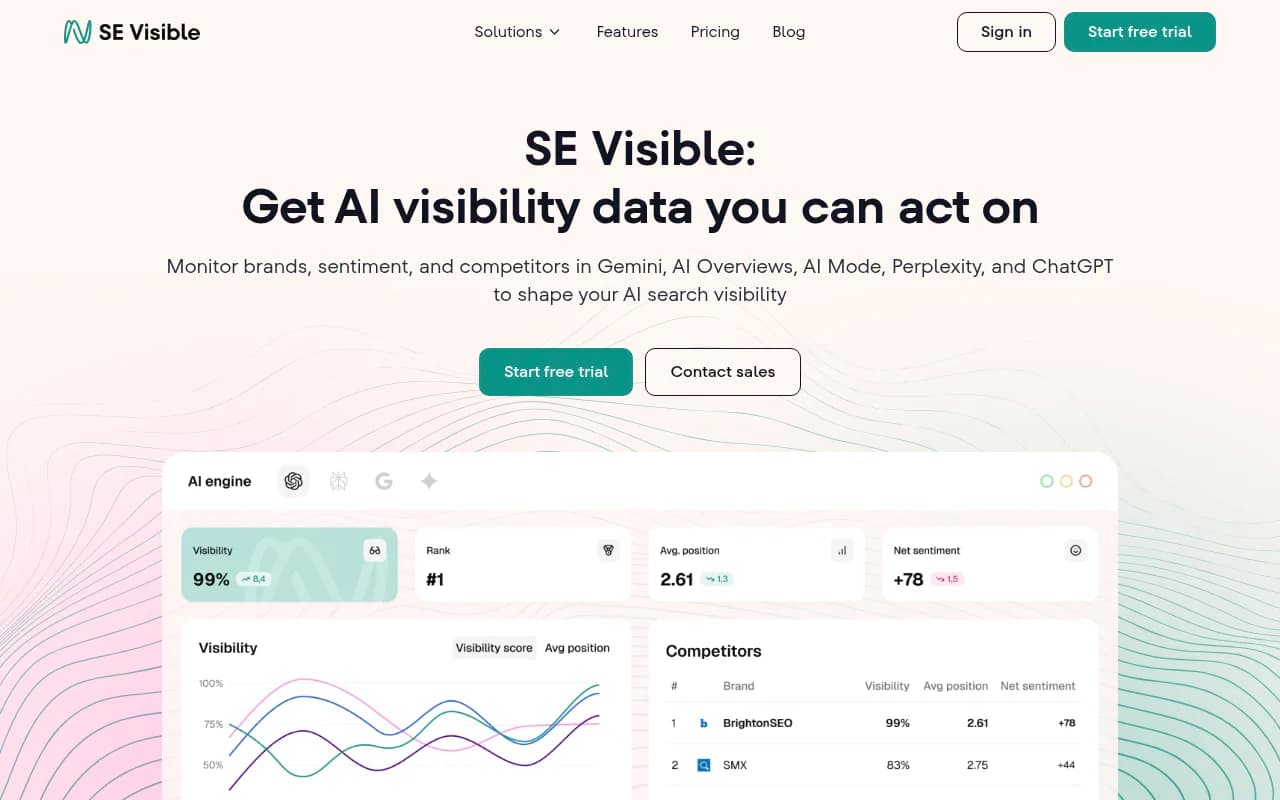
SE Visible is SE Ranking's AI visibility toolkit. It's user-friendly, affordable, and designed for agencies managing multiple clients.
Key features:
- Multi-language AI visibility tracking
- White-label reporting for agencies
- Tracks ChatGPT, Perplexity, Google AI Overviews, Claude, Gemini
- Sentiment analysis and citation tracking
- Integrates with SE Ranking's broader SEO platform
Pricing: Starts at $49/mo for basic plans. Agency plans scale with client count.
Best for: Agencies that need simple, client-ready reports without a steep learning curve.
Skip if: You need advanced features like AI crawler logs or content generation.
Best for budget-conscious teams: Otterly.AI
Otterly.AI is one of the most affordable AI visibility tools on the market. It's bare-bones but functional.

Key features:
- Tracks ChatGPT, Perplexity, Google AI Overviews
- Basic brand mention monitoring
- Competitor tracking (limited to 3-5 competitors)
- Email alerts for new mentions
Pricing: Starts at $49/mo.
Best for: Freelancers and small teams that need basic monitoring without advanced analytics.
Skip if: You need prompt volume data, content gap analysis, or multi-engine coverage beyond the big three.
Best for content teams: Peec AI
Peec AI focuses on straightforward dashboards and fast setup. It's designed for content teams that want visibility insights without technical overhead.

Key features:
- Multi-language tracking
- Sentiment analysis
- Simple UI with minimal learning curve
- Tracks ChatGPT, Claude, Perplexity, Google AI Overviews
Pricing: Starts at $99/mo.
Best for: B2B SaaS content teams that want quick insights to inform editorial calendars.
Skip if: You need advanced analytics, API access, or content optimization tools.
Best for technical SEO teams: Ahrefs Brand Radar
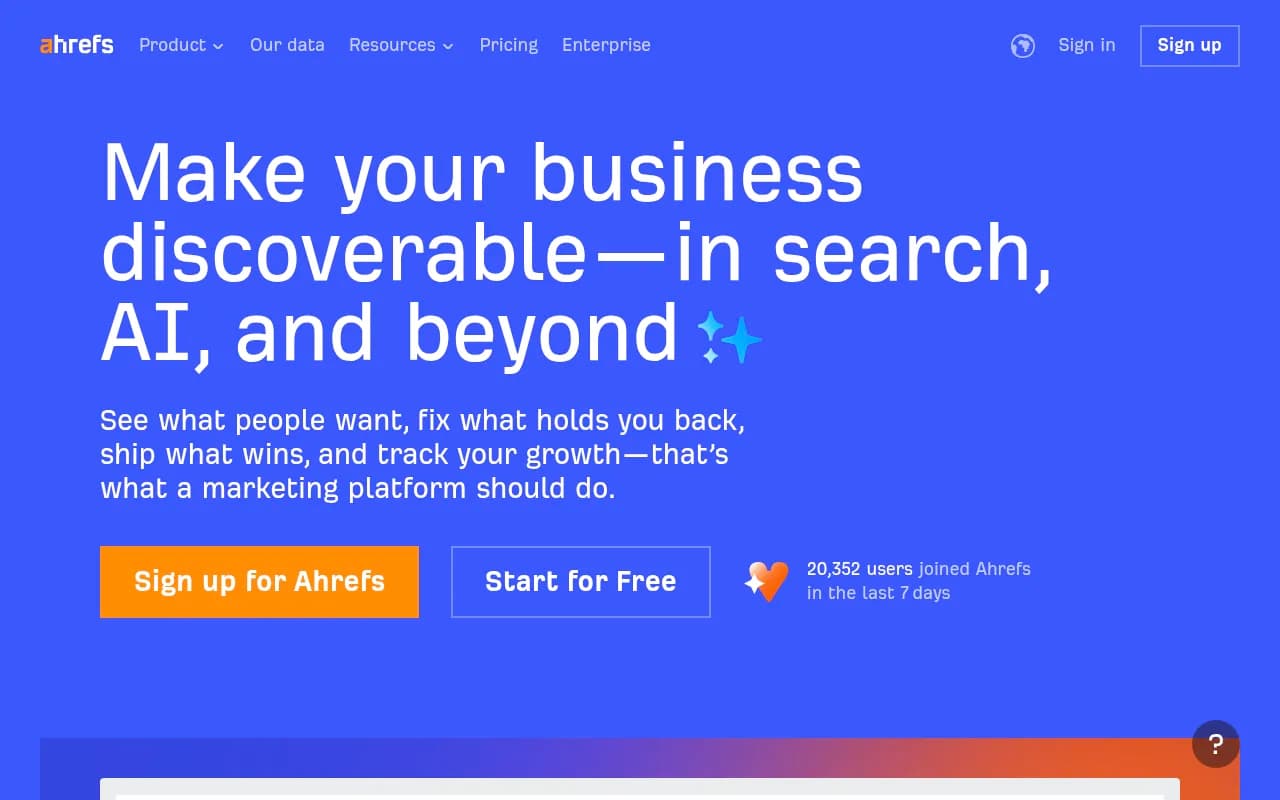
Ahrefs recently launched Brand Radar to track brand mentions in AI search results. It's integrated into the broader Ahrefs SEO platform.
Key features:
- Tracks Google AI Overviews and Bing Chat
- Integrates with Ahrefs' keyword research and backlink tools
- Fixed prompt sets (limited customization)
- No AI traffic attribution
Pricing: Included with Ahrefs subscription (starts at $129/mo).
Best for: Teams already using Ahrefs for traditional SEO who want basic AI visibility tracking in the same platform.
Skip if: You need deep AI search analytics or custom prompt tracking. Ahrefs' AI features are still early-stage.
Best for PR and brand teams: AthenaHQ
AthenaHQ focuses on brand monitoring across AI engines. It's designed for PR teams that need to track sentiment and respond to mentions.

Key features:
- Tracks 8+ AI engines
- Sentiment analysis and context tracking
- Competitor benchmarking
- Email alerts for new mentions
Pricing: Starts at $199/mo.
Best for: PR and brand teams that need to monitor how AI engines talk about their company.
Skip if: You need content optimization or technical SEO features.
Comparison table: AI visibility tools for B2B SaaS
| Tool | Starting price | AI engines tracked | Content generation | Crawler logs | Best for |
|---|---|---|---|---|---|
| Promptwatch | $99/mo | 10 | Yes | Yes | Teams that want to optimize, not just monitor |
| Profound | $500/mo | 10+ | No | No | Enterprise teams with analyst resources |
| SE Visible | $49/mo | 5 | No | No | Agencies managing multiple clients |
| Otterly.AI | $49/mo | 3 | No | No | Budget-conscious small teams |
| Peec AI | $99/mo | 4 | No | No | Content teams needing fast insights |
| Ahrefs Brand Radar | $129/mo | 2 | No | No | Teams already using Ahrefs for SEO |
| AthenaHQ | $199/mo | 8+ | No | No | PR and brand monitoring |
How to choose the right AI visibility tool
Start with these questions:
1. Do you need monitoring or optimization?
If you just want to track mentions and benchmark against competitors, basic monitoring tools (Otterly.AI, Peec AI, SE Visible) work fine. If you need to close content gaps and improve visibility, look for platforms with content generation and gap analysis (Promptwatch, Writesonic).
2. How many AI engines matter to your buyers?
B2B SaaS buyers use multiple platforms. If your ICP skews technical, they're likely using Claude and Perplexity. If they're less technical, ChatGPT and Google AI Overviews dominate. Track where your audience actually searches—don't pay for 10-engine coverage if you only need 4.
3. What's your team's technical capacity?
Enterprise platforms (Profound, Semrush AIO) offer powerful APIs and raw data exports, but they require analyst resources to extract value. If you're a lean team, prioritize tools with out-of-the-box insights and simple UIs (Peec AI, SE Visible).
4. Do you need AI crawler logs?
If you're serious about AI search optimization, crawler logs are invaluable. They show you exactly how AI engines interact with your website—which pages they prioritize, errors they encounter, how often they return. Most tools skip this feature. Promptwatch includes it.
5. What's your budget?
Pricing ranges from $49/mo to $1,000+/mo. But cheap tools that only monitor won't move the needle if you can't act on the data. A $249/mo platform that helps you generate optimized content delivers better ROI than a $49/mo dashboard that just shows you problems.
What B2B SaaS teams should track (beyond mentions)
Raw mention counts are a vanity metric. Focus on:
Share of voice by prompt category
Group prompts into categories (e.g. "CRM comparisons," "project management features," "pricing questions"). Track your share of voice in each category vs competitors. This reveals where you're strong and where you're losing ground.
Citation position trends
Being mentioned first in an AI response is worth 3-5x more than being mentioned third. Track whether your average citation position is improving or declining over time.
Content gap closure rate
How many high-priority content gaps did you close this quarter? How many new prompts are you now visible for? This metric ties AI visibility directly to content production.
AI traffic attribution
The ultimate metric: how much traffic and pipeline comes from AI search? Some platforms (Promptwatch, Profound) offer traffic attribution via code snippets, Google Search Console integration, or server log analysis. Connect visibility to revenue.
Common mistakes B2B SaaS teams make with AI visibility tools
Tracking too many prompts
More prompts ≠ better insights. Start with 50-100 high-value prompts that align with your buyer journey. Expand once you've optimized for those.
Ignoring prompt volume data
A prompt with 10,000 monthly searches is worth more than one with 50 searches. Prioritize high-volume prompts where you're currently invisible.
Focusing only on branded prompts
Tracking "[Your Company] vs [Competitor]" prompts is useful, but non-branded prompts ("best CRM for startups") drive more new customer acquisition. Balance both.
Not connecting visibility to pipeline
AI visibility is a means, not an end. Track how visibility improvements correlate with demo requests, free trial signups, and closed deals. If visibility goes up but pipeline doesn't, your content isn't converting.
Treating AI search as separate from SEO
AI engines crawl your website just like Googlebot. Technical SEO issues (slow load times, broken links, poor mobile experience) hurt both traditional and AI search visibility. Fix the fundamentals first.
The future of AI visibility for B2B SaaS
AI search is still early. Expect these trends:
AI engines will prioritize recency
ChatGPT and Perplexity already favor fresh content. B2B SaaS companies that publish regularly (weekly, not monthly) will win.
Structured data will matter more
Schema markup, clear product specs, and machine-readable pricing tables help AI engines extract information accurately. Invest in structured data now.
Reddit and YouTube will become citation goldmines
AI engines increasingly cite Reddit threads and YouTube videos. B2B SaaS companies that build communities and publish video content will gain an edge.
AI shopping features will expand
ChatGPT Shopping already recommends products. Expect Claude, Perplexity, and others to launch similar features. B2B SaaS companies with clear product listings and reviews will benefit.
Multi-agent search will emerge
Instead of one AI engine answering a query, multiple agents will collaborate—one for research, one for comparison, one for recommendations. Your content needs to serve each agent's role.
Getting started with AI visibility tracking
Here's a 30-day plan:
Week 1: Audit your current visibility
- Sign up for a free trial of 2-3 tools (Promptwatch, Peec AI, Otterly.AI)
- Track 20-30 high-value prompts related to your product category
- Benchmark against 3-5 competitors
- Identify your biggest content gaps
Week 2: Prioritize prompts
- Use prompt volume data to rank opportunities
- Focus on high-volume, low-competition prompts where competitors are visible but you're not
- Map prompts to buyer journey stages (awareness, consideration, decision)
Week 3: Create optimized content
- Write or generate 3-5 articles targeting your priority prompts
- Use structured data and clear headings
- Include specific product details, pricing, and comparisons
- Publish and submit to AI crawlers
Week 4: Track and iterate
- Monitor visibility changes for your new content
- Check AI crawler logs to confirm pages are being accessed
- Adjust content based on what's working
- Plan next month's content based on remaining gaps
AI search isn't replacing traditional SEO—it's adding a new layer. B2B SaaS companies that track, optimize, and iterate will capture buyer attention before competitors even know the game has changed.