Key takeaways
- AI hallucinations about brand information are a real, measurable problem -- most monitoring tools track mentions but don't flag when the information is wrong
- Independent testing by LLMClicks found that most AI visibility tools miss incorrect brand information entirely, focusing only on whether a brand appears, not what's being said
- Promptwatch, Profound, and LLMClicks each take different approaches to this problem, with Promptwatch offering the most complete workflow from detection to content-based correction
- Otterly.AI is a solid entry-level monitoring tool but lacks the depth needed for hallucination-specific tracking
- If incorrect brand information is your primary concern, you need a platform that shows you the actual AI response text, not just a visibility score
There's a scenario playing out right now at companies across every industry: someone Googles a competitor, gets an AI-generated answer, and that answer contains a wrong price, a discontinued product, an outdated feature list, or a fabricated claim. Sometimes the brand being misrepresented is yours.
AI hallucinations about brands aren't rare edge cases. They're a structural problem. Language models are trained on web data that goes stale, gets taken out of context, or was never accurate to begin with. When ChatGPT tells someone your software doesn't integrate with Salesforce -- and it does -- that's a lost deal you'll never know about.
The question for 2026 is: which platforms actually help you catch and correct this, versus which ones just show you a visibility score and call it a day?
This guide breaks down four platforms -- Promptwatch, LLMClicks, Profound, and Otterly.AI -- specifically through the lens of hallucination detection and incorrect brand information tracking.
Why hallucination tracking is different from standard AI visibility monitoring
Most AI visibility tools were built to answer one question: "Is my brand showing up in AI search results?" That's useful, but it's only half the picture.
The harder question is: "When my brand shows up, is the information accurate?"
Standard visibility monitoring counts mentions and citations. Hallucination tracking requires reading the actual response text, comparing it against known brand facts, and flagging discrepancies. That's a meaningfully different technical challenge, and most platforms haven't solved it.
According to independent testing cited by Alhena AI, most AI visibility tools track mentions but miss when AI engines get your brand information wrong. The platforms that do address this tend to fall into two camps: those that show you the raw response text so you can review it manually, and those that attempt automated accuracy checking against a brand knowledge base.
Neither approach is perfect. Manual review doesn't scale. Automated checking requires you to maintain an accurate knowledge base and trust the comparison logic. But both are better than a visibility score that tells you nothing about what's actually being said.
The four platforms compared
Promptwatch

Promptwatch is the most complete platform in this comparison for teams that want to go beyond detection. The core workflow is: find where AI models are saying something wrong (or saying nothing at all), create content that gives them accurate information to cite, and track whether that content gets picked up.
For hallucination tracking specifically, Promptwatch shows you the full AI response text for every prompt you're monitoring. You can see exactly what ChatGPT, Perplexity, Gemini, Claude, and seven other models are saying about your brand -- not just whether you appear, but the actual sentences. That's the foundation for catching inaccurate claims.
What makes Promptwatch different from the others here is what happens after you find a problem. The Answer Gap Analysis shows which prompts competitors are visible for but you're not -- and by extension, where AI models are filling gaps with potentially inaccurate information because your own content doesn't exist to correct it. The Content Agents then generate articles and briefs grounded in real prompt data to fill those gaps.
The AI Crawler Logs (available on Professional and Business plans) are particularly relevant for hallucination correction. You can see when AI crawlers visit your pages, which pages they read, and when those pages move from crawl to citation. If you publish a correction page and want to know whether ChatGPT has actually picked it up, this tells you.
Pricing starts at $99/month for the Essential plan (1 site, 50 prompts), with Professional at $249/month and Business at $579/month. Free trial available.
LLMClicks
LLMClicks takes a citation-first approach. The platform focuses on tracking which sources AI models actually cite when answering questions about your brand or category -- and by extension, which sources are influencing what gets said.
This is genuinely useful for hallucination investigation. If ChatGPT is consistently citing an outdated TechCrunch article from 2023 that contains wrong information about your pricing, LLMClicks will surface that. You can then go after that specific citation -- update the article, get a correction published, or create newer content that displaces it.
The platform's independent testing work (referenced by Alhena AI) has made them credible voices on the gap between "brand appears" and "brand information is accurate." They've documented cases where tools give brands high visibility scores while AI models are actively spreading incorrect information about them.
LLMClicks is more narrowly focused than Promptwatch -- it's primarily a citation and source intelligence tool rather than a full GEO platform. That's a reasonable tradeoff if citation analysis is your primary need and you don't require content generation or crawler logs.
Profound

Profound is an enterprise-focused platform with strong prompt monitoring and response analysis capabilities. It's built for larger organizations that need structured workflows, team collaboration, and reporting at scale.
For hallucination tracking, Profound's strength is response depth. The platform captures full AI response text across major models and lets teams annotate, flag, and track specific claims over time. If a model says something wrong about your brand, you can log it, assign it to someone, and monitor whether it changes after you take corrective action.
The enterprise positioning means Profound is priced accordingly -- it's not the right choice for a startup or mid-market company watching their budget. But for a large brand managing complex AI visibility across multiple product lines, the structured approach is valuable.
Profound also has solid competitor tracking, which matters for hallucination work: sometimes the most damaging AI responses aren't wrong about your brand directly, but they're recommending a competitor based on outdated comparative information.
Otterly.AI

Otterly.AI was one of the first dedicated AI search monitoring tools and has built a solid user base among marketers who want straightforward visibility tracking without a steep learning curve.
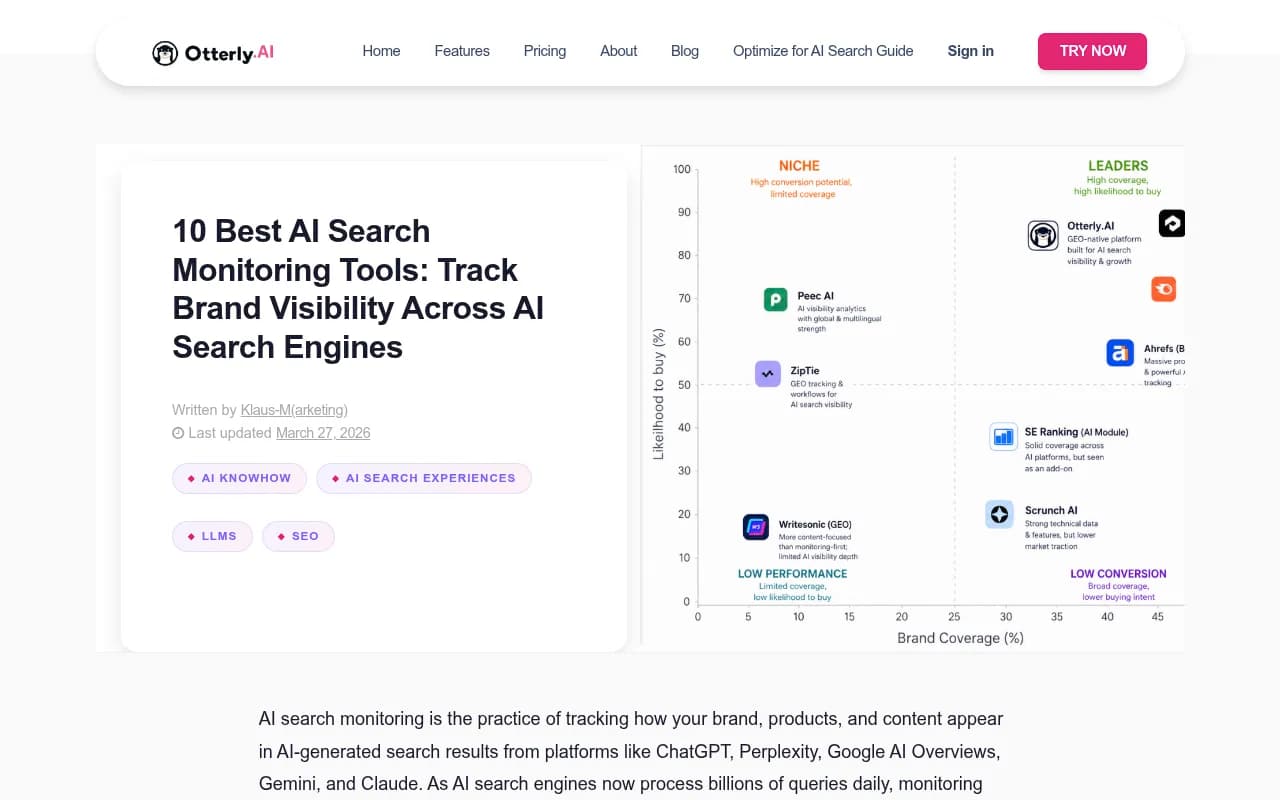
For hallucination detection specifically, Otterly.AI is limited. The platform tracks mentions, citations, and share of voice across major AI platforms -- ChatGPT, Perplexity, Google AI Overviews, Gemini, Copilot -- but it's primarily a monitoring dashboard. You can see that your brand appeared in a response, but the platform doesn't systematically surface response text for accuracy review or flag potential inaccuracies.
That said, Otterly.AI's research is worth noting: their 2026 data shows 15% of all website traffic now comes from AI agents and bots, with ChatGPT accounting for 56% of AI search referral traffic. That context helps teams make the case internally for why hallucination monitoring matters.
Otterly.AI makes sense as a starting point or for teams with limited budgets who primarily want to know whether they're appearing in AI results. For hallucination-specific work, you'll outgrow it quickly.
Feature comparison
| Feature | Promptwatch | LLMClicks | Profound | Otterly.AI |
|---|---|---|---|---|
| Full response text visibility | Yes | Partial | Yes | Limited |
| Hallucination / accuracy flagging | Manual review | Via citation analysis | Manual review | No |
| Citation source tracking | Yes | Yes (primary focus) | Yes | Yes |
| AI crawler logs | Yes (Pro+) | No | No | No |
| Content generation to fix gaps | Yes | No | No | No |
| Answer gap analysis | Yes | No | Partial | No |
| Competitor response tracking | Yes | Yes | Yes | Yes |
| Reddit/YouTube source tracking | Yes | No | No | No |
| ChatGPT Shopping tracking | Yes | No | No | No |
| AI models covered | 10+ | Major platforms | Major platforms | 5 major |
| Pricing (entry) | $99/mo | Varies | Enterprise | Affordable |
| Free trial | Yes | Yes | Demo | Yes |
| Best for | Full GEO workflow | Citation investigation | Enterprise teams | Beginners |
How to actually use these tools for hallucination detection
Knowing a tool can show you response text is one thing. Having a process for catching and correcting inaccuracies is another.
Step 1: Define what "accurate" means for your brand
Before you can flag a hallucination, you need a source of truth. Document your current pricing, key features, integrations, founding date, team size, and any other facts AI models commonly reference. This becomes your comparison baseline.
Step 2: Monitor response text, not just visibility scores
Set up prompts that are likely to surface brand-specific claims: "[Your brand] pricing", "[Your brand] vs [Competitor]", "Does [Your brand] integrate with [Tool]", "What is [Your brand] used for". These are the queries where inaccurate information does the most damage.
With Promptwatch or Profound, you can review the actual response text for these prompts across multiple models. With LLMClicks, you can trace which sources are feeding those responses.
Step 3: Trace inaccurate claims to their source
When you find wrong information, the next question is where it came from. LLMClicks' citation analysis is particularly useful here. If a model is citing a specific page that contains outdated information, that's an actionable target. If no specific source is cited, the model may have synthesized the claim from training data -- harder to fix, but content creation can still help over time.
Step 4: Create content that provides accurate information
This is where most monitoring-only tools leave you stranded. You've found the problem, but now what? Promptwatch's Content Agents can generate articles, FAQs, and comparison pages grounded in real prompt data -- content specifically designed to give AI models accurate information to cite. Pair this with the crawler logs to confirm when models pick up the new content.
Step 5: Track whether the correction sticks
AI models update their responses as they crawl new content, but the timeline is unpredictable. Set up ongoing monitoring for the specific prompts where you found inaccuracies and watch for response changes over weeks and months. Promptwatch's page-level tracking shows which of your pages are being cited and by which models, so you can see when a correction page starts influencing responses.
Which platform should you choose?
The honest answer depends on what you're trying to do.
If you want the most complete workflow -- find inaccurate claims, understand why they're happening, create content to correct them, and track the results -- Promptwatch is the strongest option. It's the only platform here that connects all four steps. The crawler logs alone are something none of the other three offer, and they're genuinely useful for understanding whether your corrections are being picked up.
If citation investigation is your specific need -- you want to know exactly which sources are feeding inaccurate AI responses about your brand -- LLMClicks is worth a close look. It's more narrowly focused but does that specific job well.
If you're at an enterprise with complex team workflows, structured reporting needs, and budget to match, Profound's depth and organization make it a reasonable choice despite the price.
If you're just starting out and want basic visibility monitoring before committing to a more sophisticated platform, Otterly.AI is a reasonable first step. Just go in knowing it won't tell you whether what AI engines are saying is actually true.
The hallucination problem isn't going away -- if anything, as AI search handles more queries and users trust AI answers more readily, the stakes for incorrect brand information keep rising. The platforms that help you detect and fix inaccuracies, not just count mentions, are the ones worth investing in.