Key takeaways
- AI search now drives roughly 25% of product discovery, and AI visitors convert 4.4x better than traditional organic traffic -- making visibility in LLMs a genuine revenue lever for PLG companies.
- Most AI visibility tools are monitoring dashboards only. For PLG teams that need to act on data, not just look at it, the gap between "tracker" and "optimization platform" matters enormously.
- PLG companies have specific needs that generic SEO tools don't cover: prompt-based tracking that mirrors how buyers actually ask questions, competitor gap analysis, and content generation tied to real citation data.
- The right platform depends on your stage: early-stage teams need affordable monitoring with clear upgrade paths; growth-stage teams need content gap analysis and crawler logs; enterprise PLG teams need multi-model coverage and attribution.
- Promptwatch is the only platform in this comparison rated as a "Leader" across all categories in a 2026 review of 12 GEO platforms -- largely because it closes the loop from gap identification to content creation to citation tracking.
Why PLG companies should care about AI search right now
Product-led growth runs on discovery. Your free tier, your viral loops, your in-product referrals -- they all depend on people finding your product before they talk to a salesperson. Historically, that meant ranking on Google. In 2026, it increasingly means showing up in AI-generated answers.
The numbers are hard to ignore. ChatGPT crossed 1 billion weekly active users. Perplexity grew 243% year-over-year. AI platforms now drive over 1.1 billion referral visits monthly -- a 357% increase from 2024. And when someone asks ChatGPT "what's the best project management tool for remote teams," they get one synthesized answer. If your product isn't in it, that buyer moves on without ever seeing your free trial CTA.
What makes this particularly relevant for PLG is the conversion quality. Research cited by Semrush puts AI search visitors converting at 4.4x the rate of traditional organic visitors. These are people who arrive already comparing options, already in research mode. For a PLG motion that depends on low-friction trial starts, that's a meaningful difference.
The catch: most PLG marketing teams are still optimizing for Google rankings while their AI visibility goes unmeasured and unmanaged. That's the gap this guide addresses.
What PLG companies actually need from an AI visibility platform
Generic AI visibility tools are built for brand monitoring. PLG companies need something more specific. Here's what actually matters for your use case:
Prompt-based tracking that mirrors buyer intent. PLG buyers don't search "Slack alternative." They ask "what's the best team communication tool for a 20-person startup that doesn't want to pay enterprise prices." The platform needs to track prompts that reflect how your actual buyers talk, not just branded keyword variations.
Competitor gap analysis. PLG growth is often zero-sum in AI search. If Notion is cited every time someone asks about collaborative docs and you're not, that's a concrete problem with a concrete fix. You need to see which prompts competitors are winning that you're not.
Content generation tied to citation data. Knowing you have a gap is step one. Being able to create content that fills it -- content grounded in what AI models actually want to cite -- is step two. Most tools stop at step one.
Crawler and attribution data. PLG teams run tight attribution models. You need to know which pages AI crawlers are reading, which ones are getting cited, and whether that citation activity is translating into trial signups. This is rare functionality that most monitoring-only tools don't offer.
Affordable entry points with room to grow. Early-stage PLG companies can't justify $1,500/month enterprise contracts. The best platforms offer meaningful functionality at sub-$300/month with clear upgrade paths.
The platforms worth considering
Promptwatch -- best overall for PLG teams that want to act, not just monitor
Promptwatch is the platform that comes up most often when practitioners in PLG communities talk about actually moving their AI visibility metrics. The reason isn't the monitoring features -- it's what happens after the monitoring.
The core workflow is a loop: Answer Gap Analysis shows you which prompts competitors are visible for but you're not. Content Agents then generate articles, listicles, and comparisons grounded in that gap data -- not generic SEO filler, but content engineered around the specific questions AI models are already exposing. Then page-level tracking shows you when those pages get crawled and cited, and traffic attribution connects citations to actual signups.
For PLG specifically, the crawler log feature is unusually valuable. You can see which pages ChatGPT, Perplexity, and Claude are actually reading on your site, which ones they return to, and where they hit errors. That's the kind of data that lets a growth engineer fix an indexing problem rather than just observe that visibility is low.
Coverage spans 10 AI models: ChatGPT, Perplexity, Google AI Overviews, Google AI Mode, Claude, Gemini, Meta/Llama, DeepSeek, Grok, and Mistral. Pricing starts at $99/month for the Essential plan (1 site, 50 prompts, 5 articles), $249/month for Professional (2 sites, 150 prompts, 15 articles, crawler logs), and $579/month for Business (5 sites, 350 prompts, 30 articles). There's a free trial.

Profound -- best for enterprise PLG teams with large budgets
Profound is the other name that comes up consistently in enterprise AI visibility conversations. It has strong platform coverage and solid competitor analysis features. The trade-off is price: Profound is positioned toward Fortune 500 budgets, which puts it out of reach for most growth-stage PLG companies. If you're a public company or a late-stage startup with a dedicated SEO team and budget to match, it's worth evaluating. If you're pre-Series B, probably not.

Otterly.AI -- best for early-stage teams that just need basic monitoring
Otterly is the affordable entry point in this category. It covers the main AI platforms, gives you share-of-voice data, and won't break a seed-stage budget. The limitation is that it's monitoring only -- there's no content gap analysis, no crawler logs, no content generation. It's a good starting point if you want to establish a baseline before investing in a more complete platform.

Peec AI -- best for multi-language PLG companies
Peec AI's standout feature is multi-language tracking. If your PLG motion spans multiple markets -- common for European SaaS companies or products with strong APAC traction -- Peec gives you visibility data across languages that most competitors don't support well. Feature depth is more limited than Promptwatch or Profound, but the language coverage is genuinely differentiated.

Omnia -- best for scaleups that need monitoring plus some action capability
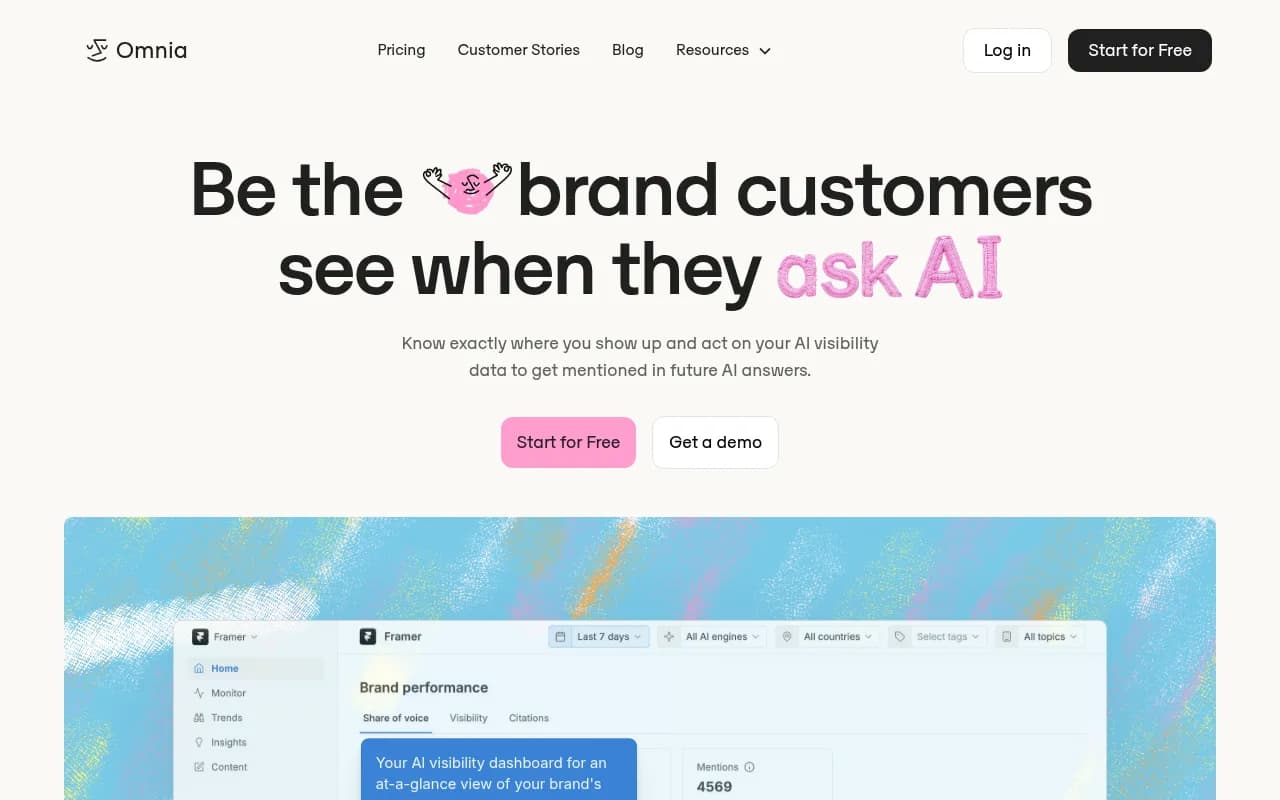
Omnia sits between pure monitoring tools and full optimization platforms. It offers share-of-voice analytics and some action-oriented features, which makes it more useful than Otterly for teams that want to do something with their data. Pricing starts at $200/month for solo users and $2,000/month for the Pro tier, which is a significant jump. Worth evaluating if you're between the Otterly and Promptwatch tiers in terms of needs and budget.
AthenaHQ -- best for teams focused on brand tracking across many models
AthenaHQ covers 8+ AI search engines and does a solid job of brand tracking and sentiment monitoring. It's more monitoring-focused than optimization-focused, which is fine if your primary goal is understanding where you stand rather than actively improving it. The platform lacks content optimization and generation capabilities, so you'd need to pair it with other tools to close the loop.

SE Ranking -- best for teams that want AI visibility inside a broader SEO platform
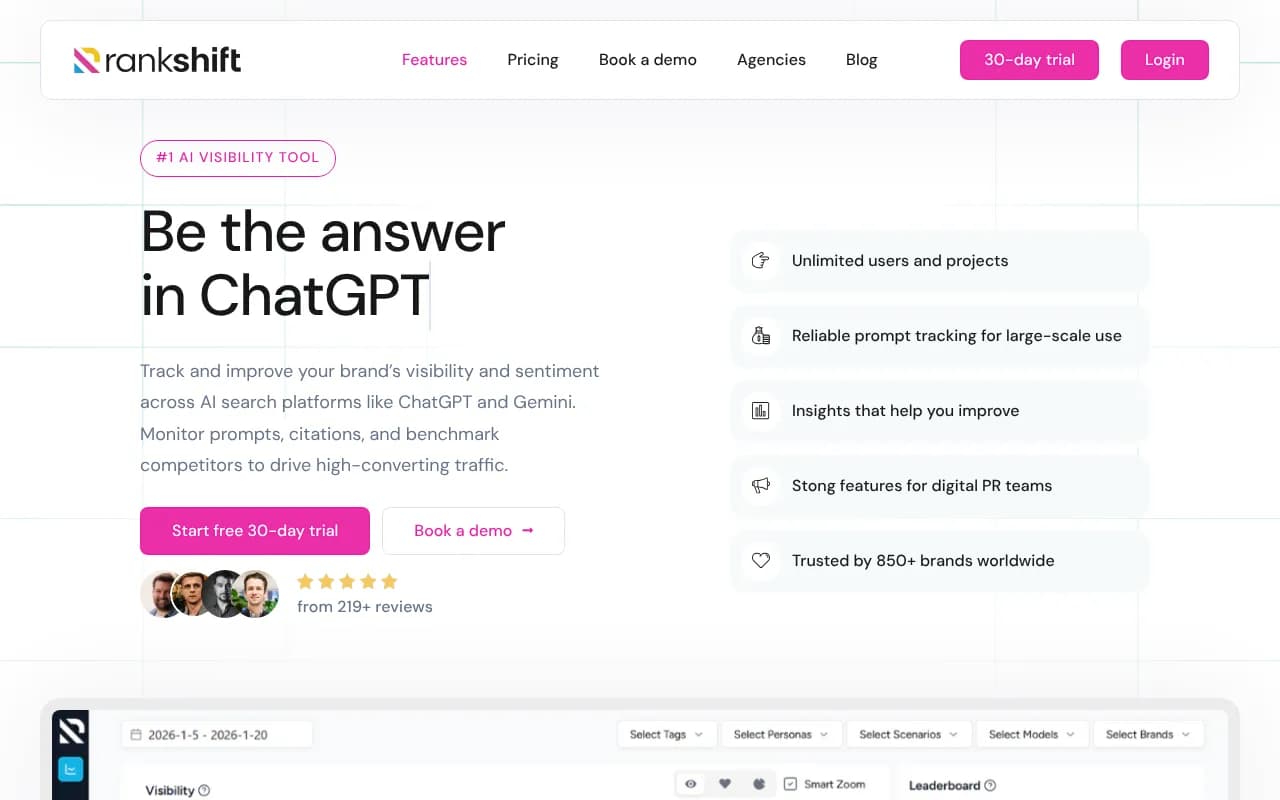
SE Ranking is a full SEO platform that added AI visibility tracking. If your team already uses SE Ranking for traditional SEO and wants to add AI monitoring without switching tools, this is the path of least resistance. The AI visibility features aren't as deep as dedicated platforms, but the integration with keyword research, site audits, and rank tracking is genuinely useful for teams that think about SEO holistically.
Rankshift -- solid LLM tracking for GEO-focused teams
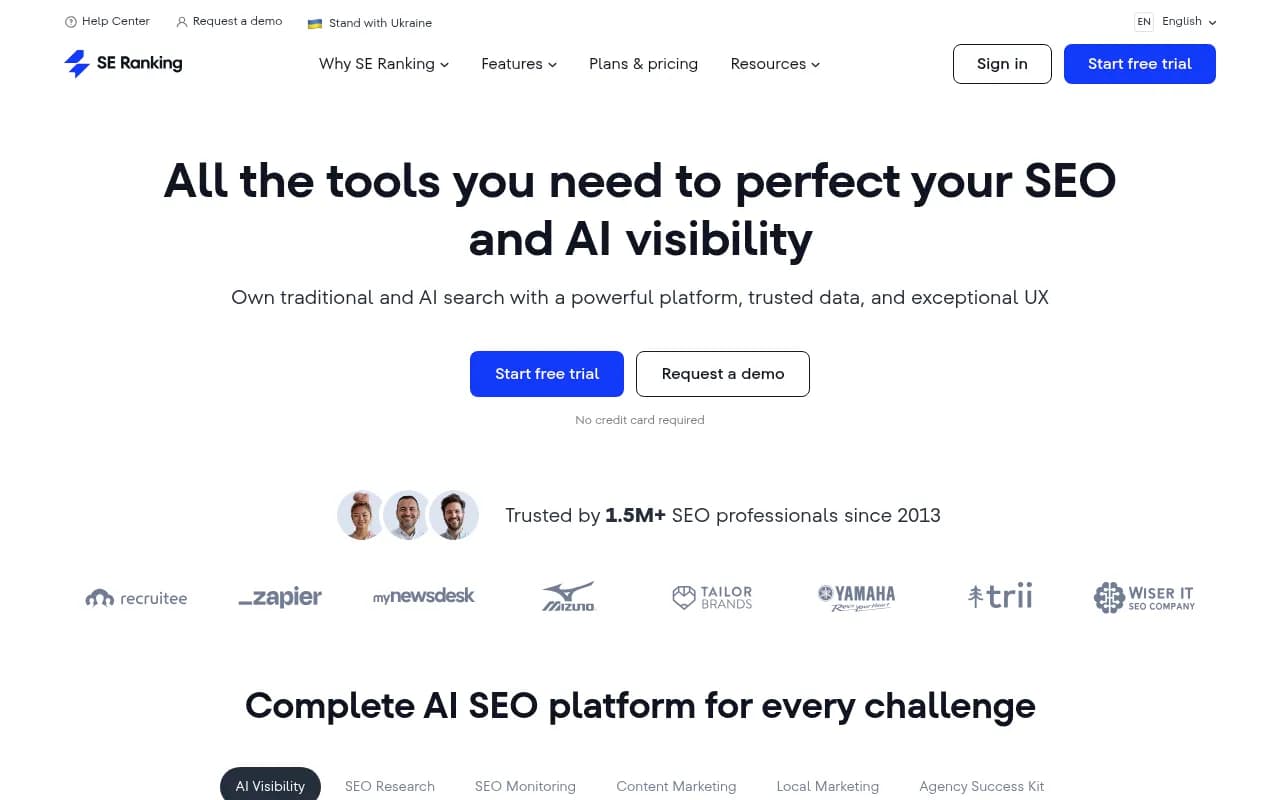
Rankshift is a newer entrant focused specifically on LLM tracking and GEO (Generative Engine Optimization). It's worth watching, particularly if your team is building a GEO practice from scratch and wants a tool designed around that workflow rather than adapted from traditional SEO. Feature set is still maturing compared to more established platforms.
Platform comparison table
| Platform | AI models covered | Content generation | Crawler logs | Prompt tracking | Starting price | Best for |
|---|---|---|---|---|---|---|
| Promptwatch | 10 | Yes (Content Agents) | Yes | Yes, with volume data | $99/mo | PLG teams that want the full optimization loop |
| Profound | 6+ | No | No | Yes | ~$1,499/mo (unverified) | Enterprise / Fortune 500 |
| Otterly.AI | 5+ | No | No | Yes | ~$49/mo | Early-stage monitoring |
| Peec AI | 5+ | No | No | Yes | ~$99/mo | Multi-language PLG |
| Omnia | 5+ | Partial | No | Yes | $200/mo | Scaleups needing some action features |
| AthenaHQ | 8+ | No | No | Yes | Custom | Brand tracking focus |
| SE Ranking | 4+ | No | No | Yes | ~$65/mo | Teams already using SE Ranking for SEO |
| Rankshift | 5+ | No | No | Yes | ~$79/mo | GEO-focused teams |
How to think about the monitoring-vs-optimization gap
This is the most important distinction in the category, and it's worth being direct about it.
Most AI visibility tools are dashboards. They show you your share of voice, your citation count, how often you're mentioned versus competitors. That data is useful. But it doesn't tell you what to do next, and it doesn't help you do it.
The monitoring-only approach creates a familiar problem for PLG growth teams: you have a metric, you know it's bad, and you have no clear path to improving it. You can see that a competitor is cited in 73% of responses to "best onboarding tool for SaaS" and you're cited in 12%, but the tool doesn't tell you why or what content would close that gap.
The optimization loop -- find the gap, generate content that fills it, track whether citations improve -- is what separates tools like Promptwatch from the rest of the field. It's also why the "Leader" designation in the 2026 comparison of 12 GEO platforms went to Promptwatch specifically: it's the only platform that covers all three steps rather than stopping at step one.
For PLG teams, this matters more than it does for traditional enterprise marketing. PLG growth is iterative and data-driven by nature. You're used to running experiments, measuring outcomes, and doubling down on what works. A monitoring dashboard gives you a metric to watch. An optimization platform gives you an experiment to run.
What the AI search landscape looks like for PLG products specifically
The citation dynamics vary significantly by AI platform, and PLG companies should understand which platforms matter most for their buyer personas.
ChatGPT controls roughly 78% of AI referral traffic and favors authoritative sources -- Wikipedia, established publications, well-cited documentation. For PLG products, this means your help docs, comparison pages, and integration guides need to be structured for citation, not just for human readers.
Perplexity is the fastest-growing platform (243% YoY) and has the best citation quality of any major AI search engine. It indexes in real-time, which means fresh content gets picked up quickly. For PLG teams running content experiments, Perplexity is the fastest feedback loop.
Google AI Overviews draws from a broader mix including blogs and Reddit, which is actually good news for PLG companies that participate in community discussions. Your presence in relevant subreddits and forums can directly influence AI citations -- something most platforms don't track but Promptwatch does.
The practical implication: don't optimize for one AI platform. Your buyers use ChatGPT for research, Perplexity for comparison, and Google AI Overviews for quick answers. You need visibility across all of them.
A practical approach for PLG teams at different stages
Seed to Series A
At this stage, you're establishing a baseline. Start with a tool that gives you prompt-based monitoring without a massive budget commitment. Otterly or Peec AI work for this. The goal is understanding which prompts matter for your category and where you currently stand.
Don't invest heavily in optimization yet -- you likely don't have enough content volume or domain authority for AI models to cite you consistently. Focus on building foundational content: comparison pages, use case pages, integration documentation.
Series A to Series C
This is where AI visibility starts to compound. You have enough content that AI models might cite you, and you have enough budget to invest in optimization. This is the right moment to move to a platform with content gap analysis and generation capabilities.
The prompt tracking at this stage should reflect your actual buyer personas. A PLG company selling to engineering teams needs different prompts than one selling to marketing teams. Tools that let you customize personas -- asking questions the way your specific buyers would ask them -- give you more accurate visibility data.
Growth stage and beyond
At scale, attribution becomes the critical feature. You need to connect AI citation activity to trial starts, activation events, and revenue. Crawler logs that show which pages AI models are reading, combined with traffic attribution that connects that activity to your product analytics, give you the data to make investment decisions.
This is also the stage where multi-model coverage matters. Your buyers are distributed across ChatGPT, Perplexity, Gemini, and increasingly Grok and Claude. A tool that only monitors two or three platforms is giving you an incomplete picture.
The Reddit and YouTube factor
One thing most PLG teams underestimate: AI models cite community content heavily. Google AI Overviews in particular draws from Reddit threads, YouTube videos, and forum discussions. If your product is being discussed positively in relevant subreddits -- or if your team has published YouTube tutorials that answer common buyer questions -- those citations can drive AI visibility without any traditional SEO work.
This is worth tracking explicitly. Knowing which Reddit threads and YouTube videos are influencing AI recommendations in your category tells you where to participate, what to create, and which community discussions to engage with. Most monitoring tools ignore this channel entirely.
Making the decision
The honest answer is that the right platform depends on what you're trying to do with the data.
If you want to understand where you stand and report on it, any of the monitoring tools in this list will work. Otterly is the cheapest, AthenaHQ covers the most models for brand tracking, and SE Ranking integrates best with existing SEO workflows.
If you want to actually improve your AI visibility -- find the gaps, create content that fills them, track whether citations improve, and connect that to revenue -- the field narrows considerably. Promptwatch is the most complete option at a price point that makes sense for growth-stage PLG companies. Profound is the enterprise alternative if budget isn't a constraint.
The PLG growth model rewards teams that can run tight experiment loops. The best AI visibility platform for a PLG company isn't the one with the prettiest dashboard -- it's the one that gives you something to act on every week.