Key takeaways
- GEO (Generative Engine Optimization) is now a distinct discipline from SEO — you need dedicated tools to track and improve how AI models like ChatGPT, Perplexity, and Gemini cite your brand.
- Most GEO platforms in 2026 are monitoring dashboards. They show you data but don't help you act on it.
- The platforms that drive real results combine visibility tracking with content gap analysis and content creation — closing the loop from "where am I invisible?" to "here's the content that fixes it."
- Pricing ranges from ~$20/month for basic trackers to $500+/month for enterprise suites. Picking the wrong tier wastes budget fast.
- Promptwatch is the only platform in 2026 rated as a "Leader" across all GEO categories — the core reason being its full action loop: find gaps, generate content, track results.
Why GEO platforms matter now
Search behavior has shifted faster than most marketing teams expected. A growing share of users now go straight to ChatGPT, Perplexity, or Google AI Overviews for product research, vendor comparisons, and buying decisions — skipping the traditional results page entirely. Gartner projected a 25% decline in traditional search traffic by 2026, and early data suggests that number is tracking close.
The problem for brands: traditional SEO tools can't tell you whether you're being cited by AI models, which prompts trigger your competitors' names instead of yours, or why an AI describes your product in a way that's slightly (or very) wrong.
That's the gap GEO platforms fill. But not all of them fill it equally.
Some tools are essentially dashboards — they run prompts, record whether your brand appeared, and show you a visibility score. That's useful baseline data. Others go further: they identify which specific content gaps are causing you to lose citations, generate the content to fill those gaps, and track whether the new content actually gets picked up by AI models.
The difference between those two categories is significant. This guide covers both, so you can decide which type you actually need.
What to look for in a GEO platform
Before comparing specific tools, it helps to know what capabilities actually matter. Here's a framework:
Monitoring depth — Does the platform track multiple AI models (ChatGPT, Perplexity, Claude, Gemini, Google AI Overviews, Grok, etc.) or just one or two? Does it run prompts at scale, or are you limited to a small fixed set?
Prompt intelligence — Can you see which prompts your competitors rank for but you don't? Do you get volume estimates and difficulty scores so you can prioritize?
Content gap analysis — Does the platform tell you why you're missing from certain AI responses, and what content you'd need to fix it?
Content generation — Can you create AI-optimized content directly in the platform, grounded in real citation data? Or do you have to export data and write elsewhere?
Traffic attribution — Can you connect AI visibility to actual website traffic and revenue? This is where most tools fall short.
Crawler logs — Does the platform show you which AI crawlers are hitting your site, which pages they're reading, and what errors they encounter?
Competitor intelligence — Can you benchmark your AI visibility against specific competitors across different models and prompt types?
The tools below vary considerably across these dimensions. I've tried to be specific about where each one excels and where it stops short.
The top GEO platforms in 2026
Promptwatch — best for teams that want to act, not just monitor
Promptwatch is the platform that comes up most often when practitioners compare the full GEO stack. It monitors 10 AI models (ChatGPT, Perplexity, Claude, Gemini, Google AI Overviews, Google AI Mode, Grok, DeepSeek, Meta AI, Copilot, Mistral) and has processed over 1.1 billion citations, clicks, and prompts.
What separates it from most competitors is the action loop. The Answer Gap Analysis shows you exactly which prompts competitors appear for but you don't — not as a vague "you're missing coverage here" note, but as specific prompts with volume estimates and difficulty scores. From there, the built-in AI writing agent generates content grounded in real citation data, targeting those gaps directly. Then page-level tracking shows whether the new content gets picked up.
It also has AI crawler logs — real-time visibility into which AI bots are crawling your site, which pages they're reading, and what errors they hit. Most competitors don't have this at all.
Used by 6,700+ brands and agencies including Booking.com and Center Parcs. Pricing starts at $99/month (Essential: 1 site, 50 prompts, 5 articles), with Professional at $249/month and Business at $579/month. Free trial available.

Profound — solid monitoring with strong enterprise positioning
Profound has built a reputation as a reliable visibility tracker for enterprise teams. It covers major LLMs, offers share-of-voice metrics, and has decent competitor benchmarking. The UI is clean and the data is trustworthy.
The limitation is that it stops at monitoring. You get good data about where you stand, but the platform doesn't help you figure out what to do about it. For teams that have a separate content operation and just need reliable tracking data, that's fine. For teams that need to move fast, it's a bottleneck.
Pricing is on the higher end for what you get, which has led some teams to look elsewhere as more full-featured platforms have matured.

AthenaHQ — strong on prompt volume data
AthenaHQ has a genuinely useful feature set for teams that want to understand prompt-level demand. Its prompt volume tracking and GEO scoring are among the more sophisticated in the market, and the Shopify integration makes it relevant for ecommerce brands.
Like Profound, though, it's primarily a monitoring and measurement tool. The content optimization and generation capabilities aren't there, so you're still on your own when it comes to actually improving your visibility. Starting price is around $295/month.

Otterly.AI — good entry point for small teams
Otterly.AI is one of the more affordable options in the space, which makes it a reasonable starting point if you're new to GEO and want to get a feel for the data before committing to a more expensive platform.
The feature set is basic: prompt monitoring, brand mention tracking, some competitor comparison. No crawler logs, no content generation, no traffic attribution. It's a monitoring tool, clearly positioned as one, and the price reflects that.

Peec AI — useful for multi-language coverage
Peec AI stands out for its multi-language tracking, which matters for brands operating across multiple markets. The prompt organization features are reasonably well-designed, and the competitor source analysis gives you some signal about where AI models are pulling information from.
It's a monitoring-focused platform without content optimization capabilities, but for international teams that need visibility data across languages, it's worth evaluating.

Semrush — traditional SEO giant adding AI features
Semrush has added AI visibility tracking to its platform, which makes sense given its existing user base. If you're already a Semrush customer, the AI features are worth exploring.
The core issue is that the AI tracking uses fixed prompts rather than a dynamic, customizable prompt set. That limits how useful it is for brands with specific positioning or niche audiences. It's also not a dedicated GEO platform — AI visibility is an add-on to a traditional SEO tool, which means the depth isn't there compared to purpose-built platforms.
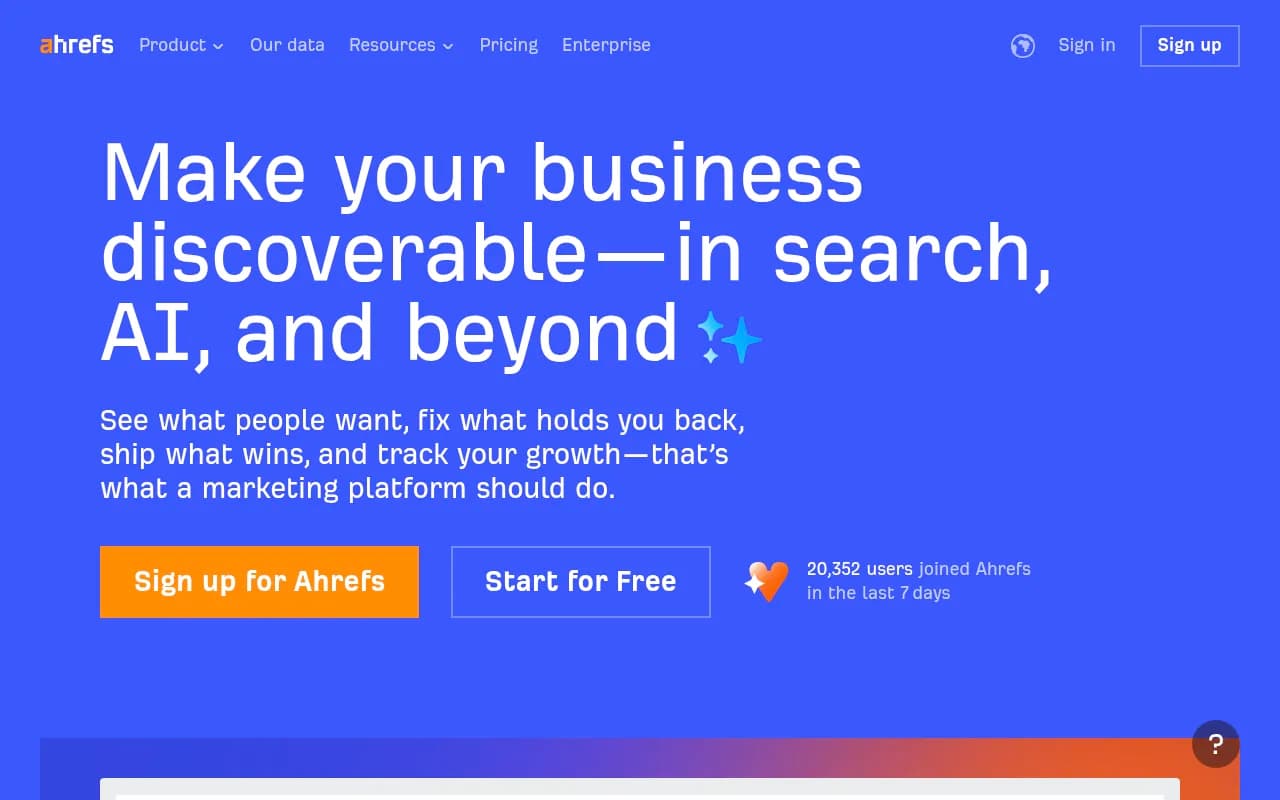
Ahrefs Brand Radar — limited but familiar
Ahrefs Brand Radar gives existing Ahrefs users a way to see brand mentions in AI responses. Like Semrush, it uses fixed prompts, which constrains its usefulness. There's no AI traffic attribution, and the feature set is narrow compared to dedicated GEO tools.
Worth knowing about if you're already in the Ahrefs ecosystem, but not a reason to switch from a purpose-built platform.
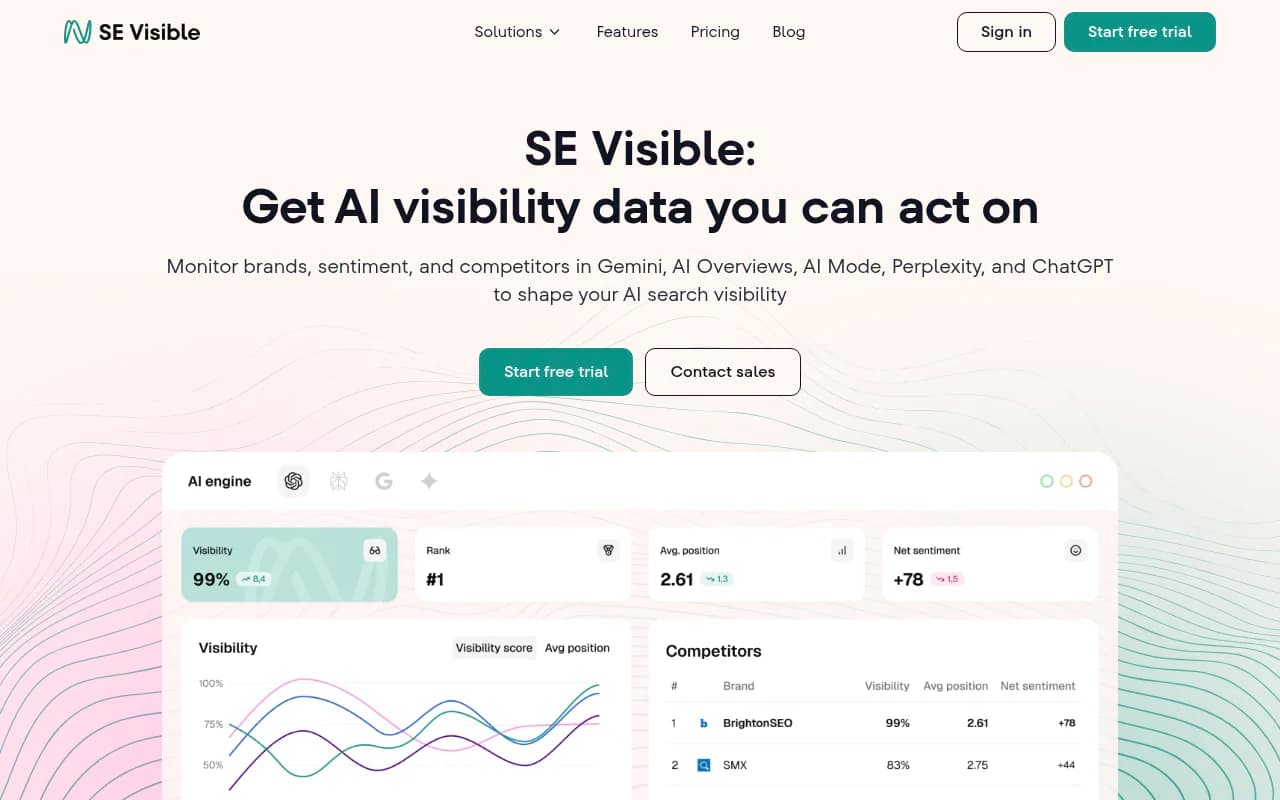
SE Visible — accessible with good sentiment tracking
SE Visible (from SE Ranking) offers a visibility score, net sentiment score, and competitor benchmarking across AI Overviews, AI Mode, Gemini, ChatGPT, and Perplexity. The sentiment tracking is a nice differentiator — knowing not just whether you appear but how AI models describe you is genuinely useful.
Starting price is $189/month, which puts it in the mid-tier. It's a monitoring-focused tool but with more nuance than some of the cheaper options.
Scrunch AI — niche focus on influencer signals
Scrunch AI takes an interesting angle: it tracks which influencer content and third-party sources are shaping AI model responses. That's a real factor in how LLMs form their answers, and most platforms ignore it entirely.
The trade-off is that it's narrow. If influencer signal analysis is your specific need, Scrunch is worth a look. If you need broad GEO coverage, it's not a complete solution on its own.
Bluefish — enterprise-focused with high price point
Bluefish positions itself as an enterprise GEO platform and has a feature set to match. It covers brand positioning, source influence analysis, and competitor benchmarking at a level that suits large organizations.
The pricing reflects the enterprise positioning — it's not a tool for smaller teams or agencies working with mid-market clients. For Fortune 500 brands with dedicated GEO budgets, it's a credible option.
Platform comparison table
| Platform | AI models covered | Content generation | Crawler logs | Traffic attribution | Prompt intelligence | Starting price |
|---|---|---|---|---|---|---|
| Promptwatch | 10+ | Yes (built-in AI writer) | Yes | Yes (GSC, code snippet, logs) | Volume + difficulty scores | $99/mo |
| Profound | Major LLMs | No | No | Limited | Basic | Higher tier |
| AthenaHQ | Broad LLM coverage | No | No | No | Volume tracking | ~$295/mo |
| Otterly.AI | Selected LLMs | No | No | No | Basic | Low tier |
| Peec AI | Selected LLMs | No | No | No | Basic | Mid tier |
| SE Visible | 5 platforms | No | No | No | Basic | $189/mo |
| Semrush | Limited (fixed prompts) | Via ContentShake | No | No | Fixed prompts | Add-on to existing plan |
| Ahrefs Brand Radar | Limited (fixed prompts) | No | No | No | Fixed prompts | Add-on to existing plan |
| Bluefish | Enterprise coverage | No | No | No | Advanced | Enterprise |
| Scrunch AI | Selected LLMs | No | No | No | Influencer signals | Mid tier |
The monitoring-only problem
One pattern worth naming directly: the majority of GEO platforms in 2026 are monitoring dashboards. They run prompts, record results, and show you a score. That's the whole product.
This isn't useless. Knowing your current visibility, tracking it over time, and benchmarking against competitors is genuinely valuable. But it leaves you with a data problem rather than solving a business problem. You know you're invisible for certain prompts. Now what?
Most teams end up exporting data, trying to interpret which content gaps matter most, briefing writers, producing content without knowing if it'll actually get cited, and then waiting weeks to see if anything changed. That process is slow and the feedback loop is weak.
The platforms that have moved beyond monitoring — building content gap analysis and content generation into the same workflow — are the ones that actually help you improve visibility rather than just measure it. That's the distinction worth paying attention to when you're evaluating options.
How to choose the right GEO platform for your situation
If you're just starting out with GEO and want to understand your baseline visibility before committing to a larger budget, Otterly.AI or Peec AI give you enough data to get oriented. Don't expect to take action from them, but they'll tell you where you stand.
If you're a marketing or SEO team at a mid-size company that needs to actually move the needle on AI visibility, you need a platform with content gap analysis and some form of content optimization. Promptwatch is the obvious choice at this level — the price is reasonable and the action loop is built in.
If you're a digital agency managing AI visibility for multiple clients, you need multi-site support, white-label reporting, and enough prompt capacity to cover diverse client portfolios. Promptwatch's agency/enterprise tier is worth a conversation. Search Party is another option specifically built for agency workflows.
If you're an enterprise brand with a large budget and complex requirements (multiple regions, languages, personas), both Promptwatch's Business/Enterprise tier and Bluefish are worth evaluating. The key question is whether you need content generation built in or have a separate content team.
If you're already deep in the Semrush or Ahrefs ecosystem, the AI features in those platforms are worth turning on as a baseline layer — but don't mistake them for a GEO strategy. The fixed-prompt approach and lack of content optimization mean you'll hit a ceiling quickly.
What good GEO practice actually looks like in 2026
The platforms are tools. What matters is the workflow you build around them.
The teams seeing real results from GEO in 2026 are running a consistent cycle: they identify which prompts matter for their category (not just branded prompts, but category-level and comparison prompts), they audit which of those prompts they're missing, they create content specifically designed to answer those prompts with the depth and structure AI models want, and they track whether that content gets cited.
That cycle requires data (which prompts, which competitors, which sources AI models trust), content creation capability, and tracking. Most platforms give you the first piece. Fewer give you all three.
The other thing practitioners have learned is that AI visibility isn't just about your website. Reddit threads, YouTube videos, industry publications, and third-party review sites all influence what AI models say about your brand. A complete GEO strategy pays attention to those channels too — which is why platforms that surface Reddit and YouTube signals (rather than just tracking your own domain) tend to give a more accurate picture of what's actually driving your AI visibility.
Final thoughts
The GEO platform market has matured quickly. A year ago, most tools were barely past the "run a prompt and see if your brand appears" stage. Now there's meaningful differentiation between platforms, and the gap between monitoring-only tools and full optimization platforms is real.
If you're evaluating options, the most important question to ask any vendor is: "After I see that I'm invisible for a prompt, what does your platform do to help me fix it?" The answer to that question will tell you more about the tool's actual value than any feature list.
For most teams, Promptwatch is the clearest answer to that question right now — but the right choice depends on your team size, budget, and how much of the content work you want the platform to handle versus doing yourself.