Key takeaways
- All three tools (AthenaHQ, Otterly.AI, Peec.ai) are monitoring-first platforms — they show you where you're invisible in AI search, but none of them help you fix it
- Otterly.AI is the most affordable entry point, starting at $29/month, making it a reasonable first step for smaller teams
- Peec.ai has the strongest analytics depth and multi-language support, with $29M raised and $4M+ ARR in under a year
- AthenaHQ adds expert guidance on top of its monitoring data, which is genuinely useful but comes at a higher price ($270/month+)
- If you need to go beyond monitoring to actually improve your AI visibility, you'll need a platform that includes content gap analysis and optimization capabilities
The AI visibility tool market has exploded. There are now dozens of platforms claiming to help you "rank in ChatGPT" or "dominate AI search." Most of them do roughly the same thing: run a set of prompts against AI engines on a schedule, record whether your brand gets mentioned, and show you a dashboard.
AthenaHQ, Otterly.AI, and Peec.ai are three of the most frequently recommended tools in this category. They're real products with real users, and each has a legitimate use case. But before you subscribe to any of them, you should understand what they actually do — and more importantly, what they don't.
This guide compares all three honestly, without putting any of them at #1 just because it's convenient.
What these tools actually do (and don't do)
Let's be direct about the category first. All three platforms are fundamentally monitoring tools. They track how often your brand appears in AI-generated responses across engines like ChatGPT, Claude, Gemini, Perplexity, and Google AI Overviews. They show you metrics like mention rate, citation share, and sentiment. They let you compare your visibility against competitors.
That's genuinely useful data. Knowing you're invisible in Perplexity for a set of high-intent prompts is better than not knowing. The problem is that the data alone doesn't tell you what to do next. None of these three tools include content generation, content gap analysis, or any mechanism for actually improving your visibility scores. They show you the problem. The solution is left to you.
This isn't a criticism unique to these three. It's a structural limitation of the monitoring-only category. Keep it in mind as you read.
Otterly.AI

Otterly.AI is the most accessible tool in this comparison. It starts at $29/month, which is low enough that a solo marketer or small agency can justify it without a budget conversation. The interface is clean and relatively easy to navigate, and setup is fast.
What it does well
Otterly covers the major AI engines — ChatGPT, Perplexity, Claude, Gemini, and Google AI Overviews — and runs prompts on a schedule to track mention rate and citation share over time. The reporting is straightforward: you can see how often your brand appears, how that changes week over week, and how you compare to a set of competitors.
For teams that are just getting started with AI visibility tracking, Otterly is a reasonable first tool. It doesn't overwhelm you with complexity, and the price means you can experiment without committing to a large contract.
Where it falls short
The depth isn't there for serious analysis. Prompt volume estimates, difficulty scoring, and query fan-outs (how one prompt branches into related sub-queries) aren't features you'll find here. There's no crawler log data, no page-level citation tracking, and no content tooling.
The competitive intelligence is also fairly surface-level. You can see that a competitor is mentioned more often than you, but you won't get a detailed breakdown of which specific prompts they're winning and why.
For a team that wants to move from "we know we have an AI visibility problem" to "here's what we're doing about it," Otterly doesn't provide the next step.
Who it's for
Otterly makes the most sense for small businesses, individual consultants, or teams that want a low-cost way to start tracking AI visibility before committing to a more comprehensive platform. It's a good "first tool" but not a long-term solution for teams that take AI search seriously.
Pricing: Starts at $29/month.
Peec.ai

Peec.ai has grown fast. The company raised $29M and reportedly crossed $4M ARR in under ten months, which suggests the product is resonating with buyers. The platform sits in the mid-market, with stronger analytics depth than Otterly and a cleaner interface than some of the enterprise-heavy competitors.
What it does well
Peec's analytics are genuinely solid. The platform covers multiple AI engines and gives you more granular data than Otterly — you can dig into which specific prompts are driving visibility, track changes over time with reasonable precision, and compare your performance against competitors at a prompt level.
Multi-language and multi-region support is a real differentiator here. If you're tracking AI visibility across markets in different languages, Peec handles this better than most tools in this price range. That's a meaningful advantage for international brands or agencies managing clients across regions.
The interface is frequently described as intuitive. It doesn't require a long onboarding process, and the data presentation is clear enough that non-technical marketers can use it without a steep learning curve.
Where it falls short
Like Otterly, Peec is a monitoring platform. There's no content generation, no content brief creation, and no mechanism for closing the gaps it identifies. You'll see that competitors are being cited for prompts you're not appearing in, but the tool won't help you create the content that would change that.
There's also no AI crawler log data. Understanding which pages AI crawlers are actually visiting, how often they return, and whether they're encountering errors is a different layer of insight — one that helps you understand the technical side of AI discoverability. Peec doesn't go there.
Who it's for
Peec is a good fit for mid-market marketing teams and agencies that want more analytical depth than Otterly provides, operate across multiple languages or regions, and are comfortable doing their own content strategy work based on the data they get. It's a solid monitoring tool for teams that already have a content process and just need better visibility data to feed into it.
Pricing: Starts at approximately €85/month.
AthenaHQ
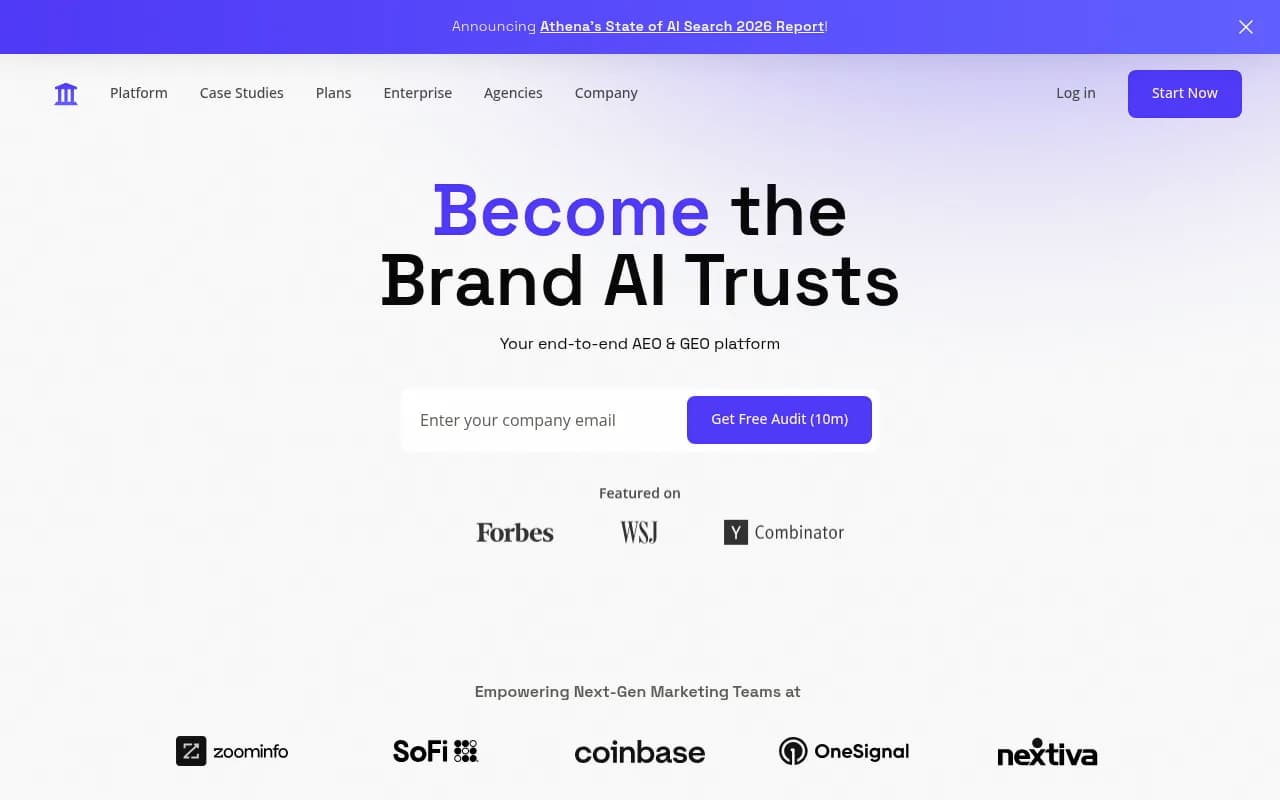
AthenaHQ sits at the higher end of this comparison, both in price and in what it offers beyond raw data. The platform tracks visibility across 8+ AI search engines and adds a layer of expert guidance that the other two don't include.
What it does well
The monitoring coverage is comprehensive. AthenaHQ tracks a wide range of AI engines and gives you visibility data at a level of detail that justifies the higher price point for the right buyer. The competitive intelligence features are more developed than Otterly's, and the platform is built for teams that want to take AI visibility seriously as a discipline.
The expert guidance component is the most distinctive thing about AthenaHQ. Rather than just handing you a dashboard and leaving you to figure out what to do, the platform includes strategic recommendations and, in some tiers, access to human experts who help interpret the data. For teams that don't have in-house GEO expertise, this is genuinely valuable.
Where it falls short
At $270/month and up, AthenaHQ is a meaningful budget commitment. The expert guidance is useful, but it's still advisory — you're getting recommendations about what to do, not tools that help you do it. Content generation, content gap analysis, and optimization workflows aren't part of the platform.
There's also no Reddit or YouTube tracking. These channels have an outsized influence on what AI models recommend, because models frequently cite community discussions and video content in their responses. Ignoring them means you're missing a significant piece of the AI visibility picture.
Who it's for
AthenaHQ makes the most sense for larger marketing teams or agencies that want comprehensive monitoring data plus strategic guidance, and are willing to pay for the combination. It's a better fit than Otterly or Peec for teams that want a human layer on top of the data, but it's still a monitoring-first platform at its core.
Pricing: Starts at approximately $270/month.
Side-by-side comparison
| Feature | Otterly.AI | Peec.ai | AthenaHQ |
|---|---|---|---|
| Starting price | $29/mo | ~€85/mo | ~$270/mo |
| AI engines covered | 5+ | 5+ | 8+ |
| Multi-language support | Limited | Strong | Moderate |
| Competitor tracking | Basic | Solid | Comprehensive |
| Prompt-level analytics | Basic | Solid | Solid |
| Expert guidance | No | No | Yes |
| Content gap analysis | No | No | No |
| Content generation | No | No | No |
| AI crawler logs | No | No | No |
| Reddit/YouTube tracking | No | No | No |
| ChatGPT Shopping tracking | No | No | No |
| Best for | SMBs, solo marketers | Mid-market, international teams | Larger teams wanting guidance |
The monitoring gap: what all three tools share
It's worth being explicit about what's missing across all three platforms, because it matters for how you plan your AI visibility strategy.
None of these tools tell you which specific content your website needs to start appearing in AI responses. They can show you that a competitor is cited for "best project management software for remote teams" and you're not. But they won't analyze your existing content, identify what's missing, or help you create something that fills the gap.
None of them track AI crawler behavior. When ChatGPT or Perplexity crawls your website, which pages do they read? How often do they return? Are they hitting errors? This data matters because it tells you whether AI models can even access your content, which is a prerequisite for being cited. None of these three tools surface it.
None of them connect visibility to revenue. You can watch your mention rate go up or down, but you won't know whether that's translating into actual traffic or conversions.
These aren't minor gaps. They're the difference between knowing you have a problem and being able to solve it. If your goal is to actually improve your AI visibility rather than just measure it, you'll eventually need a platform that goes further.
For teams that want the full loop — identifying gaps, creating content to fill them, and tracking the results through to revenue — Promptwatch is worth looking at. It's built around the action cycle rather than just the monitoring layer, and it includes content generation, crawler logs, and traffic attribution that none of these three tools offer.

How to choose between the three
If you're trying to decide which of these three tools to start with, here's a practical framework:
Start with Otterly if: You're new to AI visibility tracking, have a limited budget, and want to understand the basics before committing to a more expensive platform. It's the lowest-risk way to get started.
Choose Peec.ai if: You need solid analytics depth, operate across multiple languages or regions, and want a clean interface that your whole team can use without a lot of training. It's the best pure monitoring tool in this group.
Go with AthenaHQ if: You have the budget, want comprehensive engine coverage, and value having expert guidance alongside the data. It's the right choice for teams that want a strategic partner, not just a dashboard.
Consider a more complete platform if: You've already been monitoring for a while and you're frustrated that the data isn't translating into improved visibility. That's usually a sign that monitoring alone isn't enough.
A note on the broader market
These three tools exist in a market that raised over $300M in funding between mid-2025 and early 2026. The category is real, the demand is real, and the tools are improving quickly. Google AI Overviews now reaches 2.5 billion monthly users according to Google's I/O 2026 announcements, and ChatGPT crossed 900 million weekly active users in early 2026. The stakes for AI visibility are higher than they were even a year ago.
That context matters when you're choosing a tool. A monitoring-only platform made sense when AI search was a secondary channel. Now that it's primary for a growing share of buyer journeys, the question isn't just "are we being cited?" It's "what are we doing about it when we're not?"
The three tools in this comparison are honest, functional products. They'll tell you where you stand. What you do with that information is still up to you.
Bottom line
AthenaHQ, Otterly.AI, and Peec.ai are all legitimate tools for tracking AI visibility. Otterly is the most accessible, Peec has the best analytics for the price, and AthenaHQ adds expert guidance that the others lack. None of them help you act on what they find.
If you're just starting to measure AI visibility, any of these will get you data faster than building something yourself. If you're past the "we need to understand the problem" stage and into "we need to fix it," you'll need something that goes further than a monitoring dashboard.