Summary
- Competitor analysis is the new differentiator: Most AI visibility tools track your own brand mentions, but the best ones show you exactly where competitors are winning -- which prompts they rank for, which content they're cited from, and what gaps you can exploit
- Promptwatch leads on actionable competitor insights: Answer Gap Analysis shows the specific prompts competitors rank for but you don't, plus the exact content angles AI models want. Most competitors stop at monitoring.
- Profound and Semrush AIO offer the deepest data: Profound gives analyst teams raw API access and near real-time competitor tracking. Semrush AIO handles multi-brand, multi-region competitor benchmarking at enterprise scale.
- SE Visible and Conductor excel at visual competitor heatmaps: Both platforms let you compare your AI visibility vs competitors across LLMs with color-coded grids that make it obvious who's winning where
- Reddit and YouTube tracking separate leaders from followers: Tools like Promptwatch and ZipTie surface competitor discussions on Reddit and YouTube that directly influence AI recommendations -- a channel most platforms ignore
Why competitor analysis matters more in AI search than traditional SEO
In traditional SEO, you track keyword rankings and backlinks. In AI search, you're invisible until an LLM cites you -- and you have no idea why it chose a competitor instead.
Competitor analysis in AI visibility tools answers three questions:
- Which prompts are competitors visible for that you're not? This is the content gap. If ChatGPT cites a competitor's guide on "best project management tools for remote teams" but never mentions your brand, you're missing that angle entirely.
- What content are they getting cited from? Knowing a competitor ranks for a prompt is useless without seeing the specific page, Reddit thread, or YouTube video that earned the citation. The best tools show you the source.
- How do you stack up across LLMs? A competitor might dominate ChatGPT but be invisible in Perplexity. Knowing where you have an opening changes your strategy.
Most AI visibility tools show you your own brand mentions and call it a day. The platforms below go further -- they help you understand the competitive landscape and take action.
The best AI visibility tools for competitor analysis in 2026
Promptwatch: Answer Gap Analysis and content generation grounded in competitor data
Promptwatch is the only AI visibility platform rated as a "Leader" across all categories in a 2026 comparison of 12 GEO tools. The core difference: it doesn't just show you where competitors are winning -- it helps you close the gap.

Answer Gap Analysis is the standout feature. It shows you the exact prompts competitors are visible for but you're not, along with the specific content angles and topics AI models are looking for. You see a list of prompts like "best CRM for small businesses" or "how to automate lead scoring" where competitors get cited and you don't. Click into any prompt and Promptwatch shows you which pages competitors are cited from, what those pages cover, and what's missing from your own content.
This isn't a vague "you should write about CRMs" suggestion. It's a concrete list of winnable prompts with volume estimates, difficulty scores, and query fan-outs that show how one prompt branches into sub-queries.
Once you've identified the gaps, Promptwatch's AI writing agent generates articles, listicles, and comparisons grounded in 880M+ citations analyzed, prompt volumes, persona targeting, and competitor analysis. The content is engineered to get cited by ChatGPT, Claude, Perplexity, and other AI models -- not generic SEO filler.
After publishing, you track results with page-level citation tracking and traffic attribution (code snippet, GSC integration, or server log analysis). The loop closes: find gaps, generate content, track results.
Other competitor analysis features:
- Competitor heatmaps: Compare your AI visibility vs competitors across 10 LLMs (ChatGPT, Perplexity, Claude, Gemini, Meta AI, DeepSeek, Grok, Mistral, Copilot, Google AI Overviews). See who's winning for each prompt.
- Reddit and YouTube insights: Surface competitor discussions that directly influence AI recommendations. Most tools ignore these channels entirely.
- Citation and source analysis: See exactly which pages, Reddit threads, YouTube videos, and domains AI models cite in their responses. Know where competitors are getting cited from.
- AI crawler logs: Real-time logs of AI crawlers (ChatGPT, Claude, Perplexity, etc.) hitting competitor websites. Understand how AI engines discover their content.
- ChatGPT Shopping tracking: Monitor when competitors appear in ChatGPT's product recommendations and shopping carousels.
Pricing: Essential $99/mo (1 site, 50 prompts, 5 articles), Professional $249/mo (2 sites, 150 prompts, 15 articles, crawler logs), Business $579/mo (5 sites, 350 prompts, 30 articles). Free trial available.
Best for: Marketing teams and agencies that want to move beyond monitoring and actually optimize their AI visibility with competitor-informed content.
Profound: Analyst-led competitor tracking with API access and near real-time data
Profound is built for teams with dedicated analysts who want raw data, APIs, and the flexibility to build custom competitor dashboards. It tracks AI responses across ChatGPT, Perplexity, Claude, Gemini, and Google AI Overviews with near real-time monitoring.

The competitor analysis workflow centers on custom prompt sets. You define the prompts that matter to your business, add competitors, and Profound tracks who gets cited in each response. The data exports to CSV or pulls via API, so analyst teams can build their own visualizations in Looker, Tableau, or internal BI tools.
Profound doesn't hand you pre-built competitor heatmaps or gap analysis reports. It gives you the raw citation data and lets you decide what to do with it. If you have the team to build on top of the API, it's powerful. If you want out-of-the-box recommendations, look elsewhere.
Other competitor analysis features:
- Citation source tracking: See which URLs, Reddit threads, and YouTube videos competitors are cited from
- Multi-region and multi-language tracking: Compare competitor visibility across countries and languages
- Historical data: Track how competitor visibility changes over time
Pricing: Custom enterprise pricing. Expect $1,000+/mo for serious usage.
Best for: Enterprise teams with analyst-driven workflows that need raw data and API flexibility.
Semrush AIO: Multi-brand, multi-region competitor benchmarking at scale
Semrush AIO (AI Optimization) is the enterprise version of Semrush's AI visibility toolkit. It's designed for large organizations managing multiple brands, regions, or product lines that need granular, automated competitor reporting.
The competitor analysis workflow is built around multi-client workspaces. You can set up separate projects for each brand or region, define competitor sets for each, and compare AI visibility across all of them in a unified dashboard. This is useful if you're an agency managing 20 clients or an enterprise with regional brands in 15 countries.
Semrush AIO tracks competitors across ChatGPT, Perplexity, Google AI Overviews, and Gemini. The platform shows you which prompts competitors rank for, which content they're cited from, and how your visibility compares over time. Reports auto-generate and can be white-labeled for client delivery.
The downside: Semrush uses a fixed set of prompts. You can't define custom prompts or track niche queries that matter to your specific business. If your industry has specialized terminology or long-tail prompts, you're stuck with Semrush's generic prompt library.
Other competitor analysis features:
- GEO Audit: SWOT analysis and visibility gap identification
- Automated reporting: Schedule competitor reports to deliver weekly or monthly
- White-label dashboards: Rebrand reports for client delivery
Pricing: Custom enterprise pricing. Expect $2,000+/mo.
Best for: Agencies and enterprises managing multiple brands or regions that need automated, white-labeled competitor reporting.
SE Visible: Visual competitor heatmaps and SWOT analysis
SE Visible (formerly SE Ranking's AI Mode Tracking) is a user-friendly platform that excels at visual competitor comparisons. The standout feature is the competitor heatmap -- a color-coded grid that shows your AI visibility vs competitors across LLMs and prompts.
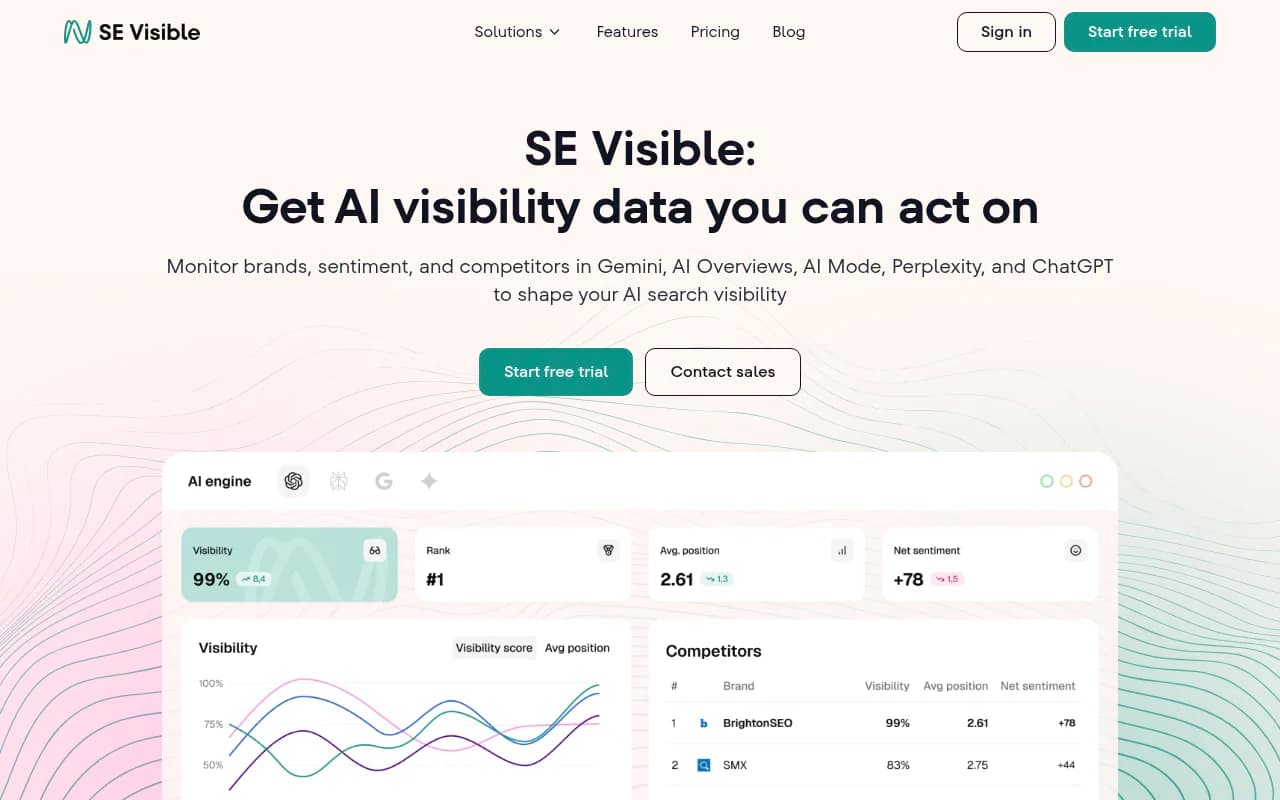
You define a set of prompts, add competitors, and SE Visible tracks who gets cited in each response. The heatmap makes it obvious at a glance: green means you're winning, red means a competitor is, gray means nobody is. Click into any cell and you see the full AI response, citations, and source URLs.
The GEO Audit feature runs a SWOT analysis comparing your AI visibility to competitors. It identifies strengths (prompts you dominate), weaknesses (prompts competitors own), opportunities (prompts with low competition), and threats (prompts where competitors are gaining ground).
SE Visible tracks ChatGPT, Perplexity, Google AI Overviews, Claude, and Gemini. It's not as deep as Profound or as action-oriented as Promptwatch, but the visual competitor heatmaps make it easy to spot patterns and prioritize.
Other competitor analysis features:
- Citation source tracking: See which URLs competitors are cited from
- Historical tracking: Compare competitor visibility over time
- Multi-client workspaces: Manage separate brands and clients
Pricing: Starts at $99/mo. Custom pricing for agencies and enterprises.
Best for: Teams that want visual, easy-to-understand competitor comparisons without heavy setup.
Conductor: Persona-based competitor tracking and content gap analysis
Conductor is an enterprise SEO platform that added AI visibility tracking in 2025. The competitor analysis workflow is built around personas -- you define different customer segments (e.g. "enterprise IT buyers" vs "SMB marketers") and track how competitors perform for each persona's prompts.
This is useful if your competitors target different audiences than you do. A competitor might dominate prompts from enterprise buyers but be invisible to SMBs. Conductor's persona-based tracking surfaces those nuances.
The platform tracks ChatGPT, Perplexity, Google AI Overviews, and Claude. It shows you which prompts competitors rank for, which content they're cited from, and how your visibility compares by persona. The content gap analysis feature identifies prompts where competitors are cited but you're not, along with suggested topics to cover.
Conductor integrates with your existing SEO workflows -- keyword research, content briefs, performance tracking. If you're already using Conductor for SEO, adding AI visibility tracking is a natural extension. If you're not, the platform is overkill for AI visibility alone.
Other competitor analysis features:
- Citation source tracking: See which URLs competitors are cited from
- Historical tracking: Compare competitor visibility over time
- Integration with SEO workflows: Connect AI visibility data to keyword research and content briefs
Pricing: Custom enterprise pricing. Expect $3,000+/mo.
Best for: Enterprise SEO teams already using Conductor that want to add AI visibility tracking with persona-based competitor analysis.
ZipTie: Deep citation analysis and Reddit/YouTube competitor tracking
ZipTie is a deep-analysis AI visibility tool that focuses on understanding why competitors get cited. The platform tracks ChatGPT, Perplexity, Claude, Gemini, and Google AI Overviews, but the real value is in the citation analysis.
For every prompt, ZipTie shows you not just which competitors are cited, but which specific pages, Reddit threads, YouTube videos, and domains they're cited from. You can filter by source type -- see all Reddit citations, all YouTube citations, all blog posts -- and identify patterns.
This is where ZipTie stands out: it surfaces competitor discussions on Reddit and YouTube that directly influence AI recommendations. If a competitor has a popular Reddit thread about "best email marketing tools" and that thread gets cited by ChatGPT, you see it. Most tools ignore these channels entirely.
ZipTie also tracks citation sentiment -- whether the AI response mentions a competitor positively, negatively, or neutrally. This helps you understand not just visibility but perception.
The downside: ZipTie is data-heavy. It's built for analyst teams that want to dig into the details, not for marketers who want quick recommendations.
Other competitor analysis features:
- Historical tracking: Compare competitor visibility over time
- Multi-region tracking: Track competitors across countries
- API access: Export data for custom analysis
Pricing: Starts at $199/mo. Custom pricing for enterprises.
Best for: Analyst teams that want deep citation analysis and Reddit/YouTube competitor tracking.
Peec AI: Multi-language competitor tracking for global brands
Peec AI is a straightforward AI visibility tracker that excels at multi-language competitor analysis. If you're a global brand competing in multiple languages, Peec AI makes it easy to compare your visibility vs competitors across regions.

You define prompts in any language, add competitors, and Peec AI tracks who gets cited in each response. The platform supports 50+ languages and tracks ChatGPT, Perplexity, Claude, Gemini, and Google AI Overviews.
The competitor analysis workflow is simple: you see a list of prompts, your visibility score for each, and your competitors' scores. Click into any prompt and you see the full AI response, citations, and source URLs. There's no fancy heatmap or SWOT analysis -- just clean, organized data.
Peec AI is best for teams that need multi-language tracking without heavy setup. If you're only tracking English prompts, other tools offer more depth.
Other competitor analysis features:
- Citation source tracking: See which URLs competitors are cited from
- Historical tracking: Compare competitor visibility over time
- Alerts: Get notified when competitors gain or lose visibility
Pricing: Starts at $99/mo. Custom pricing for enterprises.
Best for: Global brands that need multi-language competitor tracking.
Otterly.AI: Affordable competitor monitoring for small teams
Otterly.AI is a budget-friendly AI visibility tracker that offers basic competitor monitoring. It tracks ChatGPT, Perplexity, and Google AI Overviews, showing you which prompts competitors rank for and which content they're cited from.

The competitor analysis is straightforward: you add competitors, define prompts, and Otterly.AI tracks who gets cited. There's no advanced gap analysis, no Reddit tracking, no content generation. Just monitoring.
Otterly.AI is best for small teams or freelancers who want to keep an eye on competitors without spending $500+/mo. If you need deeper insights or optimization workflows, look at Promptwatch or SE Visible.
Other competitor analysis features:
- Citation source tracking: See which URLs competitors are cited from
- Alerts: Get notified when competitors gain or lose visibility
Pricing: Starts at $49/mo.
Best for: Small teams and freelancers who want affordable competitor monitoring.
Comparison table: Competitor analysis features across platforms
| Tool | Answer Gap Analysis | Reddit/YouTube Tracking | Competitor Heatmaps | Citation Source Analysis | Content Generation | Multi-language | API Access | Starting Price |
|---|---|---|---|---|---|---|---|---|
| Promptwatch | Yes | Yes | Yes | Yes | Yes | Yes | Yes | $99/mo |
| Profound | No | Limited | No | Yes | No | Yes | Yes | Custom |
| Semrush AIO | Yes | No | No | Yes | No | Yes | Limited | Custom |
| SE Visible | Yes | No | Yes | Yes | No | Yes | No | $99/mo |
| Conductor | Yes | No | No | Yes | No | Yes | Yes | Custom |
| ZipTie | No | Yes | No | Yes | No | Yes | Yes | $199/mo |
| Peec AI | No | No | No | Yes | No | Yes | No | $99/mo |
| Otterly.AI | No | No | No | Yes | No | No | No | $49/mo |
What to look for in an AI visibility tool's competitor analysis features
Not all competitor analysis features are created equal. Here's what separates the useful from the noise:
1. Answer Gap Analysis (not just "you're not ranking")
Most tools show you a list of prompts where competitors rank and you don't. That's table stakes. The best tools go further: they show you the specific content angles, topics, and questions AI models are looking for. Promptwatch's Answer Gap Analysis does this. Semrush AIO's GEO Audit does a version of it. SE Visible's SWOT analysis hints at it.
Without this, you're left guessing what to write. "Competitors rank for 'best CRM tools'" is useless without knowing whether AI models want a comparison chart, a feature breakdown, or a use-case guide.
2. Citation source tracking (not just brand mentions)
Knowing a competitor is cited for a prompt is useless without seeing the source. Is it their homepage? A blog post? A Reddit thread? A YouTube video? The source tells you what format and channel to prioritize.
Every tool on this list tracks citation sources, but Promptwatch and ZipTie go deeper by surfacing Reddit and YouTube discussions that influence AI recommendations. This is a blind spot for most platforms.
3. Competitor heatmaps (visual, not just tables)
Comparing your visibility to competitors across 50 prompts and 5 LLMs generates 250 data points. A table is unreadable. A heatmap makes patterns obvious at a glance.
SE Visible and Conductor both offer visual competitor heatmaps. Promptwatch's competitor comparison views are clean and scannable. Profound and Peec AI rely on tables and exports.
4. Reddit and YouTube tracking (the hidden influence layer)
AI models cite Reddit threads and YouTube videos more often than most marketers realize. A competitor's Reddit post about "best project management tools" can influence ChatGPT's recommendations for months.
Promptwatch and ZipTie track Reddit and YouTube citations. Most other tools ignore these channels entirely.
5. Content generation grounded in competitor data (action, not just insights)
The best competitor analysis doesn't stop at showing you gaps -- it helps you close them. Promptwatch's AI writing agent generates content grounded in competitor analysis, citation data, and prompt volumes. Writesonic offers a version of this. Most other tools leave you to figure out content creation on your own.
6. Multi-language and multi-region support (for global brands)
If you compete in multiple languages or regions, you need a tool that tracks competitors across all of them. Peec AI, Profound, and Conductor handle this well. Promptwatch supports multi-language tracking. Otterly.AI and SE Visible are more limited.
How to use competitor analysis to improve your AI visibility
Here's a practical workflow using the tools above:
Step 1: Identify your top competitors in AI search
Your traditional SEO competitors might not be your AI search competitors. AI models cite different sources -- Reddit threads, YouTube videos, niche blogs -- that don't rank on Google.
Use Promptwatch, SE Visible, or Profound to track a broad set of prompts relevant to your business. See which brands, domains, and sources get cited most often. Those are your AI search competitors.
Step 2: Find the content gaps
Run Answer Gap Analysis in Promptwatch or GEO Audit in Semrush AIO. Export the list of prompts where competitors are cited but you're not. Prioritize by prompt volume and difficulty.
For each gap, look at the citation sources. What format are competitors using? Blog posts? Comparison pages? Reddit threads? What topics and angles are they covering?
Step 3: Create content that fills the gaps
Use Promptwatch's AI writing agent or Writesonic to generate content grounded in competitor analysis and citation data. If you're using Profound or SE Visible, you'll need to create content manually or with a separate tool.
Focus on the specific angles and questions AI models are looking for. If competitors are cited for "best CRM for small businesses" and their content covers pricing, integrations, and ease of use, your content should cover those too -- plus something they're missing.
Step 4: Track the results
Publish the content and monitor your AI visibility for those prompts. Use Promptwatch's page-level tracking, SE Visible's heatmaps, or Profound's API to see if your new content starts getting cited.
Connect visibility to traffic with Promptwatch's traffic attribution, GSC integration, or server log analysis. Close the loop: did the new content improve your AI visibility and drive actual traffic?
Step 5: Repeat
AI search is not a one-time optimization. AI models update their training data, competitors publish new content, and prompt trends shift. Run Answer Gap Analysis monthly. Track competitor visibility weekly. Keep creating content that fills the gaps.
Final thoughts
Competitor analysis is the difference between guessing and knowing. Most AI visibility tools show you your own brand mentions and stop there. The platforms above go further -- they show you where competitors are winning, what content they're cited from, and what gaps you can exploit.
Promptwatch leads on actionable competitor insights with Answer Gap Analysis, Reddit/YouTube tracking, and AI content generation grounded in competitor data. Profound and Semrush AIO offer the deepest data for analyst-driven teams. SE Visible and Conductor excel at visual competitor heatmaps. ZipTie surfaces Reddit and YouTube discussions that influence AI recommendations.
Pick the tool that matches your team's workflow. If you want to move beyond monitoring and actually optimize your AI visibility, start with Promptwatch. If you need raw data and API access, go with Profound. If you want visual competitor heatmaps without heavy setup, try SE Visible.
The brands that win in AI search are the ones that understand the competitive landscape and take action. Competitor analysis is how you get there.