Key takeaways
- Real-time alerting in AI search is genuinely different from traditional rank tracking -- you're not watching a position number change, you're watching whether an LLM mentions you at all.
- Most AI visibility platforms are monitoring dashboards that show you what happened. The best ones also tell you why it happened and what to do about it.
- The tools that stand out in 2026 combine alert systems with content gap analysis and optimization workflows -- catching a drop is only useful if you can act on it.
- Pricing ranges from free tiers to $500+/month for enterprise plans. The right choice depends on how many AI models you need to track and whether you need content creation built in.
- If you're managing AI visibility for multiple brands or clients, look for platforms with multi-site support, white-label reporting, and API access.
Your competitor just got cited in a ChatGPT answer to 50,000 people asking which software to buy. You found out three weeks later when your pipeline numbers looked weird.
That's the reality of AI search in 2026. Traditional rank trackers don't see it. Google Search Console doesn't log it. And by the time you notice the traffic dip, the damage is already done.
Real-time alerting for AI search visibility is no longer a nice-to-have. It's the difference between catching a brand narrative problem in hours versus months. This guide covers the seven platforms that actually do it well -- what they alert on, how fast, and whether they help you fix the problem or just document it.
What "real-time alerting" actually means in AI search
Before getting into the tools, it's worth being precise about what we're comparing.
In traditional SEO, an alert usually means "your keyword dropped from position 3 to position 7." That's a rank change on a known SERP. Straightforward.
In AI search, the equivalent is messier. You're tracking whether a language model like ChatGPT, Perplexity, Claude, or Gemini mentions your brand when someone asks a relevant question. The "position" is whether you appear at all, how prominently, and what the model says about you. That changes based on the model's training data, retrieval sources, the exact phrasing of the prompt, and sometimes just random variation in generation.
So when a platform claims "real-time alerting," you want to know:
- What triggers the alert? (Mention dropped, competitor appeared, sentiment changed, new citation source detected?)
- How frequently do they actually re-query the AI models? (Hourly, daily, weekly?)
- Do they alert on specific pages being cited or dropped from citations?
- Can you customize alert thresholds?
With that framing in mind, here are the seven platforms worth your attention.
The top 7 AI search alerting platforms in 2026
1. Promptwatch
Promptwatch is the most complete option on this list for teams that want to move from "we got an alert" to "we fixed the problem" without switching tools.

The alerting system sits inside a broader workflow: you track prompts across 10 AI models (ChatGPT, Perplexity, Claude, Gemini, Grok, DeepSeek, Copilot, Meta AI, Mistral, and Google AI Overviews), and when your visibility score drops or a competitor gains ground, you get notified. But the part that separates it from most competitors is what happens next.
Promptwatch's Answer Gap Analysis shows you the specific prompts where competitors appear and you don't. The built-in AI writing agent then generates content -- articles, listicles, comparisons -- engineered around the citation patterns from 880M+ analyzed citations. You're not just watching the gap widen; you're closing it.
The AI Crawler Logs feature is particularly useful for alerting purposes. You can see in real time which AI crawlers (ChatGPT's GPTBot, Perplexity's bot, etc.) are hitting your site, which pages they're reading, and whether they're encountering errors. If a crawler stops visiting a key page, that's an early warning sign before your citation numbers drop.
Pricing starts at $99/month (Essential: 1 site, 50 prompts), $249/month (Professional: 2 sites, 150 prompts, crawler logs), and $579/month (Business: 5 sites, 350 prompts). A free trial is available.
2. Profound
Profound is the enterprise standard for AI search monitoring, and it earns that reputation through depth of data rather than breadth of features.

The alerting system in Profound is built around what they call "AI answer monitoring" -- tracking how specific AI models respond to your target prompts over time. When the response changes (your brand appears, disappears, or the sentiment shifts), you get notified. For large brands running hundreds of prompts across multiple markets, this is genuinely valuable.
Where Profound is strong: the quality of the underlying data, the ability to track at enterprise scale, and the research-grade analysis. Their landmark study on generative intent (finding that 37.5% of search behavior has shifted to generative intent) gives you a sense of how seriously they approach the data side.
Where it's less strong: Profound is primarily a monitoring and analytics platform. It doesn't have built-in content generation or the kind of action loop that Promptwatch offers. You'll get excellent alerts, but you'll need other tools to act on them.
Best for: Enterprise brands and agencies that need rigorous monitoring at scale and have separate content teams to act on the insights.
3. Otterly.AI
Otterly is the budget-friendly entry point for AI search monitoring, and it's genuinely good at what it does within its scope.

Starting at $29/month, Otterly tracks your brand mentions across ChatGPT, Perplexity, Gemini, and a handful of other models. The alerting is straightforward: set up your prompts, and get notified when your visibility changes. The interface is clean and the setup time is minimal -- you can be tracking within 20 minutes of signing up.
The limitation is that Otterly is a monitoring-only tool. There's no content gap analysis, no built-in content generation, no crawler log access. It shows you the data and leaves the "what do I do about it?" question entirely to you. For a solo marketer or a small team just getting started with AI visibility, that's probably fine. For a team that needs to act on the data quickly, you'll hit the ceiling fast.
Best for: Small teams and individuals who want affordable AI mention monitoring without a complex setup.
4. Peec AI
Peec AI sits in an interesting middle ground -- more capable than Otterly, less expensive than Profound, with genuinely strong multi-language support that most competitors ignore.

At around €89/month, Peec tracks your brand across major AI models and alerts you when your visibility changes. The multi-language and multi-region tracking is a real differentiator: if you're running campaigns in French, German, Spanish, or other languages, Peec handles that natively in a way that most English-first tools don't.
The alerting system is solid and the dashboards are clear. Like Otterly, it's primarily a monitoring platform -- the alerts tell you something changed, but the optimization work happens outside the tool. The competitive heatmaps are useful for understanding where you're losing ground relative to specific competitors.
Best for: International brands and European companies that need multi-language AI visibility tracking at a reasonable price.
5. Omnia
Omnia is a newer entrant that's built specifically around share-of-voice analytics in AI search, and its alerting system reflects that focus.
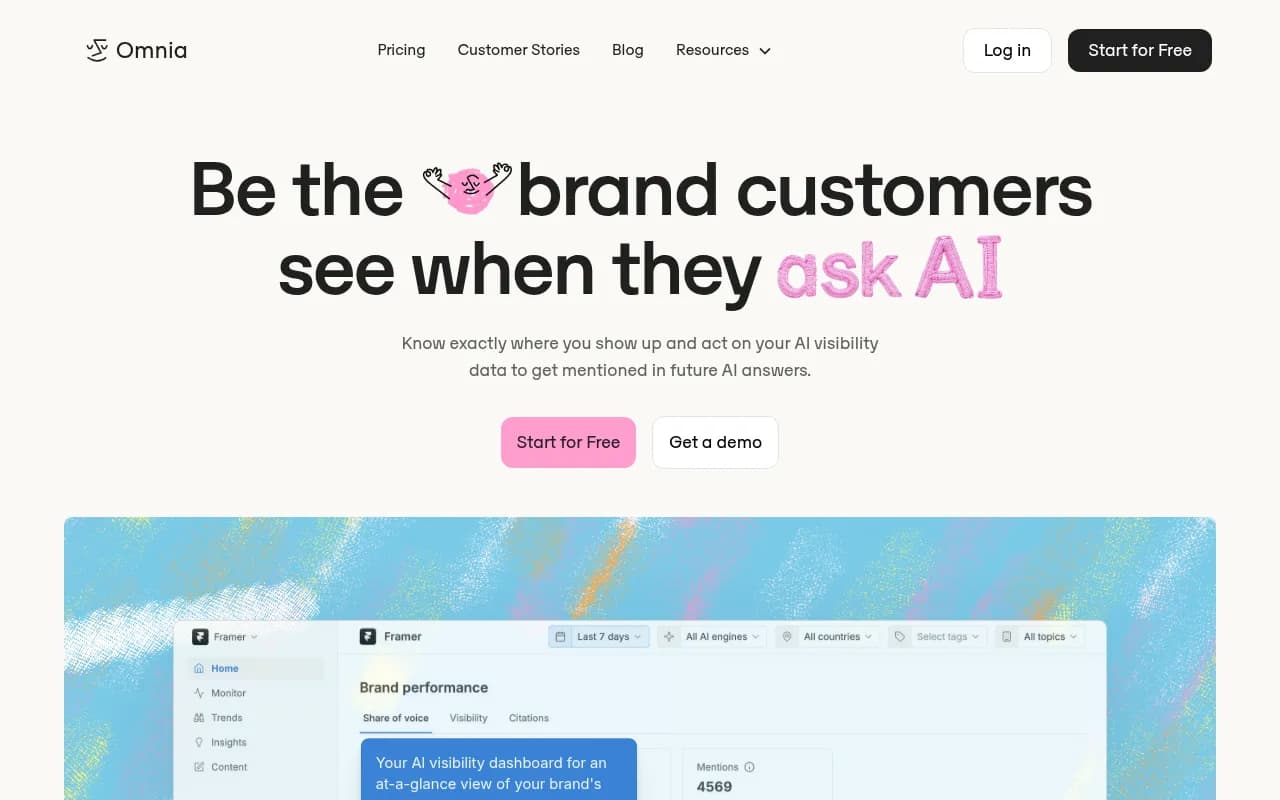
Rather than just tracking whether you appear in AI answers, Omnia measures your share of voice relative to your competitive set. The alerts are framed in competitive terms: "Your share of voice dropped 8 points while Competitor X gained 12 points." That framing is more actionable than a raw visibility score change, because it tells you whether you're losing ground or just experiencing normal variation.
The platform tracks across ChatGPT, Perplexity, Gemini, and Claude, with prompt-level granularity. The setup process is more involved than Otterly but the resulting data is richer.
Best for: Teams that think about AI visibility in competitive terms and want alerts framed around market share rather than absolute scores.
6. Scrunch AI
Scrunch AI approaches the alerting problem from a content intelligence angle, which makes it useful for teams whose primary concern is understanding why AI models cite certain sources.
The platform monitors which sources AI models are pulling from when they answer questions in your category. When a new source appears in citations -- a competitor's blog post, a Reddit thread, a YouTube video -- you get alerted. That's a different kind of signal than "your brand mention dropped." It's telling you what content is influencing the AI's answers, which is the upstream problem.
Scrunch is stronger on the intelligence side than the alerting side. The notifications are there, but the real value is in the source analysis: understanding the citation ecosystem around your category so you can publish content in the right places.
Best for: Content strategists and SEO teams who want to understand the citation landscape, not just their own visibility scores.
7. AthenaHQ
AthenaHQ tracks visibility across 8+ AI search engines and has built a clean alerting system that works well for mid-market brands.

The alerts in AthenaHQ are customizable: you can set thresholds for visibility score drops, competitor appearance rates, and sentiment changes. The platform covers ChatGPT, Perplexity, Claude, Gemini, and several others, with daily refresh rates on most plans.
AthenaHQ is monitoring-focused -- it doesn't have content generation capabilities built in. But the alert customization is more flexible than Otterly, and the competitive tracking is solid. If you want to know the moment a competitor starts appearing in answers where you used to dominate, AthenaHQ catches that reliably.
Best for: Mid-market brands that want customizable alerts and solid competitive tracking without the complexity of an enterprise platform.
How these platforms compare
| Platform | Alert types | Models tracked | Content generation | Starting price | Best for |
|---|---|---|---|---|---|
| Promptwatch | Visibility drops, crawler activity, competitor gains, citation changes | 10 (ChatGPT, Perplexity, Claude, Gemini, Grok, DeepSeek, Copilot, Meta AI, Mistral, Google AIO) | Yes (built-in AI writer) | $99/mo | Teams that need to act, not just monitor |
| Profound | Mention changes, sentiment shifts, answer changes | Multiple (enterprise scale) | No | Custom/enterprise | Enterprise brands at scale |
| Otterly.AI | Visibility changes, mention drops | 4-6 models | No | $29/mo | Solo marketers, small teams |
| Peec AI | Visibility changes, competitor movements | Multiple, multi-language | No | ~€89/mo | International brands |
| Omnia | Share of voice changes, competitive shifts | ChatGPT, Perplexity, Gemini, Claude | No | Free tier available | Competitive share-of-voice tracking |
| Scrunch AI | Citation source changes, new competitor content | Multiple | No | Custom | Content strategy teams |
| AthenaHQ | Customizable threshold alerts, competitor appearances | 8+ models | No | Custom | Mid-market, flexible alerting |
What to look for when choosing
The table above makes the feature comparison clear, but the real decision comes down to a few questions.
Do you need to act on alerts or just receive them? If your team has a separate content workflow and just needs reliable signals, any of these tools will serve you. If you want to go from "alert received" to "content published" without switching tools, Promptwatch is the only platform on this list that closes that loop natively.
How many AI models matter to your audience? If your customers primarily use ChatGPT and Google, you don't need a platform tracking 10 models. But if you're in a category where Perplexity, Claude, and Grok are all relevant (tech, finance, B2B software), broader coverage matters.
What's your volume of prompts? Enterprise brands tracking hundreds of keywords across multiple markets need a platform built for that scale. Otterly at $29/month caps out quickly. Profound and Promptwatch's Business tier are built for higher volumes.
Do you need multi-language support? Most platforms are English-first. Peec AI and Promptwatch both handle multi-language and multi-region tracking natively.
Is crawler log access important? This is a feature most platforms don't offer at all. Knowing that GPTBot stopped crawling your pricing page three days before your citation numbers dropped is a genuinely different kind of signal -- it's predictive rather than reactive. Promptwatch includes this on the Professional plan and above.
The alerting gap most teams miss
Here's something worth saying directly: most teams set up AI visibility monitoring, get their first alerts, and then don't know what to do with them.
An alert that says "your visibility score dropped from 42 to 31 this week" is information. It's not an action. The platforms that are genuinely useful in 2026 are the ones that help you answer the follow-up questions: Which prompts dropped? Which competitors gained? What content do they have that you don't? What should I publish to close the gap?
That's why the distinction between monitoring-only tools and optimization platforms matters more than any individual feature. The alert is the starting gun, not the finish line.

Setting up your alerting stack
If you're starting from scratch, here's a practical approach:
Start with one platform and track 20-30 prompts that represent your most important buyer questions. Don't try to track everything at once -- you'll get alert fatigue and stop paying attention.
Set up alerts for three things specifically: your own visibility score, your top two competitors' visibility scores, and any new citation sources appearing in your category. Those three signals cover most of what you need to know.
Review alerts weekly at minimum, daily if you're in a competitive category or running active content campaigns. AI model behavior can shift quickly when a competitor publishes something that gets widely cited.
Connect your alerting data to your content calendar. When an alert fires, the response should be a content task, not just a Slack message. The teams that improve AI visibility fastest are the ones that have a clear path from "alert received" to "content published."
Bottom line
Real-time alerting for AI search is table stakes in 2026. The question isn't whether to monitor -- it's whether your monitoring platform helps you do something about what it finds.
For most teams, Promptwatch offers the most complete workflow: alerts, gap analysis, and content generation in one place. For enterprise brands that need scale above all else, Profound is the serious choice. For teams on tight budgets just getting started, Otterly at $29/month is a reasonable first step.
The worst outcome is picking a tool, getting alerts, and having no process to act on them. Whatever platform you choose, build the response workflow before you need it.