Key takeaways
- More than 51% of Google searches now end without a click -- AI Overviews answer the question before anyone visits a website.
- Local businesses need to check their AI Overview visibility by city, not just nationally, because responses vary by location and query phrasing.
- The three biggest factors driving local AI visibility are: a complete and consistent Google Business Profile, genuine expertise signals on your website, and a strong review profile (87% of consumers won't consider a business rated below 4 stars).
- You can check your visibility manually using incognito search, or use tools like Local Falcon or Promptwatch to track it systematically across locations and queries.
- Fixing visibility gaps requires action -- not just knowing you're missing, but creating the content and citations that AI models actually want to reference.
Why local businesses need to care about AI Overviews right now
Something changed in local search over the past 18 months, and a lot of small business owners haven't caught up yet.
When someone in your city searches "best plumber near me" or "family dentist in [your town]," Google increasingly shows an AI-generated summary at the top of the results page. This summary pulls from multiple sources -- your website, review platforms, local directories, and third-party content -- and delivers an answer before the user has scrolled past the first fold.
If your business is in that summary, you get visibility even without a click. If you're not, you're invisible to a growing share of searchers who never make it past the AI response.
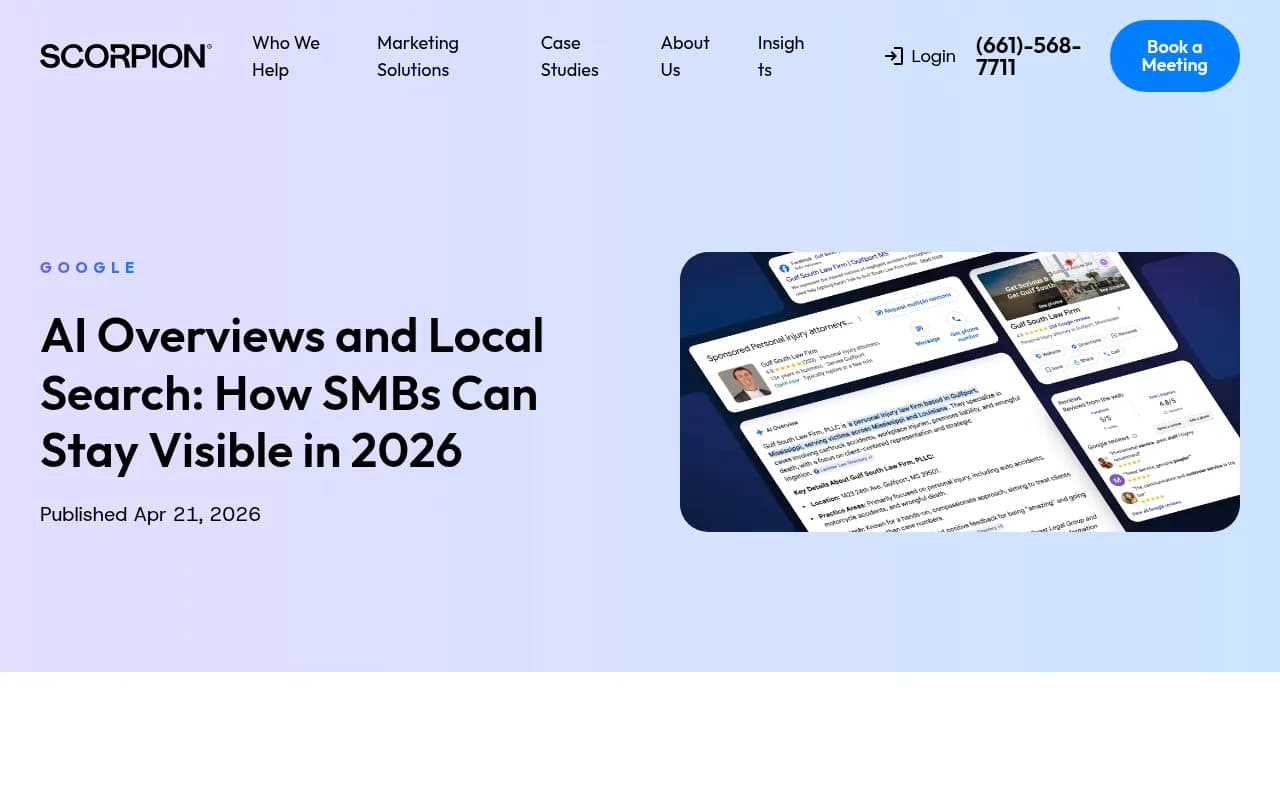
According to Scorpion's 2026 analysis of local search behavior, over 51% of Google searches now end without a click. That number is higher for informational queries ("how long does a roof replacement take?") and still significant for transactional local ones ("roofing company near me"). The map pack and review summaries still appear, but the information Google uses to populate them is now filtered through the same trust signals it uses for AI recommendations.
The question isn't whether AI Overviews affect your business. They do. The question is whether you know where you stand.
How to manually check if your business appears in AI Overviews
Before you invest in any tool, you can do a basic check yourself. It takes about 10 minutes and gives you a real sense of where you stand.
Step 1: Open an incognito window
Your browsing history and location settings can skew results. Open an incognito or private window in Chrome to get a cleaner view.
Step 2: Set your location
Google uses your IP address and location settings to determine local results. If you want to check visibility in a specific city (especially one you're not physically in), you'll need to either:
- Use a VPN set to that city
- Use Google's built-in location tool (search any query, scroll to the bottom, click "Use precise location" or adjust via Settings > Search settings > Location)
This step matters a lot. AI Overviews for "best HVAC company in Denver" will look completely different from the same query run from a Denver IP versus a New York one.
Step 3: Search the queries your customers actually use
Don't just search your business name. AI Overviews are triggered by longer, more specific queries -- the kind of thing a real customer would type when they're trying to make a decision.
Good examples:
- "Who is the best family dentist for kids in [your city]?"
- "Affordable roofing contractor in [your neighborhood]"
- "How do I find a reliable electrician in [your city]?"
- "Best [your service] near [local landmark or neighborhood]"
Short, generic terms like "plumber" or "dentist" rarely trigger AI Overviews. Long-tail queries with informational or comparative intent are where they appear most often.
Step 4: Check whether your business is cited
When an AI Overview appears, look for:
- Your business name mentioned in the summary text
- A link to your website or Google Business Profile in the sources panel
- Your business appearing in the "sources" carousel that often appears alongside the AI summary
If you see your business there, great. If not, note which competitors are showing up -- that's your benchmark.
Step 5: Check Google Search Console
In Google Search Console, go to the Performance report and filter by query type. Look for queries that are generating impressions but low clicks -- these are often queries where an AI Overview is answering the question before users click through. This won't tell you directly whether you're in the AI Overview, but it's a useful signal.
The problem with manual checks: they don't scale
Checking one query in one city once is fine for a quick gut check. But if you want to understand your AI Overview visibility across:
- Multiple service types
- Multiple neighborhoods or cities
- Changes over time
- How you compare to specific competitors
...manual checking falls apart fast. You'd need to run dozens of searches from different locations every week, which isn't realistic.
This is where purpose-built tools come in.
Tools for tracking local AI Overview visibility
Local Falcon
Local Falcon has a dedicated Google AI Overviews tracking feature that lets you run location-specific scans. You select a business, enter long-tail keywords, and it shows you whether your business appears in AI-generated summaries across a geographic grid.
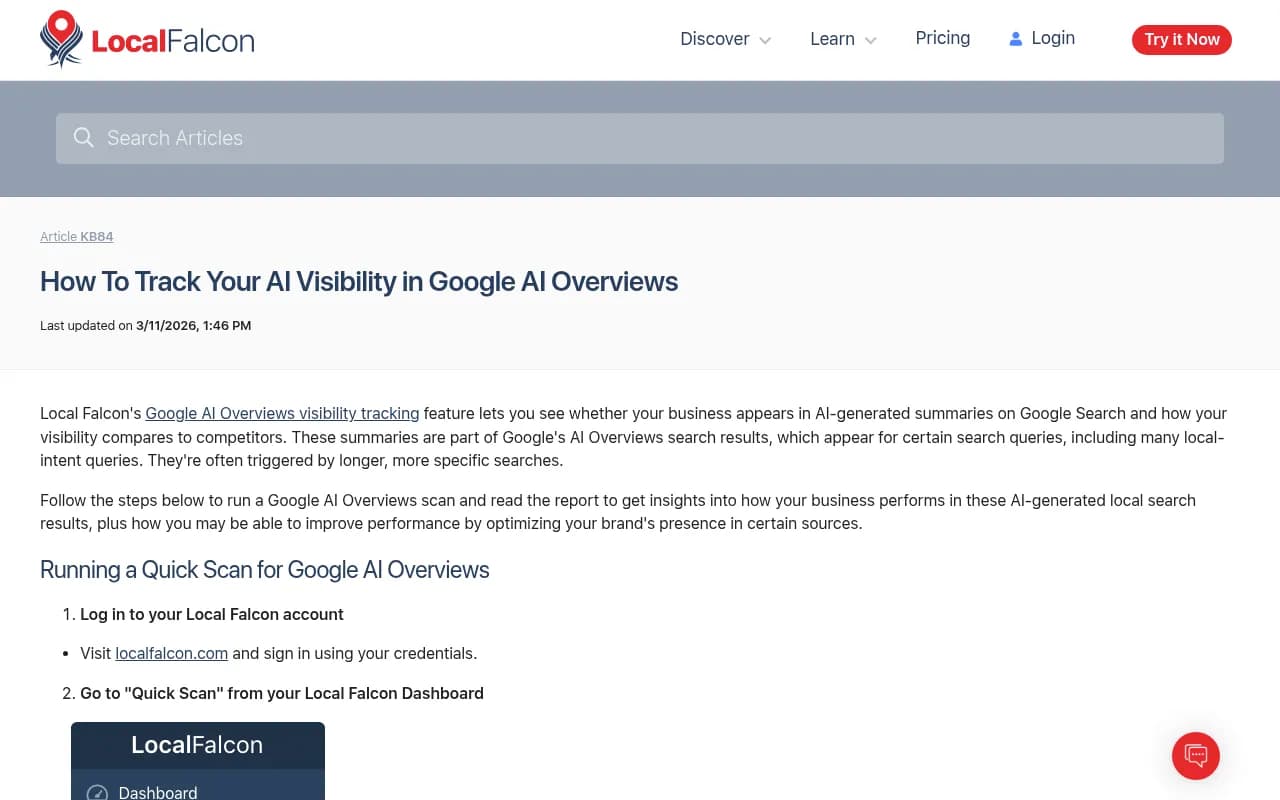
The workflow is straightforward: choose your data source (Google AI Overview), pick your business location, add keywords that are likely to trigger AI Overviews (longer, more specific phrases), and run the scan. The output shows you visibility across a map grid -- useful for businesses that serve multiple neighborhoods within a city.

Promptwatch takes a broader approach. It monitors AI visibility across 10 models -- not just Google AI Overviews, but also ChatGPT, Perplexity, Claude, Gemini, and others. For local businesses that want to understand how they appear across the full AI search ecosystem (not just Google), it's worth looking at. It also includes prompt volume estimates and difficulty scores, so you can prioritize which queries to target first rather than guessing.
SE Ranking has added AI visibility tracking to its existing SEO platform, which makes it a reasonable option if you're already using it for traditional rank tracking and want to add AI Overview monitoring without switching tools.
Comparison: local AI visibility tools
| Tool | AI models tracked | Location-specific tracking | Content gap analysis | Best for |
|---|---|---|---|---|
| Local Falcon | Google AI Overviews | Yes (grid-based) | No | Local businesses focused on Google |
| Promptwatch | 10 models (ChatGPT, Perplexity, Google, Claude, etc.) | Yes (city/state level) | Yes | Brands wanting full AI search coverage |
| SE Ranking | Google AI Overviews + some LLMs | Limited | No | Existing SE Ranking users |
| Rankscale | Multiple LLMs | Yes | Limited | Mid-market brands |
What actually determines whether you show up
Knowing you're not visible is only useful if you know what to fix. Here's what drives local AI Overview visibility, based on what Google and other AI models consistently cite.
Your Google Business Profile
This is the single most important local signal. A complete, accurate, and regularly updated GBP tells Google (and by extension, its AI) that your business is real, active, and trustworthy.
Make sure:
- Your business name, address, and phone number (NAP) are exactly consistent with every other place they appear online
- Your category is specific (not just "contractor" but "roofing contractor")
- Your hours are current
- You've added photos recently
- You're posting updates at least monthly
- You've answered the Q&A section
AI models cross-check your GBP against third-party sources. If your address on Yelp doesn't match your GBP, that inconsistency is a trust signal problem.
Reviews: volume, recency, and response rate
87% of consumers won't consider a business rated below 4 stars. Google knows this, and review signals feed directly into local AI recommendations.
What matters:
- Overall rating (4.0+ is the baseline)
- Number of reviews (more is better, but recency matters too -- 50 reviews from this year beats 200 reviews from 2021)
- Whether you respond to reviews, especially negative ones
- Whether reviews mention specific services and locations (a review that says "best plumber in downtown Austin" is more valuable than "great service!")
Website content that signals real expertise
AI models don't just look at your GBP. They read your website. And they're looking for evidence that you actually know what you're doing.
Generic, templated content ("We provide quality services at affordable prices") doesn't help. What does:
- Service pages that explain your process in specific detail
- Location pages that describe the neighborhoods you serve and any local specifics (local building codes, common issues in that area, etc.)
- Case studies or project examples with real details
- Staff bios with credentials and certifications
- An FAQ section that answers the questions your customers actually ask
The StudioHawk team put it well in their local AI SEO breakdown: AI is rewarding brands that have consistent listings, clear data, and strong social proof. The rest get filtered out.
Schema markup
LocalBusiness schema tells AI crawlers exactly what your business is, where it is, and what it does. Without it, AI models have to infer this from your content -- which introduces errors and uncertainty.
At minimum, implement:
LocalBusinessschema with your NAP, hours, and service areaServiceschema for each major service you offerReviewschema if you're displaying reviews on your siteFAQPageschema for your FAQ content
Citations and directory consistency
AI models cross-reference your business across multiple sources before recommending you. If your information is inconsistent across Yelp, TripAdvisor, Angi, HomeAdvisor, the BBB, and local chamber of commerce directories, that inconsistency reduces confidence.
Run a citation audit. Tools like Moz Local or BrightLocal can show you where your NAP data is inconsistent. Fix the discrepancies before doing anything else.
A practical action plan for local businesses
Here's a realistic sequence for a local business starting from scratch:
Week 1: Audit your current state
- Run manual AI Overview checks for your top 5-10 service queries in your city
- Check your GBP for completeness and accuracy
- Run a citation audit to find NAP inconsistencies
- Check your review profile: rating, recency, response rate
Week 2-3: Fix the foundation
- Correct any NAP inconsistencies across directories
- Complete any missing GBP fields
- Add LocalBusiness schema to your website if it's missing
- Respond to any unanswered reviews (especially negative ones)
Month 2: Build content that AI wants to cite
- Write or rewrite your core service pages with specific, expert-level detail
- Create location-specific pages if you serve multiple cities or neighborhoods
- Add an FAQ section covering the questions AI Overviews tend to answer
- Start a review generation campaign to increase recency and volume
Ongoing: Track and adjust
- Set up systematic AI Overview monitoring (Local Falcon, Promptwatch, or similar)
- Check visibility monthly across your key queries and locations
- Watch which competitors are appearing and what content they have that you don't
The "near me" problem: why city-level tracking matters
One thing that catches local businesses off guard: AI Overviews are highly location-sensitive. A business that appears prominently in AI summaries for searches run from the city center might be invisible for the same query run from a suburb 10 miles away.
This is especially relevant for businesses that serve a metro area rather than a single address -- contractors, mobile services, multi-location restaurants, home services businesses.
When you're tracking AI visibility, don't just check from one location. Check from multiple points within your service area. Local Falcon's grid-based scanning is useful here because it runs the same query from multiple geographic points simultaneously, giving you a heat map of where you're visible and where you're not.
What happens when you fix it
The businesses that show up consistently in local AI Overviews share a few traits: their information is consistent everywhere, their website content is genuinely useful, their reviews are recent and plentiful, and they've structured their data so AI models can read it cleanly.
None of this is technically complex. It's mostly about doing the basics well and doing them consistently. The gap between businesses that show up in AI Overviews and those that don't is usually not about budget or sophistication -- it's about whether someone has paid attention to these signals.
Start with the manual check. See where you stand. Then build the foundation that makes AI models confident enough to recommend you.