Key takeaways
- Google AI Overviews appear on 13-48% of searches depending on the keyword set and methodology used to measure them -- the range is wide because every study samples differently.
- Informational queries still trigger AI Overviews most often, but their share dropped from 91% to 57% between January and October 2025 as commercial and navigational queries caught up fast.
- Question-phrased queries trigger AI Overviews 57.9% of the time vs. 15.5% for non-question queries -- phrasing matters, not just intent.
- Long-tail queries (4+ words) trigger AI Overviews 60.85% of the time, making them a high-priority target for content teams.
- Transactional queries, YMYL topics, and branded navigational searches are the most suppressed categories -- Google is cautious about generating AI answers where getting it wrong has real consequences.
Why the trigger rate numbers are all over the place
If you've tried to research AI Overviews recently, you've probably seen figures ranging from 6% to 48% and wondered which one is real. The honest answer: all of them, depending on what you're measuring.
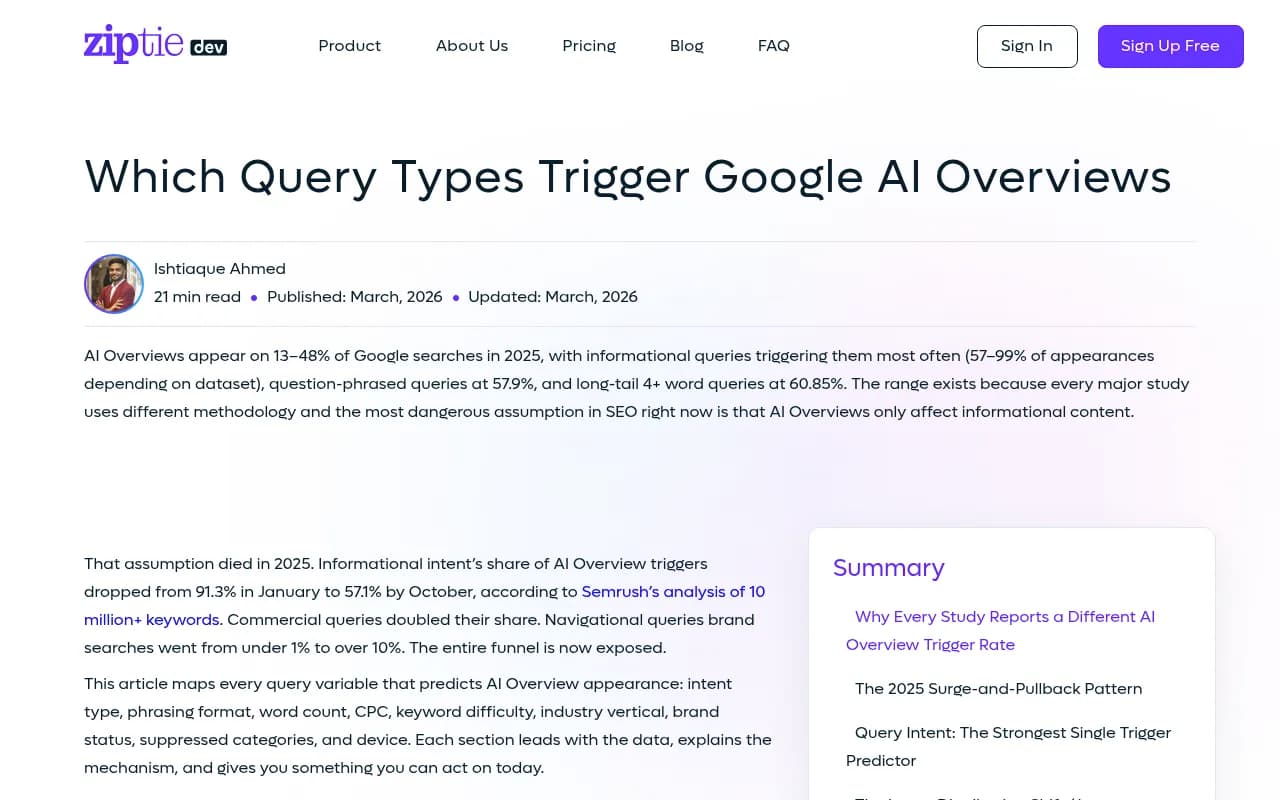
BrightEdge's 48% figure comes from a curated set of industry-specific keywords weighted toward informational content -- the exact type most likely to trigger an AI Overview. Pew Research's 18% comes from observing real users across a broad, unfiltered sample of searches. SE Ranking's ~30% tracks U.S. desktop keywords. And WordStream reports that 81% of AI Overview triggers happen on mobile, meaning desktop-only tools systematically undercount them.
So when someone tells you "AI Overviews appear on X% of searches," the useful follow-up question is: which searches, measured how, on which device, in which country?
Here's a simplified version of what the data actually shows:
| Source | AIO trigger rate | Methodology |
|---|---|---|
| SellersCommerce | 6.5% - 13.1% | Global query sample |
| Pew Research | ~18% | Real-world user behavior |
| SE Ranking | ~30% | U.S. keyword tracking |
| BrightEdge | 48% | Curated 9-industry keyword set |
The takeaway isn't that one number is right. It's that AI Overviews are now a structural feature of Google Search, not an occasional experiment. The question is which of your queries are exposed.
The query types that trigger AI Overviews most often
Informational queries
Informational queries are still the dominant trigger category, but their dominance is shrinking. In January 2025, Semrush's analysis of 10 million+ keywords found that informational queries accounted for 91.3% of AI Overview appearances. By October 2025, that share had dropped to 57.1%.
That's not because informational queries stopped triggering AI Overviews. It's because other query types caught up. Commercial queries roughly doubled their share. Navigational queries went from under 1% to over 10%. The funnel is opening up.
The queries that reliably trigger AI Overviews in the informational category include:
- Explanatory searches ("how does X work", "what is X")
- Comparison queries ("X vs Y", "differences between X and Y")
- How-to and step-by-step guides
- Definition and concept queries
- Research-style multi-part questions
These work because Google's system is designed to synthesize a helpful answer when the user is clearly trying to learn something. The more complex and multi-faceted the question, the more likely an AI Overview appears -- because a single blue link can't fully answer it.
Question-phrased queries
Phrasing matters independently of intent. Queries written as questions trigger AI Overviews 57.9% of the time, compared to just 15.5% for non-question queries with equivalent intent. That's a 3.7x difference from adding a question mark and restructuring the phrasing.
This has a direct implication for content strategy: if you're targeting a keyword like "best project management software," you should also be targeting "what is the best project management software for small teams?" The second version is far more likely to trigger an AI Overview -- and if your content answers it directly, you have a shot at being cited.
Long-tail queries (4+ words)
Long-tail queries trigger AI Overviews 60.85% of the time. This makes intuitive sense. A two-word query like "running shoes" is ambiguous -- Google doesn't know if you want to buy them, compare them, or read about their history. A six-word query like "best running shoes for flat feet 2026" signals clear intent and complexity, which is exactly what AI Overviews are designed to address.
For content teams, this means long-tail keyword coverage isn't just a traffic strategy anymore -- it's an AI visibility strategy. The more specific the query, the more likely an AI Overview appears, and the more likely a well-structured answer gets cited.
Commercial investigation queries
This is where things get interesting. Commercial queries (comparing products, reading reviews, researching before a purchase) have roughly doubled their share of AI Overview triggers since early 2025. Google is increasingly willing to generate AI-assisted answers for queries like "best CRM for B2B sales teams" or "is X worth it."
This is a significant shift. It means AI Overviews are no longer just a top-of-funnel concern. Mid-funnel content -- comparison pages, review roundups, "best of" lists -- is now exposed to AI Overview competition in a way it wasn't 18 months ago.
The query types that suppress AI Overviews
Understanding what doesn't trigger AI Overviews is just as useful as knowing what does. Google is deliberately cautious in several categories.
Transactional queries
Pure transactional queries -- "buy Nike Air Max", "book a hotel in Barcelona", "download X app" -- rarely trigger AI Overviews. The user wants to complete an action, not read a summary. Google serves product listings, local results, or direct links instead.
That said, the line between commercial investigation and transactional is blurring. "Best hotels in Barcelona" might trigger an AI Overview. "Book a hotel in Barcelona" probably won't.
YMYL topics
Your Money or Your Life (YMYL) topics -- medical advice, legal guidance, financial decisions -- are heavily suppressed. Google's systems are cautious about generating AI answers where a wrong or incomplete response could cause real harm. Queries like "symptoms of appendicitis" or "how to contest a will" are less likely to trigger AI Overviews than they were in 2024, after Google pulled back following early criticism.
This doesn't mean YMYL content can't appear in AI Overviews. It means the bar is higher, and the content needs to demonstrate strong E-E-A-T signals to be cited.
Navigational queries (mostly)
Queries where the user clearly wants to reach a specific website -- "Facebook login", "Gmail", "Amazon" -- don't trigger AI Overviews. There's nothing to synthesize; the user wants a link.
The exception is brand research queries. "What does Salesforce do?" or "Is HubSpot good for small businesses?" can trigger AI Overviews, which is why navigational queries went from under 1% to over 10% of AI Overview appearances. Brand-adjacent informational queries are now in scope.
Real-time and local queries
Queries that require current information ("weather today", "stock price of Apple right now", "news about X") don't trigger AI Overviews because the model's training data can't reliably answer them. Highly local queries ("plumber near me", "coffee shop open now") also tend to surface local packs and maps rather than AI-generated summaries.
How word count, CPC, and keyword difficulty factor in
Beyond intent and phrasing, a few other variables predict AI Overview appearance:
Query length: As covered above, 4+ word queries trigger AI Overviews at 60.85%. Shorter queries are less predictable.
Keyword difficulty: Lower-difficulty keywords tend to trigger AI Overviews more often. High-difficulty commercial terms are more likely to serve traditional organic results where established sites dominate.
CPC: High-CPC keywords are less likely to trigger AI Overviews. Google has a financial incentive to show ads for high-value commercial queries rather than replacing the results page with an AI summary.
Industry vertical: BrightEdge's research across nine industries found significant variation. Healthcare and education queries trigger AI Overviews at high rates. E-commerce and finance queries are more suppressed.
What this means for content strategy
The shift in AI Overview trigger patterns has a few concrete implications.
First, the "informational content only" assumption is dead. If you've been treating AI Overviews as a top-of-funnel problem, you need to revisit your commercial and comparison content. Those pages are increasingly in scope.
Second, question-based content structuring is no longer optional. FAQ sections, "People Also Ask" targeting, and question-phrased headers aren't just good UX -- they're directly correlated with AI Overview citation rates.
Third, long-tail coverage matters more than ever. A page that ranks #4 for a high-volume head term might get zero AI Overview citations. A page that directly answers a specific long-tail question might get cited in an AI Overview that appears above position #1.
Fourth, tracking which of your queries trigger AI Overviews -- and whether your pages are cited in them -- is now a core SEO measurement task, not an optional extra. Tools like Promptwatch can help you monitor AI visibility across Google AI Overviews and other AI search engines, tracking which pages get cited and identifying gaps where competitors appear but you don't.

Tools for tracking AI Overview visibility
Knowing the theory is one thing. Actually monitoring which of your keywords trigger AI Overviews, and whether your content appears in them, requires tooling. Here's what's available:
Semrush's Position Tracking feature flags which keywords in your tracked set are triggering AI Overviews and whether your pages are being included. It's a solid starting point if you're already using Semrush for rank tracking.
SE Ranking has built AI Overview tracking into its keyword monitoring suite, with U.S. data that's reasonably comprehensive for most use cases.
BrightEdge's AI Catalyst product goes deeper for enterprise teams -- their dataset of 48% AI Overview coverage across nine industries comes from their own tracking infrastructure.
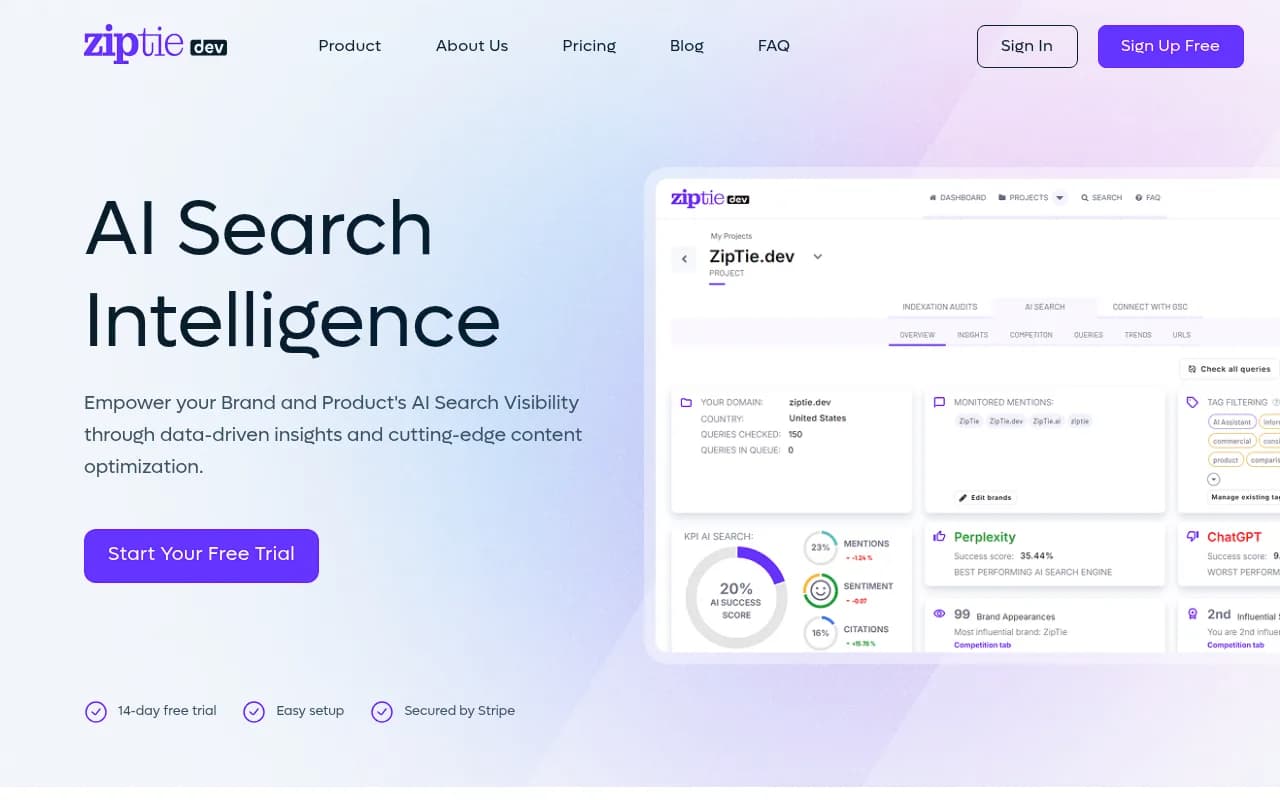
Ziptie.dev is worth checking out if you want a more diagnostic approach to understanding which query types are triggering AI Overviews in your specific niche.
For teams that want to go beyond monitoring and actually understand why competitors are being cited in AI Overviews while they aren't, Promptwatch's Answer Gap Analysis shows the specific prompts and queries where you're invisible -- and its built-in content tools help you create pages designed to get cited.
A comparison of AI Overview tracking capabilities
| Tool | Tracks AIO triggers | Shows citation status | Content recommendations | Free tier |
|---|---|---|---|---|
| Promptwatch | Yes | Yes | Yes (AI writing agent) | Trial available |
| Semrush | Yes | Yes | Limited | No |
| SE Ranking | Yes | Partial | No | Limited |
| BrightEdge | Yes | Yes | Yes | No (enterprise) |
| Ziptie.dev | Yes | No | No | Yes |
How to optimize content for AI Overview citation
Given everything above, here's what actually moves the needle:
Answer questions directly and early. AI Overviews pull from content that gives a clear, direct answer in the first paragraph -- not content that buries the answer after three paragraphs of context. If your page answers "what is X," say what X is in sentence one.
Use structured formatting. Headers, numbered lists, and definition-style formatting make it easier for Google's systems to extract a clean answer. A wall of prose is harder to cite than a well-structured response.
Cover the full question, not just the keyword. A page optimized for "project management software" might rank well organically but get ignored by AI Overviews. A page that thoroughly answers "what should I look for in project management software for a remote team" is a better citation candidate.
Build E-E-A-T signals. For any query where Google is cautious -- YMYL topics, commercial decisions, health and finance -- demonstrating real expertise and experience is the baseline requirement. Author bios, original research, and first-hand experience signals matter.
Target question-phrased variants. For every keyword you're targeting, identify the question-phrased version and make sure your content addresses it explicitly. FAQ sections help, but so does structuring your main headers as questions.
Monitor and iterate. AI Overview citation isn't static. Pages that get cited today might drop out next month. Pages that aren't cited now might get picked up after a content update. Regular monitoring is the only way to know what's working.
The bottom line
AI Overviews are no longer a niche concern for informational content teams. At 48% query coverage in some verticals and climbing, they're part of the standard Google SERP for a wide range of query types. The trigger patterns have shifted significantly in the past 12 months -- commercial and navigational queries are increasingly in scope, question-phrased and long-tail queries are the highest-probability triggers, and transactional or YMYL queries remain the most suppressed.
The practical implication is straightforward: if you're not tracking which of your keywords trigger AI Overviews, and whether your pages appear in them, you're flying blind on a significant portion of your organic visibility. The content strategy implications are equally concrete -- question-based structuring, direct answers, and long-tail coverage are no longer nice-to-haves.
The brands that figure this out now will have a meaningful head start. The ones that treat AI Overviews as a future problem will find they've already lost ground they didn't know they were competing for.