Key takeaways
- AI search engines (ChatGPT, Perplexity, Google AI Overviews, Gemini) are now a significant discovery channel for shoppers, but most e-commerce brands have no idea whether their pages are being cited.
- Product pages that answer questions outperform pages that just list features. Category pages that explain tradeoffs get cited more than pages that just list SKUs.
- Amazon still dominates e-commerce citations despite restricting crawler access -- which means there's real opportunity for brands that publish structured, question-answering content.
- Citation patterns vary significantly by AI platform and product vertical. You need page-level tracking, not just brand-level monitoring.
- Tools like Promptwatch go beyond tracking to show you which content gaps to fix and help you create the pages that AI models actually want to cite.
Why e-commerce brands suddenly care about AI citations
A year ago, "AI citation tracking" was mostly a concern for publishers and B2B SaaS companies. That's changed. ChatGPT now has around 910 million weekly active users. Google AI Overviews reach 2 billion monthly users across 200+ countries. When someone asks "what's the best standing desk under $500" or "which protein powder is best for women over 40," they're getting an AI-generated answer with cited sources -- and buying from whatever that answer recommends.
The brands showing up in those answers are getting traffic, consideration, and conversions. The brands that aren't are invisible to a growing slice of their potential customers.
What makes this particularly urgent for e-commerce is that AI search skews toward purchase-intent queries. These aren't informational questions about history or science -- they're "which one should I buy" and "is this brand worth it" questions. That's the exact moment you want to be cited.
The problem is that most e-commerce teams are still optimizing for Google rankings while AI search engines build their own citation hierarchies from scratch. And those hierarchies don't always match Google's.
How AI search engines decide what to cite
Before you can improve your citations, you need to understand what AI models are actually looking for when they pull sources.
AI models don't rank pages the way Google does. They're not looking for the highest PageRank or the most backlinks. They're looking for content that directly and confidently answers the question being asked. A few factors consistently drive citations:
Specificity and directness. A page that says "The Ergotron LX is the best monitor arm for most people because it supports up to 25 lbs, adjusts to any height, and has a 10-year warranty" will get cited over a page that says "Our monitor arms are high quality and durable." AI models want to quote something concrete.
Freshness. According to Ahrefs data cited in The Digital Bloom's 2026 AI Citation Position & Revenue Report, AI-cited content is 25.7% fresher on average than content cited in traditional Google results. If your product pages haven't been updated in 18 months, that's a real disadvantage.
Structured information. Specs, comparison tables, FAQs, and clearly labeled sections all help AI models parse and extract information. A wall of marketing copy is hard to cite. A structured page with headers like "Who this is for," "Key specs," and "How it compares to alternatives" is much easier.
Third-party validation signals. Reviews, expert mentions, Reddit discussions, and YouTube coverage all feed into what AI models consider authoritative. This is why Amazon still dominates e-commerce citations -- it has massive review volume and social proof signals, even though it actively restricts AI crawler access.
Platform-specific behavior. Tinuiti's Q1 2026 AI Citation Trends Report, which tracked mid-to-lower funnel prompts across seven AI platforms and nine commercial categories, found that citation patterns vary significantly between ChatGPT, Perplexity, Google AI Mode, Gemini, Copilot, and Meta AI. What works on Perplexity doesn't automatically work on Gemini.
Which e-commerce pages actually get cited
Not all pages are equal. Here's what the data and patterns show about which page types earn citations.
Product pages
The product pages that get cited share a few characteristics. They answer the question "is this right for me?" not just "what is this?" That means including:
- Who the product is designed for (and who it's not)
- Honest comparisons to alternatives (even competitors)
- Specific use cases with concrete examples
- Technical specs in plain language
- Common questions and objections addressed directly
A Forbes piece from February 2026 on getting agentic AI to recommend e-commerce sites put it bluntly: "Product pages need to answer questions, not just describe features." That's the core shift. Your product page is no longer just a conversion page -- it's also a content page that AI models need to be able to quote.
Pages that only contain a product title, bullet points of features, and a price rarely get cited. Pages that read more like a buying guide for that specific product do.
Category pages
Category pages are underused and underoptimized for AI citations. Most e-commerce category pages are just filtered grids of products. AI models can't do much with that.
The category pages that get cited tend to explain the category itself: what the tradeoffs are between different options, what factors matter when choosing, and which products are best for which use cases. Think of it as turning your category page into a "how to choose" guide that also happens to list your products.
A category page for "running shoes" that explains the difference between stability, neutral, and motion control shoes -- and then shows which products fall into each category -- is far more citable than a page that just shows 48 pairs of shoes with filter options.
Comparison and "best of" pages
These are the highest-performing page type for AI citations in e-commerce, and most brands don't publish enough of them. When someone asks ChatGPT "what's the best air fryer for a family of four," it needs to cite something. If you've published a well-structured comparison of air fryers by household size, you're in the running.
The key is that these pages need to be genuinely useful, not just SEO filler. AI models are good at detecting thin content. A comparison page that actually explains the tradeoffs, names specific models, and gives clear recommendations will consistently outperform a page that hedges everything and never commits to an answer.
FAQ and buying guide pages
FAQ pages are citation gold for AI models because they're structured exactly the way AI models like to pull information. A question followed by a direct, specific answer is easy to extract and quote.
If you don't have FAQ sections on your product and category pages, add them. Focus on the questions your customers actually ask -- check your support tickets, your product reviews, and your on-site search queries. Those are the prompts your customers are also typing into ChatGPT.
The citation gap problem: why tracking matters
Here's the uncomfortable truth: most e-commerce brands don't know which of their pages are being cited, which prompts trigger those citations, or which competitors are getting cited instead of them.
That's not a minor data gap. If a competitor's category page is being cited every time someone asks about your product category, they're getting the consideration and you're not. You can't fix what you can't see.
Page-level citation tracking -- knowing exactly which URL gets cited for which prompt on which AI platform -- is the foundation of any serious AI visibility strategy. Brand-level monitoring ("we were mentioned in Perplexity") is interesting but not actionable. URL-level tracking is what tells you where to focus.
Tools for tracking AI citations in e-commerce
The market for AI citation tracking tools has grown fast. Here's an honest look at what's available and what each is best suited for.
Full-stack platforms (track + optimize + act)
Promptwatch is the most complete option for e-commerce teams that want to do more than just monitor. It tracks citations across 10 AI models (ChatGPT, Perplexity, Claude, Gemini, Google AI Overviews, Grok, DeepSeek, Copilot, Meta AI, and Mistral), shows you page-level citation data, and -- critically -- helps you fix gaps. The Answer Gap Analysis shows which prompts your competitors rank for that you don't, and the built-in AI writing agent generates content engineered to earn citations. It also includes AI crawler logs so you can see which of your pages AI bots are actually reading.

For e-commerce specifically, the ChatGPT Shopping tracking is worth calling out. ChatGPT's product recommendation carousels are a growing traffic source, and Promptwatch is one of the few tools that monitors when your products appear in them.
Profound is another strong option, particularly for enterprise teams. Tinuiti's Q1 2026 research was built using Profound's data, which gives you a sense of its depth. It's strong on multi-platform tracking and commercial-intent prompts.
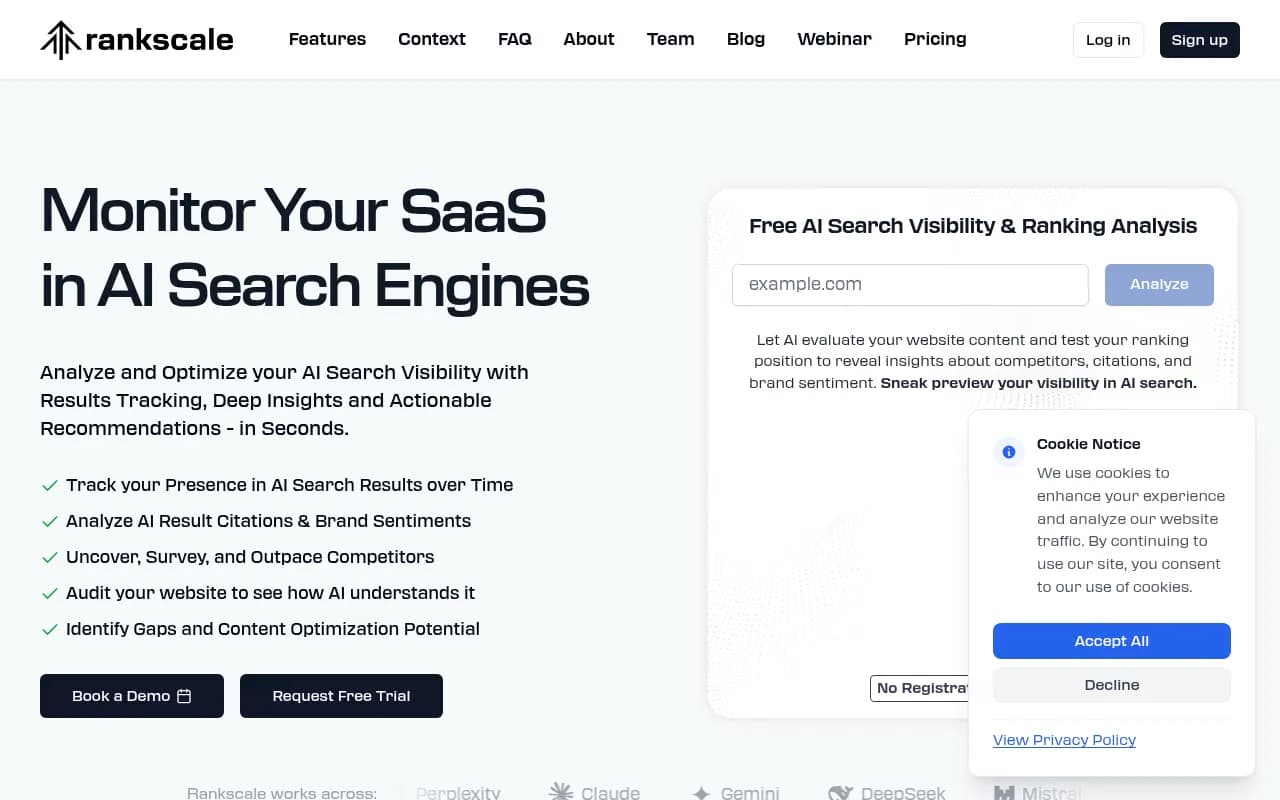
Rankscale offers solid AI search ranking and visibility tracking with a clean interface. Good for teams that want focused monitoring without a lot of extra features.
Mid-tier monitoring tools
Otterly.AI is a popular, affordable option for smaller e-commerce brands getting started with AI visibility monitoring. It covers the major platforms and gives you a clear picture of where you stand, though it doesn't have content generation or gap analysis built in.

Peec AI is worth considering if you sell in multiple languages or markets -- its multi-language tracking is one of the better implementations in this category.

AthenaHQ covers 8+ AI search engines and has a clean monitoring interface. Like most monitoring-only tools, it shows you the data but leaves the optimization work to you.
Specialized tools
Azoma is built specifically for AI shopping optimization -- ChatGPT, Amazon Rufus, and similar shopping-focused AI surfaces. If your primary concern is product visibility in AI shopping features rather than general AI search, this is worth a look.
GetCito focuses specifically on AI visibility tracking and optimization, with a clean interface for tracking citation performance over time.
LLM Clicks tracks citation performance with a focus on connecting AI visibility to actual click data -- useful for e-commerce teams trying to tie AI citations to traffic.
Comparison table
| Tool | Page-level tracking | Content generation | ChatGPT Shopping | AI crawler logs | Best for |
|---|---|---|---|---|---|
| Promptwatch | Yes | Yes | Yes | Yes | Full optimization cycle |
| Profound | Yes | No | No | No | Enterprise monitoring |
| Rankscale | Yes | No | No | No | Focused tracking |
| Otterly.AI | Limited | No | No | No | Small teams, budget |
| Peec AI | Yes | No | No | No | Multi-language brands |
| AthenaHQ | Yes | No | No | No | Multi-platform monitoring |
| Azoma | Yes | No | Yes | No | AI shopping focus |
How to get more citations: a practical framework
Knowing which pages get cited is step one. Getting more of them cited is the actual goal. Here's a framework that works for e-commerce.
Step 1: Audit your current citation footprint
Before creating anything new, find out where you stand. Run your top product and category page URLs through a citation tracking tool and see which ones are being cited, for which prompts, and on which platforms. You'll almost certainly find that a small number of pages are doing most of the work -- and that large sections of your catalog have zero AI visibility.
Pay attention to which competitor pages are getting cited for the prompts you care about. That's your gap list.
Step 2: Prioritize by prompt volume and commercial intent
Not all prompts are worth chasing. Focus on prompts with high purchase intent and meaningful volume. "Best [product category] for [specific use case]" prompts are typically the highest value for e-commerce. "How does [product] work" prompts are lower priority unless they're a direct path to purchase in your category.
Tools with prompt volume scoring (Promptwatch has this built in) let you prioritize which gaps to close first based on actual search demand rather than guessing.
Step 3: Rewrite product pages to answer questions
Take your top 20 product pages and rewrite them with the following structure in mind:
- Open with a one-sentence verdict: who this is for and why
- Include a "who this is best for / not for" section
- Add a FAQ section with 5-8 questions your customers actually ask
- Include a comparison section: how this product differs from the 2-3 closest alternatives
- Update the page with current information (AI models favor fresh content)
This doesn't mean removing your existing product content -- it means adding the question-answering layer on top of it.
Step 4: Build category pages that explain tradeoffs
For each major category, create or rewrite the category page to function as a buying guide. Structure it like this:
- What to consider when choosing [category]
- The main types/variants and who each is for
- Our top picks by use case
- Common questions about [category]
This type of page is highly citable because it directly answers the "help me choose" prompts that shoppers type into AI search engines.
Step 5: Publish comparison and "best of" content
Map out the comparison queries in your category -- "X vs Y," "best [product] for [use case]," "alternatives to [competitor product]." These are high-intent prompts that AI models need to cite something for. If you don't have pages targeting them, a competitor does.
Publish honest, specific comparisons. Don't hedge. AI models cite content that takes a position.
Step 6: Track, iterate, and close the loop
After publishing new or updated content, monitor whether your citation rates improve. This is where the tracking loop matters -- you need to see which new pages are getting picked up, which prompts they're winning, and what traffic (if any) is coming from AI referrals.
Connect your AI visibility data to your traffic analytics. Some platforms (Promptwatch, for example) offer GSC integration and traffic attribution so you can see whether AI citations are actually driving sessions and revenue.
Platform-specific considerations for e-commerce
Different AI platforms behave differently, and it's worth knowing the key differences.
ChatGPT is increasingly important for product discovery, especially with its shopping features. It tends to cite authoritative, well-structured pages and has a strong preference for content that directly answers the query. ChatGPT Shopping carousels are a separate surface worth tracking.
Perplexity is heavy on citations and tends to pull from a wider range of sources than ChatGPT. It's more likely to cite niche or specialist sites alongside major retailers. If you're a specialist brand, Perplexity is often the easiest platform to win citations on.
Google AI Overviews appear in roughly 25% of tracked searches, and up to 48% in some verticals. For e-commerce, they tend to appear most on category and comparison queries. Your existing Google SEO authority matters here more than on other platforms.
Gemini has different citation patterns from Google AI Overviews despite both being Google products. It tends to favor content with strong structured data and clear topical authority.
Amazon is still the dominant cited source for product queries across most AI platforms, despite restricting crawler access. The implication for brands: you need your own site to be a credible alternative source, which means publishing the kind of detailed, question-answering content that Amazon's product pages often lack.
What to measure
If you're building an AI citation program for your e-commerce site, these are the metrics that matter:
- Citation rate by page: what percentage of relevant prompts result in your page being cited
- Share of voice by category: how your citation rate compares to competitors across your key product categories
- Platform distribution: which AI platforms are citing you and which aren't
- Prompt coverage: how many of your target prompts result in any citation for your site
- AI-referred traffic: sessions and revenue attributable to AI search referrals
- Citation freshness: how recently your cited pages were updated (a proxy for whether AI models consider them current)
The goal is to move from "we don't know if AI mentions us" to "we know exactly which pages are cited for which prompts, and we have a clear plan to improve the gaps."
The bottom line
AI search is not a future concern for e-commerce -- it's a current one. Shoppers are already using ChatGPT, Perplexity, and Google AI Overviews to make purchase decisions, and the brands showing up in those answers are getting a real advantage.
The good news is that most e-commerce brands haven't optimized for AI citations yet. Product pages that answer questions, category pages that explain tradeoffs, and honest comparison content are still relatively rare. If you build them now, you're not fighting an entrenched competitor -- you're getting in early.
Start by finding out where you stand. Then fix the gaps. Then track whether it's working. That cycle, done consistently, is what builds durable AI search visibility.