Key takeaways
- Autonomous content agents can be trusted at scale only when autonomy is tiered: low-risk pages run hands-off, fact-heavy pages go through a review gate.
- The pages ChatGPT cites most are product and landing pages (about 39% of citations combined, Sep 28 to Oct 4, 2026). Those are also the pages where a wrong fact does the most damage.
- Product pages lose about half their ChatGPT citations in 74 to 77 days, so scheduled refreshes are a measurable job for an agent, not a nice-to-have.
- The real enterprise risks are shadow agents, permission creep and unattributable actions, not just bad prose.
- Trust is earned by closing the loop: publish, check crawler access, check citations, check traffic, then roll back or refresh.
What agentic GEO actually means
Generative engine optimization (GEO) is the work of getting your brand mentioned and cited in answers from ChatGPT, Gemini, Perplexity, Claude and Google AI Overviews. The "agentic" part is newer. Instead of a dashboard that tells you where you are invisible, an agent plans content against the gaps, writes it, publishes it to your CMS and then checks what happened.
OpenText describes agentic AI as goal-oriented: it keeps an objective over time and works out the steps itself, rather than answering one prompt and stopping. That is a fair description of a content agent with a monthly budget and a publishing calendar. It is also exactly why enterprises get nervous. A tool that suggests is safe. A tool that publishes to production has real permissions and real consequences.
So the question in the title is the right one. Not "can agents write well enough?" (they mostly can) but "can we let them act without a human on every step?"
Why the trust question is harder at enterprise scale
A startup with one site and one marketer can read every page an agent produces. An enterprise with 40 markets, five CMS instances and a legal team cannot. Three things change.
Actions stop mapping to a person
Aembit makes a point that applies directly here: agentic systems break the enterprise security assumption that every action traces back to a human. If an agent publishes a pricing claim to a regional site at 3 a.m., who approved it? If your answer is "the agent," your compliance team will not be happy.
The practical fix is boring and effective. Every agent action should be logged with its source (dashboard, API, chat or scheduled job), and every published document should have a named owner.
Shadow agents spread quietly
DigiCert's write-up on shadow agents describes a pattern I recognize from content teams. An agent is connected to clear a backlog. It gets a bit more access. Then another system. Eventually it behaves like infrastructure, and nobody has it in the inventory. DigiCert's stated goal is not to ban these agents but to make them visible and governable so autonomy cannot scale beyond reach.
For GEO, that means one sanctioned platform with scoped credentials, not five team-level scripts that each hold a CMS token.
Facts are the product
Here is where GEO differs from generic content automation. According to Promptwatch Data's analysis of ChatGPT citations by content type (Sep 28 to Oct 4, 2026), the most cited formats are:
| Content type | Share of ChatGPT citations |
|---|---|
| Product pages | 22.4% |
| Landing pages | 16.8% |
| Listicles | 13.6% |
| How-to guides | 8.7% |
| Documentation | 7.5% |
| General articles | 6.1% |
| Comparisons | 5.9% |
| News | 5.7% |
| FAQ pages | 3.3% |
| Reviews | 1.7% |
Product and landing pages together are about 39% of citations. For commercial prompts, product pages, landing pages, listicles and comparisons add up to almost 70%. These are fact-heavy pages: specs, prices, positioning. ChatGPT quotes them directly.
That is my reading, not a Promptwatch finding, but it follows naturally: an agent that rewrites the pages AI cites most is editing the pages where a hallucinated number gets repeated back to buyers. A blog post with a weak sentence costs you little. A product page with the wrong price costs you a lot.
A tiered autonomy model that works
The teams I would trust treat autonomy as a dial per content type, not a switch for the whole program.
Tier 1: hands-off
Low factual risk, high volume. Think informational how-tos, glossary-style explainers and topical articles that fill gaps in prompt coverage. The agent plans, writes and publishes on a schedule. A human samples a percentage after the fact.
Tier 2: review inbox
Comparisons, listicles that name competitors, anything with claims about your own product. The agent drafts and a named reviewer approves, edits or declines. This is the default tier for most enterprise content.
Tier 3: human-written, agent-assisted
Pricing pages, product specs, regulated claims, healthcare or financial copy. The agent can propose a diff and flag stale facts, but a person writes and signs off. Pull in a Knowledge Base or brand book so any draft is grounded in approved facts rather than the model's guesses.
If a platform cannot express these tiers (publish windows, review inbox, fully hands-off as an option), it is not ready for an enterprise rollout.
The refresh problem is where agents earn their keep
Writing new pages is the glamorous half. Maintenance is the half that pays.
Promptwatch's content half-life study tracked every classified page ChatGPT cited on July 6, 2026 for 90 days. Findings worth knowing:
- Landing pages: 78% still cited after 30 days, 69% after 60.
- Docs: 76% after 30 days, 67% after 60. ChatGPT cited 93% of docs again after day 0.
- Comparisons: 72% after 30 days, 63% after 60.
- Product pages, reviews and how-tos: about 55% after 60 days, with a half-life of 74 to 77 days.
- News: half the pages were gone after 36 days.
Landing pages, docs, comparisons and listicles only crossed 50% in the final week, because the tracking window ended, so their real half-life is likely near or beyond 90 days.
Translate that into an operations policy. Product pages decay about as fast as how-tos, which surprises people who assume product pages are "evergreen." An agent on a refresh schedule has a measurable job: keep prices, specs and availability current. And the flip side matters for trust. An agent that publishes stale facts hurts your longest-lived assets, the landing pages and docs that keep getting cited.
News is different. Use it for short bursts of visibility and do not expect it to compound.
What to demand from an agentic GEO platform
Before you let anything publish autonomously, check for these.
Real-interface monitoring, not just API calls
An agent that optimizes against API outputs is optimizing against the wrong target, because user-facing answers and citations can differ. Ask where the data comes from.
Crawler visibility
If an AI bot cannot fetch the page the agent just published, nothing else matters. IP-verified crawler logs separate an access problem from a content problem. Without them, an agent's success report is guesswork.
A review gate and an audit trail
Approve, edit, decline. Plus a log that records whether a change came from the dashboard, an API, an MCP client or the agent itself. Role-based access with project-level scoping. Scoped API keys rather than one master token.
Grounding in your approved facts
A knowledge base and brand book that the agent writes from. Without this, fact-checking becomes your whole job.
Closed-loop measurement
The platform should track each document from draft to live URL, then follow it through crawls, citations and visits. Pages that underperform should come back as actions.
Where the platforms fit
The market splits into three groups. Monitoring tools tell you what AI says. Content generators write but do not know what AI cites. A smaller set tries to do both.
Promptwatch sits in that last group. Its Content Agent plans, writes and publishes against your visibility gaps to WordPress, Webflow or Framer, with a publishing calendar, monthly budget, publish windows and a review inbox where you can approve, edit, decline or run hands-off. It adds IP-verified crawler logs, page tracking, visitor analytics and an audit log on Business and above, which covers most of the governance checklist above.

Other tools in our catalog take different angles. A few are worth knowing:

Profound is a strong monitoring product for enterprise brands, though it is more about visibility reporting than autonomous execution.
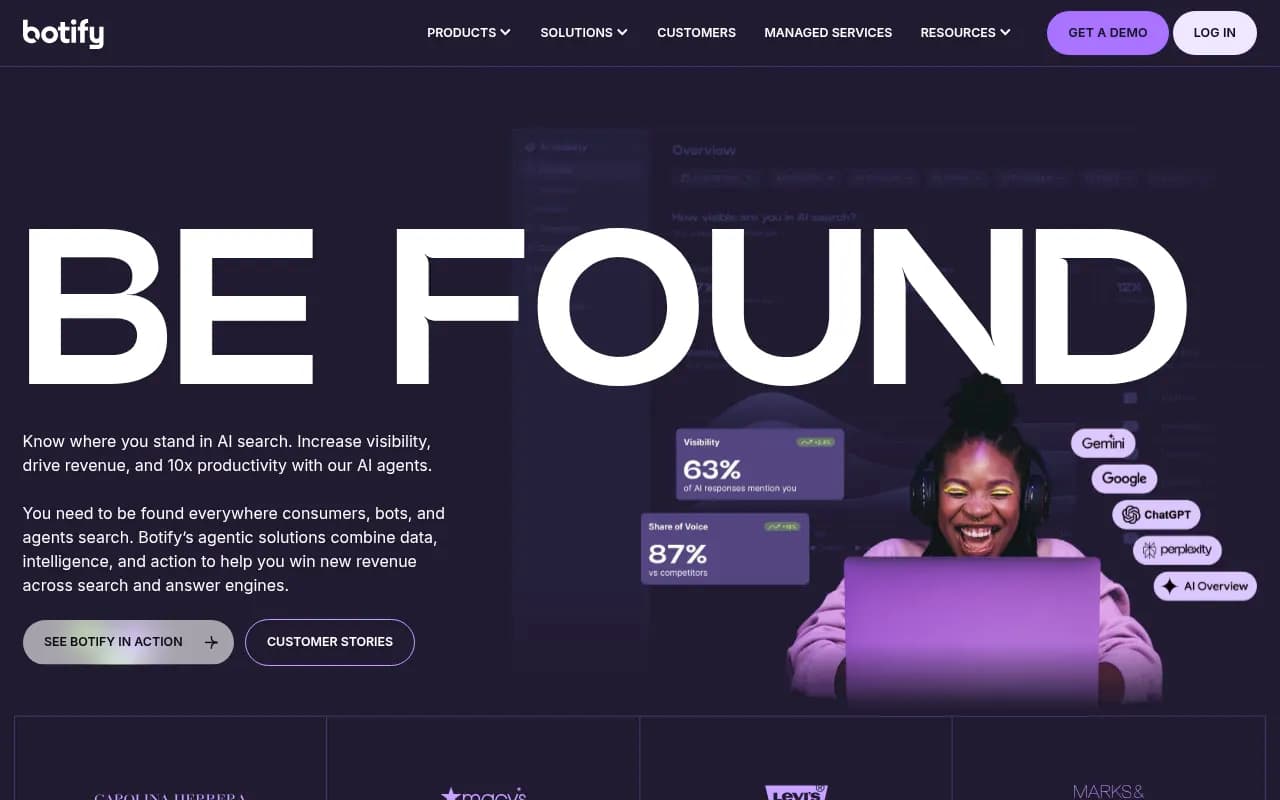
Botify is an enterprise SEO and GEO platform with AI agents, aimed at large sites where crawl and log data is the main concern.
BrightEdge AI Catalyst suits teams already standardized on BrightEdge for traditional SEO.
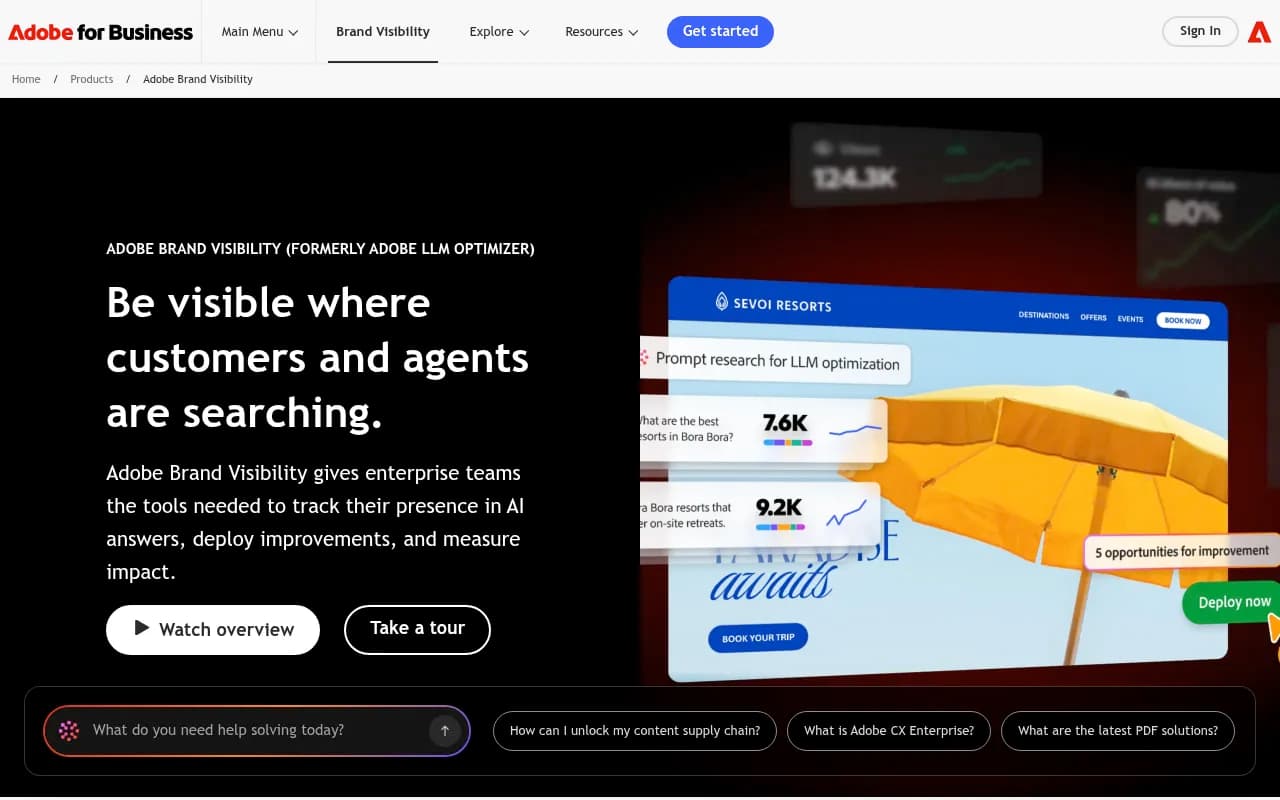
Adobe LLM Optimizer is the natural pick if you live inside Adobe Experience Cloud.
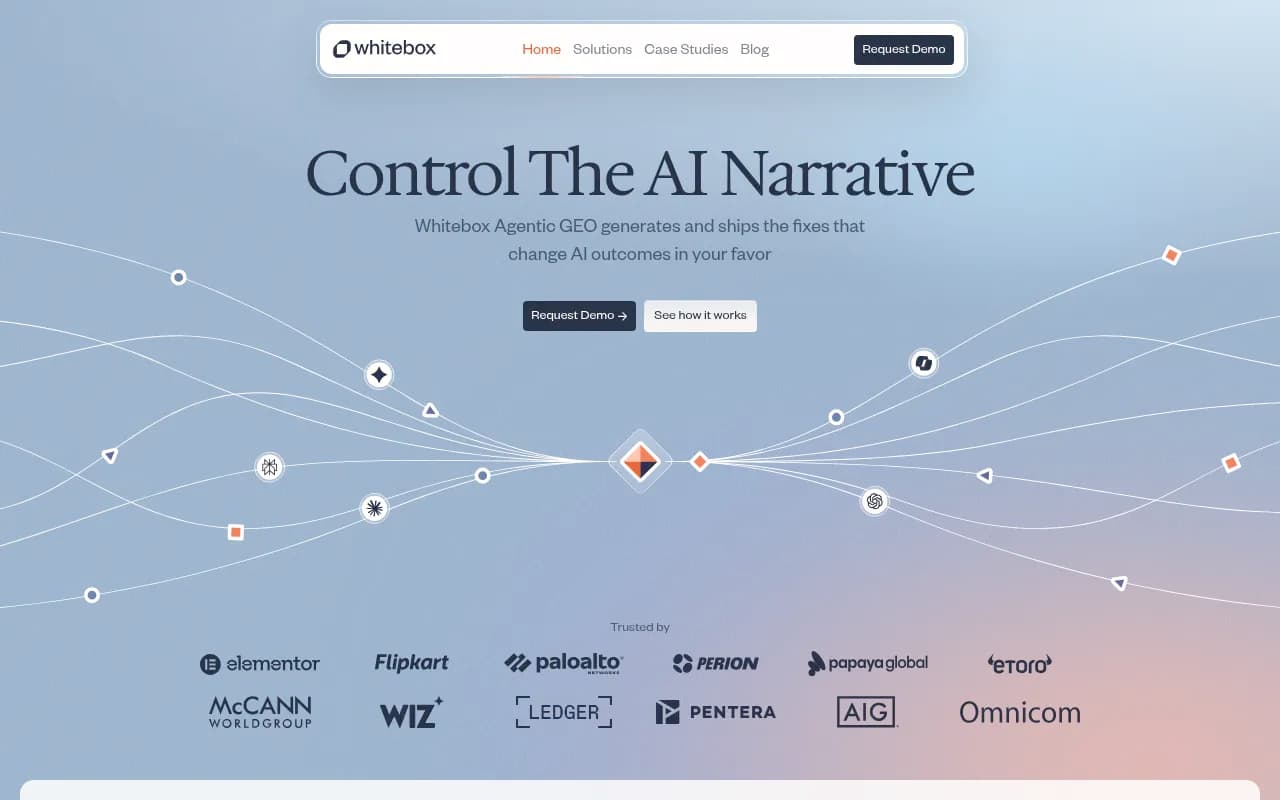
Whitebox describes itself as agentic GEO that generates and ships narrative fixes automatically, which is the model that most needs a review gate.

AirOps is a content engineering platform. It is good at building content workflows, but it works from your inputs rather than from first-party citation data.
| Approach | Examples | Strength | Trust gap to check |
|---|---|---|---|
| End-to-end (monitor, write, publish, measure) | Promptwatch | Closed loop with review inbox and audit log | Choose the right autonomy tier per content type |
| Enterprise SEO suites with GEO modules | Botify, BrightEdge, Adobe LLM Optimizer | Fits existing procurement and workflows | Depth of AI-specific data and crawler visibility |
| Autonomous fix generators | Whitebox, Nuwtonic, Seology | Speed | Who approves what ships |
| Content workflow builders | AirOps, Jasper | Flexible generation | No native citation grounding |
| Monitoring only | Profound, Peec AI, Otterly.AI | Clear visibility reporting | You still do the work |
To browse more options, the GEO software directory lists the category in detail.
A rollout plan that earns trust
Weeks 1 to 2: baseline and access
Measure current visibility, citations and sentiment. Verify AI crawlers can read your site (the free Agentic Readiness Check is a quick first pass). Set up scoped credentials and define owners.
Weeks 3 to 6: review-gated publishing
Turn the agent on with every draft going to a review inbox. Track the approval rate and the reasons for edits. If reviewers keep correcting the same fact, fix the knowledge base, not the draft.
Weeks 7 to 12: loosen where the data allows
Move Tier 1 content to hands-off once edit rates are low. Keep Tier 2 and 3 gated. Add a refresh cadence for product and pricing pages that fits the 74 to 77 day half-life, so you are updating before citations fade rather than after.
Promptwatch's own 90-day GEO program lays out a similar sequence if you want a template.
Ongoing: measure the outcome, not the output
Pages published is a vanity number. What matters is whether those pages got crawled, cited and clicked. Crisp, for example, reported 2x higher conversion rates from AI traffic than from traditional channels while scaling to 5 to 10 articles a day. That is the shape of result you want to be able to verify yourself, per page.
What about the "only 6% trust agentic AI" statistic?
You will see it floating around: 86% investing, 6% trusting. The version I found is a LinkedIn post, and I could not trace it to a primary source, so I would not put it in a board deck. The direction is plausible. Investment is outrunning governance in most organizations. But cite something you can verify.
A short risk checklist
- Do we have one sanctioned agent platform, with an inventory of every agent that can publish?
- Is every published page tied to an owner and an approval record?
- Are credentials scoped per project, with an audit log of changes?
- Are fact-heavy pages (product, pricing, docs, FAQ) behind a review gate?
- Is there a refresh schedule tied to measured decay?
- Can we see crawl, citation and traffic data for each published page?
- Can we roll back a page quickly?
If you answer no to more than two, slow down before adding autonomy.
The bottom line
Autonomous content agents can be trusted at scale, but not by default and not uniformly. Trust comes from a tiered model, a review gate on the pages where facts matter, and measurement that proves each page did something. Start gated, loosen with evidence, and keep humans on pricing and specs. If you want to see how the loop works on your own site, the free AI visibility report or the 7-day trial on Promptwatch pricing are low-risk places to start.